

SUBSCRIBE TO OUR FREE NEWSLETTER
Daily news & progressive opinion—funded by the people, not the corporations—delivered straight to your inbox.
5
#000000
#FFFFFF
To donate by check, phone, or other method, see our More Ways to Give page.
Daily news & progressive opinion—funded by the people, not the corporations—delivered straight to your inbox.

Residents of Flint, Michigan will finally get their lead pipes replaced as the result of a settlement agreement approved by a federal judge today. The settlement will require the State of Michigan and City of Flint to replace Flint's lead pipes within three years, and will be enforceable by the court. The lawsuit was filed in response to the Flint water crisis, the result of failed government decisions that caused lead to leach out from aging pipes into thousands of homes in Flint.
"This hard-fought victory means safer water for Flint. For the first time, there will be an enforceable commitment to get the lead pipes out of the ground. The people of Flint are owed at least this much," said Dimple Chaudhary, a senior attorney with the Natural Resources Defense Council (NRDC), and lead counsel in the case Concerned Pastors for Social Action v. Khouri.
The agreement requires the State of Michigan to provide nearly $100 million to the City for replacement of Flint's lead service lines. The agreement also requires the State to maintain a door-to-door water filter installation and education program, to extensively monitor Flint's tap water for lead, and to continue to make bottled water available to Flint residents.
"Concerned Pastors brought this lawsuit to heal the damage to the community from both the lead in our water and government indifference, and to take a stand for what is right for the people of Flint. The water issue must be resolved before we can make Flint thrive again, and I believe this resolution offers a path to a healthier, less traumatic future for everyone in Flint," said Pastor Allen Overton, of the Concerned Pastors for Social Action. "I remain hopeful that we have time to restore Flint to a place where dreams are made and hope stays alive," said Overton.
Melissa Mays, a plaintiff in the case and one of the parents who confirmed Flint's water was contaminated with lead through independent testing, said "This is a win for the people of Flint. When the government fails to uphold democracy, and protect our rights to clean water, we have to stand up and fight. The greatest lesson I've learned from Flint's water crisis is that change only happens when you get up and make your voice heard."
"We are thrilled that, after nearly three years of grappling with lead-poisoned water, the residents of Flint can finally look forward to a long-term solution to a catastrophe that has devastated the community," said Michael J. Steinberg, Legal Director of the ACLU of Michigan. "The Flint Water Crisis has its roots in the state's toxic emergency manager law and is a tragic example of what happens when state government displaces democracy to save a few bucks. This ground-breaking settlement marks a huge step toward restoring a long-neglected community to some semblance of normalcy."
The terms of the agreement require:
The State to provide $97 million to the City of Flint for replacement of lead and galvanized steel pipes at no cost to Flint residents; $47 million will come directly from Michigan state funding sources; and $50 million will come from federal and state funding directed to Flint by Congress;
The City to conduct the pipe replacements within three years;
The State to expand and maintain its program for filter installation and education, including by conducting door-to-door visits to residents' homes through December 2018;
The State to fund a pair of extensive tap water monitoring programs, beyond what is legally required under federal law, to test hundreds of homes in Flint. All testing data will be made available to the public, including at https://www.NRDC.org/Flint;
The State to guarantee bottled water availability at distribution centers until at least September 1, 2017 and delivery through the 2-1-1 helpline to homebound residents until at least July 1, 2017;
The State to guarantee funding for seven existing health and medical programs designed to mitigate the effects of lead exposure for Flint residents.
The Court will retain authority to enforce the agreement and to ensure that the State and City meet their deadlines and fulfil their obligations.
Plaintiffs in the case Concerned Pastors for Social Action v. Khouri are Concerned Pastors for Social Action, Flint resident Melissa Mays, the Natural Resources Defense Council, and the ACLU of Michigan. The plaintiffs will monitor implementation of the agreement and make available information related to the status of lead pipe removal and water quality reports at https://www.nrdc.org/Flint.
The Flint water crisis began when dangerous amounts of lead leached out of the city's pipes and into the drinking water of Flint's homes and schools following a decision by Flint and Michigan officials to use the Flint River as the City's primary drinking water source without first treating the water to prevent corrosion. There is no safe level of lead exposure. The toxic effects of lead on virtually every system in the body, and particularly on the developing brains of young children, are well documented and irreversible.
The summary of the settlement is available at: https://www.nrdc.org/sites/default/files/flint-lead-pipe-replacement-agreement-summary.pdf
Visit www.nrdc.org/Flint for information related to the status of lead pipe removal and water quality reports.
Case Timeline:
On November 16, 2015, the Plaintiffs and other community groups filed a Notice of Intent to sue state and city officials for ongoing violations of the federal Safe Drinking Water Act amid the city's widespread lead-contamination crisis.
On January 25, 2016, the Plaintiffs filed a complaint that sought to compel the City and state officials to follow federal requirements for testing and treating water to control for lead and the prompt replacement of all lead water pipes at no cost to Flint residents. More at: https://www.nrdc.org/media/2016/160127
On, March 24, 2016, the Plaintiffs filed a motion for preliminary injunction, asking the court to direct the delivery of bottled water to people's homes, as many Flint residents cannot obtain water for their daily needs due to transportation or other access issues.
On November 10, 2016, a federal judge issued a preliminary injunction and ordered Michigan officials and the City of Flint to immediately ensure that every Flint household has safe drinking water. That means the City and State were required to verify that each home has a properly installed and maintained faucet filter or, if they could not, deliver bottled water to that home. More at: https://www.nrdc.org/media/2016/161110
On December 2, 2016, federal Judge David Lawson denied the State motion to stay the preliminary injunction order. On December 16, 2016, a Sixth Circuit Court of Appeals paneled similarly denied the State's motion to stay the order.
On December 28, 2016, the District Court appointed a settlement master for the purpose of mediating settlement discussions between Plaintiffs, the State, and the City.
March 28, 2017, Judge Lawson will consider approving a settlement agreement to resolve the case.
MEDIA ALERT:
The following are press opportunities related to the settlement this week:
Tuesday Telebriefing:
Attorneys and plaintiffs in the case will be available during a telebriefing for national media on Tuesday, March 28 at 3:30 eastern. To join the call, dial 1 (866) 939-3921 and use the confirmation number 44649152.
Thursday Community Meeting:
Plaintiffs will host a community meeting to discuss the latest developments in the case on Thursday, March 30, at 6 pm eastern. The Town Hall will be held at the Rev. LW and Ella Owens Educational Center at the New Jerusalem Full Gospel Baptist Church, 1035 E. Carpenter Road in Flint.
NRDC works to safeguard the earth--its people, its plants and animals, and the natural systems on which all life depends. We combine the power of more than three million members and online activists with the expertise of some 700 scientists, lawyers, and policy advocates across the globe to ensure the rights of all people to the air, the water, and the wild.
(212) 727-2700
"Mifepristone is safe and effective, and women should be able to get abortion medication through the mail or telehealth if they need," said Sen. Patty Murray.
Defenders of reproductive rights, including key Democrats in Congress, reiterated the safety of mifepristone on Monday after the US Supreme Court temporarily extended access to the medication—commonly used in abortion and miscarriage care—by mail while the justices review a ruling from a notoriously right-wing appellate court.
The US Court of Appeals for the 5th Circuit blocked a federal rule allowing mifepristone to be dispensed by mail at the beginning of the month. Drugmakers quickly appealed to the high court, where Justice Samuel Alito, who is part of the right-wing supermajority, issued a one-week stay to give himself and colleagues time to review the case.
As Alito's initial Monday evening deadline approached, he extended the stay until 5:00 pm ET on Thursday. The move means that "for now, mifepristone is still available via telehealth, mail order, and pharmacy while the case proceeds," noted the Democratic Women's Caucus in the US House of Representatives.
However, pro-choice advocates and policymakers are still sounding the alarm and arguing that, as the caucus put it in a social media post, "reproductive freedom should not depend on emergency rulings or political attacks."
Senate Minority Leader Chuck Schumer (D-NY) said in a statement that "mifepristone has been safe, effective, and trusted for decades. Today's order keeps access in place for now, but it's not cause for celebration—it's a reminder that basic reproductive care is still under attack every day. Anti-abortion extremists are trying to use the courts to roll back access to medication abortion nationwide, and Senate Dems will keep fighting to protect women's freedom to make their own healthcare decisions."
Sen. Patty Murray (D-Wash.) similarly wrote on social media: "Another extension, but this shouldn't be complicated. Mifepristone is safe and effective, and women should be able to get abortion medication through the mail or telehealth if they need. Extremist judges shouldn't get to decide how women get healthcare."
This case traces back to early 2023, when the Biden administration's Food and Drug Administration permanently lifted mifepristone's in-person dispensing requirement, just months after the Supreme Court's right-wing supermajority overturned Roe v. Wade. Louisiana, which has among the most restrictive abortion policies in the country, sued over the FDA's policy change.
Medication abortions account for the majority of abortions provided in the United States, and those patients generally take both mifepristone and another drug, misoprostol. Demand for abortion pills by mail increased after Roe's reversal, as advocates of forced pregnancy policies in Republican-controlled states ramped up attacks on reproductive freedom.
"With the Supreme Court punting a decision on access to mifepristone—a safe, effective medication used in abortion care—until later this week, patients and providers are left facing continued uncertainty," said Rachel Fey, interim co-CEO of Power to Decide. "Wondering day by day whether you'll have access to an essential medication is not practical, and the confusion only deepens the barriers people already face when seeking abortion care."
"Access to mifepristone should be based on scientific evidence, not ideology," Fey declared. "We urge the Supreme Court to follow that science and maintain current telehealth access to mifepristone—not just for a few days at a time, but permanently."
Alito's extensions in recent days are not necessarily signals of where the conservative will ultimately come down. The Associated Press pointed out Monday that "the current dispute is similar to one that reached the court three years ago," when the justices blocked another 5th Circuit ruling "over the dissenting votes of Alito and Justice Clarence Thomas," and then unanimously dismissed that case due to lack of standing, or a legal right to sue.
The battle comes as the Trump administration's FDA is conducting a review of mifepristone that Julia Kaye, senior staff attorney for the ACLU’s Reproductive Freedom Project, has said seems "designed to manufacture an excuse for further restricting medication abortion across the country."
The New York Times noted Monday that US Department of Justice "lawyers have not said in court proceedings or publicly whether they back regulations that allow people to be prescribed the pills through telehealth appointments. Instead, they have asked the lower courts to pause the litigation to give the FDA time to complete a review of the safety of mifepristone, which was first approved in 2000."
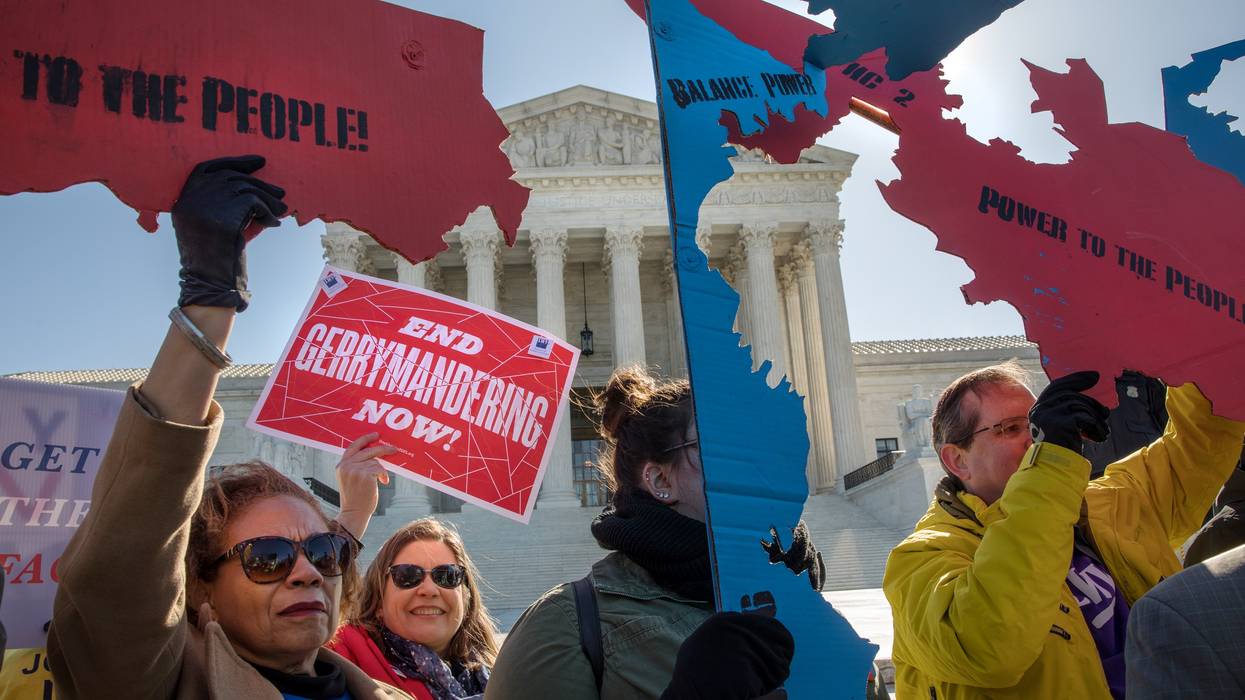
"Boy, it's a complete mystery why the public thinks the court is making partisan political decisions," quipped one law professor following the ruling on Alabama's redistricting.
The US Supreme Court's right-wing majority Monday opened the door for Alabama to eliminate a majority-Black congressional district before this year's midterm elections in a decision that came as Tennessee voters sued to stop their state's racially rigged redistricting.
The nation's high court issued a 6-3 order with no explanation allowing Alabama officials to revert to a congressional map which, despite the state population being roughly 26% African American, has just one majority-Black district out of seven. The order came just a week before Alabama's primary election and less than three years after the same court ordered the state to create a second majority-Black district.
In that case, Allen v. Milligan, two right-wing members—Chief Justice John Roberts and Justice Brett Kavanaugh—joined their liberal colleagues who sided with Black voters in defense of the Voting Rights Act.
SCOTUS, which ordered Alabama to create a second Black opportunity district just 3 years ago, has lifted that order a week before the primary. The Purcell principle says courts shouldn't permit chaos too close to an election—it's now an open question whether there will even be a primary on schedule.
[image or embed]
— Joyce White Vance (@joycewhitevance.bsky.social) May 11, 2026 at 3:32 PM
Monday's ruling follows last month's Louisiana v. Callais decision, in which the justices ruled 6-3, also along ideological lines, that Louisiana's congressional map is “an unconstitutional racial gerrymander."
The decision ironically voided the last remaining provision of Section 2 of the Voting Rights Act, which allows voters of color to challenge racially discriminatory electoral maps in court.
Dissenting in Monday's decision, liberal Justice Sonia Sotomayor noted that the high court previously found that "Alabama violated the 14th Amendment by intentionally diluting the votes of Black voters."
"That constitutional finding of intentional discrimination is independent of, and unaffected by, any of the legal issues discussed in Callais," she added.
Earlier on Monday, the ACLU and ACLU of Tennessee filed a federal lawsuit on behalf of three Black voters, the Black Clergy Collaborative of Memphis, the Memphis A. Philip Randolph Institute, and the Equity Alliance seeking to block the state's racially rigged congressional map approved last week by the state Legislature and signed into law by Republican Gov. Bill Lee despite tremendous opposition from African American Tennesseans and their allies.
The lawsuit argues that the new map violates the Constitution by intentionally discriminating against Black voters in Memphis and retaliates against them for exercising their First Amendment right to political expression and association.
As the ACLU of Tennessee explained:
Tennessee has had a Memphis-based congressional district for the better part of a century. The challenged map dismantles that district, which is the state’s only majority-Black congressional district. It divides Black voters in Memphis and Shelby County across three majority-white districts that stretch from Memphis hundreds of miles into central Tennessee, diluting Black Memphians’ votes and stripping those communities of any meaningful voice in Congress...
A white-controlled supermajority of the Tennessee General Assembly enacted the new map targeting Black Memphians over mere days in a special legislative session that had been called after the candidate-qualifying deadline had already run.
"Black voters in Memphis did exactly what the Constitution empowers every American to do, which is to choose their representative,” ACLU of Tennessee executive director Miriar Nemeth said in a statement. “The Legislature’s response was an effort to ensure that those votes never carry the same weight again. The law has a name for this, and it’s not redistricting, it is textbook First Amendment retaliation. And it is, at its heart, racism.”
The Tennessee branch of the NAACP, state Democratic Party, Democratic candidates, and voters have also sued to challenge the redistricting.
The current partisan redistricting war began when President Donald Trump and congressional Republicans, who fear losing control of Congress after November's midterms, pushed Texas to enact a mid-decade redistricting. California retaliated with its own voter-approved redraw, and numerous red and blue states have followed suit or announced plans to at least consider doing so.
On Monday, Virginia's Democratic attorney general and party legislative leaders asked the US Supreme Court to block a state high court ruling against a voter-approved redistricting that favors Democrats.
Last week, Roberts dismissed the increasingly prevalent public perception that Supreme Court justices are "political actors."
Chief Justice Roberts bemoans the public's view of the Justices as political actors ...and then offers no explanation at all as the Court sprints to vacate a finding of INTENTIONAL discrimination, interfering with an impending election to let Alabama Rs sneak in a touch more partisan gerrymander.
[image or embed]
— Justin Levitt (@justinlevitt.bsky.social) May 11, 2026 at 3:21 PM
Following Monday's ruling, Loyola Law School professor Justin Levitt said sardonically on Bluesky, "Boy, it's a complete mystery why the public thinks the court is making partisan political decisions."
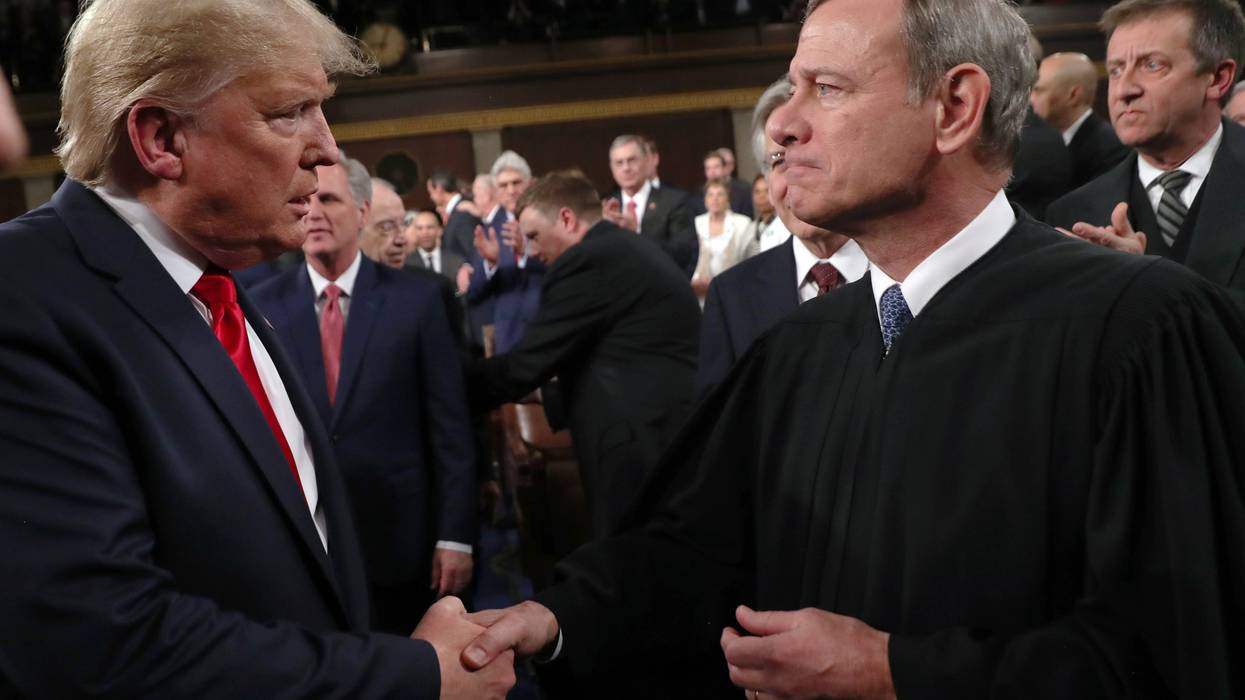
"The irreparable harm resulting from the Supreme Court of Virginia's decision is profound and immediate," top state Democrats said of the decision that struck down the new districts.
Virginia Attorney General Jay Jones and Democratic leaders in the state General Assembly on Monday asked the US Supreme Court to block a ruling against a ballot measure establishing new voter-approved congressional districts that favored Democrats.
The Virginia Supreme Court on Friday delivered a blow to the Democratic battle against President Donald Trump's gerrymandering campaign when it struck down a political map that Virginians had narrowly backed last month. The new districts could help Democrats secure up to four seats in the US House of Representatives in the November midterm elections.
Jones, Speaker of the Virginia House of Delegates Don Scott (D-88), state Senate Majority Leader Scott Surovell (D-34), and Senate President Pro Tempore L. Louise Lucas (D-18) are seeking a stay, arguing that based on a "novel and manifestly atextual interpretation" of the Virginia Constitution, the state Supreme Court "overrode the will of the people who ratified the amendment by ordering the commonwealth to conduct its election with the congressional districts that the people rejected."
"A stay is warranted because the decision by the Supreme Court of Virginia is deeply mistaken on two critical issues of federal law with profound practical importance to the nation. The decision below violates federal law in two separate ways," the emergency application says. "First, it predicated its interpretation of the Virginia Constitution on a grave misreading of federal law, which expressly fixes a single day for the 'election' of representatives and delegates to Congress."
"Second, by rejecting the plain text of the Virginia Constitution's definition of the term 'election' to adopt its own contrary meaning, the Supreme Court of Virginia 'transgressed the ordinary bounds of judicial review such that it arrogated to itself the power vested in the state legislature to regulate federal elections,'" the application continues.
The filing also stresses that "the irreparable harm resulting from the Supreme Court of Virginia's decision is profound and immediate. By forcing the commonwealth to conduct its congressional elections using districts different from those adopted by the General Assembly pursuant to a constitutional amendment the people just ratified, the Supreme Court of Virginia has deprived voters, candidates, and the commonwealth of their right to the lawfully enacted congressional districts."
The Associated Press noted that "Democrats are taking a legal long shot in asking the justices to reverse the Virginia ruling. The Supreme Court tries to avoid second-guessing state courts’ interpretations of their own constitutions. In 2023, it turned down a request by North Carolina Republicans to overrule a state Supreme Court decision that blocked the GOP's congressional map."
The high court also has a right-wing supermajority that includes three Trump appointees—and which gutted the remnants of the Voting Rights Act in a ruling related to Louisiana's congressional districts late last month.
Under current conditions, Republicans are expected to pick up seats in Florida, Missouri, North Carolina, Tennessee, and Texas due to redistricting demanded by Trump, while Democrats are expected to win more districts in California, where voters also approved new political lines benefiting them.
The Washington Post reported Monday that "some top Democrats express little hope that the appeal will affect this November's congressional midterms and are pivoting to waging campaigns in the state's existing districts."
According to the newspaper:
Surovell (D-Fairfax) said "the practical realities of our election calendar" will prevent candidates from running in new maps even if conservative justices on the US Supreme Court were open to helping Virginia Democrats.
Tuesday is the deadline set by state elections officials for putting the ballot mechanisms in place. Surovell noted that Virginia’s elections software is antiquated and overdue for replacement.
Instead, Democrats are making the case that it’s time to work with the cards they have in hand.
"Since we can't control anything other than mobilizing and organizing, then let's mobilize and organize and turn our anger into fuel for that," Rep. Jennifer McClellan (D-Va.) said.
In a Monday letter to fellow congressional Democrats, US House Minority Leader Hakeem Jeffries (NY) called out the "vicious Republican assault on the right to vote, free and fair elections, and Black political representation in the South," and pledged that "our effort to forcefully push back against the Republican redistricting scheme will not slow down."
Jeffries also announced a caucus-wide briefing planned for Thursday "to discuss the steps Democrats are taking to advance the largest voter protection effort in modern American history," and declared that "Democrats will take control of the House of Representatives in November."