SUBSCRIBE TO OUR FREE NEWSLETTER
Daily news & progressive opinion—funded by the people, not the corporations—delivered straight to your inbox.
5
#000000
#FFFFFF
To donate by check, phone, or other method, see our More Ways to Give page.
Daily news & progressive opinion—funded by the people, not the corporations—delivered straight to your inbox.
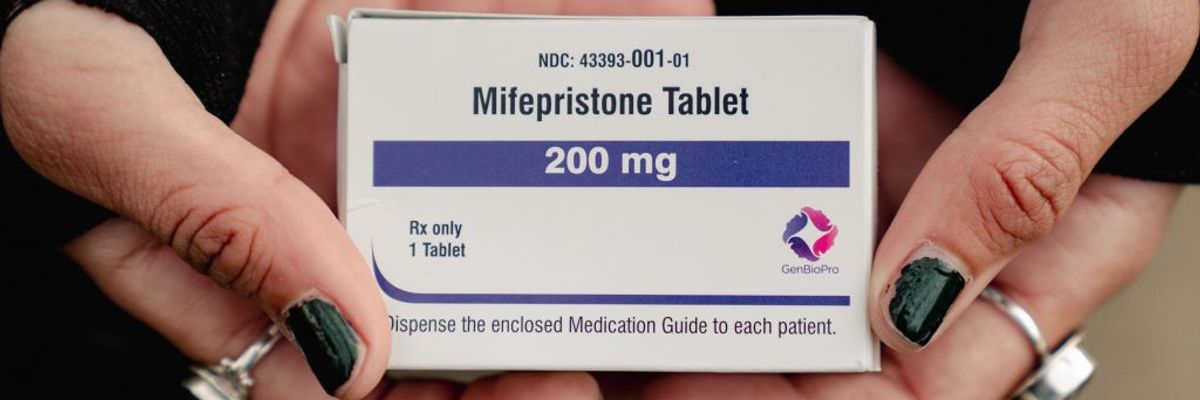
An abortion rights advocate holds a box of mifepristone outside the US Supreme Court in Washington, DC, on March 26, 2024.
The "politically driven" ruling, warned one campaigner, "overrides medical expertise and years of research, and threatens to upend how abortion care is delivered nationwide."
Rights advocates swiftly sounded the alarm on Friday after the infamously far-right US Court of Appeals for the 5th Circuit temporarily blocked a federal rule allowing mifepristone to be dispensed by mail, dramatically curtailing access to the medication—commonly used for abortion and early miscarriage care—nationwide, particularly in states with policies hostile to reproductive freedom.
Just months after the US Supreme Court's right-wing supermajority reversed Roe v. Wade, the Food and Drug Administration permanently lifted mifepristone's in-person dispensing requirement in early 2023, under then-President Joe Biden. Louisiana—which has among the nation's most restrictive abortion policies—challenged the FDA's move.
A federal judge in Louisiana paused that lawsuit last month while President Donald Trump's administration conducts an FDA review that seems "designed to manufacture an excuse for further restricting medication abortion across the country," as Julia Kaye, senior staff attorney for the ACLU's Reproductive Freedom Project, warned at the time.
After a panel from the appellate court overturned that decision and revived the in-person dispensing rule on Friday, Kaye declared that "anti-abortion politicians have just made it much harder for people everywhere in the country to get a medication that abortion and miscarriage patients have been safely using for more than 25 years."
"Louisiana's legal attack on mifepristone shamelessly packaged lies and propaganda as an excuse to restrict abortion—and the 5th Circuit rubber-stamped it," she continued. "This decision defies clear science and settled law and advances an anti-abortion agenda that is deeply unpopular with the American people. For countless people, especially those who live in rural areas, face intimate partner violence, or live with disabilities, losing a telemedicine option will mean losing access to this vital medication altogether."
Brittany Fonteno, president and CEO of the National Abortion Federation (NAF), similarly stressed that "this ruling is a sweeping and dangerous rollback that disregards the well-established safety and efficacy of the use of mifepristone via telehealth, and will create immediate, medically unnecessary barriers to care for patients across the country."
"Make no mistake: This ruling is not grounded in science or patient safety," she said. "It is a politically driven decision that overrides medical expertise and years of research, and threatens to upend how abortion care is delivered nationwide. Through this litigation, Louisiana seeks to impose its cruel abortion ban across the nation—including in states with legal protections for abortion—and today the court has taken an extreme step toward that end."
While pledging that "NAF and our allies will continue to advocate to restore full access to medication abortion," Fonteno reminded patients that mifepristone "remains available in doctors' offices, clinics, and hospitals."
Terrific thread. I’ll just add:1. I think there’s a good chance the Supreme Court will stay this decision, allowing providers to keep mailing mifepristone for the time being.2. The Trump administration didn’t want this! Its plan was to wait until after the midterms to crack down on mifepristone.
[image or embed]
— Mark Joseph Stern (@mjsdc.bsky.social) May 1, 2026 at 6:52 PM
After Roe's reversal, the anti-choice movement and its allies in elected offices ramped up efforts to impose state-level restrictions on reproductive healthcare. A significant majority of abortions in the United States involve a two-drug regimen of mifepristone and misoprostol, and a quarter of those patients receive care via telemedicine.
"Telehealth has been the last bridge to care for many seeking abortion, which is precisely why Louisiana officials want it banned," said Nancy Northup, president and CEO of the Center for Reproductive Rights, which joined over 100 other reproductive health, justice, and rights groups, including the ACLU and NAF, that filed an amicus brief in this case.
"This isn't about science—it's about making abortion as difficult, expensive, and unreachable as possible," Northup added. "Telehealth has transformed healthcare. Selectively stripping that away from abortion patients is a political blockade."
The drug companies Danco Laboratories, which makes the brand-name version of mifepristone, Mifeprex, and GenBioPro, which makes the generic, have intervened in Louisiana v. FDA. GenBioPro is represented by the law firm Arnold & Porter and Democracy Forward, whose president and CEO, Skye Perryman, declared Friday that "this is the anti-abortion extremists' playbook in action once again: Weaponize the courts to serve their political interests, ignore decades of scientific evidence proving mifepristone’s safety, and put women directly in harm's way."
"Even as this assault defies the will of the overwhelming majority of the American public, these ideologically extreme politicians and organizations are determined to impose a narrow, autocratic agenda—no matter the cost," she continued, emphasizing that "our fight is not over."
This is a ruling purporting to halt telehealth prescriptions of mifepristone NATIONWIDE. Louisiana asked the Fifth Circuit for a decision by Monday, May 11. That they dropped it on a Friday afternoon feels intentional to keep it in effect for longer. Expect emergency appeal to SCOTUS shadow docket
[image or embed]
— Susan Rinkunas (@susanrinkunas.com) May 1, 2026 at 5:35 PM
The effects of the 5th Circuit's decision are expected to be immediate absent a quick intervention from the Supreme Court, and Nourbese Flint, president of All* Above All, warned that "as always, the people most impacted will be Black and brown communities and those already navigating systemic barriers to care."
Serra Sippel, executive director of the Brigid Alliance, a national abortion support group that helps coordinate and fund travel, said that "we expect to see an immediate increase in patients forced to travel hundreds or even thousands of miles for care. That includes many who are later in pregnancy—when care is more complex and more expensive."
"Over the past several years, we've seen a dramatic rise in abortion travel and a growing reliance on practical support networks like ours, particularly in states where patients already travel long distances for care," Sippel noted. "We will continue to monitor the impact of this ruling and are committed to ensuring abortion patients who need to travel can safely get to the care they need, regardless of where they live."
Dear Common Dreams reader, It’s been nearly 30 years since I co-founded Common Dreams with my late wife, Lina Newhouser. We had the radical notion that journalism should serve the public good, not corporate profits. It was clear to us from the outset what it would take to build such a project. No paid advertisements. No corporate sponsors. No millionaire publisher telling us what to think or do. Many people said we wouldn't last a year, but we proved those doubters wrong. Together with a tremendous team of journalists and dedicated staff, we built an independent media outlet free from the constraints of profits and corporate control. Our mission has always been simple: To inform. To inspire. To ignite change for the common good. Building Common Dreams was not easy. Our survival was never guaranteed. When you take on the most powerful forces—Wall Street greed, fossil fuel industry destruction, Big Tech lobbyists, and uber-rich oligarchs who have spent billions upon billions rigging the economy and democracy in their favor—the only bulwark you have is supporters who believe in your work. But here’s the urgent message from me today. It's never been this bad out there. And it's never been this hard to keep us going. At the very moment Common Dreams is most needed, the threats we face are intensifying. We need your support now more than ever. We don't accept corporate advertising and never will. We don't have a paywall because we don't think people should be blocked from critical news based on their ability to pay. Everything we do is funded by the donations of readers like you. When everyone does the little they can afford, we are strong. But if that support retreats or dries up, so do we. Will you donate now to make sure Common Dreams not only survives but thrives? —Craig Brown, Co-founder |
Rights advocates swiftly sounded the alarm on Friday after the infamously far-right US Court of Appeals for the 5th Circuit temporarily blocked a federal rule allowing mifepristone to be dispensed by mail, dramatically curtailing access to the medication—commonly used for abortion and early miscarriage care—nationwide, particularly in states with policies hostile to reproductive freedom.
Just months after the US Supreme Court's right-wing supermajority reversed Roe v. Wade, the Food and Drug Administration permanently lifted mifepristone's in-person dispensing requirement in early 2023, under then-President Joe Biden. Louisiana—which has among the nation's most restrictive abortion policies—challenged the FDA's move.
A federal judge in Louisiana paused that lawsuit last month while President Donald Trump's administration conducts an FDA review that seems "designed to manufacture an excuse for further restricting medication abortion across the country," as Julia Kaye, senior staff attorney for the ACLU's Reproductive Freedom Project, warned at the time.
After a panel from the appellate court overturned that decision and revived the in-person dispensing rule on Friday, Kaye declared that "anti-abortion politicians have just made it much harder for people everywhere in the country to get a medication that abortion and miscarriage patients have been safely using for more than 25 years."
"Louisiana's legal attack on mifepristone shamelessly packaged lies and propaganda as an excuse to restrict abortion—and the 5th Circuit rubber-stamped it," she continued. "This decision defies clear science and settled law and advances an anti-abortion agenda that is deeply unpopular with the American people. For countless people, especially those who live in rural areas, face intimate partner violence, or live with disabilities, losing a telemedicine option will mean losing access to this vital medication altogether."
Brittany Fonteno, president and CEO of the National Abortion Federation (NAF), similarly stressed that "this ruling is a sweeping and dangerous rollback that disregards the well-established safety and efficacy of the use of mifepristone via telehealth, and will create immediate, medically unnecessary barriers to care for patients across the country."
"Make no mistake: This ruling is not grounded in science or patient safety," she said. "It is a politically driven decision that overrides medical expertise and years of research, and threatens to upend how abortion care is delivered nationwide. Through this litigation, Louisiana seeks to impose its cruel abortion ban across the nation—including in states with legal protections for abortion—and today the court has taken an extreme step toward that end."
While pledging that "NAF and our allies will continue to advocate to restore full access to medication abortion," Fonteno reminded patients that mifepristone "remains available in doctors' offices, clinics, and hospitals."
Terrific thread. I’ll just add:1. I think there’s a good chance the Supreme Court will stay this decision, allowing providers to keep mailing mifepristone for the time being.2. The Trump administration didn’t want this! Its plan was to wait until after the midterms to crack down on mifepristone.
[image or embed]
— Mark Joseph Stern (@mjsdc.bsky.social) May 1, 2026 at 6:52 PM
After Roe's reversal, the anti-choice movement and its allies in elected offices ramped up efforts to impose state-level restrictions on reproductive healthcare. A significant majority of abortions in the United States involve a two-drug regimen of mifepristone and misoprostol, and a quarter of those patients receive care via telemedicine.
"Telehealth has been the last bridge to care for many seeking abortion, which is precisely why Louisiana officials want it banned," said Nancy Northup, president and CEO of the Center for Reproductive Rights, which joined over 100 other reproductive health, justice, and rights groups, including the ACLU and NAF, that filed an amicus brief in this case.
"This isn't about science—it's about making abortion as difficult, expensive, and unreachable as possible," Northup added. "Telehealth has transformed healthcare. Selectively stripping that away from abortion patients is a political blockade."
The drug companies Danco Laboratories, which makes the brand-name version of mifepristone, Mifeprex, and GenBioPro, which makes the generic, have intervened in Louisiana v. FDA. GenBioPro is represented by the law firm Arnold & Porter and Democracy Forward, whose president and CEO, Skye Perryman, declared Friday that "this is the anti-abortion extremists' playbook in action once again: Weaponize the courts to serve their political interests, ignore decades of scientific evidence proving mifepristone’s safety, and put women directly in harm's way."
"Even as this assault defies the will of the overwhelming majority of the American public, these ideologically extreme politicians and organizations are determined to impose a narrow, autocratic agenda—no matter the cost," she continued, emphasizing that "our fight is not over."
This is a ruling purporting to halt telehealth prescriptions of mifepristone NATIONWIDE. Louisiana asked the Fifth Circuit for a decision by Monday, May 11. That they dropped it on a Friday afternoon feels intentional to keep it in effect for longer. Expect emergency appeal to SCOTUS shadow docket
[image or embed]
— Susan Rinkunas (@susanrinkunas.com) May 1, 2026 at 5:35 PM
The effects of the 5th Circuit's decision are expected to be immediate absent a quick intervention from the Supreme Court, and Nourbese Flint, president of All* Above All, warned that "as always, the people most impacted will be Black and brown communities and those already navigating systemic barriers to care."
Serra Sippel, executive director of the Brigid Alliance, a national abortion support group that helps coordinate and fund travel, said that "we expect to see an immediate increase in patients forced to travel hundreds or even thousands of miles for care. That includes many who are later in pregnancy—when care is more complex and more expensive."
"Over the past several years, we've seen a dramatic rise in abortion travel and a growing reliance on practical support networks like ours, particularly in states where patients already travel long distances for care," Sippel noted. "We will continue to monitor the impact of this ruling and are committed to ensuring abortion patients who need to travel can safely get to the care they need, regardless of where they live."
Rights advocates swiftly sounded the alarm on Friday after the infamously far-right US Court of Appeals for the 5th Circuit temporarily blocked a federal rule allowing mifepristone to be dispensed by mail, dramatically curtailing access to the medication—commonly used for abortion and early miscarriage care—nationwide, particularly in states with policies hostile to reproductive freedom.
Just months after the US Supreme Court's right-wing supermajority reversed Roe v. Wade, the Food and Drug Administration permanently lifted mifepristone's in-person dispensing requirement in early 2023, under then-President Joe Biden. Louisiana—which has among the nation's most restrictive abortion policies—challenged the FDA's move.
A federal judge in Louisiana paused that lawsuit last month while President Donald Trump's administration conducts an FDA review that seems "designed to manufacture an excuse for further restricting medication abortion across the country," as Julia Kaye, senior staff attorney for the ACLU's Reproductive Freedom Project, warned at the time.
After a panel from the appellate court overturned that decision and revived the in-person dispensing rule on Friday, Kaye declared that "anti-abortion politicians have just made it much harder for people everywhere in the country to get a medication that abortion and miscarriage patients have been safely using for more than 25 years."
"Louisiana's legal attack on mifepristone shamelessly packaged lies and propaganda as an excuse to restrict abortion—and the 5th Circuit rubber-stamped it," she continued. "This decision defies clear science and settled law and advances an anti-abortion agenda that is deeply unpopular with the American people. For countless people, especially those who live in rural areas, face intimate partner violence, or live with disabilities, losing a telemedicine option will mean losing access to this vital medication altogether."
Brittany Fonteno, president and CEO of the National Abortion Federation (NAF), similarly stressed that "this ruling is a sweeping and dangerous rollback that disregards the well-established safety and efficacy of the use of mifepristone via telehealth, and will create immediate, medically unnecessary barriers to care for patients across the country."
"Make no mistake: This ruling is not grounded in science or patient safety," she said. "It is a politically driven decision that overrides medical expertise and years of research, and threatens to upend how abortion care is delivered nationwide. Through this litigation, Louisiana seeks to impose its cruel abortion ban across the nation—including in states with legal protections for abortion—and today the court has taken an extreme step toward that end."
While pledging that "NAF and our allies will continue to advocate to restore full access to medication abortion," Fonteno reminded patients that mifepristone "remains available in doctors' offices, clinics, and hospitals."
Terrific thread. I’ll just add:1. I think there’s a good chance the Supreme Court will stay this decision, allowing providers to keep mailing mifepristone for the time being.2. The Trump administration didn’t want this! Its plan was to wait until after the midterms to crack down on mifepristone.
[image or embed]
— Mark Joseph Stern (@mjsdc.bsky.social) May 1, 2026 at 6:52 PM
After Roe's reversal, the anti-choice movement and its allies in elected offices ramped up efforts to impose state-level restrictions on reproductive healthcare. A significant majority of abortions in the United States involve a two-drug regimen of mifepristone and misoprostol, and a quarter of those patients receive care via telemedicine.
"Telehealth has been the last bridge to care for many seeking abortion, which is precisely why Louisiana officials want it banned," said Nancy Northup, president and CEO of the Center for Reproductive Rights, which joined over 100 other reproductive health, justice, and rights groups, including the ACLU and NAF, that filed an amicus brief in this case.
"This isn't about science—it's about making abortion as difficult, expensive, and unreachable as possible," Northup added. "Telehealth has transformed healthcare. Selectively stripping that away from abortion patients is a political blockade."
The drug companies Danco Laboratories, which makes the brand-name version of mifepristone, Mifeprex, and GenBioPro, which makes the generic, have intervened in Louisiana v. FDA. GenBioPro is represented by the law firm Arnold & Porter and Democracy Forward, whose president and CEO, Skye Perryman, declared Friday that "this is the anti-abortion extremists' playbook in action once again: Weaponize the courts to serve their political interests, ignore decades of scientific evidence proving mifepristone’s safety, and put women directly in harm's way."
"Even as this assault defies the will of the overwhelming majority of the American public, these ideologically extreme politicians and organizations are determined to impose a narrow, autocratic agenda—no matter the cost," she continued, emphasizing that "our fight is not over."
This is a ruling purporting to halt telehealth prescriptions of mifepristone NATIONWIDE. Louisiana asked the Fifth Circuit for a decision by Monday, May 11. That they dropped it on a Friday afternoon feels intentional to keep it in effect for longer. Expect emergency appeal to SCOTUS shadow docket
[image or embed]
— Susan Rinkunas (@susanrinkunas.com) May 1, 2026 at 5:35 PM
The effects of the 5th Circuit's decision are expected to be immediate absent a quick intervention from the Supreme Court, and Nourbese Flint, president of All* Above All, warned that "as always, the people most impacted will be Black and brown communities and those already navigating systemic barriers to care."
Serra Sippel, executive director of the Brigid Alliance, a national abortion support group that helps coordinate and fund travel, said that "we expect to see an immediate increase in patients forced to travel hundreds or even thousands of miles for care. That includes many who are later in pregnancy—when care is more complex and more expensive."
"Over the past several years, we've seen a dramatic rise in abortion travel and a growing reliance on practical support networks like ours, particularly in states where patients already travel long distances for care," Sippel noted. "We will continue to monitor the impact of this ruling and are committed to ensuring abortion patients who need to travel can safely get to the care they need, regardless of where they live."