SUBSCRIBE TO OUR FREE NEWSLETTER
Daily news & progressive opinion—funded by the people, not the corporations—delivered straight to your inbox.
5
#000000
#FFFFFF
To donate by check, phone, or other method, see our More Ways to Give page.
Daily news & progressive opinion—funded by the people, not the corporations—delivered straight to your inbox.
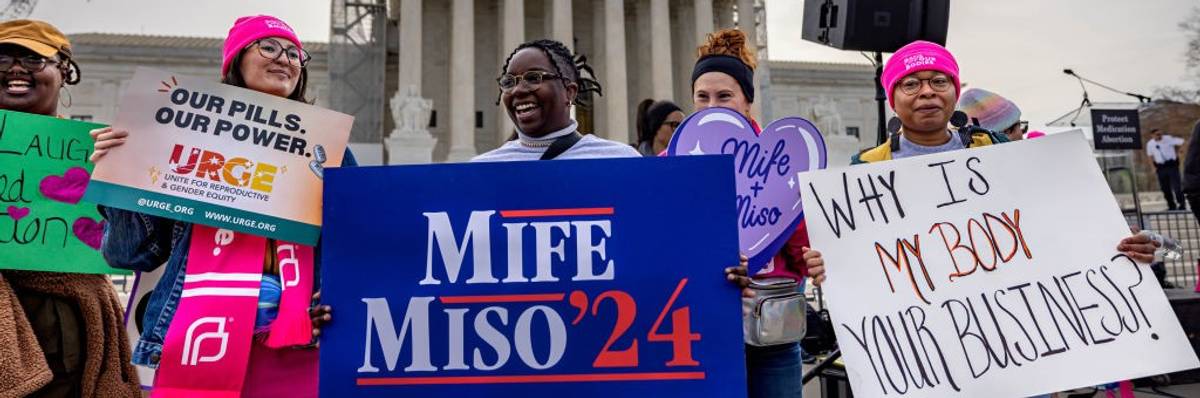
Abortion rights supporters demonstrate outside the U.S. Supreme Court in Washington, D.C. on March 26, 2024.
"We must remain vigilant," one expert warned. "The anti-abortion movement is ruthlessly pursuing its end goal of banning abortion nationwide."
While welcoming the U.S. Supreme Court's unanimous decision to preserve access to mifepristone, a medication commonly used for abortion care, rights advocates on Thursday also stressed that the six conservative justices who reversed Roe v. Wade are no allies to reproductive freedom.
"We are relieved by this outcome, but we are not celebrating," said Destiny Lopez, acting co-CEO of the Guttmacher Institute. "From the start, this case was rooted in bad faith and lacking any basis in facts or science. This case never should have reached our nation's top court in the first place and the Supreme Court made the only reasonable decision by leaving access to medication abortion using mifepristone unchanged."
"Mifepristone is safe, effective, and essential."
"Mifepristone is safe, effective, and essential," Lopez continued, citing Guttmacher data that two-thirds of known U.S. abortion patients last year used medication to end their pregnancies. "Even with this baseless challenge defeated, we must remain vigilant. The anti-abortion movement is ruthlessly pursuing its end goal of banning abortion nationwide."
Two years after Dobbs v. Jackson Women's Health Organization overturned Roe, "abortion is banned in 14 states and severely restricted in many more," she noted. "In the face of relentless attacks, policymakers at all levels need to keep pushing forward expansive and protective policies that ensure everyone can access abortion care using the method that best suits their needs.
The court agreed to take Food and Drug Administration v. Alliance for Hippocratic Medicine in December and heard arguments in March. The new opinion, written by Justice Brett Kavanaugh, concludes that the anti-choice groups that were trying to cut off access to the abortion pill across the country lacked "standing to challenge FDA's actions regarding the regulation of mifepristone."
Justice Clarence Thomas penned a concurring opinion—as he did for Dobbs, when he suggested the court should also reconsider rulings that affirmed the right to use contraceptives, overturned a state law that criminalized consensual sexual activity between adults of the same sex, and enabled LGBTQ+ couples to legally marry nationwide.
The dismissal on standing "is a powerful affirmation of what we have always known: mifepristone is a safe and essential medication, and there is no legitimate medical or scientific reason why access to mifepristone should be limited," said Dr. Jamila Perritt, a Washington, D.C.-based OB-GYN who leads Physicians for Reproductive Health.
"We fought tirelessly to ensure access to mifepristone because of its critical role in reproductive healthcare and its importance in expanding abortion access for our community members, especially those living at the intersections of systemic oppression disproportionately harmed by abortion bans and restrictions," Perritt explained.
However, that fight is far from over. Like Lopez, ACLU Reproductive Freedom Project director Jennifer Dalven emphasized that "we are relieved the Supreme Court didn't take this bait, but unfortunately we know that this is far from the end of the line."
"Although the court refused to allow these particular people to bring this case, anti-abortion politicians are waiting in the wings to attempt to continue pushing this case before an extremist judge in Texas in an effort to deny people access to medication abortion care," she said, calling out District Judge Matthew Kacsmaryk, an appointee of former President Donald Trump, the presumed Republican nominee for November.
While Trump has bragged about his role in reversing Roe—he appointed three of the court's six right-wing justices—Democratic President Joe Biden has campaigned on his support for reproductive rights. Like the advocates, he welcomed Thursday's ruling but also warned of "Republican elected officials' extreme and dangerous agenda to ban abortion nationwide."
With the mifepristone case settled—for now—rights defenders are shifting their focus to another forthcoming decision.
"Today, the Supreme Court did the bare minimum by rejecting this case on standing and allowing mifepristone to remain FDA-approved and without new restrictions. However, with the case returning to the district court, the fight is not over," said Planned Parenthood Federation of America president and CEO Alexis McGill Johnson. "As we breathe a sigh of relief for now, we cannot forget that the court is deciding another case about abortion this term."
That case, Dalven noted, "will determine whether politicians can force doctors to withhold emergency room care from their patients while they suffer severe, life-altering pregnancy complications."
"These cases show the extreme lengths politicians will go," she added, "to prevent people from getting the reproductive healthcare they need."
Dear Common Dreams reader, It’s been nearly 30 years since I co-founded Common Dreams with my late wife, Lina Newhouser. We had the radical notion that journalism should serve the public good, not corporate profits. It was clear to us from the outset what it would take to build such a project. No paid advertisements. No corporate sponsors. No millionaire publisher telling us what to think or do. Many people said we wouldn't last a year, but we proved those doubters wrong. Together with a tremendous team of journalists and dedicated staff, we built an independent media outlet free from the constraints of profits and corporate control. Our mission has always been simple: To inform. To inspire. To ignite change for the common good. Building Common Dreams was not easy. Our survival was never guaranteed. When you take on the most powerful forces—Wall Street greed, fossil fuel industry destruction, Big Tech lobbyists, and uber-rich oligarchs who have spent billions upon billions rigging the economy and democracy in their favor—the only bulwark you have is supporters who believe in your work. But here’s the urgent message from me today. It's never been this bad out there. And it's never been this hard to keep us going. At the very moment Common Dreams is most needed, the threats we face are intensifying. We need your support now more than ever. We don't accept corporate advertising and never will. We don't have a paywall because we don't think people should be blocked from critical news based on their ability to pay. Everything we do is funded by the donations of readers like you. When everyone does the little they can afford, we are strong. But if that support retreats or dries up, so do we. Will you donate now to make sure Common Dreams not only survives but thrives? —Craig Brown, Co-founder |
While welcoming the U.S. Supreme Court's unanimous decision to preserve access to mifepristone, a medication commonly used for abortion care, rights advocates on Thursday also stressed that the six conservative justices who reversed Roe v. Wade are no allies to reproductive freedom.
"We are relieved by this outcome, but we are not celebrating," said Destiny Lopez, acting co-CEO of the Guttmacher Institute. "From the start, this case was rooted in bad faith and lacking any basis in facts or science. This case never should have reached our nation's top court in the first place and the Supreme Court made the only reasonable decision by leaving access to medication abortion using mifepristone unchanged."
"Mifepristone is safe, effective, and essential."
"Mifepristone is safe, effective, and essential," Lopez continued, citing Guttmacher data that two-thirds of known U.S. abortion patients last year used medication to end their pregnancies. "Even with this baseless challenge defeated, we must remain vigilant. The anti-abortion movement is ruthlessly pursuing its end goal of banning abortion nationwide."
Two years after Dobbs v. Jackson Women's Health Organization overturned Roe, "abortion is banned in 14 states and severely restricted in many more," she noted. "In the face of relentless attacks, policymakers at all levels need to keep pushing forward expansive and protective policies that ensure everyone can access abortion care using the method that best suits their needs.
The court agreed to take Food and Drug Administration v. Alliance for Hippocratic Medicine in December and heard arguments in March. The new opinion, written by Justice Brett Kavanaugh, concludes that the anti-choice groups that were trying to cut off access to the abortion pill across the country lacked "standing to challenge FDA's actions regarding the regulation of mifepristone."
Justice Clarence Thomas penned a concurring opinion—as he did for Dobbs, when he suggested the court should also reconsider rulings that affirmed the right to use contraceptives, overturned a state law that criminalized consensual sexual activity between adults of the same sex, and enabled LGBTQ+ couples to legally marry nationwide.
The dismissal on standing "is a powerful affirmation of what we have always known: mifepristone is a safe and essential medication, and there is no legitimate medical or scientific reason why access to mifepristone should be limited," said Dr. Jamila Perritt, a Washington, D.C.-based OB-GYN who leads Physicians for Reproductive Health.
"We fought tirelessly to ensure access to mifepristone because of its critical role in reproductive healthcare and its importance in expanding abortion access for our community members, especially those living at the intersections of systemic oppression disproportionately harmed by abortion bans and restrictions," Perritt explained.
However, that fight is far from over. Like Lopez, ACLU Reproductive Freedom Project director Jennifer Dalven emphasized that "we are relieved the Supreme Court didn't take this bait, but unfortunately we know that this is far from the end of the line."
"Although the court refused to allow these particular people to bring this case, anti-abortion politicians are waiting in the wings to attempt to continue pushing this case before an extremist judge in Texas in an effort to deny people access to medication abortion care," she said, calling out District Judge Matthew Kacsmaryk, an appointee of former President Donald Trump, the presumed Republican nominee for November.
While Trump has bragged about his role in reversing Roe—he appointed three of the court's six right-wing justices—Democratic President Joe Biden has campaigned on his support for reproductive rights. Like the advocates, he welcomed Thursday's ruling but also warned of "Republican elected officials' extreme and dangerous agenda to ban abortion nationwide."
With the mifepristone case settled—for now—rights defenders are shifting their focus to another forthcoming decision.
"Today, the Supreme Court did the bare minimum by rejecting this case on standing and allowing mifepristone to remain FDA-approved and without new restrictions. However, with the case returning to the district court, the fight is not over," said Planned Parenthood Federation of America president and CEO Alexis McGill Johnson. "As we breathe a sigh of relief for now, we cannot forget that the court is deciding another case about abortion this term."
That case, Dalven noted, "will determine whether politicians can force doctors to withhold emergency room care from their patients while they suffer severe, life-altering pregnancy complications."
"These cases show the extreme lengths politicians will go," she added, "to prevent people from getting the reproductive healthcare they need."
While welcoming the U.S. Supreme Court's unanimous decision to preserve access to mifepristone, a medication commonly used for abortion care, rights advocates on Thursday also stressed that the six conservative justices who reversed Roe v. Wade are no allies to reproductive freedom.
"We are relieved by this outcome, but we are not celebrating," said Destiny Lopez, acting co-CEO of the Guttmacher Institute. "From the start, this case was rooted in bad faith and lacking any basis in facts or science. This case never should have reached our nation's top court in the first place and the Supreme Court made the only reasonable decision by leaving access to medication abortion using mifepristone unchanged."
"Mifepristone is safe, effective, and essential."
"Mifepristone is safe, effective, and essential," Lopez continued, citing Guttmacher data that two-thirds of known U.S. abortion patients last year used medication to end their pregnancies. "Even with this baseless challenge defeated, we must remain vigilant. The anti-abortion movement is ruthlessly pursuing its end goal of banning abortion nationwide."
Two years after Dobbs v. Jackson Women's Health Organization overturned Roe, "abortion is banned in 14 states and severely restricted in many more," she noted. "In the face of relentless attacks, policymakers at all levels need to keep pushing forward expansive and protective policies that ensure everyone can access abortion care using the method that best suits their needs.
The court agreed to take Food and Drug Administration v. Alliance for Hippocratic Medicine in December and heard arguments in March. The new opinion, written by Justice Brett Kavanaugh, concludes that the anti-choice groups that were trying to cut off access to the abortion pill across the country lacked "standing to challenge FDA's actions regarding the regulation of mifepristone."
Justice Clarence Thomas penned a concurring opinion—as he did for Dobbs, when he suggested the court should also reconsider rulings that affirmed the right to use contraceptives, overturned a state law that criminalized consensual sexual activity between adults of the same sex, and enabled LGBTQ+ couples to legally marry nationwide.
The dismissal on standing "is a powerful affirmation of what we have always known: mifepristone is a safe and essential medication, and there is no legitimate medical or scientific reason why access to mifepristone should be limited," said Dr. Jamila Perritt, a Washington, D.C.-based OB-GYN who leads Physicians for Reproductive Health.
"We fought tirelessly to ensure access to mifepristone because of its critical role in reproductive healthcare and its importance in expanding abortion access for our community members, especially those living at the intersections of systemic oppression disproportionately harmed by abortion bans and restrictions," Perritt explained.
However, that fight is far from over. Like Lopez, ACLU Reproductive Freedom Project director Jennifer Dalven emphasized that "we are relieved the Supreme Court didn't take this bait, but unfortunately we know that this is far from the end of the line."
"Although the court refused to allow these particular people to bring this case, anti-abortion politicians are waiting in the wings to attempt to continue pushing this case before an extremist judge in Texas in an effort to deny people access to medication abortion care," she said, calling out District Judge Matthew Kacsmaryk, an appointee of former President Donald Trump, the presumed Republican nominee for November.
While Trump has bragged about his role in reversing Roe—he appointed three of the court's six right-wing justices—Democratic President Joe Biden has campaigned on his support for reproductive rights. Like the advocates, he welcomed Thursday's ruling but also warned of "Republican elected officials' extreme and dangerous agenda to ban abortion nationwide."
With the mifepristone case settled—for now—rights defenders are shifting their focus to another forthcoming decision.
"Today, the Supreme Court did the bare minimum by rejecting this case on standing and allowing mifepristone to remain FDA-approved and without new restrictions. However, with the case returning to the district court, the fight is not over," said Planned Parenthood Federation of America president and CEO Alexis McGill Johnson. "As we breathe a sigh of relief for now, we cannot forget that the court is deciding another case about abortion this term."
That case, Dalven noted, "will determine whether politicians can force doctors to withhold emergency room care from their patients while they suffer severe, life-altering pregnancy complications."
"These cases show the extreme lengths politicians will go," she added, "to prevent people from getting the reproductive healthcare they need."