Victims of Our Post-9/11 Wars Deserve Remembrance, Too
We Americans want only to recall our innocent dead and to honor them. Unlike the Germans, we spurn acknowledging the evils done in their name that came to be intertwined with our losses, the catastrophe we inflicted on an innocent nation, Iraq.
What We Can Learn From Kassel’s Holocaust Counter-Memorial
In 1939, the Nazis destroyed a 40-foot pyramidal fountain in Kassel, Germany because it had been built by a Jew, the entrepreneur Sigmund Aschrott. The elimination of “the Jews’ Fountain” was soon followed by the elimination of Kassel’s 3,000 Jews themselves.
 The Aschrott Fountain (1908–1939) is shown.
Forty-five years later it was proposed to rebuild the fountain. But simply rebuilding the original fountain would have erased the memory of its destruction. So artist Horst Hoheisel designed a new fountain: “a mirror image of the old one, sunk beneath the old place in order to rescue the history of this place as a wound and an open question.”
 The Memorial to the Aschrottbrunnen Fountain is shown. (Photo by Eistreter, CC BY-SA 4.0)
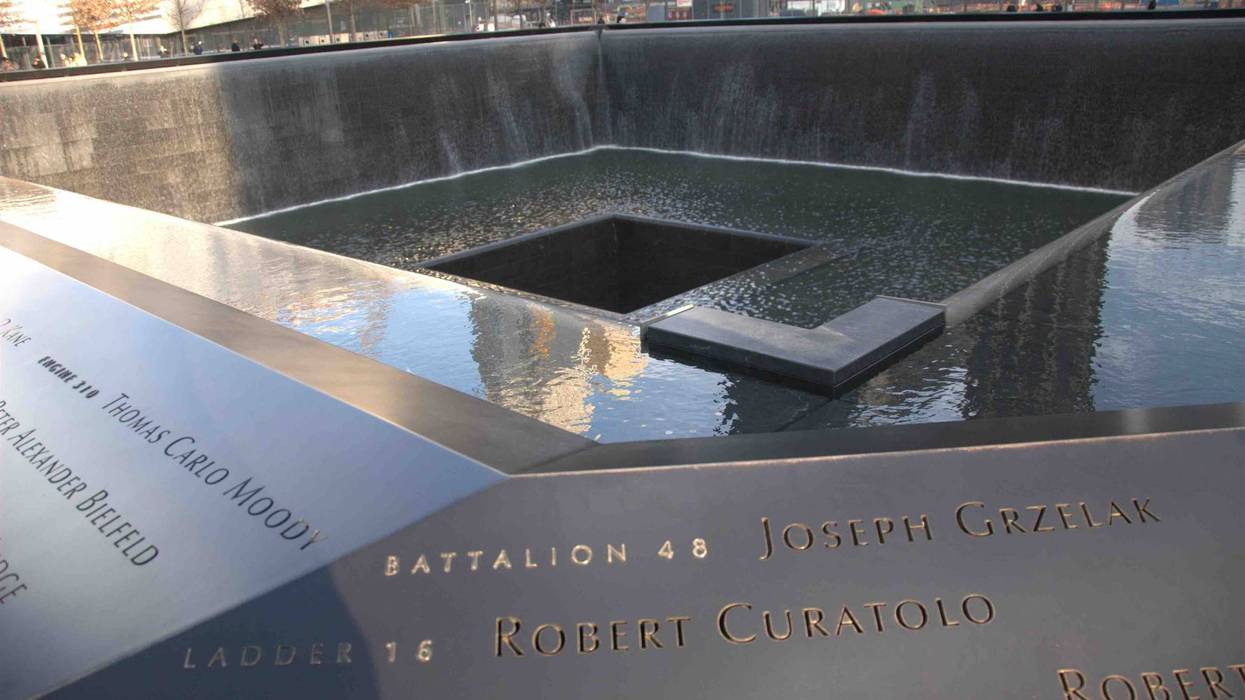
The September 11 memorial, which is called Reflecting Absence, evokes the missing Twin Towers by revealing their empty foundations. Hoheisel’s earlier Kassel counter-monument is, similarly, an emptiness in the shape of the missing original. “The pyramid will be turned into a funnel into whose darkness water runs down,” Hoheisel says.
“The sunken fountain is an invitation to passersby who stand upon it to search for the memorial in their own heads. For only there is the memorial to be found.”
 The underground portion of the Aschrottbrunnen Fountain is shown. (Photo by Horst Hoheisel)
Kassel’s Holocaust memorial is one of many throughout Germany, part of the way the Germans have accepted responsibility for the crimes of the Nazi era. This small, local memorial compels us to think of those who were murdered, but also of those who murdered and those who stood by.
 The installation of the Aschrottbrunnen Fountain is shown. (Photo by Horst Hoheisel)
We reflect on the small viciousness of destroying “the Jew’s fountain,” and the monstrous barbarity to which this was prelude. The small monument conjures the sadness of loss, and the responsibility of a people for acts that can never be made right.
Can America Accept Responsibility for the Mass Deaths Inflicted in the Name of Our “War on Terrorism”
The murder of thousands of Americans, the crime of September 11, 2001, spawned a larger tragedy for another people. Using the false suggestion of Iraq complicity as one of its pretexts, and treating the 9/11 “war on terrorism” as license for war on Baghdad as well as on Kabul, our government invaded Iraq, overthrew its government, and occupied the country.
In reality, as Bush White House anti-terrorism adviser Richard Clarke confirmed, Iraq was not responsible for 9/11 and our government knew it. “In the weeks immediately after 9/11,” Clarke explained, “the president… instruct[ed] the Pentagon to prepare for the invasion of Iraq... Even though they knew at the time from me, from the FBI, from the CIA, that Iraq had nothing to do with 9/11.”
Knowing that Iraq had nothing to do with the al Qaeda attack did not matter because President George W. Bush’s government had begun targeting Iraq for invasion long before September 11. The very first meeting of Bush’s national security team on January 20, 2001 included a discussion of “military options” for Iraq and overthrowing its government.
It would represent no insult to the memory of the innocents murdered in America, 25 Septembers ago, were we to acknowledge and memorialize the carnage and catastrophe we unleashed in Iraq.
As a delegation from our British allies secretly reported to their government before the invasion, “The intelligence and facts were being fixed around the [Bush] policy” of going to war. “The case [for war] was thin.”
The American invasion, and the resistance and chaotic civil war triggered by the US occupation, likely took between 500,000 and 1 million Iraqi lives. It made refugees of millions more, and inflicted malnutrition, birth defects, and other health disasters on a generation of Iraqi children.
It would represent no insult to the memory of the innocents murdered in America, 25 Septembers ago, were we to acknowledge and memorialize the carnage and catastrophe we unleashed in Iraq.
To America’s 9/11 memorial we should add a wall on which we engrave, in a necessarily small font, the names of however many can be identified of the million Iraqi men, women, and children slain in the wars and sectarian strife our invasion precipitated. And since President Donald Trump has ensnared our nation in another pointless war, another war of aggression based on the excuse of “terrorism,” a Middle East war he has no plan to end, we should inscribe as well the names of the Iranian civilians killed in Trump’s war. The 100 children slain at the beginning of the bombing campaign. The wedding guests bombed in a small Iran town last week. They deserve remembrance, too.
Of course, this is unthinkable and will never happen.
It would be “too political” to acknowledge any connection between the horrors we suffered and the horrors we inflicted. In fact, even the suggestion will be said to “disrespect” our honored dead—as though their memories could be further sullied than they already have been by the evil perpetrated in their names.
Nonetheless, the proposal may be useful. As Hoheisel says: “That’s how a counter-monument works. People get angry, they write letters, but you have a discussion. Out of this void, the history begins to come out.” In America, such a provocation may be the only kind of counter-monument that is permitted.
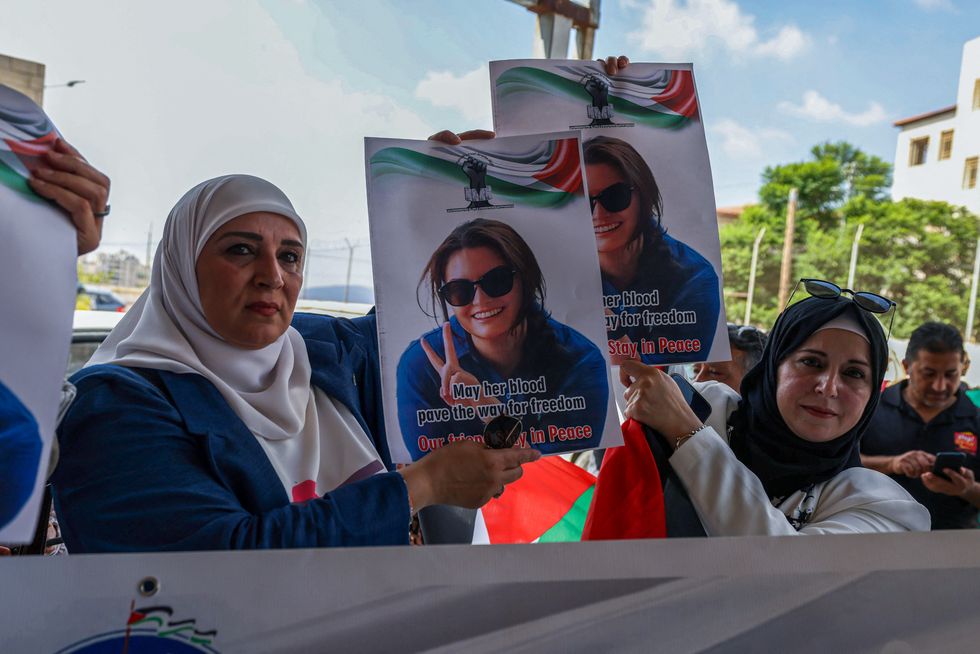 Palestinians and international activists lift portraits of slain Turkish-American activist Aysenur Ezgi Eygi as they arrive for her final farewell at the Rafidia hospital morgue in Nablus in the occupied West Bank on September 8, 2024. (Photo by Jaafar Ashtiyeh/ AFP via Getty Images)