
SUBSCRIBE TO OUR FREE NEWSLETTER
Daily news & progressive opinion—funded by the people, not the corporations—delivered straight to your inbox.
5
#000000
#FFFFFF
To donate by check, phone, or other method, see our More Ways to Give page.


Daily news & progressive opinion—funded by the people, not the corporations—delivered straight to your inbox.
"Alito claims it was to help a former clerk get a job," wrote one legal commentator. "Doesn't matter. Federal law requires Alito now be DISQUALIFIED from the Trump stay petition."
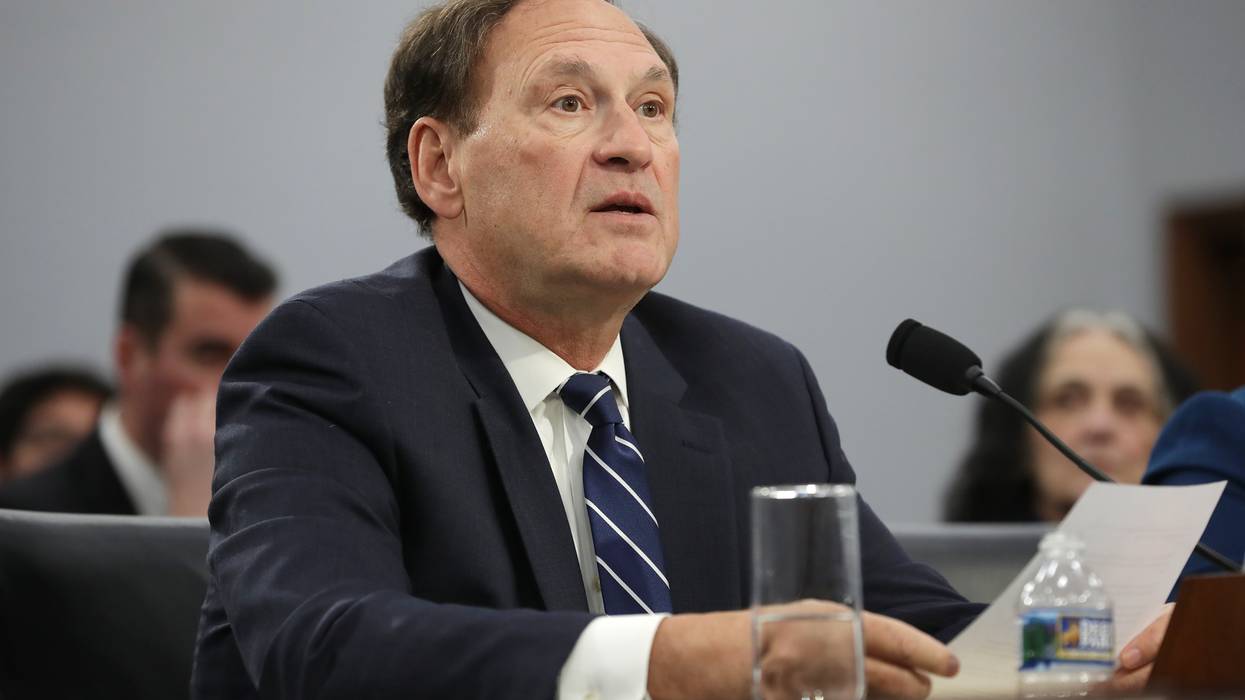
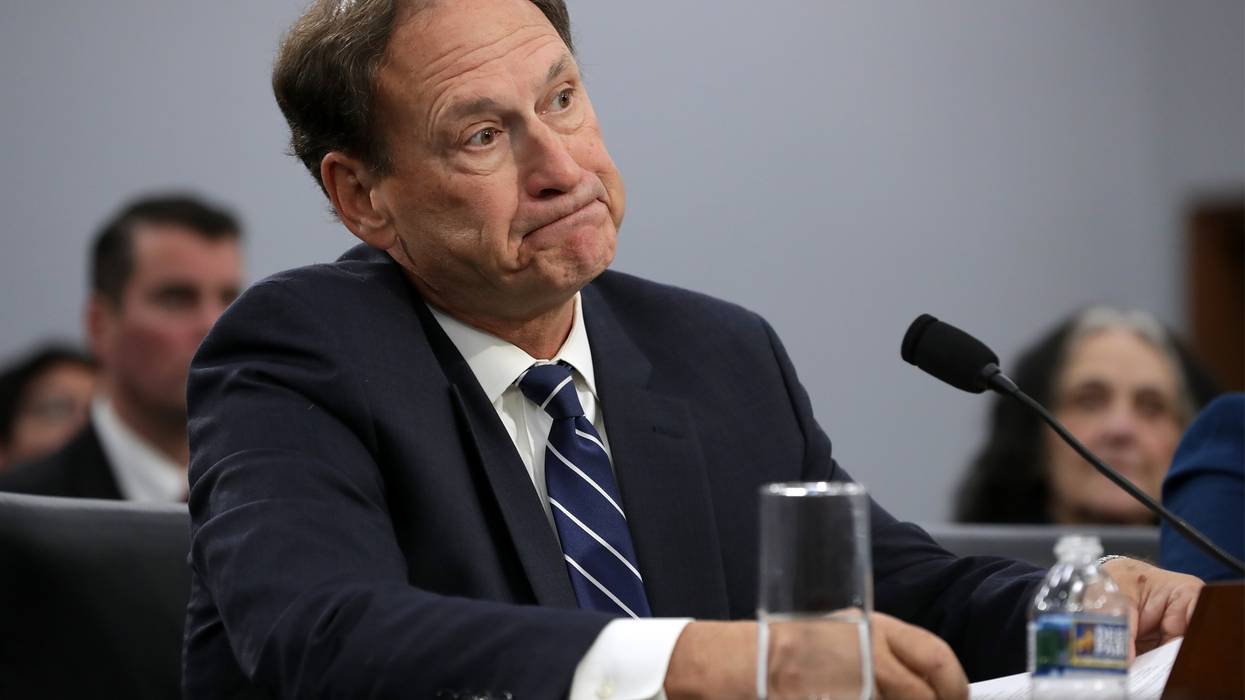
Following the revelation that Supreme Court Justice Samuel Alito had a private phone call with Trump the day before Trump's legal team petitioned the Supreme Court to halt his sentencing in his New York "hush money" case, Congressman Jamie Raskin was among those Thursday who called for Alito's recusal from the high profile case.
ABC News first reported the call between Trump and Alito, which took place Tuesday, and that Alito subsequently claimed concerned one of Alito's former law clerks, who is seeking a job in the new administration. "William Levi, one of my former law clerks, asked me to take a call from President-elect Trump regarding his qualifications to serve in a government position," Alito explained to ABC News in a statement.
On Wednesday morning, Trump's legal team filed an emergency request with the Supreme Court to pause his sentencing in New York court on on 34 felony counts of falsifying business records in connection to hush-money payment to porn actress Stormy Daniels.
Alito said that he and Trump did not discuss Trump's emergency request.
Raskin, ranking member of the House Judiciary Committee, denounced the call as a "breach of judicial ethics" in a statement Thursday, adding "especially when paired with his troubling past partisan ideological activity in favor of Trump, Justice Alito's decision to have a personal phone call with President Trump—who obviously has an active and deeply personal matter before the court—makes clear that he fundamentally misunderstands the basic requirements of judicial ethics or, more likely, believes himself to be above judicial ethics altogether."
Trump's legal team also appealed to the New York Court of Appeals to postpone the sentencing, which was rejected Thursday, a day after a state appeals court in New York also rejected the request. The sentencing is slated to take place on Friday.
Other court watchers also blasted Alito for the phone call.
President of the watchdog Accountable.US Caroline Ciccone urged Alito to recuse himself from all upcoming cases in which Trump is a named party. "In addition, Congress should investigate Alito's—and other justices'—lapses in judicial ethics in order to strengthen the Court's lax code of conduct. Anything less would confirm what so many already fear: that the Court has become overtly political and a playground for the powerful," she wrote.
"Alito claims it was to help a former clerk get a job. Doesn't matter. Federal law requires Alito now be DISQUALIFIED from the Trump stay petition," wrote Tristan Snell, a lawyer and legal commentator, on Wednesday.
This is not the first time that Alito has engendered this type of scrutiny. Last year, following revelations that flags carried by Trump supporters who took part in the January 6 insurrection at the Capitol were seen flying outside Alito's homes, Alito faced calls to recuse himself from a case two cases: one dealing with Trump's claims of presidential immunity and another on the question of whether defendants who participated in the January 6, 2021 attempted insurrection should be charged with obstructing an official proceeding. Alito rejected the calls to step aside.
"Every federal judge and justice knows he or she must avoid situations such as this. Yet Justice Alito did not," said Raskin.
A breach of this magnitude—in a case that implicates the health of our democratic institutions, by a justice that hasn’t shown a single shred of contrition—is a fit topic for robust political intervention.
In January 2021, the upside down American flag had become a banner for former U.S. President Donald Trump’s effort to block the peaceful transfer of power. Armed insurrectionists carried it into the U.S. Capitol on January 6. Eleven days later, even as National Guard troops still guarded the Capitol and the Supreme Court building itself, Justice Samuel Alito flew the insurrectionists’ flag outside his Virginia home.
This was far more than an act of indiscreet partisanship, troubling though that might have been. We’ve had those before, from Sandra Day O’Connor backing George W. Bush to Ruth Bader Ginsburg mocking Trump. Justices are human, and sometimes they slip up.
No, this was not a gaffe. It was a senior government official hoisting the banner of a violent insurrectionist movement devoted to overturning a core constitutional principle. At the time, there were numerous cases before the court in which the justices swatted away Trump’s false claims of a stolen election.
In response to the latest scandal, Alito has shrugged. That is a powerful demonstration of the dangerously emboldening effects of lifetime power.
And now this term alone, three major cases have been argued that go straight to the misconduct that marked the “Stop the Steal” effort. Already Alito joined the majority in rejecting Colorado’s effort to keep Trump off the ballot because he had engaged in an insurrection. The court is considering a challenge to the use of federal criminal law that could toss the convictions of 350 insurrectionists who stormed the Capitol.
And of course, Alito is part of the Supreme Court’s most egregious intervention on Trump’s behalf—its refusal to allow the timely federal prosecution of the former president. Special Counsel Jack Smith asked for a ruling confirming that Trump is not immune from prosecution in December 2023. Instead, Alito and his colleagues scheduled arguments for the last hour of the term and seemed to make up a doctrine of wide immunity for some criminal misconduct on the spot. Stop the steal? Start the stall.
Alito has long been inscrutably angry, unwaveringly dogmatic, and the most predictably partisan of all justices. But his growing brazenness still shocks. Judges are required to “act at all times in a manner that promotes public confidence in the integrity and impartiality of the judiciary.” There is simply no question that Alito has breached the rules. Of course he should recuse himself from consideration of the Trump immunity case and the other cases dealing with January 6. Of course he won’t.
So in the face of this kind of brazenness, what to do?
To start, Congress must finally pass a binding code of conduct for the justices. The current code, which the court announced in November, is vague and toothless. It was always a bid to forestall congressional action.
Last year, Alito told The Wall Street Journal, “I know this is a controversial view, but I’m willing to say it. No provision in the Constitution gives [Congress] the authority to regulate the Supreme Court—period.” That’s silly. As my colleagues Jennifer Ahearn and Michael Milov-Cordoba recently documented in a well-timed law review article, Congress has a major role to play in enforcing Supreme Court ethics. Congress can, and repeatedly has, expanded and shrunk the size of the court. It can change the court’s jurisdiction. It has set rules for recusal and financial disclosure. Congress even wrote the justices’ first mandatory oath of office way back in 1789. As Justice Elena Kagan wisely responded last year, “It just can’t be that the court is the only institution that somehow is not subject to checks and balances from anybody else. We’re not imperial.”
Congress can also demand that Alito answer questions under oath, rather than hiding behind incomplete press releases (and his wife). Maybe it can do more.
A breach of this magnitude—in a case that implicates the health of our democratic institutions, by a justice that hasn’t shown a single shred of contrition—is a fit topic for robust political intervention.
And, as we’ve said before, it’s time for term limits. In response to the latest scandal, Alito has shrugged. That is a powerful demonstration of the dangerously emboldening effects of lifetime power. Nobody should hold too much power for too long.
And where is Chief Justice John Roberts? He often purports to be an institutionalist and tries to curate the credibility of the court. He knows that public approval for the high court has plunged to nearly its lowest level ever recorded in polls. That goes beyond a reaction to Dobbs and other activist rulings—it reflects wide public dismay with what has become a partisan institution.
Ultimately, this kind of power grab should be a part of the national debate in our national election. Where is President Joe Biden? He seems reluctant to engage, clinging to an outdated reverence many liberals still have for the court as an institution. But as conservatives taught us for decades, it is entirely appropriate for the Supreme Court, its actions, and its impact, to be a major part of public debate.
The U.S. Flag Code instructs that the upside down flag should not be flown “except as a signal of dire distress in instance of extreme danger to life or property.” Today it is our constitutional system that is in extreme danger—but not in the way Alito and his allies believe. If Alito won’t voluntarily do the bare minimum to protect our democracy, the coequal branches should do everything they can to force him to do so.
By issuing this toothless code of conduct, the Supreme Court attempts to circumvent necessary reforms and enables more lavish gifts and lucrative speaking engagements from their wealthy patrons.
After months of ethics scandals and scrutiny from advocates, the U.S. Supreme Court released a code of conduct on November 15, with all nine justices signing on. According to the opening statement, the justices wanted to allegedly dispel a “misunderstanding that the justices of this Court, unlike all other jurists in this country, regard themselves as unrestricted by any ethics rules.”
But the code isn’t fostering understanding; it’s a mere facade, a paper-thin veiled attempt at responsibility that ultimately serves as nothing more than a PR stunt in the guise of genuine accountability. Once rumored ethical concerns have now become regular fixtures in national headlines about clear ethics violations. Deep investigations by multiple outlets have revealed a pattern and practice of questionable behavior. Congress must see through this stunt, conduct a thorough investigation, and enact binding, enforceable federal legislation covering ethics reform and court expansion.
It’s not a surprise that the code arrives just as the Senate Judiciary Committee is debating subpoenas for Harlan Crow, who has given millions of dollars in gifts to Clarence Thomas, and Leonard Leo, whose wealth influenced a far-right takeover of the court. Public opinion of the court is at historic lows. Congress is responding to public pressure and finally considering action on ethics reform. By issuing this toothless code of conduct, the Supreme Court attempts to circumvent necessary reforms and enables more lavish gifts and lucrative speaking engagements from their wealthy patrons.
The justices claim they adapted their new code of conduct from rules governing judges lower on the federal bench. But there is a key and glaring difference: The justices make the provisions of their code discretionary, thus enabling the Supreme Court to be the only federal entity not subject to an enforceable ethical code of conduct. Justices further skirt addressing conflicts of interest, misconduct, and when recusal is necessary.
The unenforceable code relies not on congressional or executive branch oversight, but on the justices’ self-reporting and self-regulation. It does not address donor influence or failure to disclose gifts over a specified amount. It leaves recusal for conflicts of interest up to individual justices. There are no procedures for public complaints or any formal reviews or investigations of rule-breaking. In contrast, the lower courts’ rules have multiple references to enforcement and disciplinary procedures, and Bloomberg even suggests that non-SCOTUS justices “divest from financial interests ‘that might require frequent disqualification.’”
Congress cannot continue to allow the Supreme Court to act as conduits for far-right billionaires. We must instead issue common-sense reforms to end the blatant corruption and mitigate the decades of far-right takeover. Luckily, we already have the blueprint.
First, the Senate Judiciary Committee must issue subpoenas to Harlan Crow and Leonard Leo and thoroughly investigate the ethics violations. The U.S. public has a right to know the extent of judicial misconduct and the influence of far-right megadonors on the Supreme Court’s business.
Second, Congress must pass a binding, enforceable Supreme Court ethics bill that outlines clear rules regarding recusals, gifts, and conflicts of interest. The legislation must also outline specific consequences if justices break the code and the body charged with investigating misconduct. Several ethics bills are already being considered, including the Supreme Court Ethics, Recusal, and Transparency Act (SCERT), marked up by the Senate Judiciary Committee earlier this year.
Congress must see through this stunt, conduct a thorough investigation, and enact binding, enforceable federal legislation covering ethics reform and court expansion.
Finally, Congress must rebalance the court by passing the Judiciary Act and adding four seats. Court expansion is the simplest and most effective way to undo decades of conservative court-packing and the far-right takeover of the courts. The Judiciary Act, sponsored by Representative Hank Johnson in the House and Senator Ed Markey in the Senate, already has 65 cosponsors. The ethics crisis is a symptom of deeper institutional rot that can only be fixed through rebalancing the court.
Public pressure to stop this ethics circus is mounting. A Morning Consult poll found 3 in 4 voters support a binding ethics code. Likewise, a Demand Justice commissioned YouGov poll found that 59% of Americans are less likely to “support a congressional candidate who opposes ethics reform at the Supreme Court.” While Justice Samuel Alito claims that congressional oversight of Supreme Court ethics is unconstitutional, he ignores hundreds of years of precedent. There’s a lot of work to do, but momentum and precedent are on our side.
Congress cannot continue to sit back and let the ultraconservative Supreme Court dictate national policy at the behest of their far-right patrons. Now is the time to do their duty, rein in the court’s corruption, and undo the far-right court packing that’s wreaked havoc on our democratic systems.
"Americans can see through the court's failed attempt at a code of conduct," said one group. "It's time for Congress to take action and pass actual ethics reform."
Nearly three-quarters of U.S. voters want federal lawmakers to pass a stricter ethics policy for the nation's Supreme Court, according to polling results released Tuesday by the progressive advocacy group Demand Justice.
The poll was conducted by YouGov after the Supreme Court announced last week that it had formally adopted a new code of conduct following months of outrage over reporting on relationships between right-wing justices and billionaires. YouGov explained to those surveyed that justices have been criticized for failing to disclose taking gifts and travel from political donors.
YouGov also told voters that supporters of a stricter ethics code say the newly adopted policy "has no way to actually enforce the rules" and believe "Congress should continue to investigate corruption allegations," while opponents of congressional action believe members of the court should be "allowed to determine their own rules without interference" and trusted to enforce them.
Across party lines, 74% of voters agreed that Congress should approve a stricter ethics code and continue to probe "the ties between justices and political megadonors," including 90% of Democrats, 70% of Independents, and 57% of Republicans.
In response to the findings, End Citizens United said that "Americans can see through the court's failed attempt at a code of conduct. It's time for Congress to take action and pass actual ethics reform."
As Common Dreams reported when the new code was announced last week, critics have condemned it as a "toothless PR stunt" intended to curb media coverage of potential corruption and "halt momentum for transparency and real reform."
Amid a wave of reporting about Justices Clarence Thomas and Samuel Alito's connections to billionaire megadonors and Leonard Leo—who leads the Federalist Society, a primary force in pushing U.S. courts to the right—Democrats on the Senate Judiciary Committee passed the Supreme Court Ethics, Recusal, and Transparency (SCERT) Act in July.
However, the bill is unlikely to win approval from the full Senate or GOP-controlled House of Representatives. Still, the Senate panel—chaired by Sen. Dick Durbin (D-Ill.)—is expected to continue its probe, possibly with subpoenas targeting Leo and Thomas benefactor Harlan Crow.
Demand Justice was among over a dozen groups that last week called on the committee to issue subpoenas, arguing that "we must learn the full scope of these hidden efforts to improperly influence the Supreme Court and the extent of Justices Thomas' and Alito's ethical wrongdoings."
"This unenforceable public relations document serves absolutely no purpose other than to permit the media to revert to pretending that our unaccountable and unethical Supreme Court retains legitimacy," one advocate said.
In the wake of a series of high-profile scandals surrounding the relationship between right-wing justices and billionaires, the U.S. Supreme Court announced on Monday that it had formally adopted a new Code of Conduct.
The 14-page code is based on requirements for lower court judges, and most of the rules it outlines are not new, the court said. Watchdog groups have been widely critical of the new document, which does not stipulate how the conduct it promotes will be enforced, with the Revolving Door Project labeling it a "toothless PR stunt."
"This unenforceable public relations document serves absolutely no purpose other than to permit the media to revert to pretending that our unaccountable and unethical Supreme Court retains legitimacy," the project's executive director Jeff Hauser said in a statement.
Pressure on the Supreme Court to reform its ethics rules has mounted since ProPublica revealed in April that Justice Clarence Thomas had failed to disclose more than two decades worth of trips he had taken that had been paid for by billionaire Harlan Crow. Additional reporting in June uncovered the fact that Justice Samuel Alito had also taken undisclosed trips financed by hedge fund billionaire Paul Singer, who had appealed to the court to side with him in business disputes.
In response to these and other revelations of financial gifts to justices from wealthy and influential individuals, Democrats on the Senate Judiciary Committee advanced legislation in July that would require the court to follow stricter disclosure rules, adhere to an enforceable ethics code, and explain any recusal decisions to the American people. It would also enable investigations of any suspected breaches of the ethics code. Sen. Sheldon Whitehouse (D-R.I.), who led the push for the law, said that the Supreme Court's newly announced code was not an effective substitution.
"This is a long-overdue step by the justices, but a code of ethics is not binding unless there is a mechanism to investigate possible violations and enforce the rules," Whitehouse said in a statement. "The honor system has not worked for members of the Roberts Court. My ethics bill would create a transparent process for complaints and allow a panel of chief judges from the lower courts to investigate and make recommendations based on those complaints."
In the newly published code, the justices promised to "uphold the integrity and independence of the judiciary" and "avoid impropriety and the appearance of impropriety," among other key points. It stipulated that "a justice should not allow family, social, political, financial, or other relationships to influence official conduct or judgment," or "knowingly convey or permit others to convey the impression that they are in a special position to influence the justice."
However, the code begins with a statement that the court had "largely" already adhered to the tenets of the document, saying that the lack of an official code had "led in recent years to the misunderstanding that the justices of this court, unlike all other jurists in this country, regard themselves as unrestricted by any ethics rules." It says the primary purpose of the new code was "to dispel this misunderstanding."
"This document reeks of a cover-up for, among others, Justice Clarence Thomas," Hauser said in response to the preamble. "The list of weak ethics-adjacent aphori[s]ms is prefaced by a statement from the justices that they have 'largely' been complying with the loose norms they set forth today. Yet Thomas' conduct, in particular, has long been at odds with any pretense to any remotely serious standard of ethics."
"Will a risible PR stunt succeed in relieving pressure off a Supreme Court that is rightly widely deemed to be in crisis?"
Stand Up America managing director for policy and political affairs Brett Edkins said the document was "clearly" a response to public outrage over the ProPublica revelations.
"The court is attempting to halt momentum for transparency and real reform," Edkins said in a statement. "Congress must use its authority as a co-equal branch of government to pass a code of ethics with real enforcement mechanisms, and the Senate Judiciary Committee should move forward with subpoenas of Harlan Crow and Leonard Leo. The American people deserve to know the full scope of this court's corruption."
A committee vote on the committee on whether or not to issue such subpoenas was postponed last week, as NBC News reported.
Take Back the Court Action Fund president Sarah Lipton-Lubet also saw the code as a response to public pressure.
"With 53 uses of the word 'should' and only six of the word 'must,' the court's new 'code of ethics' reads a lot more like a friendly suggestion than a binding, enforceable guideline," Lipton-Lubet said in a statement.
Lipton-Lubet added that the document's lack of enforcement was more evidence that the court "cannot police itself."
"We've all seen what happens when it is left to do so, and the result is public confidence in the illegitimate Supreme Court has reached an all-time low," Lipton-Lubet continued. "Now is not the time to let up. Congress should move forward with actual ethics rules as soon as possible."
Trevor Potter, president of Campaign Legal Center and a former Republican chairman of the Federal Election Commission, said the code "may seem like a step in the right direction" but was "little more than an effort to assuage public outrage without assuming any actual accountability."
"Every other branch of government has a dedicated body responsible for enforcing its ethics code, yet the court does not even attempt to create one for itself here," Potter continued. "This 'code' changes nothing about the existing system of ethics self-policing in the Supreme Court. In fact, buried at the end of the document, the Court says they may rely on a variety of sources in interpreting the requirements of the ethics code—business as usual."
Senate Majority Leader Chuck Schumer (D-N.Y.) said the code was an "important first step," but added that "the lack of any way to enforce the code of conduct should any justice decide to ignore it is a glaring omission."
Ultimately, Hauser said the code was a "big test" for media and legal elites.
"Will a risible PR stunt succeed in relieving pressure off a Supreme Court that is rightly widely deemed to be in crisis?" Hauser asked. "People who care about the rule of law must hope those who lead our national coverage about the Supreme Court are not readily co-opted by lawyering that, truth be told, is not even especially slick or sophisticated."
"The American people demand and deserve an ethical Supreme Court," said the Democrat-controlled Senate Judiciary Committee.
Amid mounting calls to address ethics concerns with the U.S. Supreme Court, Senate Judiciary Committee Chair Dick Durbin on Thursday unveiled his motion to subpoena three wealthy men with ties to right-wing Justices Samuel Alito and Clarence Thomas.
The panel "will vote to subpoena Harlan Crow, Robin Arkley, and Leonard Leo—two billionaire megadonors and one of their enablers—who sit at the center of the ethical crisis currently gripping the United States Supreme Court," Durbin (D-Ill.) said in a floor speech earlier this week.
"This vote is the next step in the committee's ongoing investigation on the ethics of the Supreme Court," he noted. "It comes only after Mr. Crow refused to comply with committee requests, and Mr. Leo and Arkley outright stonewalled the committee in the exercise of our constitutional authority."
Durbin—who's also the Senate majority whip—said on social media Thursday that the panel could vote as soon as next week. Citing a committee spokesperson, NBC News reported that it will likely be scheduled for November 9.
After Durbin and Sen. Sheldon Whitehouse (D-R.I.), who chairs a key subcommittee, confirmed the subpoena plans on Monday, Crow's office pointed out that he shared some information with senators and called the new move "a stunt aimed at undermining a sitting Supreme Court Justice for ideological and political purposes."
Leo—who heads the Federalist Society, a key force in shifting the U.S. judiciary to the right—similarly responded that "I will not bow to the vile and disgusting liberal McCarthyism that seeks to destroy the Supreme Court simply because it follows the Constitution rather than their political agenda."
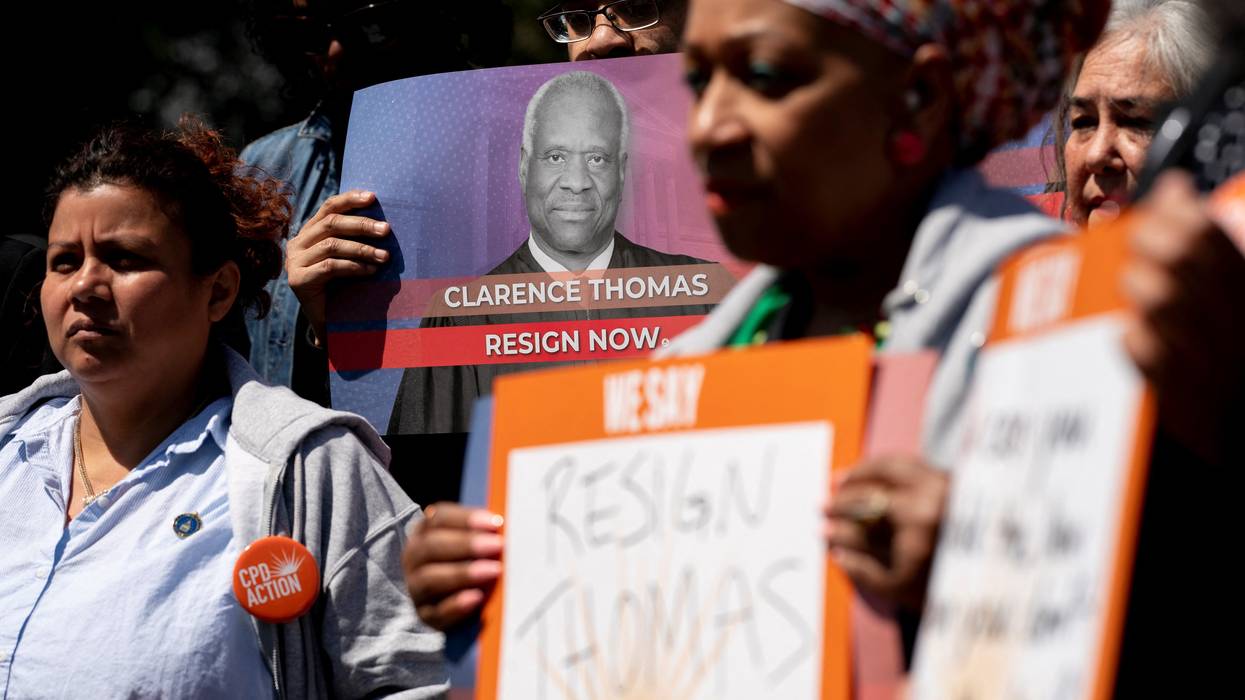
Throughout this year, reporters and Democrat-controlled Senate panels have exposed various instances of rich, powerful men providing Alito and Thomas with previously undisclosed gifts, from luxury trips to private school tuition for a relative. In Thomas' case, dozens of groups nationwide are now demanding his immediate resignation.
"How can a Supreme Court justice accept such lavish gifts, let alone fail to disclose them to the American people?" Durbin said in his speech. "The Supreme Court of the United States, the highest court in the land, does not have an enforceable code of conduct."
Democrats on his panel passed Whitehouse's Supreme Court Ethics, Recusal, and Transparency (SCERT) Act in July, but the bill is unlikely to be approved by the full Senate or Republican-dominated House.
Following that vote, Alito publicly suggested that Congress lacks the power to regulate the high court—which experts called "wrong and frightening" and Whitehouse rebuked with an ethics complaint.
"So far, the chief justice, John Roberts, and the court have failed to do anything," Durbin stressed. "I am sorry to say I happen to believe that we have just seen a small amount of the lavish gifts that have gone to the Supreme Court thanks to the efforts of investigative journalists and the Senate Finance Committee that have discovered some of these things."
"I'm not going to stand idly by as these fawning billionaires with interest before the court use their immense wealth to buy private access to the justices and then deny the Senate Judiciary Committee information to which we're lawfully entitled," he vowed. "That is why the committee will vote to authorize subpoenas to these individuals."
National advocacy groups on Monday delivered over 400,000 petition signatures to the offices of Durbin and Senate Majority Leader Chuck Schumer (D-N.Y.), demanding probes of recent claims against Alito and Thomas, and a floor vote for the SCERT Act.
"We cannot afford to sit back and hope this issue resolves itself," said Stand Up America executive director Christina Harvey. "We need urgent action to meet this moment. It's time for Senate leaders to step in and do something. If the court cannot act in an ethical manner and put the will of the people over their wealthy benefactors, then Congress must act now."
The group later thanked Durbin and Whitehouse for their "leadership in taking this important first step" of launching the subpoena process and called for public hearings "to understand the full scope of influence these right-wing megadonors had on sitting justices."
"It's time for Senate leaders to step in and do something," said one campaigner. "If the court cannot act in an ethical manner and put the will of the people over their wealthy benefactors, then Congress must act now."
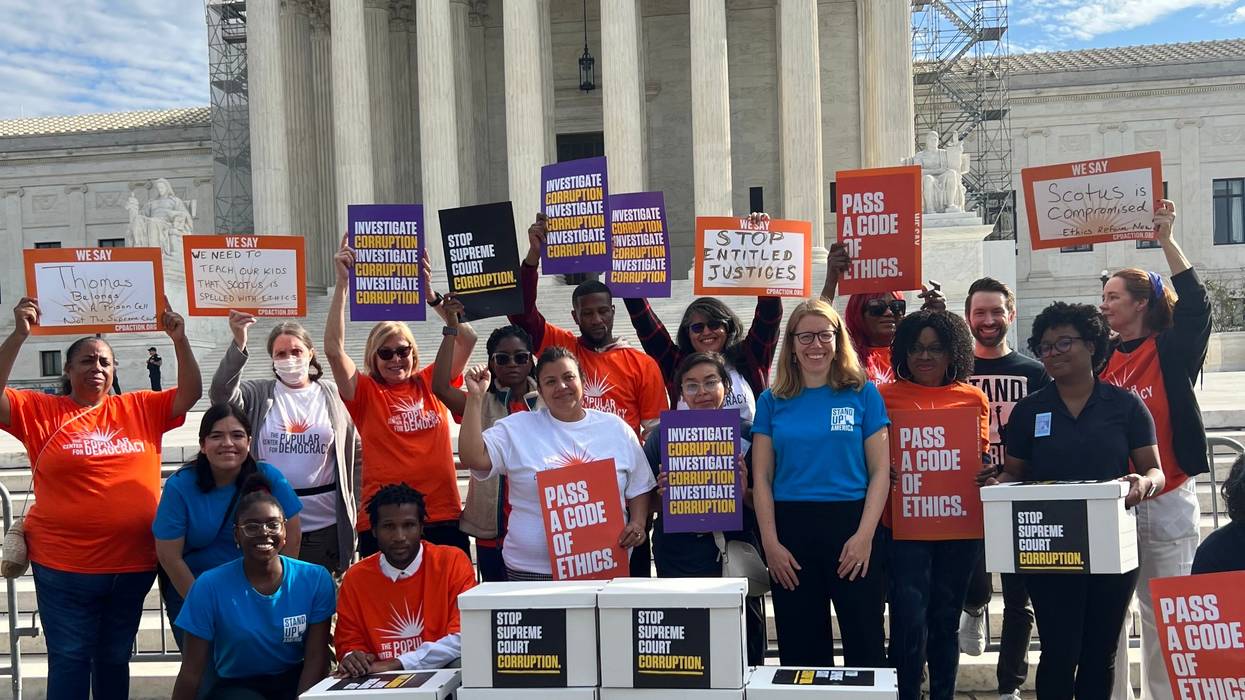
National advocacy groups representing millions of U.S. citizens on Monday delivered over 400,000 petition signatures to the offices of top Senate Democrats to demand congressional action on alleged United States Supreme Court corruption.
The groups want senators to investigate recent claims against conservative Justices Clarence Thomas and Samuel Alito and to bring Sen. Sheldon Whitehouse's (D-R.I.) Supreme Court Ethics, Recusal, and Transparency (SCERT) Act up for a floor vote.
Senate Judiciary Committee Democrats advanced the bill—which would require an enforceable code of ethics and stronger disclosure rules—in July, but it is unlikely to pass the divided upper chamber or the GOP-controlled House of Representatives.
"Each scandal is brushed aside because the justices know that there will be no consequences, but today we are saying: Enough is enough."
Still, the groups—including Center for Popular Democracy, Demand Justice, Indivisible, MoveOn, and Stand Up America—submitted the signatures to Senate Majority Leader Chuck Schumer (D-N.Y.) and Judiciary Committee Chair Dick Durbin (D-Ill.).
"Each scandal is brushed aside because the justices know that there will be no consequences, but today we are saying: Enough is enough," said Stand Up America executive director Christina Harvey. "We cannot afford to sit back and hope this issue resolves itself. We need urgent action to meet this moment. It's time for Senate leaders to step in and do something. If the court cannot act in an ethical manner and put the will of the people over their wealthy benefactors, then Congress must act now."
The petition delivery and related press conference outside the court came after the U.S. Senate Finance Committee last week released a report detailing how Thomas may have had a substantial amount of a loan for a luxury RV forgiven by a wealthy friend—which an attorney for the justice disputed to The New York Times but did not provide documentation to support.
Thomas has already faced calls to recuse himself from certain cases or resign from the court over his ties to the Koch network, fellow members of the Horatio Alger Association of Distinguished Americans, and billionaire real estate developer Harlan Crow.
Alito has similarly come under fire this year for declining to recuse himself from multiple cases after revelations of his connections to hedge fund billionaire Paul Singer, as well as for publicly casting doubt on the power of Congress to reform the court.
"While we appreciate the steps Senate Democrats have taken to address the ethical disasters currently destroying the Supreme Court's integrity and reputation, it is clear that more must be done," said Meagan Hatcher-Mays, Indivisible's director of democracy policy.
"The conservative justices at the center of this almost comical corruption are now openly mocking Congress' authority to rein them in, and they and their network of billionaire benefactors have been emboldened due to a lack of real consequences," she noted. "Congress has both the authority and a constitutional duty to reform the court when the justices throw the institution this far off the rails."
"That starts with subpoenas," Hatcher-Mays added. "Indivisibles across the country urge Majority Leader Schumer and Sen. Durbin to take swift and bold action by issuing subpoenas to address this crisis of democracy before it's too late."
Analilia Mejia, co-executive director of Center for Popular Democracy, stressed that "if they had any shame or conscience, Justices Thomas and Alito would hang up their robes and resign. But they don't."
"It's in the Senate's hands and it must act now," she declared. "Our senators must investigate Justices Thomas and Alito, remove them from their seats, hold hearings, and pass a code of ethics for Supreme Court justices."
The Senate Finance Committee chair said he "should inform the committee exactly how much debt was forgiven and whether he properly reported the loan forgiveness on his tax returns and paid all taxes owed."
The U.S. Senate Finance Committee on Wednesday released a report detailing how embattled Supreme Court Justice Clarence Thomas may have had a substantial amount of a loan for a luxury RV forgiven by a wealthy friend—which one watchdog
called "a serious ethics issue."
The panel's probe was sparked by New York Times reporting from August about Anthony Welters loaning Thomas money to buy a used Prevost Le Mirage XL Marathon, or "the Rolls-Royce of motor coaches," which cost $267,230 in 1999. Welters told the newspaper that "the loan was satisfied" and provided a photograph of the title with his signature and a handwritten "lien release" date of November 22, 2008.
The Senate memorandum states that "while additional documents pertaining to the loan agreement may exist, documents reviewed by Democratic staff suggest that Justice Thomas did not repay a significant portion of the loan principal. In fact, none of the documents reviewed by committee staff indicated that Thomas ever made payments to Welters in excess of the annual interest on the loan."
Senate Finance Committee Chair Ron Wyden (D-Ore.) said in a statement that "the committee has the answer to one of the pressing questions raised by reporting about his arrangement with Justice Thomas—was the loan ever repaid? Now we know that Justice Thomas had up to $267,230 in debt forgiven and never reported it on his ethics forms."
Wyden noted some of the "damning" details his staff uncovered in social media posts:
"Regular Americans don't get wealthy friends to forgive huge amounts of debt so they can buy a second home," the senator stressed. "Justice Thomas should inform the committee exactly how much debt was forgiven and whether he properly reported the loan forgiveness on his tax returns and paid all taxes owed."
As the Times reported Wednesday:
A lawyer for Justice Thomas, Elliot S. Berke, disputed the committee's findings, saying, "The loan was never forgiven." He added, "The Thomases made all payments to Mr. Welters on a regular basis until the terms of the agreement were satisfied in full."
But he did not to respond when the Times asked him to reconcile that statement with documents obtained by the committee and cited in its report, including a 2008 letter from Mr. Welters to Justice Thomas stating that he would not seek further payments on the loan despite being entitled to them. Nor would Mr. Berke say whether "satisfied" meant that the justice had fully repaid the $267,230 he borrowed plus interest.
Wyden also said Wednesday that he "directed the committee to share our findings with the Judiciary Committee to evaluate the ethics implications of this disclosure."
In response to the findings, More Perfect Union's Jordan Zakarin asked Senate Judiciary Committee Chair Dick Durbin (D-Ill.) on social media: "Do you have any interest in investigating? Or are you just going to let these maniac right-wing billionaires buy the Supreme Court and trash what remains of democracy?"
Durbin said that "with each new report, the American people realize how many lavish, undisclosed gifts Justice Thomas has received from his gaggle of fawning billionaires."
Thomas has also come under fire recently for his relationships with the
Koch network, fellow members of the Horatio Alger Association of Distinguished Americans, and billionaire real estate developer Harlan Crow, who treated Thomas to luxury vacations, bought his mother's house, and contributed to the private school tuition for a great-nephew the right-wing justice raised.
"This latest example—an undisclosed, forgiven $250,000+ loan—further proves the need for a binding code of conduct for all Supreme Court justices," Durbin added, pledging to take the report into account as his panel presses forward with ethics reform. He also has a message for Chief John Roberts: "Just How many more bombshell reports need to drop before you act on ethics reform? Until you act, we will."
Senate Judiciary Committee Democrats advanced Sen. Sheldon Whitehouse's (D-R.I.) Supreme Court Ethics, Recusal, and Transparency (SCERT) Act in July, but the bill is unlikely to be passed by the full chamber or the GOP-controlled House.
Ethics concerns related to Thomas and other justices have fueled demands this year for reform legislation—including to expand the court—as well as recusals from specific cases and even Thomas' resignation.
Congressman Bill Pascrell (D-N.J.) said in response to the Senate's RV report that "Thomas takes cash while crushing your freedoms. He's corrupt as hell and should resign today."
Others highlighted that Thomas in June voted to strike down President Joe Biden's student debt relief plan, which would have canceled up to $20,000 per federal borrower.
"Clarence Thomas got a rich buddy to #cancelcamperdebt," Mike Pierce of the Student Borrower Protection Center wrote on social media. "That sound you hear is the collective primal scream coming from 40 million people who just want the Corrupt Clarence deal."
"It comes as little surprise that Mr. Crow is doubling down on bogus legal theories as he continues to stonewall basic questions about his gifts to Clarence Thomas and his family."
U.S. Senate Finance Committee Chair Ron Wyden on Tuesday said that "nothing is off the table"—including a subpoena—after a lawyer for Republican mega-donor Harlan Crow continued to duck questions about the billionaire's gifts to Supreme Court Justice Clarence Thomas and his relatives.
In a June 2 letter to Senate Judiciary Committee Chair Dick Durbin (D-Ill.), Crow attorney Michael Bopp expressed "respect" for the panel's "important role in formulating legislation concerning our federal courts system," while stating that he would "welcome a discussion with your staff."
However, Bopp also reiterated his assertion that "Congress does not have the power to impose ethics standards on the Supreme Court" and "therefore cannot mount an investigation for the purpose of helping craft such standards."
"It comes as little surprise that Mr. Crow is doubling down on bogus legal theories as he continues to stonewall basic questions about his gifts to Clarence Thomas and his family."
Thomas and Crow have repeatedly refused to answer questions about years of gifts—including luxury vacations and private school tuition—to the right-wing justice and members of his family.
In response to Bopp's assertion—which has been roundly refuted by Durbin and legal experts—Wyden, a progressive Oregon Democrat, accused the Gibson Dunn partner of "stonewalling."
"It comes as little surprise that Mr. Crow is doubling down on bogus legal theories as he continues to stonewall basic questions about his gifts to Clarence Thomas and his family. If anything, the most recent letter from his attorney raises more questions than it answers," the senator said in a statement.
"The letter states, 'charter rates or reimbursements at rates prescribed by law were paid to the Crow family entities' with zero additional detail that could help clarify these financial arrangements, such as exactly who made those payments for Justice Thomas' extravagant luxury travel, and how many times and in what amounts those payments were made," Wyden continued.
"Far too often, efforts to investigate real-life tax practices of the ultra-wealthy and powerful end with this kind of vague, carefully-worded assurance that everything is on the level. That's simply not good enough," he argued. "This is exactly why the Finance Committee is pursuing this matter as part of its broader review of gift and estate tax practices of ultra-high net worth individuals."
Wyden added: "I've already begun productive discussions with the Finance Committee on next steps to compel answers to our questions from Mr. Crow, including by subpoena, and those discussions will continue."