

SUBSCRIBE TO OUR FREE NEWSLETTER
Daily news & progressive opinion—funded by the people, not the corporations—delivered straight to your inbox.
5
#000000
#FFFFFF
To donate by check, phone, or other method, see our More Ways to Give page.
Daily news & progressive opinion—funded by the people, not the corporations—delivered straight to your inbox.
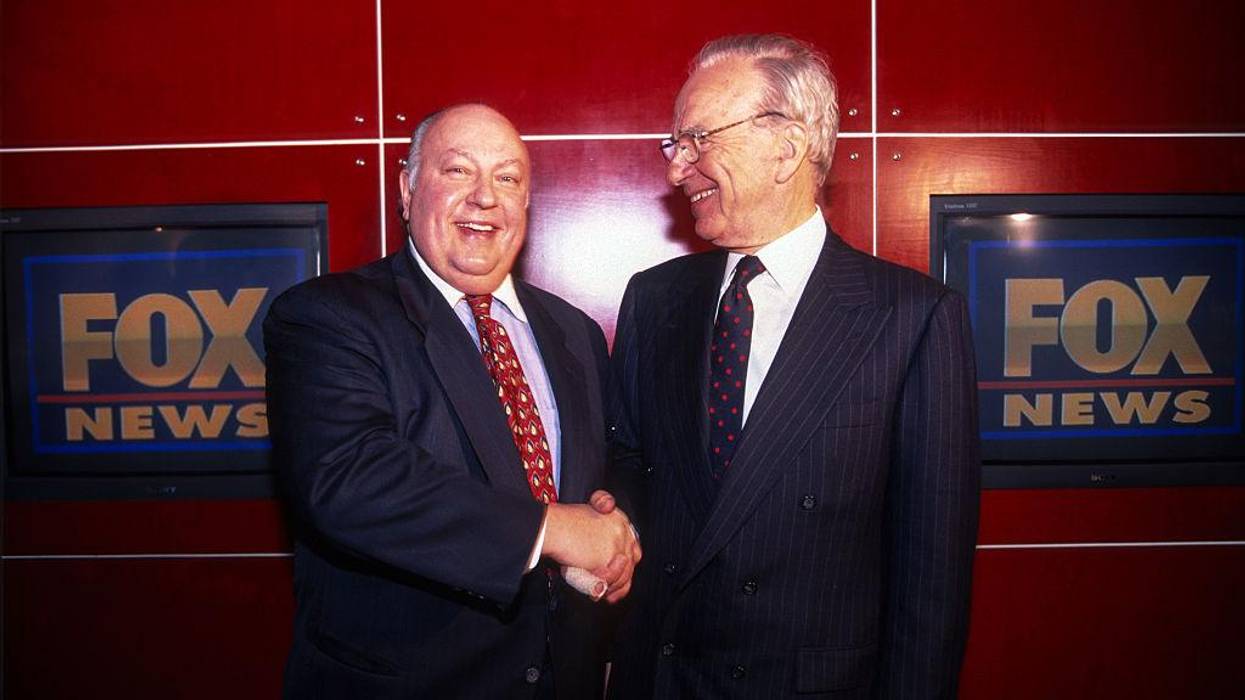
The Four Horsemen of our media apocalypse--Rush Limbaugh, Roger Ailes, Rupert Murdoch, and Donald Trump--have ridden roughshod over us this past half-century leaving their hoofprints on our politics, our culture, and our lives. Two of them are gone now, but their legacies, including the News Corporation, the Fox News empire, and a gang of broadcast barbarians will ensure that a lasting plague of misinformation, propaganda masquerading as journalism, and plain old fake news will be our inheritance.
The original Four Horsemen were biblical characters seen as punishments from God. By the time they became common literary and then film currency, they generally went by the names of Pestilence, War, Famine, and Death. Matching each with Limbaugh, Ailes, Murdoch, and Trump should prove a grisly but all-too-relevant parlor game. The originals were supposed to signal end times and sometimes, when I think about their modern American descendants, I wonder if we're heading in just that direction.
Isn't there any protection against evil of their sort in a democracy, even when you know about it early? Maybe when evil plays so cleverly into fears and resentments or is just so damn entertaining, not enough people can resist it.
Reflecting on the lives of those modern embodiments of (self-) punishment makes me wonder how we ever let them happen. Isn't there any protection against evil of their sort in a democracy, even when you know about it early? Maybe when evil plays so cleverly into fears and resentments or is just so damn entertaining, not enough people can resist it. Hey, I even worked for one of the horsemen. It was my favorite job... until it wasn't.
But first, let me start with Rush Limbaugh. The nation's leading right-wing bullhorn died last month at 70. His vicious wit ("feminazis") and ability to squeeze complex subjects into catchy sound bites ("In Obama's America, the white kids now get beat up with the Black kids cheering") stirred and nourished a devoted mass who would become a crucial part of Trump's base. Limbaugh, earning by the end more than $80 million a year, left his heirs a reported $600 million.
Those numbers, I believe, defined him far more than any political stance he took and, at the same time, made him indefensible. He was Pestilence, spreading poison without either genuine ideology or principle of any sort. He was doing shtick, whatever worked for him (and work it certainly did). He was, by nature, a great entertainer. One more thing: don't kid yourself, he was smart.
I realized this in 1995 when Baltimore Orioles shortstop Cal Ripken, Jr., was approaching Lou Gehrig's record of 2,130 consecutive baseball games. The Yankee star set that record in 1939 when, after 17 big league seasons, he finally took himself out of the lineup because he was suffering from amyotrophic lateral sclerosis, later known as Lou Gehrig's Disease.
Tongue-in-cheek, in my then-weekly New York Times sports column, I called on Cal to take a day off to avoid breaking the record. I wrote that, if he did, he would "be remembered forever as an athlete who stepped proudly over the statistical rubble of his sport to lead us all into a higher level of consciousness. He will end up a bigger Calvin than Klein."
The response from pundits, sportswriters, and fans was overwhelmingly negative. I was called clueless and stupid or, at least, a running dog of a new, much-mocked and demeaned "participation culture," unaware of the competitive nature of sports. Worse yet, I was trying to deny a hero his due.
It seemed that, of all people, only Limbaugh picked up on the mindless paradox of the situation--after all, Ripken would merely have to show up at work that day to claim his trophy--or even how obviously I had been offering my advice tongue in cheek. And he said so on a national radio network carrying his shows.
As the saying goes, it takes one to know one. That he saw what I was actually doing convinced me that he, too, often had his tongue tucked firmly in that cheek of his and away from anything that might pass for his rational brain. And this would, in the end, make it all that much worse. My guess: he wasn't ever truly a believer in the right-wing trash he talked. From the beginning, he was a mercenary, a commercial provocateur who found fame and fortune by spreading ever more toxic takes.
Down Under with Murdoch
Of the Four Horsemen, I came upon Rupert Murdoch first--in early 1977, soon after he bought that once-liberal newspaper, the New York Post. Among his earliest hires as columnists (strange indeed, given what we now know of him) were progressive icon Murray Kempton and me.
I already knew something about Murdoch's Australian and British reputation as a venal press lord, but the lure of a no-holds-barred cityside column and the possibility of sharing an office with Kempton proved irresistible. Murdoch and I first met in the crowded, raffish Post newsroom in lower Manhattan. He was brisk but pleasant that day, asking me at one point how I would improve the paper. I answered breezily: "For starters, I'd hire more women, Blacks, Latinos, gays, so the city can be properly covered."
He regarded me coolly. "Hmm, yes," he said, "but instead I'm hiring a liberal like you."
At that moment, I sensed that he was a monster and that this would end badly. I lasted all of seven months, mostly thanks to another monster, the serial killer Son of Sam, who terrorized the city that year. Like so many other tabloid writers of that moment, I spent the summer writing about the hunt for him, which mostly kept me out of trouble, since Murdoch loved sex, violence, and crime. But then there were those off-his-message columns I wrote about Israel, the South Bronx, and his favored candidate for mayor, Ed Koch.
And there were my shoes. They were soft Italian suede. Beige. I felt cool in them. One day, a new Australian editor took me aside and said, "Lose the poufter boots, mate. The boss hates them."
Of course, now I had to wear them every day despite that boss's homophobia. It was about then that whole paragraphs simply began to disappear from my column (without anyone consulting me), while the column itself was often shoved ever deeper into the paper, especially if I wrote about, say, marching in a women's movement or gay pride parade with one of my kids. Sometimes the column would be cut entirely.
I resigned from the Post live on Dave Marash's 11 p.m. local CBS TV news show. The next morning, in answer to a question during a press conference in Los Angeles, Murdoch claimed that he had fired me. When that didn't fly, he said that I had never been much good anyway. By then, thanks to TV, more people had heard about me than had ever read anything I wrote at the Times or the Post -- a lesson about the new world we were all being plunged into.
As it happened, there would be no escape from Rupert Murdoch. After quitting the Post, I went back to writing books for HarperCollins, the publishing house that he had bought. Thank goodness he never seemed to make the connection. Not so far anyway.
Soulmates Without a Soul in Sight
Among the Four Horsemen, Murdoch is surely Famine. Given the sports and gossip-driven sensibility of his newspapers and the role of Fox News as a tool of right-wing and Trumpian political propaganda, he's helped starve people on at least three continents of the kinds of information they would need to truly grasp our world and make educated decisions about it.
His most reliable collaborator in those years was Roger Ailes, who became the chairman and CEO of Fox News. He would prove so skilled when it came to purveying misinformation that he deserves a horse of his own. And no question about it, Ailes represented War, both against the truth and (within journalism) for circulation, eyeballs, and the clicks that always favor profit over facts.
Given the sports and gossip-driven sensibility of his newspapers and the role of Fox News as a tool of right-wing and Trumpian political propaganda, he's helped starve people on at least three continents of the kinds of information they would need to truly grasp our world and make educated decisions about it.
Of all four horsemen, I had the least personal interaction with him. One evening in 1990 (I think), I went to see him at his poorly lit midtown office. It was evening and I had the feeling he might have been drinking, though he didn't offer me anything. I was then the host of a nightly local public television show and we wanted to put him on a political panel we were forming. By then, after all, he had successfully advised presidents Richard Nixon, Ronald Reagan, and George H.W. Bush (though he wouldn't join Murdoch for another six years). He had blown off all the producers who tried to book him on their shows but had agreed to let me come in for a pitch.
I didn't know it, but around then he first met his future co-horseman Rush Limbaugh who, at the time, was still trying to invent himself as a radio star. Limbaugh had walked into New York's posh 21 Club looking for famous people to buttonhole. He soon spotted Ailes but was too intimidated to introduce himself.
As Rush would later tell it, Roger was the one who first swaggered up to him and boomed, "My wife loves you!" Soon after, they began talking and, so Rush reported, he felt that he had met his "soulmate." Ailes would soon be producing a short-lived Limbaugh TV show. Alas, it would prove long-lived indeed by becoming a model for the bogus news/talk format of Fox News a few years later when Murdoch hired Ailes as the devil's consigliere. Later, Ailes would use that very position to advise George W. Bush and Donald Trump.
Still, when I met Ailes that was the unknowable future. It comes back to me now as if in a dream, brief and weird. He listened to my description of my show, "The Eleventh Hour," and why we wanted him as a guest. I may not have been as fawning as I remember myself being. (I hope not anyway.) He nodded along as I made my pitch, offered me the most perfunctory thanks for coming, and dismissed me with body language suggesting that he had checked me out and found nothing he wanted. He simply turned away and began murmuring to a woman I could barely see in the darkened office.
In 2016, after years of commercial and political success together, Murdoch dumped Ailes in the midst of an ever-spreading sex scandal. He had not only personally harassed Fox employees but had created a company-wide climate of abuse and intimidation. He left with a reported $65 million. A year later, he died in Palm Beach (as would Limbaugh four years after that). He was 77.
A "Great Show" for a Great Showman
Of all the horsemen in those years, I spent the most time with Donald Trump. (By now, haven't we all?) He's our greatest shame because while we in the media may have thought that we were using him--listening sneeringly to his lies and braggadocio since it pushed our media products so effectively--he was using us bigly. Making the "fake news media" his very own accomplices may have been his greatest skill.
I was no exception to the media patsies who flocked to him for easy stories. Maybe I didn't take him seriously enough then because we both came from Queens, a scorned outer borough of New York City, or because he was already a well-known publicity hound and boldfaced tabloid name.
Honestly, who could have taken an obvious buffoon like him seriously? And back then, we didn't have to, as long as we took him. And here's what I do remember from those days: he would always respond to a question, no matter how negative, as long as he was its subject. That's all he truly cared about. Him, him, him, and him again.
The first time we met, in the early 1980s--he was then an ambitious real-estate mogul and B-list celebrity--he insisted that he didn't much like attention, but felt obligated to do the interview because I represented "a great show" ("CBS Sunday Morning with Charles Kuralt"). He would then go on to lie about his scheme to pressure the National Football League into admitting to its ranks the New Jersey Generals, the United States Football League team he then owned.
In a later meeting, I remember him offering me his supposed credo as a public figure, one that in retrospect seems grimly ironic, if not satiric: "I tend to think that you should be decent, you should be fair, you should be straight, and you should do the best you can. And beyond that, you can't do very much really. So yeah, you do have a responsibility." Then, as if adding a note in the margins of his bland comment, he added, tellingly enough, "I'm not sure to what extent that responsibility holds."
Once, for reasons I can't recall, I returned to that supposed sense of "responsibility" of his, asking him if he'd like to "run the country as you have run your organization." That was in 1984 (no symbolism intended) and he responded, "I would much prefer that somebody else do it. I just don't know if the somebody else is there." So, 32 years before his election, he was, it seems, already imagining the unimaginable that would become our very own surreal world in 2016. "This country," he added ominously, "needs major surgery."
"Are you the surgeon?" I asked, innocently enough.
"I think I'd do a fantastic job, but I really would prefer not doing it."
I would have preferred that, too, but it's much too late now and, sadly enough, there's no reason to think that the ride of the modern Four Horsemen is over. Limbaugh and Aisles have left their vast poisonous pools behind and they won't dry up soon. Murdoch, turning 90 just days from now, is still running his empire. And Donald Trump, of course, continues to gallop toward the future astride his pale horse, as the rider called Death.
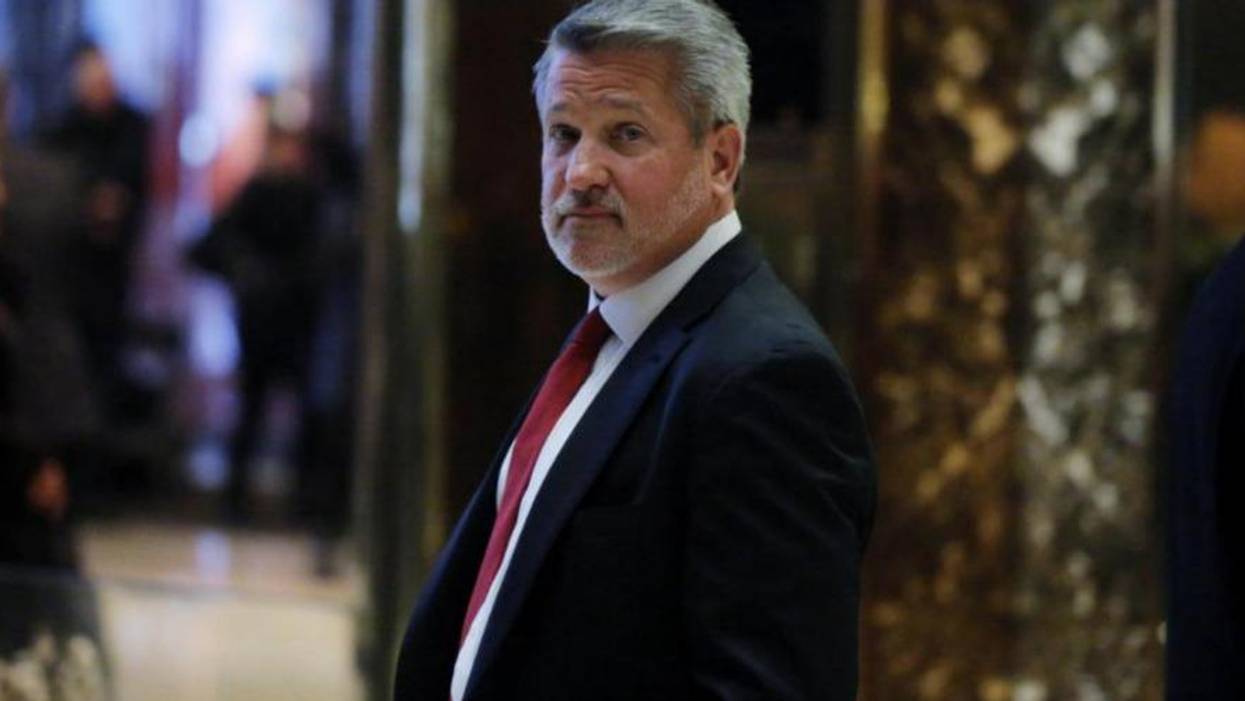
While President Donald Trump's appointment of former Fox News executive Bill Shine to a top communications role was unsurprising to critics, many denounced the selection as the latest signal that the president holds contempt for the concerns of women.
As the right-wing news outlet's co-president, Shine allegedly helped to cover up the sexual harassment faced by many women at the network at the hands of powerful men including TV host Bill O'Reilly and CEO Roger Ailes. According to former Fox News personalities Julie Roginsky and Andrea Tantaros, Shine was dismissive of accusations against Ailes, helped to arrange meetings between Ailes and women he had sexually harassed, and suppressed reports of misconduct.
"For years, Bill Shine actively covered up Roger Ailes and Bill O'Reilly's sexual misconduct at Fox News, created and fostered a toxic work environment at the network, and actively retaliated against women who reported their abuse," Shaunna Thomas, co-founder of UltraViolet, said last month as the White House was weighing Shine's possible new role.
MSNBC's Chris Hayes suggested on Twitter that Shine's entry into politics must give the public he's purported to serve the right to information about his time at Fox. Shine was ousted from the network last year and has denied the allegations against him.
Shine will work as an assistant to the president and as deputy chief of staff for communications.
Trump himself has been accused of sexual misconduct and assault by at least 16 women--and has been recorded bragging about such conduct. He is also currently considering at least two potential Supreme Court nominees who have expressed opposition to abortion rights, has terminated the White House Council on Women and Girls, and has publicly derided a number of female journalists on the basis of their looks.
Other critics noted that Shine's hiring is the latest direct link between Trump's White House and Fox News--of which the president reportedly watches several hours per day.
"In tapping Shine, Trump is effectively solidifying the idea that Fox News is state-run TV--a political sandbox where Trump floats his dumbest ideas in the morning, tweeting back and forth with the hosts of Fox & Friends, and then gets to hear his moronic ramblings echoed back to him at night as received wisdom," wrote Bess Levin at Vanity Fair.

Fox News Channel has been recognized since its inception in 1996, when it was established by Republican operative Roger Ailes, as a right-leaning news source. But a new study published in the American Economic Review shows just how influential the channel is when it comes to changing viewers' minds, causing them to shift to the right on political issues--and even influencing election outcomes in ways that the outlet's more liberal counterparts don't.
Researchers at Emory and Stanford universities found that watching only three minutes of Fox News coverage per week would make Democratic and centrist voters one percent more likely to vote Republican in the 2008 election.
According to the study, this means that if Fox News hadn't existed in 2004, George W. Bush would have captured nearly four fewer percentage points, making John Kerry the popular vote winner. In 2008, Barack Obama would have won in a landslide if it weren't for Fox, capturing 60 percent of the vote, with John McCain winning 6.34 percent fewer votes.
Notably, the research shows that Fox appears driven by its ability to shift its viewership to the right even more than it's guided by its bottom line. According to Vox, the study finds "that Fox isn't setting its ideology where it ought to, to maximize its viewership. It's much more conservative than is optimal from that perspective. But it's pretty close to the slant that would maximize its persuasive power--that would result in the largest rightward movement among viewers. CNN, by contrast, matched its political stances pretty closely to the viewer-maximizing point, showing less interest in operating as a political agent."
CNN and MSNBC are also not as effective at shaping viewers' opinions. "Fox is substantially better at influencing Democrats than MSNBC is at influencing Republicans," said the authors of the study. While Fox was able to convince 58 percent of Democratic viewers to vote for Bush in 2000, and persuaded sizable minorities of Democrats to vote Republican in the following two elections, MSNBC did not have the same effect on conservative viewers in the same elections.
Fox News Channel "is consistently more effective at converting viewers than is MSNBC which has corresponding estimated persuasion rates of just 16 percent, 0 percent, and 8 percent," said the study.
The study confirms earlier research done after Fox was introduced in 1996, including a 2007 report from Berkeley which found "a significant effect of the introduction of Fox News on the vote share in Presidential elections between 1996 and 2000...Fox News convinced 3 to 28 percent of its viewers to vote Republican."
The newest research confirms what many critics already suspected about Fox News: that it's pushed conservative ideals and Republican agendas since its beginning, serving as a tool used by the GOP establishment to shift viewers to the right--and even swing elections.
The study did not analyze Fox's impact on the 2016 election, but according to a Pew Research poll taken in January, Fox News was the most-watched news source among Trump voters during the campaign, with 40 percent of his supporters relying on the channel for their news.
Fox News creator and former chief Roger Ailes, who died at 77 last week from complications after a fall in his Florida home, may have been the most significant political figure of the last 35 years -- which isn't necessarily a compliment to those of us who believe media mavens shouldn't also be political operatives.
Ailes clearly thought differently. He simultaneously changed the contours both of American politics and American media by melding them, and in doing so changed the contours of fact and objectivity as they once were understood before the era of post-fact.
It seems a lot to put on one man, but Roger Ailes destroyed the idea of media objectivity in the name of media objectivity, the way a phony evangelist might destroy virtue in the name of virtue. Things have never been the same since.
Ailes was a political acolyte of Richard Nixon, and Nixon was a media acolyte of Ailes. It was a perfect and powerful alliance -- two outcasts seeking retribution. Nixon's great contribution to American politics was to take his personal umbrage, a lifetime of slights, and nationalize it. Like so many among the aggrieved, he aspired to be an insider and was tormented by not being admitted to their ranks. In anger, he took them on, especially those he regarded as haughty elites -- accused spy Alger Hiss, who was the personification of the Ivy-educated aristocrat and on whose takedown Nixon built his career; John Kennedy, who was everything Nixon wanted to be and wasn't; and the entire liberal establishment, which would denigrate and denounce him as he rose through the political ranks. He became the avatar for every person who had suffered the same disdain and abuse, and he turned Republicanism into a therapeutic movement of social vengeance.
Ailes was no less an outcast. Born in small-town Ohio, a pudgy hemophiliac bedridden for months at a time, bullied and baited, he nursed grievances against the same folks as Nixon. When they met, while Nixon was making an appearance on The Mike Douglas Show, which Ailes produced, Ailes found his vehicle. Ailes converted his resentments and Nixon's into a media message, and just as Nixon was able to nationalize it politically, Ailes would eventually nationalize it media-wise, first by becoming Nixon's communications adviser, and then by bringing that experience to television news.
It was no accident that Nixon and Ailes not only shared grievances, but also constituencies. The base of conservatism -- especially those angry old white men who had supported Nixon -- would be the viewership of Fox News, too. These were people who felt the world slipping away from them in the tumult of civil rights, feminism, counter-culturalism and multiculturalism; people who abhorred change; people who felt the political system was stacked against them; and more. The vector of history was pointed in the wrong direction: forward. Politically, they blamed Democrats, who seemed sympathetic to change. Culturally, they would come to blame the media, which reported on this new narrative of a changing world without expressing disapproval of it.
Exploiting the latter was Ailes' job. He constructed a snarling counternarrative in the media in which social change was not a sign of progress but rather a sign of decadence and decay. If you boil Fox News down to one basic idea, this is it: White people are losing the world, the world is going to hell as a result, and liberal elites, including the liberal media, ought to pay.
Degrading the mainstream media wasn't easy, despite these willing, disgruntled viewers, readers and listeners. For one thing, before Fox News, most people actually trusted the media. (CBS Evening News anchor Walter Cronkite was famously called the most trusted man in America.) The mainstream media weren't perceived as politically biased, and though there was certainly partisanship in newspapers, many of which tilted left or right, broadcast TV news was anodyne. Having to appeal to large swaths of the public and terrified of alienating prospective viewers, TV journalists generally walked the line between left and right. They reported. They didn't editorialize. Or at least they didn't think they editorialized.
And that is where Ailes came in. In essence, he convinced his public that simple reporting was a form of editorializing. He suggested that the media's so-called "facts" about the changing world were an endorsement of that world, and he claimed to be exposing media bias in order to correct it. In a way, he took seriously Stephen Colbert's joke, "It is a well-known fact that reality has a liberal bias." But it could only happen because cable television, unlike broadcast television, could survive on a relatively small demographic niche like angry old white men. In Fox News, they found an outlet for their rage.
You could say that Fox News gave voice to those who felt voiceless, though it might be more accurate to say that he gave voice to those who were so filled with enmity that they seemed on the borderline of sanity. With his hosts and guests howling at elites without surcease, he created not just an alternative media or even an alternative set of facts, but an alternative universe that has overtaken the real one -- a bizarre universe bubbling with resentments and conspiracies and fabrications in which liberals aren't a political opposition; they are the source of all evil. Basically, he poisoned America.
It was a brilliant strategy. Ailes not only turned those white men against broadcast television (and most of the other establishment media, about whom these folks weren't too happy to begin with); he turned them against the idea of objectivity itself. Or to put it plainly: News that wasn't biased toward the right couldn't possibly be objective.
"Fair and balanced" was the slogan with which he branded his ultra-conservative, mainstream-media bashing network -- meaning, of course, that the mainstream media weren't fair to the right and were unbalanced to the left. What he, and even many of his critics, didn't acknowledge is that the words "fair and balanced" don't stand in consonance with one another but in contrast. To be balanced is not necessarily to be fair since fairness demands one go where the facts lead, whatever the direction, though neither fairness nor balance were really Ailes' causes. His cause was unfairness and unbalance -- to disrupt the normal flow of fact and reportage and replace fact with right-wing opinion in order to get his vengeance against the left. He won there too.
(One of Ailes' cleverer tactics was a show called Fox News Watch in which he had media critics analyze news coverage. For five years I was one of them, a token liberal, and Ailes was smart enough to let me brutalize week after week the network on which I was appearing.)
Ailes was subtle in another way that may actually have had more impact in undoing objectivity than his conservative bloviating bludgeons like Bill O'Reilly and Sean Hannity. He understood that undoing objectivity wasn't just a function of skewing the news and blending it with commentary so that the two seemed inextricable; it was a function of revising the entire media environment. To that end, Ailes turned television news into tabloid news, undoing objectivity by doing what tabloid newspapers had always done: undoing seriousness.
Ailes got his start in entertainment, and he brought those talents to his network, blending news not just with noise but with showbiz. Fox News became anti-news. Most news outlets opted for a studied monochronism. Fox News was loud and colorful. Most sought to unclutter their broadcasts. Ailes sought to crowd them with the zipper across the bottom of the screen and screaming graphics. Most sought to emphasize reportorial authority. Ailes emphasized verbal muscle-flexing among the male hosts and sexiness among the women. Long before Ailes was accused of sexual harassment, the network's attitude toward women was there for everyone to see -- or ogle. The leering sexuality he brought to Fox News wasn't incidental to its success; it was instrumental to it, both in the sexual politics it purveyed and in the smarminess it conveyed. The message was: This isn't real news because there is no real news. Real news is just a media pretense.
Ailes' network, then, was a wild journalistic carnival designed to turn everything upside down and hit the media where it was most vulnerable: its own sense of seriousness. Fox News was a world of anger, accusation, cynicism, excitement, sex, heat and oversold headlines. Everything but gravitas.
If this sounds more than vaguely familiar, it is because the measure of how powerfully Fox News has penetrated the American consciousness is the presidency of Donald Trump. Trump is fully the creation of Fox News, the candidate of Ailes' dreams, the man who came to embody the two most important aspects of Fox News -- its betrayal of truth and its allegiance to journalistic porn. And this is why Ailes is so important in our political and media ecologies. We think of how Republicanism in the post-Reagan era infected the media, and we see Fox News as the prime example. But we don't think as much about how Fox News infected Republicanism. Ailes was the carrier, and Trump the result.
Without Fox News, the Republican Party might look different -- and better. Without Fox News to conflate entertainment with news, to rip apart the idea of a serious media, to push a single-minded partisan agenda and to enflame embittered white men, there would have been no foundation on which Trump could build his candidacy -- or for that matter, no platform from which to blast an unending stream of nonsense stories about Benghazi and emails and the Clinton Foundation that the mainstream media felt duty-bound to pick up. No political party had ever had a major national propaganda arm posing as a media outlet. Ailes gave the Republicans one, and took the soul of the party in return.
The damage that Roger Ailes did to the media, to our political discourse, and to objectivity is incalculable. The most significant man of his political generation, he may also have been the most dangerous. It is one hell of a legacy -- and probably a lasting one.
Roger Ailes, the man who pioneered "alternative facts," is dead. During the first five years of Fox News--which was built almost single-handedly by Ailes' genius--I was a regular on-air contributor/panelist there. I dealt with his right-wing lieutenants plenty, but only met Ailes once, at a Fox News "Holiday Party." The invite did not call it a "Christmas Party." It was one of hundreds examples of hypocrisy at the TV channel that would soon launch the "War on Christmas" hoax.
Roger Ailes, the man who pioneered "alternative facts," is dead. During the first five years of Fox News--which was built almost single-handedly by Ailes' genius--I was a regular on-air contributor/panelist there. I dealt with his right-wing lieutenants plenty, but only met Ailes once, at a Fox News "Holiday Party." The invite did not call it a "Christmas Party." It was one of hundreds examples of hypocrisy at the TV channel that would soon launch the "War on Christmas" hoax.
Fox News was created in Ailes' image--a channel that preached family values while subjecting women employees to intense harassment and body-shaming. Before Ailes launched Fox News with Rupert Murdoch's millions, he was executive producer of Rush Limbaugh's syndicated TV show--which once displayed a photograph of Chelsea Clinton while Limbaugh referred to her as the "White House dog." She was 13 years old at the time.
I wrote this in my book Cable News Confidential:
I met Ailes once at a Fox News holiday party. If you knew nothing about him, this short, pudgy, balding fellow might appear cuddly, almost huggable, like a nice old uncle you'd nickname Jolly Roger.
Looks can be deceiving. Ailes was the media consultant for Bush Sr.'s vicious 1988 campaign that linked Democratic candidate Mike Dukakis to black rapist Willie Horton. "The only question," Ailes remarked, "is whether we depict Willie Horton with a knife in his hand or without it." Lee Atwater, his partner in the campaign, said that Ailes has "two speeds--attack and destroy."
So Rupert Murdoch was putting Ailes in charge of a TV network during the reign of Bill Clinton, whom Ailes scorned as "the hippie president." Given his genius with 30-second TV attack ads, imagine what Ailes could do 24/7.
What Ailes accomplished from 1996 until last year was a political/media revolution. As much as I hate to admit it, I can't think of a single individual who's had more impact on our country's politics over the last 20 years. There would have been no Trump presidency without the decades of disinformation spewed by Fox News (and talk radio allies) to millions of voters--on issues from Christmas to immigrants to abortion, from economics to "socialist" Obama to "liberal media bias."
I learned from my five years on-air at Fox News that its viewers were a fanatical bunch. Not serious readers or thinkers, but ardent voters. Years before pro-Trump "fake news" hoaxes were shared by millions on the Internet during the 2016 campaign, Ailes had reached his audience of voters with cable TV's version of fake news. It matters that millions of hardcore activists and voters are operating from a worldview where racial minorities, women, immigrants, foreigners and terrorists have the upper hand against beleaguered white males, the depleted US military and persecuted corporations (I mean, "job creators").
Perhaps Jon Stewart said it best in 2001 when The Daily Show earned a Peabody Award, given for excellence in television without any specific categories. Jon Stewart accepted the award by joking that he had won in the "News Parody" category: "There was not much competition this year. It was just us and Fox."
Republican presidential nominee Donald Trump on Sunday morning described the numerous female employees at Fox News who accused Roger Ailes of sexual harassment in the workplace as "complaining" and explained how that makes him "sad" because really the company's top executive actually "helped" "some of those women" and he's a "very good person" and a close personal friend.
Ailes was ushered out the door of Fox late last week with a resignation tied to $40 million buyout after former news anchor Gretchen Carlson filed a suit against him for lewd behavior and abuse of power. Even though dozens of other women also came forward against Ailes with similar stories of harassment, Trump defended Ailes and would not deny rumors that he may even have him work on his presidential campaign.
Ailes, explained Trump during the interview with Chuck Todd on Meet the Press, "has been a friend of mine for a long time. And I can tell you that some of the women that are complaining, I know how much he's helped them. And even recently. And when they write books that are fairly recently released, and they say wonderful things about him."
But, Trump continued, "now all of a sudden they're saying these horrible things about him. It's very sad. Because he's a very good person. I've always found him to be just a very, very good person. And by the way, a very, very talented person. Look what he's done. So I feel very badly."
'Murdoch has a long and sordid history of discarding the accepted norms of honest journalism in order to advance his own political and corporate agenda'
Australian media mogul Rupert Murdoch added one of the most respected brands in journalism to his already vast media empire this week, gaining enough support from the deeply divided Bancroft family to buy Dow Jones & Company, publisher of the Wall Street Journal, for 5 billion dollars.
In the midst of a very public negotiation that had much of U.S. journalism recoiling in horror, Murdoch also announced his intention to launch Fox Business Network, which will begin broadcasting this October.
And it appears the News Corp. Chairman has every intention of using the journalistic resources of Dow Jones to bolster his fledgling business channel.
"Murdoch has a long and sordid history of discarding the accepted norms of honest journalism in order to advance his own political and corporate agenda," wrote Eric Boehlert, a senior fellow at Media Matters in America, in a statement published on the progressive media watchdog group's website.
"Of particular concern is Murdoch's plan to use the Journal to help launch the Fox Business Network, which will be overseen by Fox News boss and former Republican strategist Roger Ailes," Boehlert said.
The convergence of Dow Jones and Murdoch's FOX Business Network makes the NBC-owned and operated CNBC a prime target. In 1997, CNBC formed a strategic alliance with Dow Jones, including content sharing with Dow Jones Newswires and the Journal and the rebranding of the channel as "a service of NBC and Dow Jones."
Yet Murdoch and Ailes have criticized the channel for not being business friendly. "Many times I've seen things on CNBC where they are not as friendly to corporations and profits as they should be," Ailes told the New York Times.
"They [Murdoch and Ailes] say they are going to challenge this pernicious bias. Their argument is that CNBC is too anti-business, but that's hard to fathom if you've ever watched it," Peter Hart, a media analyst at Fairness and Accuracy in Reporting (FAIR) told IPS.
While the coupling of Dow Jones and the new FOX venture is a victory for proponents of media consolidation, much of the anger throughout the journalist community has been directed at Murdoch's acquisition of the Journal -- a publication many in the U.S. believe to be the most respected name in business reporting.
Critics have decried the Dow Jones sale, arguing that Murdoch has rarely improved any news media company he has purchased and that he will in all likelihood, turn the highly respected Journal into a mouthpiece for his own political views, as he has done with the Fox News Channel.
While the Journal isn't exactly a beacon of liberal opinion -- its editorial pages boast some of the most right-wing and conservative voices in the U.S. -- the paper remains an iconic publication known for its serious and credible reporting tradition. Negative sentiments were voiced by Journal reporters themselves, who, when speaking on the condition of anonymity to the Los Angeles Times, reacted bitterly to news of the sale.
The fear is that Murdoch will imbue the Journal with the same sensationalism and, it is widely acknowledged, biased news coverage found on Fox News and in the pages of the New York Post. Thirty years ago, Murdoch purchased the liberal tabloid for 30 million dollars and promised not to alter it. Currently, the paper is regarded as a right-wing gossip rag.
"Murdoch doesn't practice journalism; he molds diverse media into a single voice. It's a dangerous uniformity -- threatening the democratic discourse a free press sustains as well as enabling wars by conniving with bellicose politicians," wrote John Nichols in a report in the Nation magazine.
News Corp. owns such media companies as the Fox News Channel, Twentieth Century Fox movie studios, the New York Post, the Weekly Standard, the Times of London, publications in England and Australia, satellite television networks in Europe and Asia, as well as the popular peer-networking group MySpace.
The recent buy-out of Dow Jones gives Murdoch Barron's Financial Weekly, Dow Jones Newswires and the Ottaway community papers.
In a letter published Wednesday in WSJ, publisher L. Gordon Crovitz reassured readers that his staff would work diligently to maintain the newspaper's editorial independence and to continue practicing accurate journalism.
In fact, he wrote, "accurate and independent journalism" was the first topic discussed by Murdoch and Bancroft family during the negotiations. According to Crovitz, the News Corp. Chairman told the Bancroft family that "any interference -- or even a hint of interference -- would break the trust that exists between the paper and its readers, something I am unwilling to countenance. Apart from breaching the public's trust, it would simply be bad business."
In order to safeguard long-standing standards of conduct -- among them "no hidden agendas" and a promise to accurately and fairly represent "the facts" -- a special committee was created to protect the Journal's newsroom from attempts to steer coverage that may advance Murdoch's interests.
While Murdoch may not initially tamper with the editorial content of the Journal, his ownership does place him in a position to directly challenge the New York Times. It would not be surprising if Murdoch engaged in a less overt campaign to woo advertisers away from that paper by offering cheaper advertising rates, according to Hart.
"That's the playbook. Go after you competitors, go after their ad rates so they lose the support from advertisers," said Hart. "You have to have money to push a price war, and if [Murdoch] did that, there would be no surprise."