

SUBSCRIBE TO OUR FREE NEWSLETTER
Daily news & progressive opinion—funded by the people, not the corporations—delivered straight to your inbox.
5
#000000
#FFFFFF
To donate by check, phone, or other method, see our More Ways to Give page.
Daily news & progressive opinion—funded by the people, not the corporations—delivered straight to your inbox.
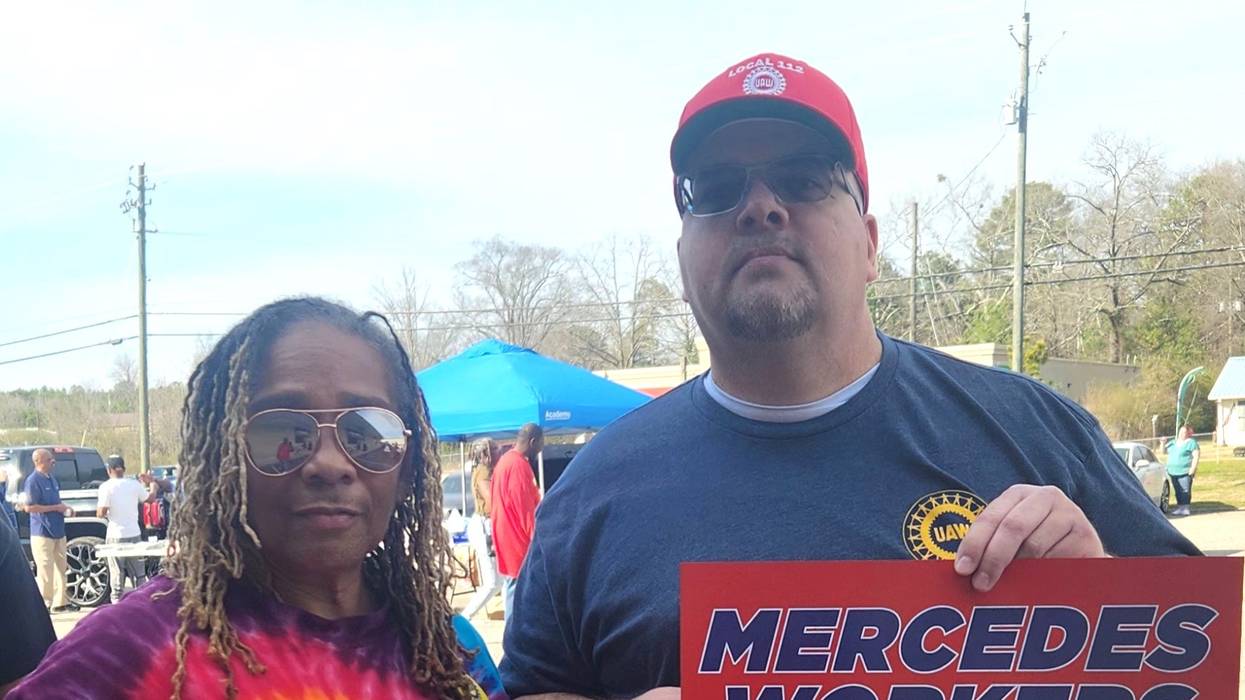
"All these workers ever wanted was a fair shot at having a voice on the job and a say in their working conditions," the union said.
The United Auto Workers on Friday formally challenged last week's election loss at a pair of Mercedes-Benz facilities in Alabama, accusing the company of engaging in "an unprecedented, illegal anti-union campaign" and requesting a new vote.
"All these workers ever wanted was a fair shot at having a voice on the job and a say in their working conditions," the UAW said in a statement. "And that's what we're asking for here. Let's get a vote at Mercedes in Alabama where the company isn't allowed to fire people, isn't allowed to intimidate people, and isn't allowed to break the law and their own corporate code, and let the workers decide."
Of the more than 5,000 employees at the two Mercedes-Benz United States International (MBUSI) plants, 2,045 (45%) voted to join the UAW and 2,642 (56%) voted against it. After the ballots were counted, union president Shawn Fain said that it was "obviously not the result we wanted" but "we'll be back."
The UAW complaint to the National Labor Relations Board (NLRB) accusing MBUSI of "wanton lawlessness" echoes the union and workers' previous allegations that the company engaged in illegal union-busting at the Vance and Woodstock facilities, which led to ongoing reviews from U.S. and German authorities.
"The employer engaged in a relentless anti-union campaign marked with unlawful discipline, unlawful captive audience meetings, and a general goal of coercing and intimidating employees."
"On January 11, 2024, employees of MBUSI publicly announced that they were exploring forming a union with the UAW at MBUSI's facilities," says the new complaint, according to Alabama Reflector. "Almost immediately thereafter, both prior to and during the election period, the employer engaged in a relentless anti-union campaign marked with unlawful discipline, unlawful captive audience meetings, and a general goal of coercing and intimidating employees who were attempting to exercise their Section 7 rights."
The Reflector reported that "the charges include disciplining employees for discussing unionization at work; not allowing union materials or paraphernalia to be distributed; surveilling employees; discharging supporters of the union; forcing employees to be in captive audience meetings, and making comments that union activities will not work."
MBUSI has denied any wrongdoing and a company spokesperson said Friday that "our goal throughout this process was to ensure every eligible team member had the opportunity to participate in a fair election."
"We sincerely hoped the UAW would respect our team members' decision," the MBUSI spokesperson added. "Throughout the election, we worked with the NLRB to adhere to its guidelines and we will continue to do so as we work through this process."
Lisa Henderson is the NLRB's regional director responsible for the complaint. The agency confirmed to CNBC that her office is still investigating the earlier accusations against MBUSI and received the new filing. As the outlet detailed: "If she finds that the objections raise substantial and material issues of fact that could be best resolved by a hearing, she will order a hearing. If after the hearing, she finds that the employer's conduct affected the election, she can order a new election."
Although leading public figures—from Republican Gov. Kay Ivey to retired University of Alabama football coach Nick Saban—battled the UAW push, organizers had high hopes going into last week's vote, which came after a victory at a Volkswagen facility in Chattanooga, Tennessee last month and union workers winning new contracts at the "Big Three" following a six-week strike last year.
Reflecting on the initial outcome in Alabama, Dave Kamper, senior state policy strategist at the Economic Policy Institute, wrote Wednesday that "while this result shows the power of corporations and state governments to smother worker efforts to unionize, even in defeat the UAW helped Mercedes workers win substantial improvements in pay and benefits."
"Workers organizing to improve their working conditions benefit from unions in many ways, but even when a union victory eludes them like in Alabama, the organizing can pay off," he stressed. "The more workers band together to fight for better jobs, the more likely they and other workers will see the benefits."
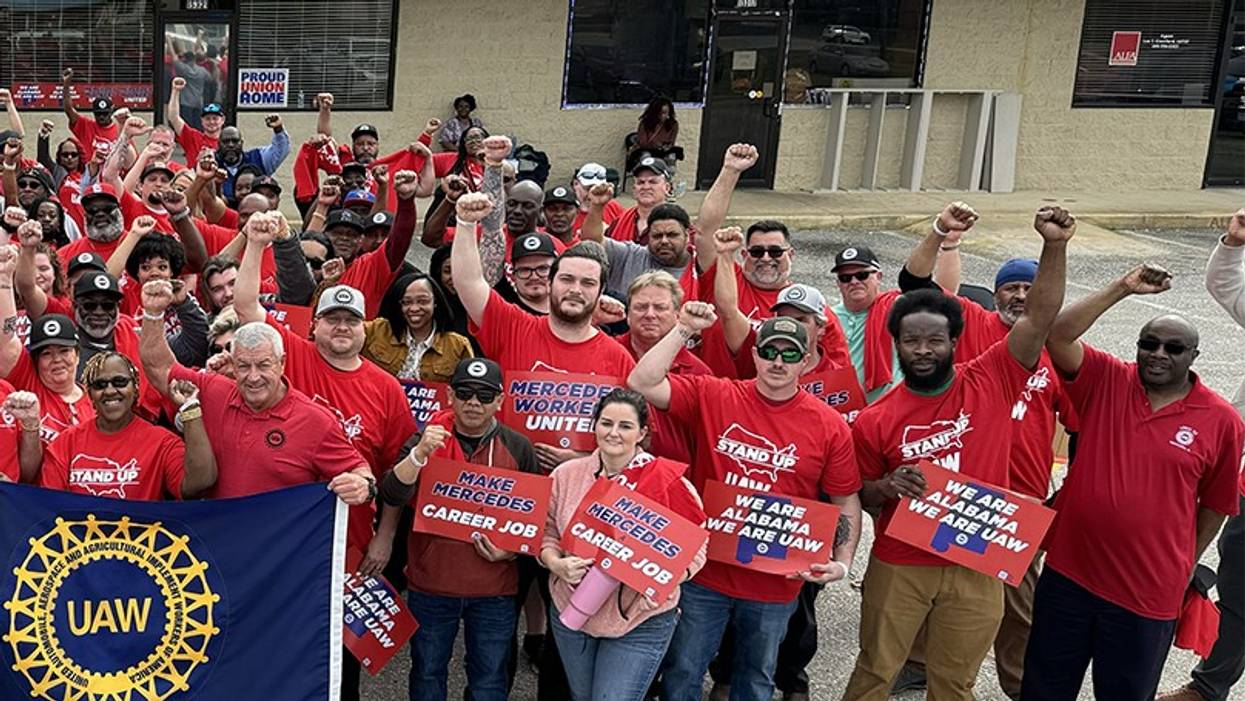
Organizers are expected to continue their effort, drawing inspiration from a recent success in Tennessee that followed two defeats.
Workers at a pair of Mercedes-Benz plants near Tuscaloosa, Alabama narrowly voted against joining the United Auto Workers this week, according to a preliminary tally on Friday.
As of press time, the UAWwebpage had the National Labor Relations Board tally at 2,045 in favor of joining the union (45%) and 2,642 opposed (56%).
Voting at the large facility in Vance and the battery plant in Woodstock kicked off Monday and wrapped up Friday morning. Speaking to reporters Friday evening, UAW president Shawn Fain said that it was "obviously not the result we wanted" but "we'll be back in Vance."
"These courageous workers reached out to us because they wanted justice," Fain said of the Mercedes employees. "They led us. They led this fight, and that's what this is all about—and what happens next is up to them."
"It's a David v. Goliath fight. Sometimes Goliath wins a battle but ultimately David will win the war."
"Justice isn't just about one vote or one campaign, it's about getting a voice and getting your fair share," he continued, noting that "workers won serious gains in this campaign."
Fain added that "it's a David v. Goliath fight. Sometimes Goliath wins a battle but ultimately David will win the war."
The Alabama election followed a UAW win in Chattanooga, Tennessee, where Volkswagen workers last month voted to join the union.
Labor reporter Mike Elk
noted that the "tough loss" in Alabama was "not a blowout," and organizers now have "a solid base that future campaigns can build on like they did at Volkswagen," where winning a union election took three rounds of voting.
The UAW has ramped up organizing in the U.S. South since securing contract victories last year following a "Stand Up Strike" targeting Ford, General Motors, and Stellantis, the American automobile industry's "Big Three."
The Alabama organizing effort has garnered support from progressives and union workers around the world. The Washington, D.C.-based Global Labor Justice said Friday that "we stand with Mercedes autoworkers who are voting to join UAW to better their lives and help end the so-called 'Alabama discount.' It's time we end the U.S. South and Global South 'discounts' that allow corporations to perpetuate a race to the bottom that hurts all workers."
Meanwhile, Republican leaders in U.S. Southern states have shown "how scared they are that workers organizing with UAW to improve jobs and wages," as the Economic Policy Institute put it last month, after Govs. Kay Ivey of Alabama, Brian Kemp of Georgia, Tate Reeves of Mississippi, Henry McMaster of South Carolina, Bill Lee of Tennessee, and Greg Abbott of Texasissued a joint statement accusing the union of coming to their states to "threaten our jobs and the values we live by."
NEW: Right now Mercedes workers in Alabama are voting on joining the @UAW.
One reason workers are voting yes? They know they're building cars that sell for $250,000 and generating billions for Mercedes.
And that they aren't seeing that money. pic.twitter.com/vOnej9ufuO
— More Perfect Union (@MorePerfectUS) May 15, 2024
Mercedes has said that it "fully respects our team members' choice whether to unionize and we look forward to participating in the election process to ensure every team member has a chance to cast their own secret-ballot vote, as well as having access to the information necessary to make an informed choice." However, both employees and the UAW accused the company of union-busting ahead of the vote.
During his remarks to the press Friday evening, Fain charged that "this company engaged in egregious illegal behavior" and pointed to ongoing probes by German and U.S. officials into "the intimidation and harassment that they inflicted on their own workers."
The Alabama facilities are operated by Mercedes-Benz U.S. International, a subsidiary of a German parent company. The UAW said Thursday that Germany's Federal Office for Economic Affairs and Export Control has launched an investigation into worker claims.
"Autoworkers in Alabama should have the same rights and be treated with the same respect as autoworkers in Germany," Jeremy Kimbrell, who has worked at one of the Alabama plants since 1999, said in a statement. "My coworkers and I are grateful to the German government for taking our testimonies and the evidence we have provided seriously and taking the first steps to hold the lawless, reckless Mercedes managers in Alabama accountable for their action."
Mercedes told Quartz that it "has not interfered with or retaliated against any team member in their right to pursue union representation" and is "fully cooperating with the authorities."
As The Washington Post reported Friday:
Alabama business leaders, politicians, and clergy have also stepped in to warn workers against voting for the union...
In a video posted this week on a Mercedes-run website about the union election, Rev. Matthew Wilson, a pastor and city council member in Tuscaloosa, told workers of the union vote: "This one change I would be careful of... As a lifelong resident of Tuscaloosa, we have come too far to turn around now."
ESPN sportscaster and retired University of Alabama football coach Nick Saban also spoke to Mercedes workers this week. According to Axios, "Saban owns multiple Mercedes dealerships and has reportedly said he does not endorse the UAW's campaign."
Kay Finklea, a Mercedes employee and member of the UAW's voluntary organizing committee, told the outlet that "they don't stop the line for hardly anything, but they shut the line down and they had a meeting with Nick Saban in there to talk to us about teamwork and the tactics and methods he used as a football coach."
The Alabama effort is widely seen as a test case for unionizing more auto workers in the South. Before the results were announced, Harley Shaiken, a labor professor at the University of California, Berkeley, told Reuters that "if the union wins, they improve their momentum dramatically for future organizing."
This post has been updated to correct the reference to Global Labor Justice.
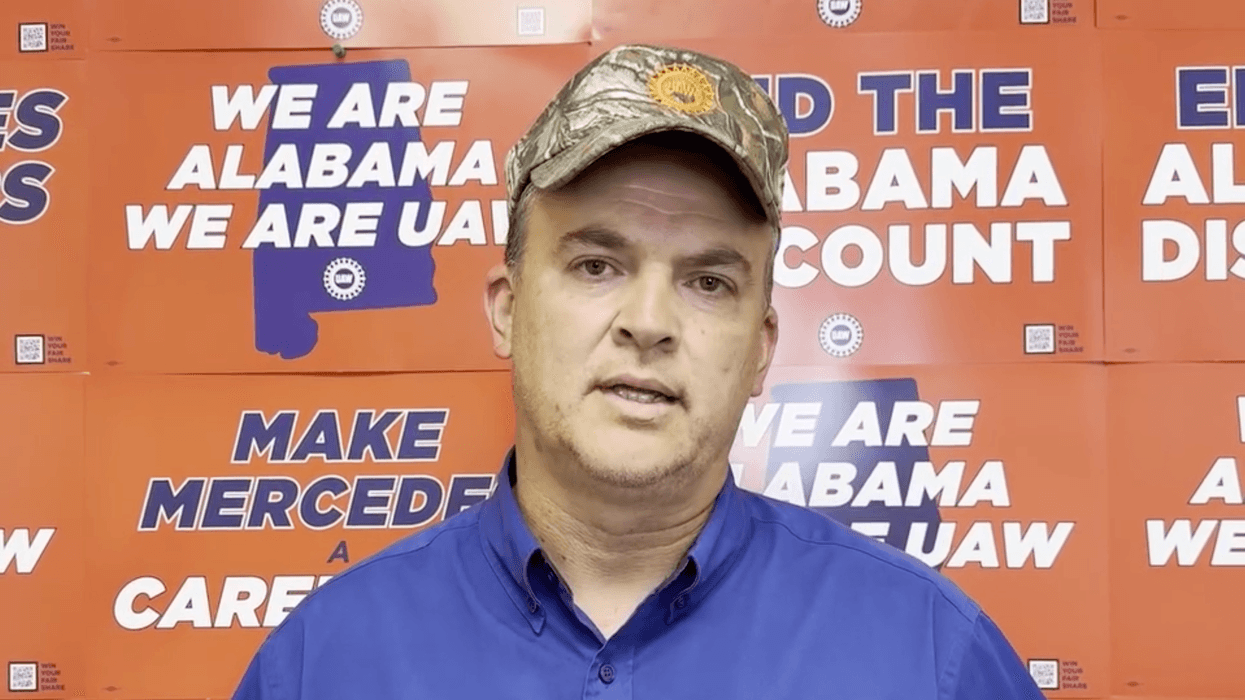
A victory in the Southern state, said one organizer, "would show workers across all different industries that they can stand up together and fight for more."
From Monday through Friday, around 5,200 employees of Mercedes-Benz in Alabama will vote on whether to join the United Auto Workers—which has set its sights on the U.S. South after contract wins at the industry's "Big Three" in Michigan last year.
While Republican leaders in the state, including Gov. Kay Ivey, and at least one worker have publicly attacked the unionization effort, multiple Mercedes employees have signaled their support for the UAW going into this week's voting at an assembly facility in Vance and battery plant in Woodstock.
"I've watched our company not keep up with the times," Mercedes worker Brett Garrard recently told the Detroit Free Press. "We pray for fair wages, comparative wages inside the auto industry. Benefits packages have suffered throughout the years. My wife, herself, has stage four cancer. I'd like to see something implemented to maybe help our situation."
David Johnston, who works at the Woodstock plant, has also cited medical concerns, telling Forbes that "I'm always in a medical hospital. I'm always sick. I need better healthcare. Plus, when I retire I'm not going to have any insurance until Medicare kicks in."
Johnston is optimistic about the vote in Alabama. He pointed to Chattanooga, Tennessee, where Volkswagen plant employees last month overwhelmingly voted to join the UAW.
"I mean, hands down. I think we're gonna win. We're gonna win. Hopefully by a lot," he said. "It seems like it's gonna be a slam dunk just like Volkswagen. Everybody's excited."
Haeden Wright, a senior organizer for Jobs to Move America, told AL.com that a win in Alamaba "would show workers across all different industries that they can stand up together and fight for more."
In comments to The Guardian, Mercedes employee Rick Webster similarly framed this week's vote as part of a larger battle.
"It's time for Alabama workers to stand up and unite not just at Mercedes, but at Hyundai, Honda, and Toyota. It's time for everybody to stand up and have a voice and we need to end the Alabama discount," he said, using an organizer term to highlight how workers in the state have subpar wages and benefits compared to their peers elsewhere in the country.
Webster also called out Mercedes' efforts to convince workers in Alabama not to vote in favor of joining the UAW—which has filed multiple union-busting complaints against the company with the National Labor Relations Board.
"It is a daily barrage of text messages, emails, and there's an app we have for work for every kind of announcement you can think of and we're getting two to three notifications daily. Every day before the shift, we have to sit in the team room and watch anti-union videos," he explained. "It's just been a constant barrage. Everybody is just sick and tired of it."
Johnston told NPR that "the entire message in those meetings is Vote no, vote no, vote no. We don't think you need to do this. This is not what you want."
A company spokesperson has told multiple news outlets that Mercedes-Benz U.S. International "fully respects our team members' choice whether to unionize and we look forward to participating in the election process to ensure every team member has a chance to cast their own secret-ballot vote, as well as having access to the information necessary to make an informed choice."
The United Auto Workers webpage on the Alabama effort includes information about who is eligible to vote, how to participate, and workers' rights as well as the UAW's responses to some of opponents' allegations against the union.
"Right now, Mercedes is doing whatever they can to discourage us. But voting yes for our union is a game-changer," the UAW webpage says. "Once we vote yes, the company is legally required to sit down with us as equals to bargain a contract. Just like VW, Mercedes has negotiated union contracts with workers all around the world. We can win our union, our union contract, and our fair share right here in Alabama."
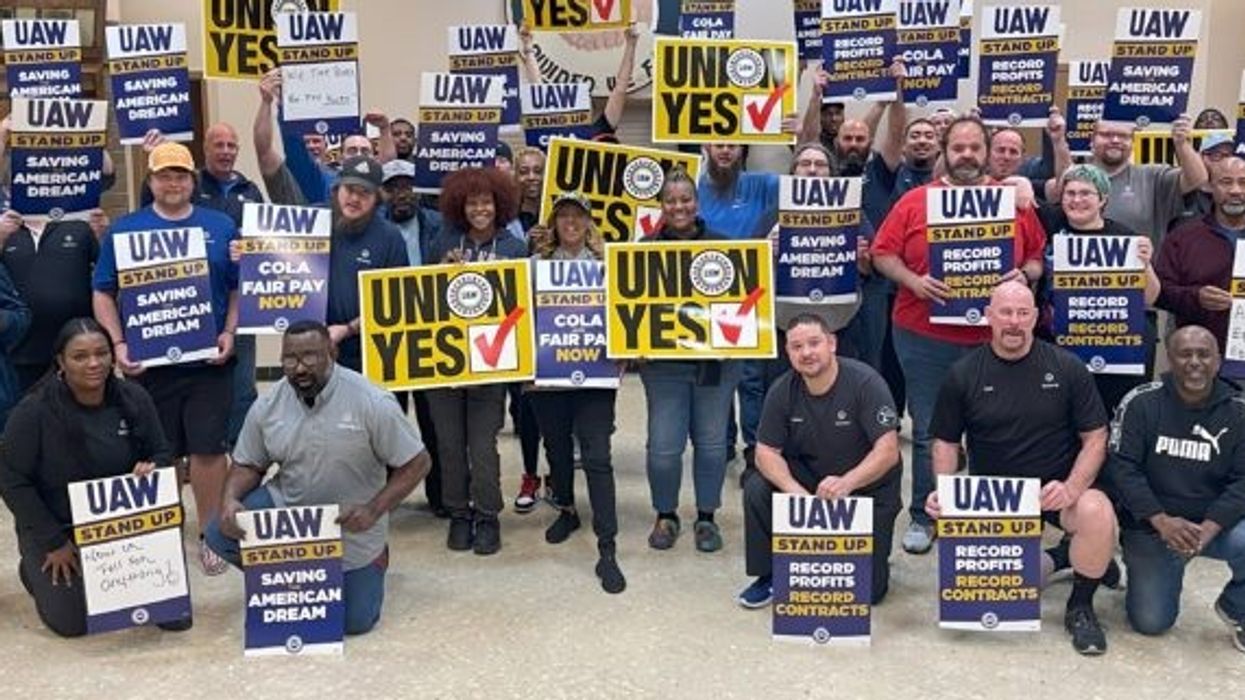
If roughly 5,000 Alabama Mercedes workers vote to unionize in the coming weeks, the ripple effects could empower workers nationwide.
The United Auto Workers recently scored the largest union victory in decades in the South. Their success at a Tennessee Volkswagen plant could be a turning point for labor in a region long known for governmental hostility to unions.
The next test will be a UAW election scheduled for the week of May 13 at a Mercedes-Benz factory in Alabama, a state that has attracted so much auto investment it has earned the nickname “the Detroit of the South.”
If the roughly 5,000 Mercedes workers vote to unionize, the ripple effects could empower workers nationwide.
We need a New South economic structure based on fairness and equity.
For decades, Southern states have pursued “low-road” development strategies, luring investors with massive public subsidies and repressive labor policies. This has pitted workers across the country against each other, undercutting everyone’s ability to secure fair compensation.
Alabama has spent $1.6 billion to woo Mercedes, along with Toyota, Hyundai, and Honda. All these foreign companies’ operations in the South are non-union, in contrast to the unionized Big Three of Ford, GM, and Stellantis.
This foreign investment has created thousands of Alabama jobs—but with weak worker protections, the state remains one of the nation’s poorest. And while these companies have enjoyed rising corporate profits, they have left workers behind.
An in-depth report by the nonprofit group Alabama Arise found that inflation-adjusted average pay for the state’s autoworkers has dropped by 11% over the past 20 years to $64,682. Meanwhile, CEO pay stands at $13.9 million at Mercedes and $6.9 million at Toyota.
The foreign-owned firms’ payrolls also reflect Alabama’s long history of racial discrimination, with Black and Latino workers earning substantially less than their white counterparts. By contrast, the Economic Policy Institute has found that union workers make 10.1% more on average than non-union workers.
The benefits are even greater for workers of color. Unionized Black workers make 13.1% more than non-union Black workers in comparable jobs—and Latino union members make 18.8% more than non-union Latino workers.
Equitable pay practices boost local economies by putting more money in workers’ pockets for groceries, housing, and other goods and services from local businesses. And that’s good for families of every color.
But Alabama Governor Kay Ivey doesn’t see things that way. Before the UAW vote in Tennessee, she joined GOP governors from Georgia, Mississippi, South Carolina, Tennessee, and Texas to discourage VW workers from voting yes with unfounded threats of mass layoffs.
When 73% of those autoworkers voted for the UAW, it was a strong rebuke of the region’s low-road, anti-worker model. So corporate lobbyists in the region have enlisted state legislators and cabinet officials in a sustained campaign to blunt organizing momentum.
How will the election turn out in Alabama?
A new poll indicates that 52% of residents in this deep-red state support the autoworkers’ union drive, while just 21% are opposed. This echoes a 2022 poll commissioned by the Institute for Policy Studies in Jefferson County, Alabama, where workers were attempting to unionize an Amazon warehouse in Bessemer. That survey showed nearly two-thirds support.
While the Alabama Amazon campaign fell short in the face of aggressive anti-union tactics, increased public approval of unions is a testament to many years of community and labor organizing.
The fact that a large majority of workers at the Mercedes-Benz plant signed petitions earlier this year in support of the election is encouraging. We need a New South economic structure based on fairness and equity. Organized labor is an essential partner in that mission.
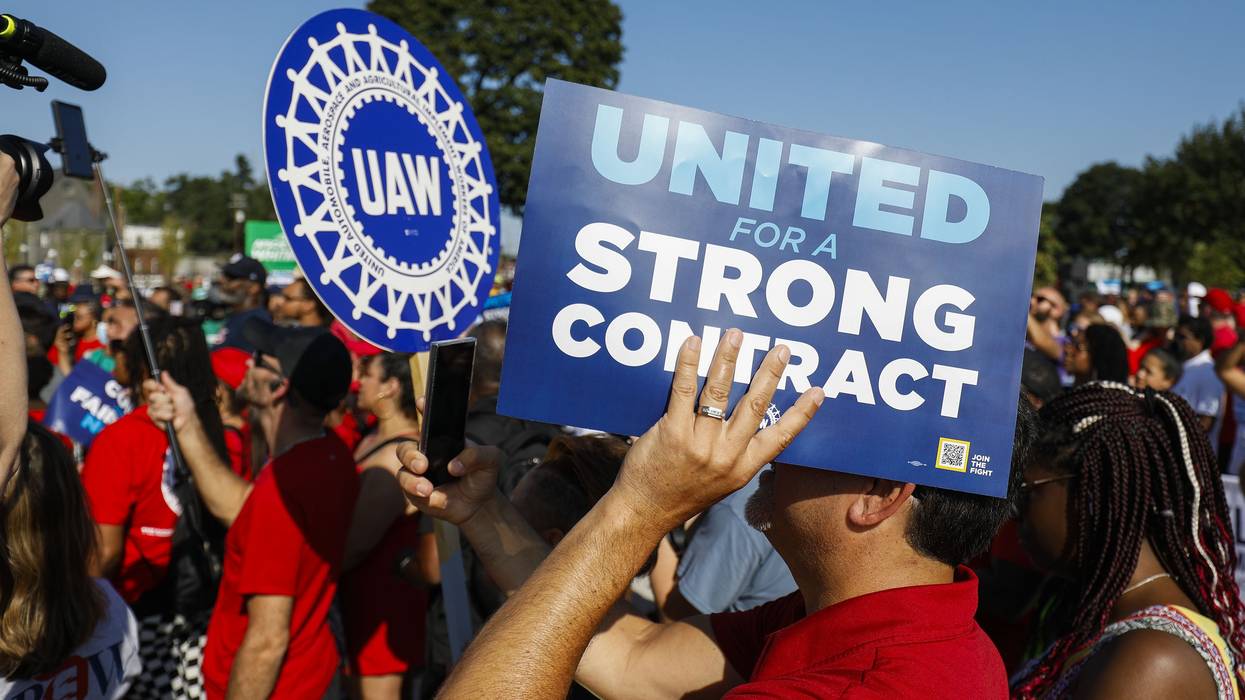
"We are standing up for every worker in Alabama," said one employee. "We're going to turn things around with this vote. We're going to end the Alabama discount."
The alleged illegal union-busting that Mercedes-Benz autoworkers in Vance, Alabama accused the car company of in a complaint to the National Labor Relations Board has not weakened the resolve of pro-union employees, a supermajority of whom now support a union election, according to the United Auto Workers.
The union announced Friday that more than 5,000 workers at the company's nonunion plant have filed a petition with the NLRB in favor of an election, with the workers aiming for a vote by early May.
"It's time for change at Mercedes," said the UAW. "It's time for justice in Alabama. It's time for Mercedes workers to stand up. That's why Mercedes workers have filed for their vote to join the UAW, and to win a better life."
The announcement comes weeks after Volkswagen employees in Chattanooga, Tennessee filed for a union election that's expected to be held April 17-19.
Both union votes are the result of aggressive campaigning by the UAW, including union president Shawn Fain, in the wake of a historic "stand-up strike" that pushed the Big Three automakers to agree to new contracts for about 150,000 workers late last year.
After the victory, Fain announced the launch of the largest union organizing drive in U.S. history, aiming to welcome 150,000 workers at nonunion auto plants into the UAW.
Over 10,000 autoworkers in recent months have signed union cards, and the UAW said Friday that employees at more than two dozen facilities are also organizing.
Mercedes' two U.S. plants in Alabama and South Carolina are its only facilities in the world where workers are not represented by a union. Workers in Vance say they want better healthcare, retirement security, safety protocols, and paid sick days.
Jeremy Kimbrell, a measurement machine operator at Mercedes, said the union vote is part of an effort to ensure carmakers no longer view Alabama as a state where workers can be compensated unfairly.
"We are standing up for every worker in Alabama," said Kimbrell. "At Mercedes, at Hyundai, and at hundreds of other companies, Alabama workers have made billions of dollars for executives and shareholders, but we haven't gotten our fair share. We're going to turn things around with this vote. We're going to end the Alabama discount."
Moesha Chandler, an assembly team member, said her job has given her "serious problems with my shoulders and hands."
"We are voting for safer jobs at Mercedes," said Chandler. "When you're still in your 20s and your body is breaking down, that's not right. By winning our union, we'll have the power to make the work safer and more sustainable.
The UAW celebrated the news out of Vance by releasing a video showing a recent rally where Fain encouraged workers to support the union effort.
"You gotta believe you can win, that this job can be better, that your life will be better, and that those things are worth fighting for," Fain told the Mercedes workers. "That's why we stand up."
The growing pro-union movement across the South represents "huge stakes," said Lauren Kaori Gurley, a labor reporter for The Washington Post. The UAW has faced resistance from right-wing politicians across the South for decades as it has attempted to unionize factories.
Alabama Gov. Kay Ivey, a Republican, said Thursday that the UAW's efforts are a "threat from Detroit" that "has no interest in seeing the people of Alabama succeed."
Ivey's comments indicated that the governor "thinks so little of Alabama workers, that we're only good for cheap labor," Kimbrell told AL.com.

"It's just plain retaliation from Mercedes, but I'm not going to be intimidated," said one worker.
A month after the United Auto Workers announced that a majority of workers at the Mercedes-Benz plant in Vance, Alabama had signed union cards, employees struck a defiant tone Tuesday as they filed official complaints of union-busting by the company with the National Labor Relations Board.
Workers detailed the illegal disciplinary measures management has taken against them for taking leave and objecting to anti-union materials that have been shown in captive-audience meetings since most of the plant's 6,000 workers indicated they want to join the UAW.
"Since we started organizing, I put in my [Family and Medical Leave Act] leave with management multiple times and every time they said they lost the paperwork," Lakeisha Carter, who works in the company's battery plant, told the UAW. "It's just plain retaliation from Mercedes, but I'm not going to be intimidated."
The U.S. Department of Labor last month recovered $438,625 in back pay, unpaid bonuses, and damages for two people who had formerly worked at the plant in Vance, finding that management had illegally fired the workers when they requested FMLA-protected leave to care for a family member and recover from a serious health condition.
After winning new contracts for workers at the Big 3 automakers last fall following an historic "stand-up strike," the UAW has launched campaigns at non-unionized plants owned by Mercedes, Volkswagen, Hyundai, and Toyota, convincing more than 10,000 autoworkers so far to sign union cards.
Another battery plant worker, Taylor Snipes, told the UAW that managers at the company were forcing him and his coworkers "to attend meetings and watch anti-union videos that are full of lies."
After he objected, Snipes was called into a meeting and "immediately fired for having his phone on the factory floor," even though he had been given permission to have his phone with him so he could be in touch with his child's daycare center.
"I told management that it was suspicious that I was being called into the office on the same day that I spoke up in anti-union meeting," said Snipes. "My manager said the two had nothing to do with one another, but then proceeded to aggressively interrogate me about why I support having a union."
UAW President Shawn Fain met with Mercedes workers in Alabama on Sunday.
"Unlike previous drives, the workers are in command," said Luis Feliz Leon of Labor Notes. "They are the collective force that will either press on to a union victory or a defeat."
"We're here to tell you that we are the majority. Mercedes workers are ready to stand up."
The United Auto Workers announced Tuesday that a majority of the approximately 6,000 workers at a Mercedes-Benz plant in Vance, Alabama have indicated they support joining the union.
That's the largest Mercedes-Benz plant in the U.S., and getting more than half of its employees to sign union cards is a major win for the UAW.
"We're here today to make a major announcement. A majority of our co-workers at Mercedes here in Alabama have signed our union cards and are ready to win our union and a better life with the UAW," Mercedes worker Jeremy Kimbrell said in a statement. "We haven't taken this step lightly. For years, we've fallen further behind while Mercedes has made billions."
"We’re here to tell you that we are the majority.
Mercedes workers are ready to stand up.
This is our decision.
It’s our life.
It’s our community.
These are our families.
It's up to us."#StandUpMercedes pic.twitter.com/tV0ctaPW2M
— UAW (@UAW) February 27, 2024
Kimbrell cited insufficient wage increases and the abuse of temporary workers as reasons the plant should be unionized. Volkswagen workers in Chattanooga, Tennessee achieved majority support for joining the UAW earlier this month. This indicates the UAW is making gains in the South, which has historically been a difficult task.
The UAW has been working hard to fight for autoworkers and expand the union over the past year, and it was able to get improved contracts with the "Big Three" auto companies—Ford, General Motors, and Stellantis—after a six-week strike last year.
President Joe Biden even became the first sitting U.S. president to join striking workers on a picket line. The UAW later went on to endorse Biden for reelection and declare that former President Donald Trump, the likely Republican nominee, is a "scab."
Rather than slowing its efforts to improve conditions for autoworkers after its win with the Big Three, the UAW instead proceeded to launch "the largest organizing drive in modern American history." The union clearly has momentum and no plans to stop its fight for workers' rights, and the Mercedes-Benz plant in Alabama achieving majority support for unionization is just the latest example.
"There comes a time when enough is enough," Kimbrell said. "Now is that time. We know what the company, what the politicians, and what their multi-millionaire buddies will say. They'll say now is not the right time. Or that this is not the right way. But here's the thing. This is our decision. It's our life. It's our community. These are our families. It's up to us."