

SUBSCRIBE TO OUR FREE NEWSLETTER
Daily news & progressive opinion—funded by the people, not the corporations—delivered straight to your inbox.
5
#000000
#FFFFFF
To donate by check, phone, or other method, see our More Ways to Give page.
Daily news & progressive opinion—funded by the people, not the corporations—delivered straight to your inbox.
His final strategy for the Kennedy Center, after judges have repeatedly told him he cannot put his name on another president’s memorial, is scorched earth.
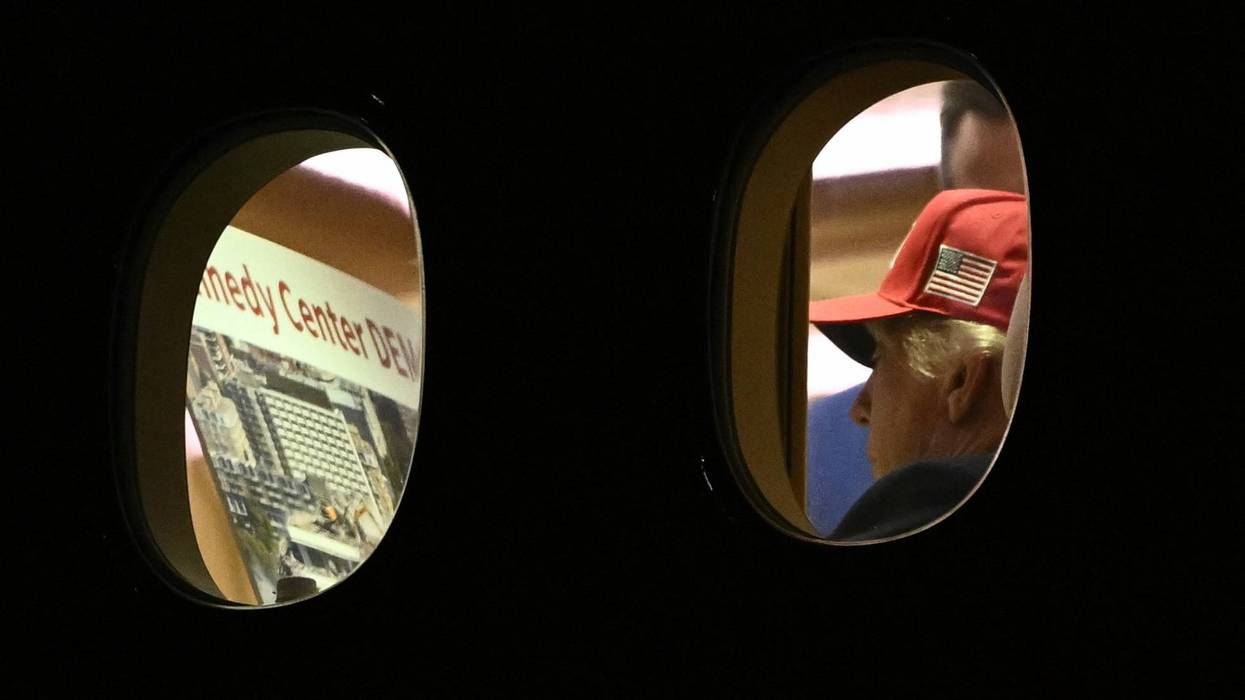
On Friday night, DC-based advocacy organization Hands Off the Arts and its allies are going to form a human chain around the Kennedy Center, called Hands Around the Kennedy Center, putting their bodies on the line to protect the institution. While the group has been planning this action for several weeks, before the removal and literal disembodiment of Joel Shapiro’s 24-foot-tall sculpture "Blue," the board’s vote to close to the Kennedy Center, and pictures captured Wednesday night showing President Donald Trump looking at a plan to demolish the Kennedy Center aboard Air Force One, the action has taken on intense meaning.
At its core, his final strategy for the Kennedy Center, after judges have repeatedly told him he cannot put his name on another president’s memorial, is scorched earth.
I have been on the ground in Washington, DC from the beginning—reporting and raising awareness about Hands Off the Arts’ weekly protests since Trump’s second inauguration. Many of the Hands Off the Arts organizers—including co-founder Mallory Miller—were my colleagues, at the arts institution where I worked as an audio describer for three years. As a public historian witnessing Trump transform the Kennedy Center into his hill to die on, I cannot help but see the similarities to Adolf Hitler’s Nero Decree where he ordered the destruction of German lands and infrastructure to prevent its future use by any Allied forces.
“The demolition watch piece of this cannot be understated. It is truly a crazy timeline that we’re living in where the president of the United States can just say that he might demolish the Kennedy Center.”
Hitler’s strategy was named after the Great Fire of Rome in 64 AD, which, according to tradition, was blamed on Rome’s Christian communities and used by Emperor Nero to justify their persecution. Although there is no historical evidence that Nero set the fire, nor that he played the fiddle or lyre while watching the city burn, Nero was blamed all the same, especially since land cleared by the fire was used to build his new palace, the Domus Aurea. Hitler issued his decree once he recognized that Germany faced imminent defeat but was unwilling to accept the terms of unconditional surrender. He ordered that this land be destroyed on the grounds that the German people had failed his great mission.
As Hitler wrote in the March 1945 decree, “All military transport and communication facilities, industrial establishments, and supply deports, as well as anything else of value within Reich territory, which could in any way be used by the enemy immediately or within the foreseeable future for the prosecution of the war, will be destroyed.”
Even before Hitler issued the Nero decree, he was already burning thousands of works of art publicly. The Nazi government confiscated art from state-owned German museums and then put them on public display in 1937 as part of a propaganda art exhibition meant to classify art created in the styles of Dadaism, Cubism, Surrealism, and Abstraction as “Degenerate Art.” What could be sold to enrich the regime was and what couldn’t was publicly burned. The similarity to Trump’s criticism of Jose de Rivera’s "Infinity" in front of the National Museum of American History and destruction of Joel Shapiro’s "Blue" is palpable.
All of the other art that he favored, namely Classical and Renaissance works, were hidden in caches and planned to be displayed at a massive art complex called the Führermuseum in his hometown of Linz, Austria. The museum was never finished because the Nazi regime fell before Hitler’s goal was realized. In the chaos of the Nazi regime’s collapse, many priceless works of art burned in two devastating fires in May 1945 that destroyed the Friedrichshain flak tower. Whether the fires were caused by an accident, combat damage, or intentionally set, we will never know, but Hitler never intentionally ordered the destruction of the art held in these caches.
While the Hitler’s Nero decree ordered the destruction of German lands and infrastructure, not the art he had stolen, the connection to Trump’s fight for the Kennedy Center is glaringly obvious. Chris Raleigh, one of the co-founders of Hands Off the Arts, pointed out the historical similarities in an interview with me this week. Raleigh compared the Hands Off the Arts group to the Monuments Men fighting to preserve the art that Hitler and the Nazi regime stole and was holding hostage.
“Hitler wanted to build a museum where he lived… I think he wanted to make basically his mausoleum. It was his antithesis to all the degenerate art of the world at the time,” Raleigh explained. “I worry about the Nero decree. It was, "If I can’t have it, no one can. Destroy all of it.’ I don’t know if we’re in Nero decree territory, but we’re going pretty close.”
In truth, comparisons between Trump and Hitler are tenuous at best. There are striking social, economic, and even religious differences between the two dictators, but historical similarities are key to helping us understand how history can help us anticipate and fight back against violent escalation. At its core, Trump’s fight for the Kennedy Center as well as the Smithsonian’s National Museum of American History is about his legacy, about how he will be remembered. It’s just like Hitler’s own fight to create a cultural district synonymous with his name, not so different from Trump’s own attempts to cast DC as culturally derelict and remake the capital in his own image, with the installation of new sculptures of controversial founding fathers and gilding “The Arts of War” and “The Arts of Peace” equestrian monuments.
As Mallory Miller, co-founder of Hands Off the Arts, explained to me, the way that the Trump administration was purposefully not caring for the exterior of the building, leading to mold growth, deinstalling "Blue," and widely publicizing the ceiling collapse is another use of this purposeful tactic to convince the public that the Kennedy Center is falling apart and needs to be closed and demolished for safety reasons.
“The demolition watch piece of this cannot be understated. It is truly a crazy timeline that we’re living in where the president of the United States can just say that he might demolish the Kennedy Center,” Miller said. Hands Off the Arts organized a livestream of the front of the building, capturing some of the first photos of his name being removed from the building before the tarp went up. The administration has even started putting up bike racks and other barriers around the perimeter of the Kennedy Center, which Miller acknowledges is likely in anticipation of their protest tonight. But with more than 900 people registered for the protest, Miller is eager to just make their circle bigger to protect the memorial to the slain president.
“We can save this,” Raleigh continued, “We can save world heritage. American heritage, but it’s going to be hard, and they’re not going to go down without a struggle, but that is also one of the things that I think about—we are not the first people [to do this work].”
A federal judge has ordered the Kennedy Center board to provide 30 days' notice ahead of any attempt to knock down the building.
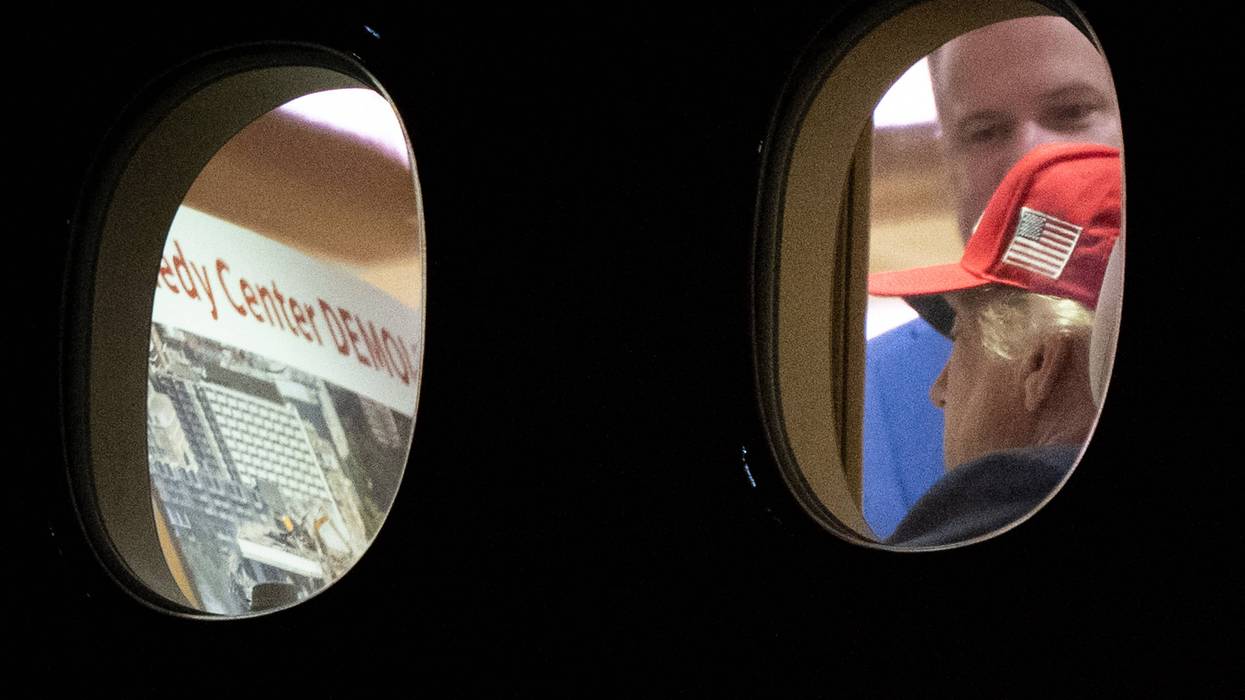
President Donald Trump is coming under heavy criticism after a photograph taken on Wednesday suggested that his threats to destroy the John F. Kennedy Memorial Center for the Performing Arts are very real.
Shortly after attending a Wednesday night rally in North Carolina, Trump was caught on camera by photographer Brendan Smialowski sitting on Air Force One and looking at a large printout of a graphic that appeared to read, "Kennedy Center DEMOLISHED."
Hours before the photo was taken, Trump told reporters that the Kennedy Center would "end up being ripped down" if he was not allowed to put his name on the side of the building in "recognition" for the work he purports to have done to improve it.
Trump basically saying The Kennedy Center will be ripped down unless his name is placed on it because in order for him to want to maintain it, his name should be on it.
(Cleaner audio version) https://t.co/wmkH2JTS7I pic.twitter.com/NEyeS17jhb
— Acyn (@Acyn) September 16, 2026
In a Tuesday social media post, Trump similarly said that the center was "destined to doom" unless he is allowed to add his name to it.
Alarmed by these developments, attorneys representing Rep. Joyce Beatty (D-Ohio), a Kennedy Center trustee, went to US District Judge Christopher Cooper on Thursday and asked him to intervene and prevent the president from unilaterally destroying the center.
Cooper subsequently ordered the Kennedy Center board to give 30 days' notice "before the implementation of any changes... including but not limited to any 'demolition' of the center's main building."
Rep. Don Beyer (D-Va.) noted in a Thursday social media post that demolishing the Kennedy Center "would be flagrantly illegal," and vowed to protect the building, which he described as "one of the crown jewels of our nation's capital."
"Trump's narcissism and incompetence are putting our national heritage and iconic sites at risk," Beyer added, "and Republicans' silence and acquiescence to this corruption speaks volumes."
Sen. Sheldon Whitehouse (D-RI) pointed to news from earlier in the week about the resignation of Kennedy Center chief financial officer Donna Kauranen as a particularly ominous development.
"If the Kennedy Center CFO has packed bags and fled," wrote Whitehouse, "that's another warning about center fiduciary failures of due diligence."
"Linguistic gymnastics cannot extricate the Kennedy Center’s board from an operative judicial order or the governing statute it was designed to enforce," said US District Judge Christopher Cooper.
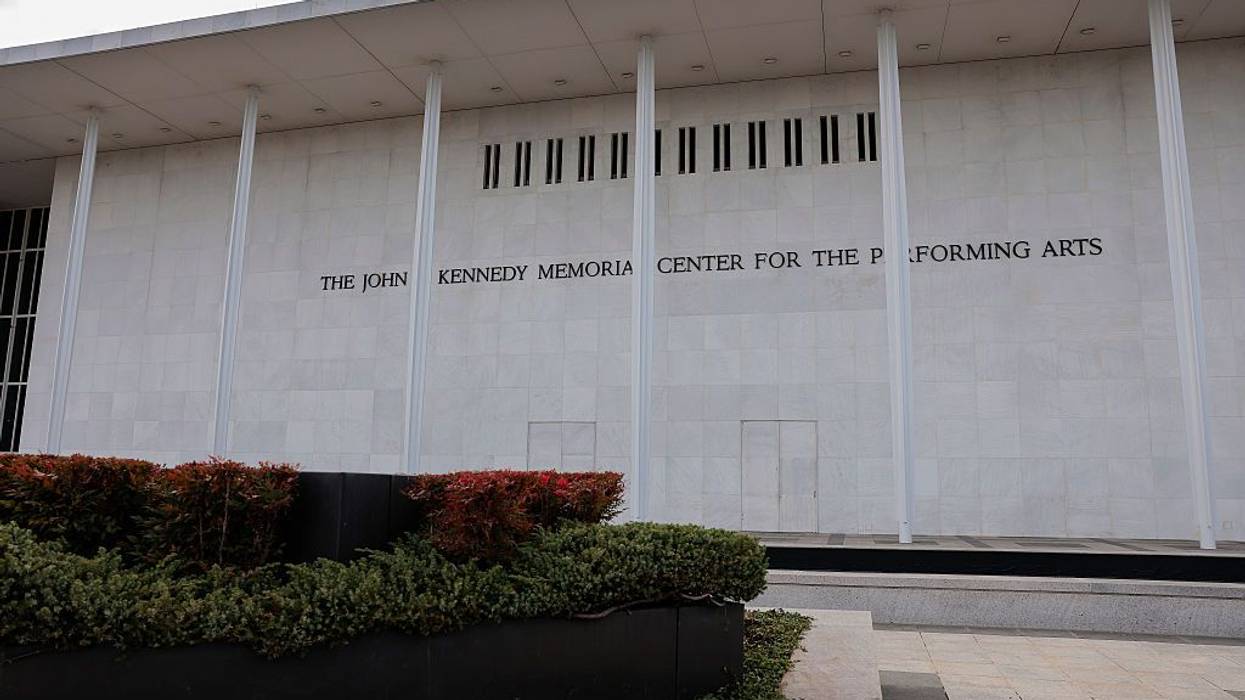
President Donald Trump declared that the John F. Kennedy Memorial Center for the Performing Arts is "destined to doom" on Tuesday shortly after a federal judge once against blocked the president from slapping his name on the side of the building.
US District Judge Christopher Cooper ruled that the Kennedy Center board's effort to restore Trump's name to the outside of the performing arts center was still unlawful, even if being purportedly done to "recognize and honor President Trump's current and future existential and unprecedented contributions" to the building.
Trump responded to the ruling with a lengthy social media post where he said that the center is "in a virtual state of collapse," while blaming Cooper for the building's purportedly imminent demise.
"A very hostile and conflicted Judge (What else is new?) seems like he won’t let that happen, in which case, unfortunately, the Building is destined to doom," Trump wrote. "Isn’t that too bad?"
Last year, the board voted to rename the center as the "Donald J. Trump and John F. Kennedy Memorial Center for the Performing Arts," despite having no congressional authorization to do so.
After a court ruled that Trump's name must be removed from the building, the board subsequently passed a resolution to add signage to the building informing visitors that it has been "renovated and restored by President Donald J. Trump."
Additionally, the board voted to rename the campus on which the building sits as the "President Donald J. Trump Plaza."
Cooper said that both of these actions were in violation of an injunction granted earlier this year that prevented the board from taking unilateral action to rename the Kennedy Center or its properties without congressional approval.
"Simply put, defendants cannot install memorials for President Trump or anyone or anything else at the Kennedy Center without Congress’ blessing," the judge emphasized. "The board resolution bucks a federal court order and a statute Congress enacted."
The judge accused the administration of playing "word games" by trying to deny that the proposed additional signage was not a "memorial" to Trump but rather a "recognition" or an "acknowledgement."
"Common sense dictates that the words 'renovated and restored by President Donald J. Trump' establish a memorial," wrote Cooper. "Defendants themselves define a 'memorial' as 'anything meant to help people remember some person or event, as a statute, holiday, etc.'"
"Linguistic gymnastics," Cooper added, "cannot extricate the Kennedy Center’s board from an operative judicial order or the governing statute it was designed to enforce."
Cooper also slapped down warnings from the Kennedy Center board that the building "will face financial peril" and could even be forced to shut down unless Trump's name is restored outside.
Under the board members' theory, putting Trump's name back on the building would lead to a surge in donations to the center that could revive its dire fiscal outlook.
Cooper, however, didn't buy this claim in the slightest.
"In fact, evidence before the court pointed in the opposite direction," the judge wrote. "The renaming of the center coincided with declines in revenue and contributions, as artists canceled performances, the Washington National Opera ended its 50-year residency, and ticket sales and viewership of the Kennedy Center Honors broadcast dropped precipitously."
According to a Sunday report in The Washington Post, Kennedy Center board members have said that the performing arts center could close as soon as Tuesday without the restoration of Trump's name.
In a Tuesday afternoon social media post, Trump revealed that the board had voted to close the Kennedy Center indefinitely to undergo "renovation and reconstruction."
However, the president also warned that fixes to the building would not be made unless courts allowed him to put his name on the side.
"This latest development is a transparent effort to circumvent the court's ruling, and flies in the face of the statutes that Congress passed," said US Rep. Joyce Beatty.
President Donald Trump's name is going back on the John F. Kennedy Center for the Performing Arts, despite a court order that mandated its removal.
Trump-appointed members of the Kennedy Center board on Thursday voted to add an inscription underneath the building's main signage that reads, "Restored and Renovated by President Donald J. Trump." The board also voted to rename the site outside the building as "the President Donald J. Trump Plaza."
In December, the board voted to rename the building the "Donald J. Trump and John F. Kennedy Center for the Performing Arts," despite having no congressional authorization to do so.
Six months later, US District Judge Christopher Cooper ruled that the board lacked power to rename the building without congressional approval and ordered the president's name taken down from the building.
Rep. Joyce Beatty (D-Ohio), an ex-officio Kennedy Center board member who filed a lawsuit to stop the building from being renamed, vowed to challenge the latest gambit to slap the president's name on a historic building.
"This latest development is a transparent effort to circumvent the court's ruling, and flies in the face of the statutes that Congress passed," Beatty said. "I will continued to fight for this treasured national monument."
Democracy Defenders Action co-founder Norm Eisen, who served as co-counsel in the previous lawsuit against the board, said that the Trump-appointed members defied the judge's ruling by putting Trump's name back on the building, and vowed that "they'll answer for it in court, again."
Rep. Ted Lieu (D-Calif.) said the Kennedy Center board's latest actions made it imperative to cleanse the nation's capital of Trump's name in the next Democratic administration.
"My bright lines for who I will endorse for president in 2028," wrote Lieu in a social media post. "1. Candidate must put in writing that all references to Trump’s name will be removed from the Kennedy Center and federal buildings. 2. Must do this at a public ceremony with fireworks."
CNN senior political reporter Aaron Blake questioned the political wisdom of forcing Trump's name back on the Kennedy Center given his current low approval ratings.
"Just a reminder that between 7 in 10 and 8 in 10 Americans think Trump is neglecting important issues like affordability, per recent polls," wrote Blake. "And apparently nobody will convince him that stuff like this isn’t helping."
Public institutions belong to the people they were created to serve, not to the ambitions of those temporarily entrusted with their care.
As we celebrate the 250th anniversary of America, it’s essential that we look to the past for lessons on how we should move forward during politically turbulent times marked by Americans holding little trust in historically respected institutions, including the federal government.
In 1796, our nation’s first president, George Washington, published his farewell address and in it, he declined to run for a third term despite many Americans wanting him to remain president indefinitely. Washington wanted to be clear that being president was not a lifetime appointment and that America was not a monarchy.
In this address, he also gave us a lesson that too many leaders seem to forget today: that the things we lead do not belong to us. Stewardship is the real assignment.
Recently, when a federal court ordered President Donald Trump’s name removed from the John F. Kennedy Center for the Performing Arts, it did more than settle a legal dispute. It served as a reminder that public institutions belong to the people they were created to serve, not to the ambitions of those temporarily entrusted with their care.
As we look ahead to the next 250 years of our nation, America’s leaders must understand that their job is not to leave their name on an institution, but to leave the institution stronger than they found it.
I learned this lesson when I served on the President’s Advisory Committee on the Arts. As an appointee of President Barack Obama in 2011 and later as chair of the committee, I had the privilege of working alongside artists, educators, philanthropists, and public servants who understood that institutions endure only when leaders respect the purpose for which they were created.
The Kennedy Center was established by Congress as a living memorial to President John F. Kennedy. Its mission was never to advance the ambitions of a particular board, administration, or political figure. It was created to serve the American people.
For more than 50 years, it has welcomed families, students, artists, and visitors from every corner of the nation. It has remained open through changing administrations, economic downturns, and periods of national division. Its purpose has endured because generations of leaders understood that they were caretakers of something larger than themselves.
Today, we see conservatives engaging in a hostile takeover of many of our nation’s key institutions by pushing an ideological agenda that refuses to tell the full, and complicated, story of our nation’s history.
At Smithsonian museums, references to President Trump’s two first-term impeachments have been removed, and the Trump administration issued an executive order that would review and remove exhibits from the Smithsonian Institution that contradict the administration’s distorted view of American history.
In our education system, higher education institutions are threatened with lawsuits and funding cuts for policies and programs that ensure all students have the opportunity to succeed. In states across the country, including Georgia, we have witnessed the passage of laws that restrict an honest and full teaching of our nation’s history—failing to give our children a true understanding of our nation and how we’ve overcome moments of grave injustice.
The understanding that President Washington had in 1796 that our nation’s institutions should not be reshaped in the image of our leadership seems increasingly absent from public life. Too often, leadership is confused with ownership and the focus shifts from mission to personality. Stewardship to control.
Strong leaders do not ask only what they have the power to do. They ask what responsibility requires of them. They understand that power is not permission, popularity is not wisdom, and institutions entrusted to their care are not personal possessions to be reshaped according to their preferences. Institutions thrive when leaders serve the mission. They struggle when the mission begins serving the leader.
When the distinction between serving an institution and owning it disappears, public trust begins to erode. That lesson has remained true since the inception of our nation, and it will remain true for the next 250 years. Once that trust is lost, it can take generations to rebuild.
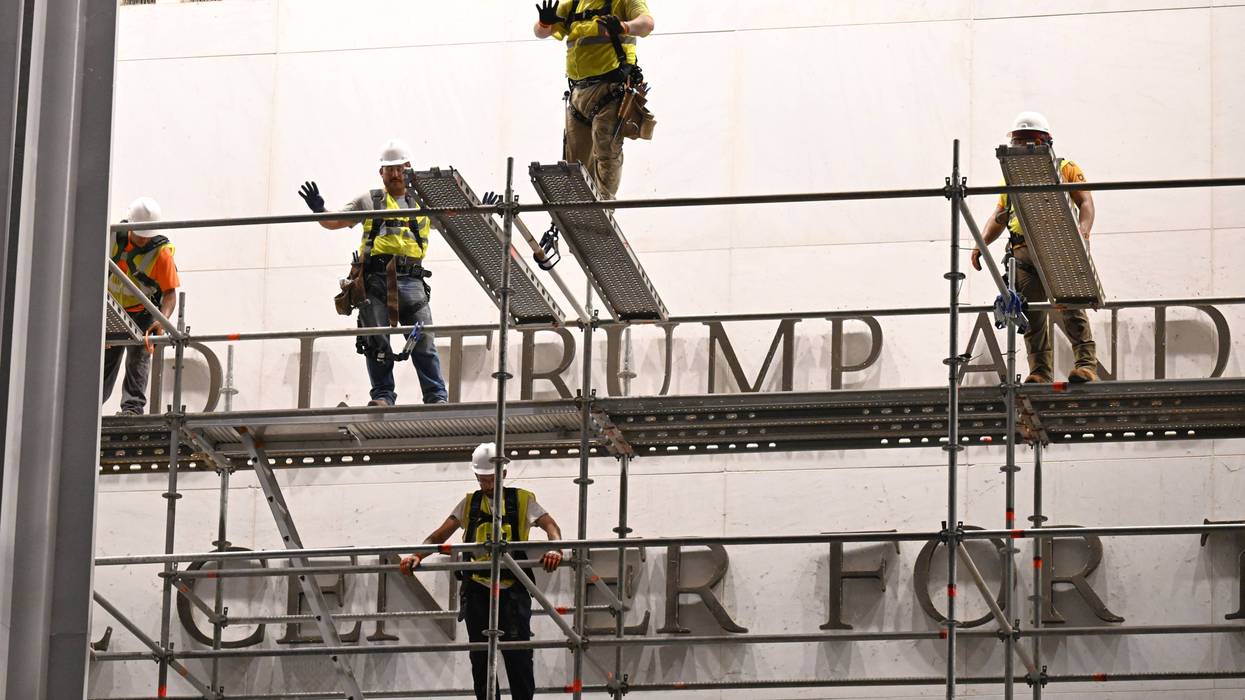
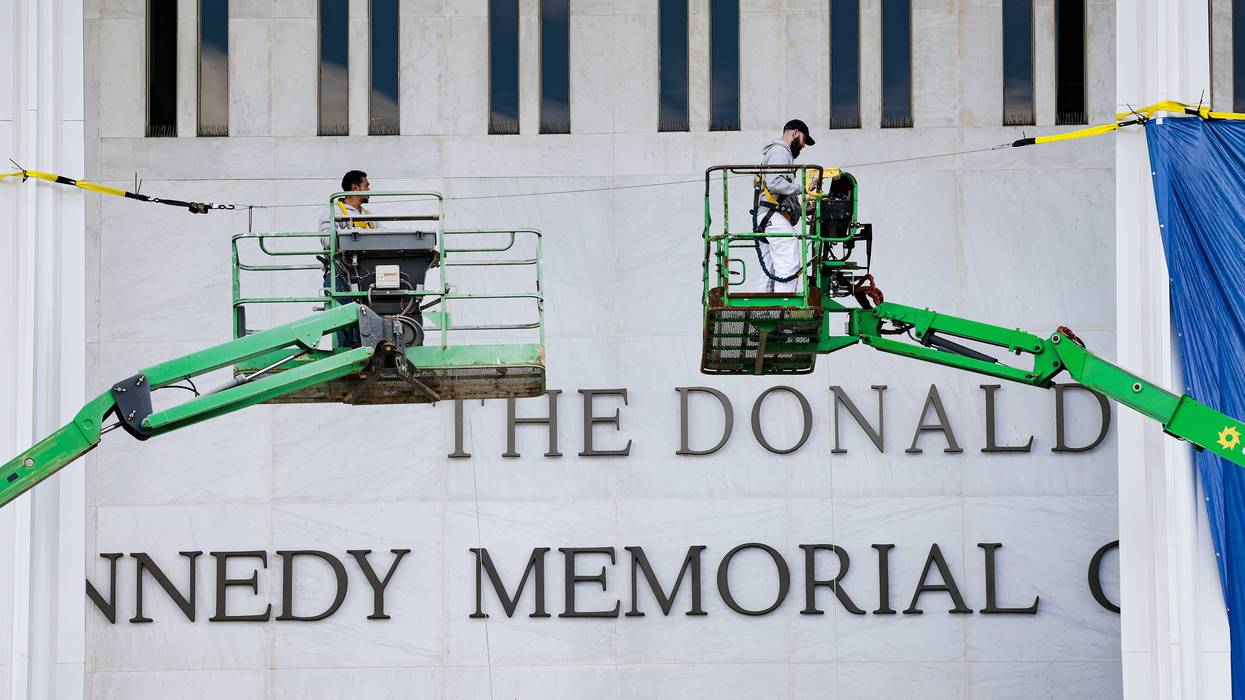
As workers continue removing the lettering from the Kennedy Center façade, they are carrying out a court order.
But they are also delivering a reminder.
Public institutions belong to the people they were created to serve, not to the ambitions of those temporarily entrusted with their care.
As we look ahead to the next 250 years of our nation, America’s leaders must understand that their job is not to leave their name on an institution, but to leave the institution stronger than they found it.
“Congress gave the Kennedy Center its name, and only Congress can change it."
A federal judge ruled Friday that President Donald Trump's renaming of the John F. Kennedy Memorial Center for the Performing Arts after himself is illegal and temporarily barred the president from shuttering the Washington, DC cultural institution for renovations.
Trump's effort to rename the iconic Kennedy Center the Trump-Kennedy Center came after the president used his authority to purge the institution's board and appoint new trustees. In an unprecedented move, the trustees then voted to make Trump the center's board chair. Last December, the board voted unanimously to rename the institution—a move that violated federal law.
Congresswoman Joyce Beatty (D-Ohio), an ex officio member of the Kennedy Center board, sued over the name change, which outraged many Americans and, along with Trump's addition of his name to the US Institute of Peace, sparked legislation aimed at banning the naming or renaming of federal assets after sitting presidents.
"May the John F. Kennedy Center for the Performing Arts be renamed absent Congressional authorization? The answer, plain from the face of the statute, is no," US District Judge Christopher Cooper wrote in his ruling on Beatty's suit. "Nor can any other individual be memorialized on the front portico of the building."
BREAKING: we just won our Kennedy Center case!Both the renaming & the closure of the Kennedy Center are enjoinedKudos to our wonderful client @repbeatty.bsky.social & my colleagues @democracydefendersaction.org & Washington Litigation GroupThis is a 1-2 punch against Trump's corruption
[image or embed]
— Norm Eisen (@normeisen.bsky.social) May 29, 2026 at 11:55 AM
Originally called the National Cultural Center, the Kennedy Center was renamed via an act of Congress following former President John F. Kennedy's 1963 assassination.
"It is hard to imagine a more intentional legislative effort to call the Center by its chosen name," Cooper—an appointee of former President Barack Obama—wrote. "The organic statute also takes pains to ensure that the Kennedy Center’s public spaces honor President Kennedy and President Kennedy alone... The prohibition is unambiguous."
“Congress gave the Kennedy Center its name, and only Congress can change it," the judge added.
Cooper also temporarily blocked Trump's planned two-year closure of the Kennedy Center for renovations.
"In ratifying President Trump’s closure announcement, the Board was derelict in discharging the full range of its responsibilities to the Center," he wrote. "More specifically, the Board based its decision on an insufficient, one-sided presentation of information and
neglected to consider the full range of its statutory obligations and potential adverse consequences of closure on programming and memorial functions."
While Trump claimed the decision to shutter the Kennedy Center was based on input from a group of “many Highly Respected experts,” who said the center was “tired, broken, and dilapidated," critics including John F. Kennedy's descendants pointed to artists not wanting to perform there after the president's takeover and purge, which resulted in programming including the world premier of a documentary film about his wife panned by one critic as "a scowling void of pure nothingness."
Cooper said that the Kennedy Center could be allowed to close “after independently balancing its multiple obligations to the Center in a prudent fashion."
Beatty welcomed Cooper's ruling, which she said "rightly affirms that this administration's efforts to rename and close the Center have no basis in law."
"The Kennedy Center is an institution that belongs to the American people, not to Donald Trump," she added. "He has desecrated this sacred memorial for his own vanity. I am proud to have fought for the rule of law and to protect this sacred institution."
Trump, meanwhile, took to his Truth Social network to rail against Cooper, "a Judge appointed by Barack Hussein Obama."
"Cooper ruled that The Kennedy Center, which was going to close in early July for largescale renovations and construction due to years of neglect, decay, and poor maintenance, and which was to be transformed by the Trump Administration into the Finest Facility of its kind, anywhere in the World, is not allowed to close for these renovations, which would not be possible to properly do without such a closure," the president wrote.
"Additionally, Judge Cooper ruled that the 36 Member Board of Trustees, which unanimously voted to add the name 'TRUMP' onto the former Kennedy Center, making it The Trump Kennedy Center, did not have the right to do such an addition, and the name, 'TRUMP,' must be removed," Trump's screed continued.
"I took great pride in taking over a losing Institution, and looked forward to making it into a Great and Prestigious WINNER for Washington, D.C., and indeed, the United States of America," he continued. "Unfortunately, Judge Cooper and the Radical Left would rather see it DIE than have President Trump transform it into something that everyone could be proud of, much as I have done, in many cases, throughout my life."
"Therefore, based on the fact that the Radical Left Democrats care more about opposing your favorite President, ME, than saving a dying Performing Arts Center, almost all of which lose large amounts of money throughout the Country, we are going to be working with Congress to transfer this failing Institution back to them so they can make a determination as to what to do with it," Trump said.
"Judge Cooper should be ashamed of himself! I cannot be involved with a situation where danger to the Public is allowed to flourish in plain and open sight," the president wrote. "Unless I am free to do what I do better than anyone else, bring this Institution back, physically, financially, and artistically, I have no interest in continuing what could only be a hopeless journey into 'NEVER NEVER LAND.'"
"There has never been a President of the United States who has been treated so unfairly by the Courts as I," he added, "but, that’s OK, I will continue to do, what is considered to be, a great job for the wonderful people of our Country."
Trump loves nothing more than hearing his name and seeing it affixed, preferably in gold color, to apartment and office buildings, casinos, and consumer products.
At his February 2026 State of the Union address, Great Leader Donald Trump was atypically modest about his achievements as president in his second term. He has conquered inflation; ended eight wars; taken $1 off the price of gas; created jobs as never before; conquered unemployment; ridded the cities of criminals and immigrants; secured $18 trillion in investments with highly effective tariff wars; and created a peace board with a modest $1 billion entry fee.
Of course, none of these claims is true. But the president should be honored for his hard work and delusionary beliefs. President Trump loves nothing more than hearing his name and seeing it affixed, preferably in gold color, to apartment and office buildings, casinos, and consumer products. The board of trustees of John F. Kennedy Center for the Performing Arts, most of whom Trump appointed and whose chairman is Donald, voted to rename it the Trump-Kennedy Center. But more work is to be done. The following buildings, objects, and programs are just a first cut of the most important honors.
To ensure these and other possibilities, in February 2026 Trump’s representatives filed three applications with the United States Patent and Trademark Office to trademark his name for future use on an airport in a variety of possible names, along “clothing, handbags, luggage, jewelry, watches, and tie clips.” This would enable US citizens to continue to pay Trump through licensing fees. A reasonable patent lawyer might trademark “Grifting President™”.
Trump has already immortalized his legacy in: at least eight Trump towers, and at least 13 others never completed; 10 other Trump buildings, and a dozen more never completed; a handful of Trump hotels, but at least 18 never completed or renamed;15 golf courses, and five abroad, and several under discussion abroad funded by Qataris and Saudis; seven former casinos and four never completed that led to six bankruptcies; and 94 felonies and one case of sexual abuse.
Trump can already be satisfied to learn that scientists have named several creatures after him: a fragile yellow-white moth (Neopalpa donaldtrumpi), a fossil sea urchin (Tetragramma donaldtrumpi), and Dermophis donaldtrumpi, the proposed name for a new species of blind amphibious 10 centimeter-long worm.