5
#000000
#FFFFFF
To donate by check, phone, or other method, see our More Ways to Give page.
Daily news & progressive opinion—funded by the people, not the corporations—delivered straight to your inbox.
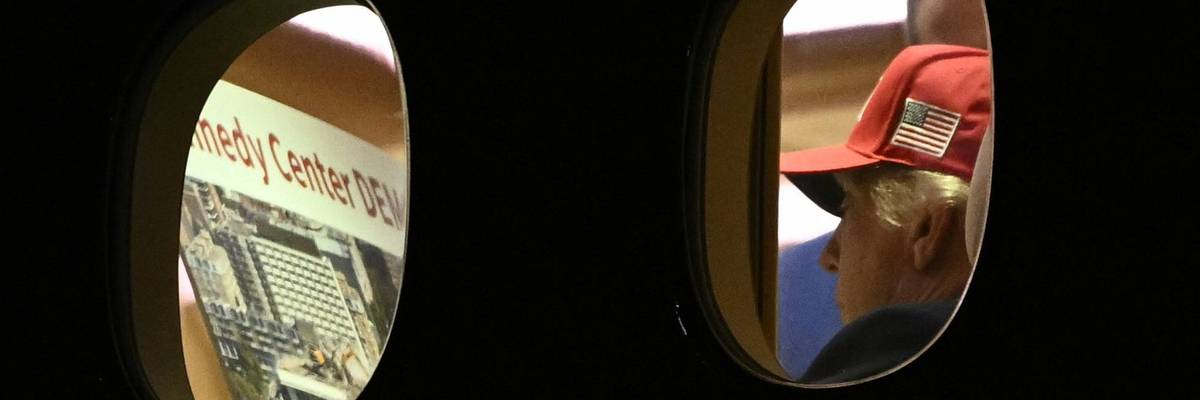
US President Donald Trump is seen aboard Air Force One checking a Kennedy Center large printout after landing at Joint Base Andrews, Maryland on September 16, 2026.
His final strategy for the Kennedy Center, after judges have repeatedly told him he cannot put his name on another president’s memorial, is scorched earth.
On Friday night, DC-based advocacy organization Hands Off the Arts and its allies are going to form a human chain around the Kennedy Center, called Hands Around the Kennedy Center, putting their bodies on the line to protect the institution. While the group has been planning this action for several weeks, before the removal and literal disembodiment of Joel Shapiro’s 24-foot-tall sculpture "Blue," the board’s vote to close to the Kennedy Center, and pictures captured Wednesday night showing President Donald Trump looking at a plan to demolish the Kennedy Center aboard Air Force One, the action has taken on intense meaning.
At its core, his final strategy for the Kennedy Center, after judges have repeatedly told him he cannot put his name on another president’s memorial, is scorched earth.
I have been on the ground in Washington, DC from the beginning—reporting and raising awareness about Hands Off the Arts’ weekly protests since Trump’s second inauguration. Many of the Hands Off the Arts organizers—including co-founder Mallory Miller—were my colleagues, at the arts institution where I worked as an audio describer for three years. As a public historian witnessing Trump transform the Kennedy Center into his hill to die on, I cannot help but see the similarities to Adolf Hitler’s Nero Decree where he ordered the destruction of German lands and infrastructure to prevent its future use by any Allied forces.
“The demolition watch piece of this cannot be understated. It is truly a crazy timeline that we’re living in where the president of the United States can just say that he might demolish the Kennedy Center.”
Hitler’s strategy was named after the Great Fire of Rome in 64 AD, which, according to tradition, was blamed on Rome’s Christian communities and used by Emperor Nero to justify their persecution. Although there is no historical evidence that Nero set the fire, nor that he played the fiddle or lyre while watching the city burn, Nero was blamed all the same, especially since land cleared by the fire was used to build his new palace, the Domus Aurea. Hitler issued his decree once he recognized that Germany faced imminent defeat but was unwilling to accept the terms of unconditional surrender. He ordered that this land be destroyed on the grounds that the German people had failed his great mission.
As Hitler wrote in the March 1945 decree, “All military transport and communication facilities, industrial establishments, and supply deports, as well as anything else of value within Reich territory, which could in any way be used by the enemy immediately or within the foreseeable future for the prosecution of the war, will be destroyed.”
Even before Hitler issued the Nero decree, he was already burning thousands of works of art publicly. The Nazi government confiscated art from state-owned German museums and then put them on public display in 1937 as part of a propaganda art exhibition meant to classify art created in the styles of Dadaism, Cubism, Surrealism, and Abstraction as “Degenerate Art.” What could be sold to enrich the regime was and what couldn’t was publicly burned. The similarity to Trump’s criticism of Jose de Rivera’s "Infinity" in front of the National Museum of American History and destruction of Joel Shapiro’s "Blue" is palpable.
All of the other art that he favored, namely Classical and Renaissance works, were hidden in caches and planned to be displayed at a massive art complex called the Führermuseum in his hometown of Linz, Austria. The museum was never finished because the Nazi regime fell before Hitler’s goal was realized. In the chaos of the Nazi regime’s collapse, many priceless works of art burned in two devastating fires in May 1945 that destroyed the Friedrichshain flak tower. Whether the fires were caused by an accident, combat damage, or intentionally set, we will never know, but Hitler never intentionally ordered the destruction of the art held in these caches.
While the Hitler’s Nero decree ordered the destruction of German lands and infrastructure, not the art he had stolen, the connection to Trump’s fight for the Kennedy Center is glaringly obvious. Chris Raleigh, one of the co-founders of Hands Off the Arts, pointed out the historical similarities in an interview with me this week. Raleigh compared the Hands Off the Arts group to the Monuments Men fighting to preserve the art that Hitler and the Nazi regime stole and was holding hostage.
“Hitler wanted to build a museum where he lived… I think he wanted to make basically his mausoleum. It was his antithesis to all the degenerate art of the world at the time,” Raleigh explained. “I worry about the Nero decree. It was, "If I can’t have it, no one can. Destroy all of it.’ I don’t know if we’re in Nero decree territory, but we’re going pretty close.”
In truth, comparisons between Trump and Hitler are tenuous at best. There are striking social, economic, and even religious differences between the two dictators, but historical similarities are key to helping us understand how history can help us anticipate and fight back against violent escalation. At its core, Trump’s fight for the Kennedy Center as well as the Smithsonian’s National Museum of American History is about his legacy, about how he will be remembered. It’s just like Hitler’s own fight to create a cultural district synonymous with his name, not so different from Trump’s own attempts to cast DC as culturally derelict and remake the capital in his own image, with the installation of new sculptures of controversial founding fathers and gilding “The Arts of War” and “The Arts of Peace” equestrian monuments.
As Mallory Miller, co-founder of Hands Off the Arts, explained to me, the way that the Trump administration was purposefully not caring for the exterior of the building, leading to mold growth, deinstalling "Blue," and widely publicizing the ceiling collapse is another use of this purposeful tactic to convince the public that the Kennedy Center is falling apart and needs to be closed and demolished for safety reasons.
“The demolition watch piece of this cannot be understated. It is truly a crazy timeline that we’re living in where the president of the United States can just say that he might demolish the Kennedy Center,” Miller said. Hands Off the Arts organized a livestream of the front of the building, capturing some of the first photos of his name being removed from the building before the tarp went up. The administration has even started putting up bike racks and other barriers around the perimeter of the Kennedy Center, which Miller acknowledges is likely in anticipation of their protest tonight. But with more than 900 people registered for the protest, Miller is eager to just make their circle bigger to protect the memorial to the slain president.
“We can save this,” Raleigh continued, “We can save world heritage. American heritage, but it’s going to be hard, and they’re not going to go down without a struggle, but that is also one of the things that I think about—we are not the first people [to do this work].”
Dear Common Dreams reader, It’s been nearly 30 years since I co-founded Common Dreams with my late wife, Lina Newhouser. We had the radical notion that journalism should serve the public good, not corporate profits. It was clear to us from the outset what it would take to build such a project. No paid advertisements. No corporate sponsors. No millionaire publisher telling us what to think or do. Many people said we wouldn't last a year, but we proved those doubters wrong. Together with a tremendous team of journalists and dedicated staff, we built an independent media outlet free from the constraints of profits and corporate control. Our mission has always been simple: To inform. To inspire. To ignite change for the common good. Building Common Dreams was not easy. Our survival was never guaranteed. When you take on the most powerful forces—Wall Street greed, fossil fuel industry destruction, Big Tech lobbyists, and uber-rich oligarchs who have spent billions upon billions rigging the economy and democracy in their favor—the only bulwark you have is supporters who believe in your work. But here’s the urgent message from me today. It's never been this bad out there. And it's never been this hard to keep us going. At the very moment Common Dreams is most needed, the threats we face are intensifying. We need your support now more than ever. We don't accept corporate advertising and never will. We don't have a paywall because we don't think people should be blocked from critical news based on their ability to pay. Everything we do is funded by the donations of readers like you. When everyone does the little they can afford, we are strong. But if that support retreats or dries up, so do we. Will you donate now to make sure Common Dreams not only survives but thrives? —Craig Brown, Co-founder |
On Friday night, DC-based advocacy organization Hands Off the Arts and its allies are going to form a human chain around the Kennedy Center, called Hands Around the Kennedy Center, putting their bodies on the line to protect the institution. While the group has been planning this action for several weeks, before the removal and literal disembodiment of Joel Shapiro’s 24-foot-tall sculpture "Blue," the board’s vote to close to the Kennedy Center, and pictures captured Wednesday night showing President Donald Trump looking at a plan to demolish the Kennedy Center aboard Air Force One, the action has taken on intense meaning.
At its core, his final strategy for the Kennedy Center, after judges have repeatedly told him he cannot put his name on another president’s memorial, is scorched earth.
I have been on the ground in Washington, DC from the beginning—reporting and raising awareness about Hands Off the Arts’ weekly protests since Trump’s second inauguration. Many of the Hands Off the Arts organizers—including co-founder Mallory Miller—were my colleagues, at the arts institution where I worked as an audio describer for three years. As a public historian witnessing Trump transform the Kennedy Center into his hill to die on, I cannot help but see the similarities to Adolf Hitler’s Nero Decree where he ordered the destruction of German lands and infrastructure to prevent its future use by any Allied forces.
“The demolition watch piece of this cannot be understated. It is truly a crazy timeline that we’re living in where the president of the United States can just say that he might demolish the Kennedy Center.”
Hitler’s strategy was named after the Great Fire of Rome in 64 AD, which, according to tradition, was blamed on Rome’s Christian communities and used by Emperor Nero to justify their persecution. Although there is no historical evidence that Nero set the fire, nor that he played the fiddle or lyre while watching the city burn, Nero was blamed all the same, especially since land cleared by the fire was used to build his new palace, the Domus Aurea. Hitler issued his decree once he recognized that Germany faced imminent defeat but was unwilling to accept the terms of unconditional surrender. He ordered that this land be destroyed on the grounds that the German people had failed his great mission.
As Hitler wrote in the March 1945 decree, “All military transport and communication facilities, industrial establishments, and supply deports, as well as anything else of value within Reich territory, which could in any way be used by the enemy immediately or within the foreseeable future for the prosecution of the war, will be destroyed.”
Even before Hitler issued the Nero decree, he was already burning thousands of works of art publicly. The Nazi government confiscated art from state-owned German museums and then put them on public display in 1937 as part of a propaganda art exhibition meant to classify art created in the styles of Dadaism, Cubism, Surrealism, and Abstraction as “Degenerate Art.” What could be sold to enrich the regime was and what couldn’t was publicly burned. The similarity to Trump’s criticism of Jose de Rivera’s "Infinity" in front of the National Museum of American History and destruction of Joel Shapiro’s "Blue" is palpable.
All of the other art that he favored, namely Classical and Renaissance works, were hidden in caches and planned to be displayed at a massive art complex called the Führermuseum in his hometown of Linz, Austria. The museum was never finished because the Nazi regime fell before Hitler’s goal was realized. In the chaos of the Nazi regime’s collapse, many priceless works of art burned in two devastating fires in May 1945 that destroyed the Friedrichshain flak tower. Whether the fires were caused by an accident, combat damage, or intentionally set, we will never know, but Hitler never intentionally ordered the destruction of the art held in these caches.
While the Hitler’s Nero decree ordered the destruction of German lands and infrastructure, not the art he had stolen, the connection to Trump’s fight for the Kennedy Center is glaringly obvious. Chris Raleigh, one of the co-founders of Hands Off the Arts, pointed out the historical similarities in an interview with me this week. Raleigh compared the Hands Off the Arts group to the Monuments Men fighting to preserve the art that Hitler and the Nazi regime stole and was holding hostage.
“Hitler wanted to build a museum where he lived… I think he wanted to make basically his mausoleum. It was his antithesis to all the degenerate art of the world at the time,” Raleigh explained. “I worry about the Nero decree. It was, "If I can’t have it, no one can. Destroy all of it.’ I don’t know if we’re in Nero decree territory, but we’re going pretty close.”
In truth, comparisons between Trump and Hitler are tenuous at best. There are striking social, economic, and even religious differences between the two dictators, but historical similarities are key to helping us understand how history can help us anticipate and fight back against violent escalation. At its core, Trump’s fight for the Kennedy Center as well as the Smithsonian’s National Museum of American History is about his legacy, about how he will be remembered. It’s just like Hitler’s own fight to create a cultural district synonymous with his name, not so different from Trump’s own attempts to cast DC as culturally derelict and remake the capital in his own image, with the installation of new sculptures of controversial founding fathers and gilding “The Arts of War” and “The Arts of Peace” equestrian monuments.
As Mallory Miller, co-founder of Hands Off the Arts, explained to me, the way that the Trump administration was purposefully not caring for the exterior of the building, leading to mold growth, deinstalling "Blue," and widely publicizing the ceiling collapse is another use of this purposeful tactic to convince the public that the Kennedy Center is falling apart and needs to be closed and demolished for safety reasons.
“The demolition watch piece of this cannot be understated. It is truly a crazy timeline that we’re living in where the president of the United States can just say that he might demolish the Kennedy Center,” Miller said. Hands Off the Arts organized a livestream of the front of the building, capturing some of the first photos of his name being removed from the building before the tarp went up. The administration has even started putting up bike racks and other barriers around the perimeter of the Kennedy Center, which Miller acknowledges is likely in anticipation of their protest tonight. But with more than 900 people registered for the protest, Miller is eager to just make their circle bigger to protect the memorial to the slain president.
“We can save this,” Raleigh continued, “We can save world heritage. American heritage, but it’s going to be hard, and they’re not going to go down without a struggle, but that is also one of the things that I think about—we are not the first people [to do this work].”
On Friday night, DC-based advocacy organization Hands Off the Arts and its allies are going to form a human chain around the Kennedy Center, called Hands Around the Kennedy Center, putting their bodies on the line to protect the institution. While the group has been planning this action for several weeks, before the removal and literal disembodiment of Joel Shapiro’s 24-foot-tall sculpture "Blue," the board’s vote to close to the Kennedy Center, and pictures captured Wednesday night showing President Donald Trump looking at a plan to demolish the Kennedy Center aboard Air Force One, the action has taken on intense meaning.
At its core, his final strategy for the Kennedy Center, after judges have repeatedly told him he cannot put his name on another president’s memorial, is scorched earth.
I have been on the ground in Washington, DC from the beginning—reporting and raising awareness about Hands Off the Arts’ weekly protests since Trump’s second inauguration. Many of the Hands Off the Arts organizers—including co-founder Mallory Miller—were my colleagues, at the arts institution where I worked as an audio describer for three years. As a public historian witnessing Trump transform the Kennedy Center into his hill to die on, I cannot help but see the similarities to Adolf Hitler’s Nero Decree where he ordered the destruction of German lands and infrastructure to prevent its future use by any Allied forces.
“The demolition watch piece of this cannot be understated. It is truly a crazy timeline that we’re living in where the president of the United States can just say that he might demolish the Kennedy Center.”
Hitler’s strategy was named after the Great Fire of Rome in 64 AD, which, according to tradition, was blamed on Rome’s Christian communities and used by Emperor Nero to justify their persecution. Although there is no historical evidence that Nero set the fire, nor that he played the fiddle or lyre while watching the city burn, Nero was blamed all the same, especially since land cleared by the fire was used to build his new palace, the Domus Aurea. Hitler issued his decree once he recognized that Germany faced imminent defeat but was unwilling to accept the terms of unconditional surrender. He ordered that this land be destroyed on the grounds that the German people had failed his great mission.
As Hitler wrote in the March 1945 decree, “All military transport and communication facilities, industrial establishments, and supply deports, as well as anything else of value within Reich territory, which could in any way be used by the enemy immediately or within the foreseeable future for the prosecution of the war, will be destroyed.”
Even before Hitler issued the Nero decree, he was already burning thousands of works of art publicly. The Nazi government confiscated art from state-owned German museums and then put them on public display in 1937 as part of a propaganda art exhibition meant to classify art created in the styles of Dadaism, Cubism, Surrealism, and Abstraction as “Degenerate Art.” What could be sold to enrich the regime was and what couldn’t was publicly burned. The similarity to Trump’s criticism of Jose de Rivera’s "Infinity" in front of the National Museum of American History and destruction of Joel Shapiro’s "Blue" is palpable.
All of the other art that he favored, namely Classical and Renaissance works, were hidden in caches and planned to be displayed at a massive art complex called the Führermuseum in his hometown of Linz, Austria. The museum was never finished because the Nazi regime fell before Hitler’s goal was realized. In the chaos of the Nazi regime’s collapse, many priceless works of art burned in two devastating fires in May 1945 that destroyed the Friedrichshain flak tower. Whether the fires were caused by an accident, combat damage, or intentionally set, we will never know, but Hitler never intentionally ordered the destruction of the art held in these caches.
While the Hitler’s Nero decree ordered the destruction of German lands and infrastructure, not the art he had stolen, the connection to Trump’s fight for the Kennedy Center is glaringly obvious. Chris Raleigh, one of the co-founders of Hands Off the Arts, pointed out the historical similarities in an interview with me this week. Raleigh compared the Hands Off the Arts group to the Monuments Men fighting to preserve the art that Hitler and the Nazi regime stole and was holding hostage.
“Hitler wanted to build a museum where he lived… I think he wanted to make basically his mausoleum. It was his antithesis to all the degenerate art of the world at the time,” Raleigh explained. “I worry about the Nero decree. It was, "If I can’t have it, no one can. Destroy all of it.’ I don’t know if we’re in Nero decree territory, but we’re going pretty close.”
In truth, comparisons between Trump and Hitler are tenuous at best. There are striking social, economic, and even religious differences between the two dictators, but historical similarities are key to helping us understand how history can help us anticipate and fight back against violent escalation. At its core, Trump’s fight for the Kennedy Center as well as the Smithsonian’s National Museum of American History is about his legacy, about how he will be remembered. It’s just like Hitler’s own fight to create a cultural district synonymous with his name, not so different from Trump’s own attempts to cast DC as culturally derelict and remake the capital in his own image, with the installation of new sculptures of controversial founding fathers and gilding “The Arts of War” and “The Arts of Peace” equestrian monuments.
As Mallory Miller, co-founder of Hands Off the Arts, explained to me, the way that the Trump administration was purposefully not caring for the exterior of the building, leading to mold growth, deinstalling "Blue," and widely publicizing the ceiling collapse is another use of this purposeful tactic to convince the public that the Kennedy Center is falling apart and needs to be closed and demolished for safety reasons.
“The demolition watch piece of this cannot be understated. It is truly a crazy timeline that we’re living in where the president of the United States can just say that he might demolish the Kennedy Center,” Miller said. Hands Off the Arts organized a livestream of the front of the building, capturing some of the first photos of his name being removed from the building before the tarp went up. The administration has even started putting up bike racks and other barriers around the perimeter of the Kennedy Center, which Miller acknowledges is likely in anticipation of their protest tonight. But with more than 900 people registered for the protest, Miller is eager to just make their circle bigger to protect the memorial to the slain president.
“We can save this,” Raleigh continued, “We can save world heritage. American heritage, but it’s going to be hard, and they’re not going to go down without a struggle, but that is also one of the things that I think about—we are not the first people [to do this work].”