

SUBSCRIBE TO OUR FREE NEWSLETTER
Daily news & progressive opinion—funded by the people, not the corporations—delivered straight to your inbox.
5
#000000
#FFFFFF
To donate by check, phone, or other method, see our More Ways to Give page.
Daily news & progressive opinion—funded by the people, not the corporations—delivered straight to your inbox.
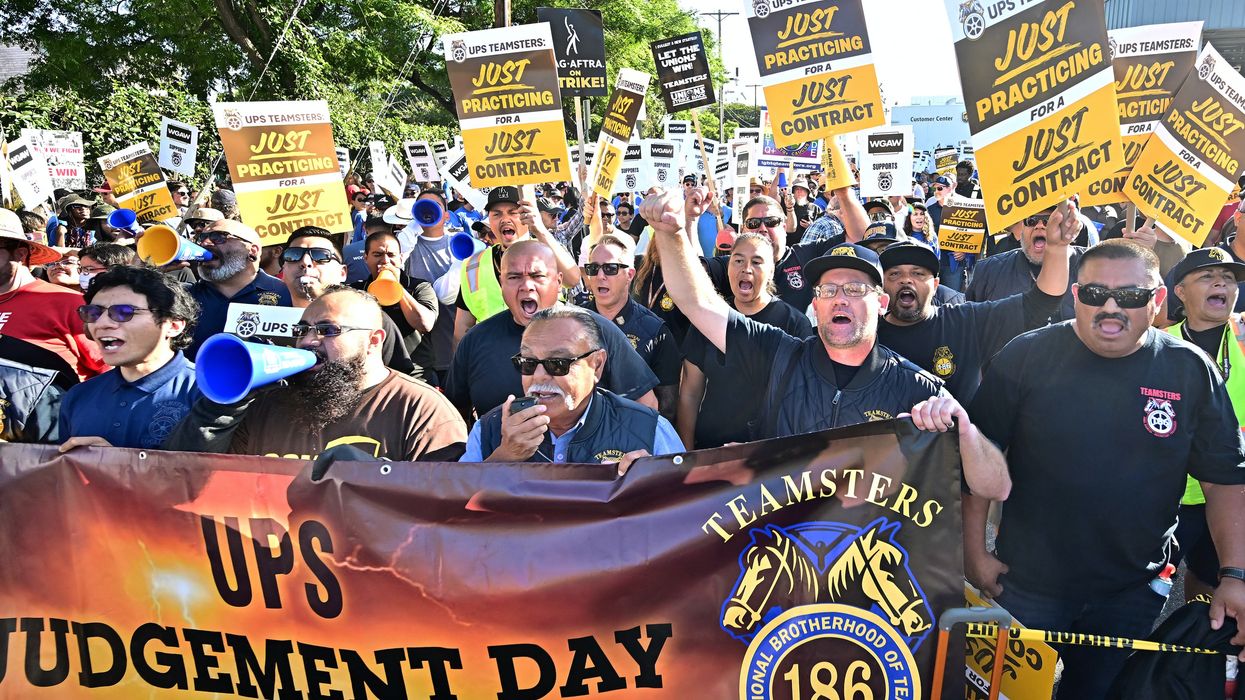
"This is the template for how workers should be paid and protected nationwide, and nonunion companies like Amazon better pay attention," said Teamsters president Sean O'Brien.
United Parcel Service workers in the International Brotherhood of Teamsters on Tuesday overwhelmingly ratified what the union called "the most historic collective bargaining agreement in the history of UPS," avoiding what experts said would have been a crippling strike.
Teamsters members voted by 86.3% to approve the new tentative contract, which raises wages for full- and part-time workers, creates more full-time jobs, and secures "important workplace protections, including air conditioning."
Both rank-and-file members and leaders of the 340,000-member union overwhelmingly approved the deal, with Teamsters leadership voting 161-1 in favor of the package.
"Our members just ratified the most lucrative agreement the Teamsters have ever negotiated at UPS. This contract will improve the lives of hundreds of thousands of workers," Teamsters general president Sean O'Brien said in a statement. "Teamsters have set a new standard and raised the bar for pay, benefits, and working conditions in the package delivery industry."
"This is the template for how workers should be paid and protected nationwide, and nonunion companies like Amazon better pay attention," he added.
Under the terms of the agreement, current full- and part-time UPS Teamsters will get $2.75 more per hour in 2023, with wage increases totaling $7.50 per hour over the length of the agreement. New part-time UPS employees will receive $21 per hour to start.
The contract includes new health and safety protections, including vehicle air conditioning and cargo ventilation. The deal also ends forced overtime on scheduled days off, makes Martin Luther King Day a full holiday for the first time, and commits to the hiring of 7,500 new full-time UPS employees.
"This is the richest national contract I've seen in my more than 40 years of representing Teamsters at UPS," Teamsters general secretary-treasurer Fred Zuckerman said. "There are more gains in this contract than in any other UPS agreement and with no givebacks to the company. But the hard work doesn't end here. We will continue to fight like hell to enforce this contract and make sure UPS lives up to every word of it over the next five years."
The final contract vote means a massive strike—an action 97% of Teamsters voted in June to take absent an agreement—will be avoided.
UPS CEO Carol Tomé said in a statement that "together we reached a win-win-win agreement on the issues that are important to Teamsters leadership, our employees, and to UPS and our customers."
"This agreement continues to reward UPS' full- and part-time employees with industry-leading pay and benefits while retaining the flexibility we need to stay competitive, serve our customers, and keep our business strong," she added.
Progressives and labor advocates cheered the new contract.
"Congratulations to the more than 340,000 UPS Teamsters on this historic contract!" Rep. Rashida Tlaib (D-Mich.) wrote on the social platform formerly called Twitter. "You have demonstrated the power of solidarity and collective action in the fight for livable wages and better working conditions for workers across our country."
Democratic Socialists of America posted: "As the result of a historic contract campaign, UPS Teamsters got a taste of how it felt to flex their power as workers. A working class with high expectations is a good thing for the union, for our labor movement, and for the struggle for workplace democracy and socialism."
The AFL-CIO said that "this historic win creates new jobs, secures crucial protections, and raises wages for all workers."
"Let's be clear: Teamsters won this through relentless organizing and a credible strike threat that showed UPS the power of collective action!" the union added. "Workers united will never be defeated!"
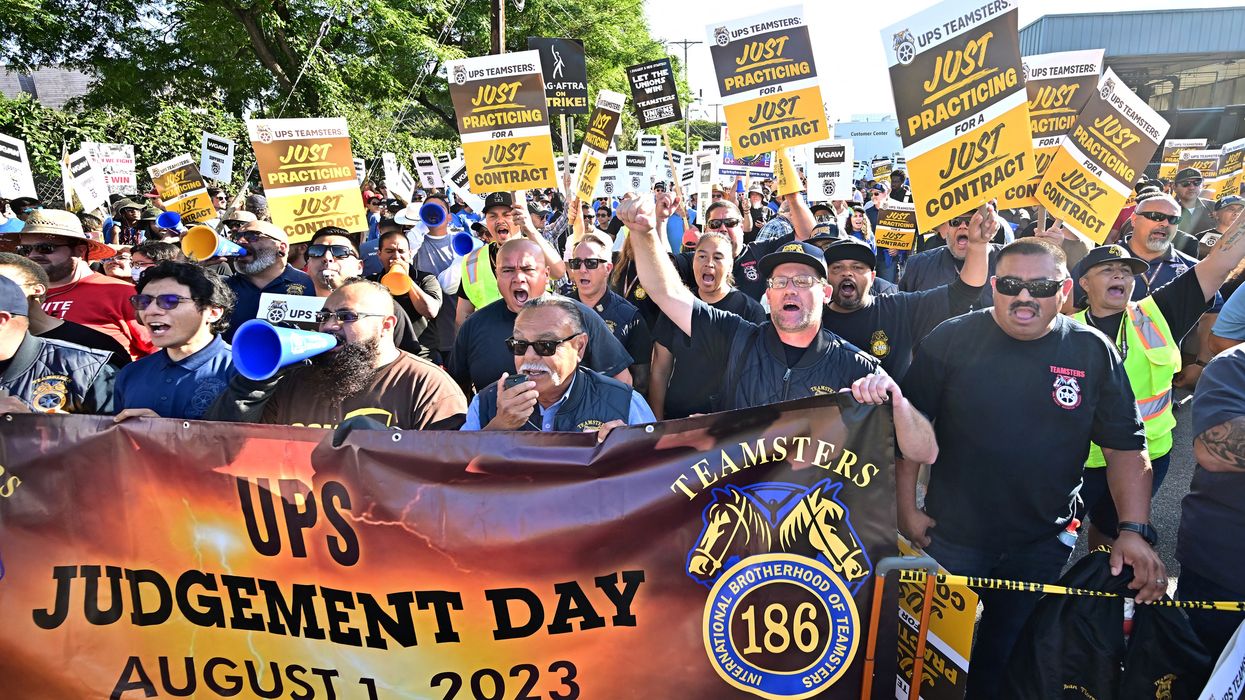
"All workers, including UPS Teamsters, deserve fair wages, safe conditions, and decent benefits," said Sen. Bernie Sanders. "If a bargaining agreement can't be reached, we will not intervene if UPS workers strike."
Two hundred members of the United States Congress have committed not to step in if United Parcel Service workers represented by the International Brotherhood of Teamsters go on strike next month.
Sen. Bernie Sanders (I-Vt.), who caucuses with the Democratic Party, and Sen. Sherrod Brown (D-Ohio) led 28 Senate Democrats in sending a letter to Teamsters president Sean O'Brien and UPS chief executive officer Carol Tomé on Wednesday. An identical letter signed by 164 House Democrats and eight House Republicans was addressed to the union leader and corporate executive on Monday.
"We are writing to strongly affirm support of our constituents' right to collectively bargain with their employer," the letter states.
The Teamsters union represents more than 340,000 UPS warehouse workers and delivery drivers nationwide. Last month, 97% of them voted to authorize a strike beginning on August 1 if a deal is not reached before their current five-year contract expires on July 31. It would be the second-largest work stoppage at a single employer in U.S. history, trailing only a 1970 strike of 400,000 General Motors workers.
"The Teamsters-UPS contract is the largest private collective bargaining agreement in North America, and given the recent increase in attacks on employees' collective bargaining rights, it is critical that these rights are in no way undermined in the current contract negotiations between Teamsters and UPS," wrote the 200 members of Congress. "Furthermore, we support the principles of fair wages, safe working conditions, affordable healthcare, and dignified retirement."
"UPS Teamsters play an essential role every day in delivering critical products across the country and keeping the American economy afloat," the lawmakers continued. "In addition to continuing to work throughout the Covid-19 pandemic, these workers moved a record amount of goods during this period to keep American families safe, healthy, and fed."
"We are hopeful that both sides can negotiate in good faith and reach a consensus agreement that addresses basic human needs and allows workers to do their jobs safely and with dignity," they added. "However, in the event a fair and equitable collective bargaining agreement cannot be reached, we commit to respect our constituents' statutory and constitutional rights to withhold their labor and initiate and participate in a strike."
The letter notes that "Congress has not previously intervened in recent history to implement a collective bargaining agreement between workers and their employer under the National Labor Relations Act, and we commit to not intervening in the collective bargaining process between Teamsters and UPS."
Because the signatories constitute a minority of Congress, the letter amounts to a symbolic gesture of solidarity. While the Teamsters welcomed it, the risk remains that federal lawmakers could impose a contract against the will of UPS workers.
If Congress stays out of the way and a strike occurs, President Joe Biden could invoke emergency provisions of the Taft-Hartley Act to end a UPS work stoppage, as former President Jimmy Carter did to break a coal miners' strike in 1978 and former President Ronald Reagan did to force striking air traffic controllers back to work in 1981.
On Sunday, during a UPS Teamsters members update webinar, O'Brien made clear that he has asked the White House on multiple occasions to stay away.
"My neighborhood where I grew up in Boston, if two people had a disagreement and you had nothing to do with it, you just kept walking," said O'Brien. "We don't need anybody getting involved in this fight."
In early December, Biden—the self-proclaimed "most pro-union president" in U.S. history—joined Congress to thwart a pending railroad worker strike using the Railway Labor Act, which covers the rail and airline industries but isn't applicable to UPS workers.
It remains unclear whether a UPS strike will happen. Negotiations have been at a standstill for weeks, with the Teamsters holding practice pickets around the country and the company, which raked in more than $100 billion in 2022, training scabs.
The practice rallies appear to have had an impact, as UPS contacted the Teamsters on Wednesday to restart contract talks.
"UPS bowed today to the overwhelming show of Teamster unity and reached out to the union to resume negotiations," the union announced. "The Teamsters National Negotiating Committee and the company will set dates soon to resume negotiations next week."
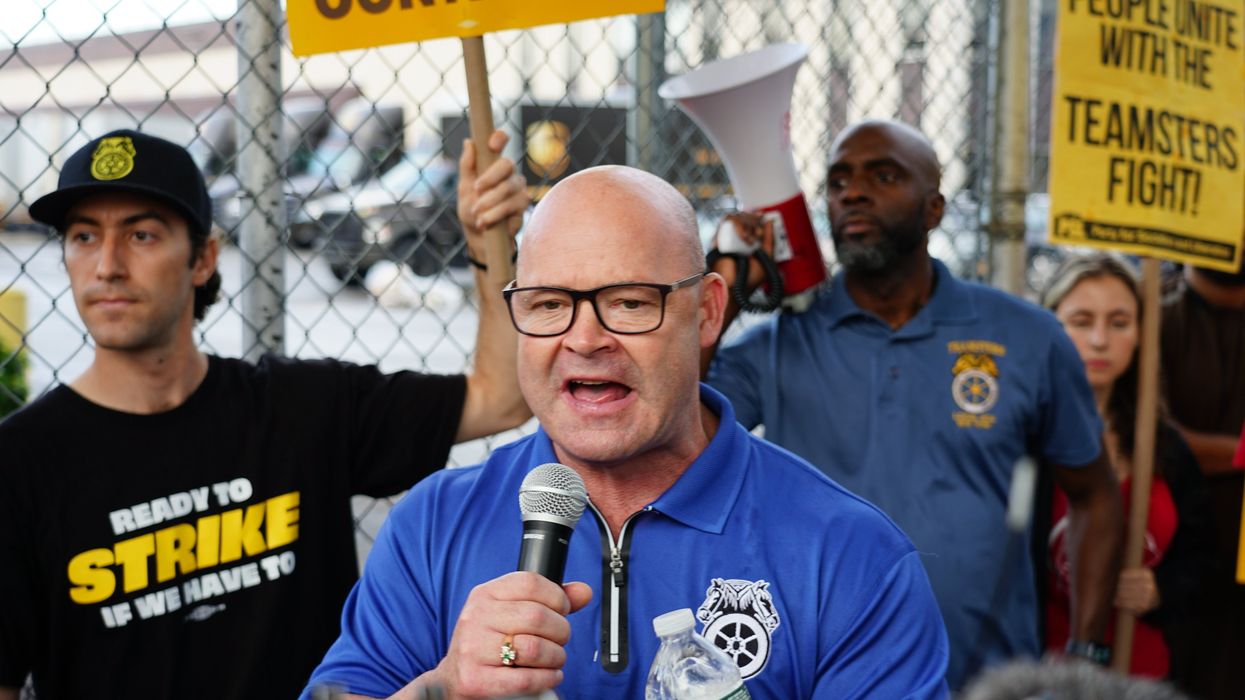
"UPS is making clear it doesn't view its workforce as a priority," the union said. "UPS should stop wasting time and money on training strikebreakers."
After negotiations between the United Parcel Service and the International Brotherhood of Teamsters broke down last week, UPS on Friday announced "business continuity training" to prepare for a potential strike by 340,000 union members next month.
"We remain focused on reaching an agreement with the Teamsters that is a win for UPS employees, our customers, our union, and our company," the shipping giant said. "While we have made great progress and are close to reaching an agreement, we have a responsibility as an essential service provider to take steps to help ensure we can deliver our customers' packages if the Teamsters choose to strike."
"Over the coming weeks, many of our U.S. employees will participate in training that would help them safely serve our customers if there is a labor disruption. This temporary plan has no effect on current operations and the industry-leading service our people continue to provide for our customers," UPS added, claiming that such activities "will not take away from our ongoing efforts to finalize a new contract" with union workers.
"UPS is not ready for the fury of 340,000 Teamsters."
Meanwhile, the Teamsters told The Associated Press on Friday that "UPS is making clear it doesn't view its workforce as a priority."
"Corporate executives are quick to brag about industry-leading service and even more quickly forget the Teamster members who perform that service," the union said. "UPS should stop wasting time and money on training strikebreakers and get back to the negotiating table with a real economic offer."
As the Teamsters
explained earlier this month, the union is fighting for a deal that "guarantees better pay for all workers, eliminates a two-tier wage system, increases full-time jobs, resolves safety and health concerns, and provides stronger protections against managerial harassment."
Last month, 97% of UPS workers represented by the Teamsters voted to strike if there is no deal by July 31. The union has been holding practice pickets, including one in Brooklyn, New York on Friday that was joined by Sean O'Brien, the Teamsters general president.
"For too long, this multibillion-dollar corporation has padded its bottom line with the unpaid wages of our members who sacrificed themselves and their families during the pandemic," O'Brien said at the event, according to the union. "UPS is not ready for the fury of 340,000 Teamsters."
After the Friday rally, O'Brien made clear that the union is still prepared to negotiate with UPS, telling Reuters that "the clock is on our side, not theirs. I assume at some point they'll be reaching out looking to try and get a deal."
The last strike by UPS workers represented by the union was in 1997 and is considered a major labor win in U.S. history. As Labor Notes recalled in 2017: "For 15 days, Teamsters shut down UPS nationwide. Managers struggled to make even a tiny fraction of deliveries... Out of options and running out of time, management surrendered on every key demand."
If the looming strike happens, "things could be a lot worse this time around, putting even more pressure on companies, consumers, and UPS. That's because the economy a quarter-century ago is entirely different than now—one where package delivery is more important than it's ever been," Vox reported Friday. "While competitors like FedEx and the U.S. Postal Service could pick up some of the deliveries, experts said logistics networks are too strained to fill many of the gaps that would be created."
"A 10-day strike would cost the economy more than $7 billion and be the costliest work stoppage in at least a century, according to a new
study by Anderson Economic Group, which researches labor disruptions," Vox noted. "That includes $4.6 billion in losses to consumers and businesses that rely on UPS, as well as more than a billion in lost wages and $800 million in company losses."
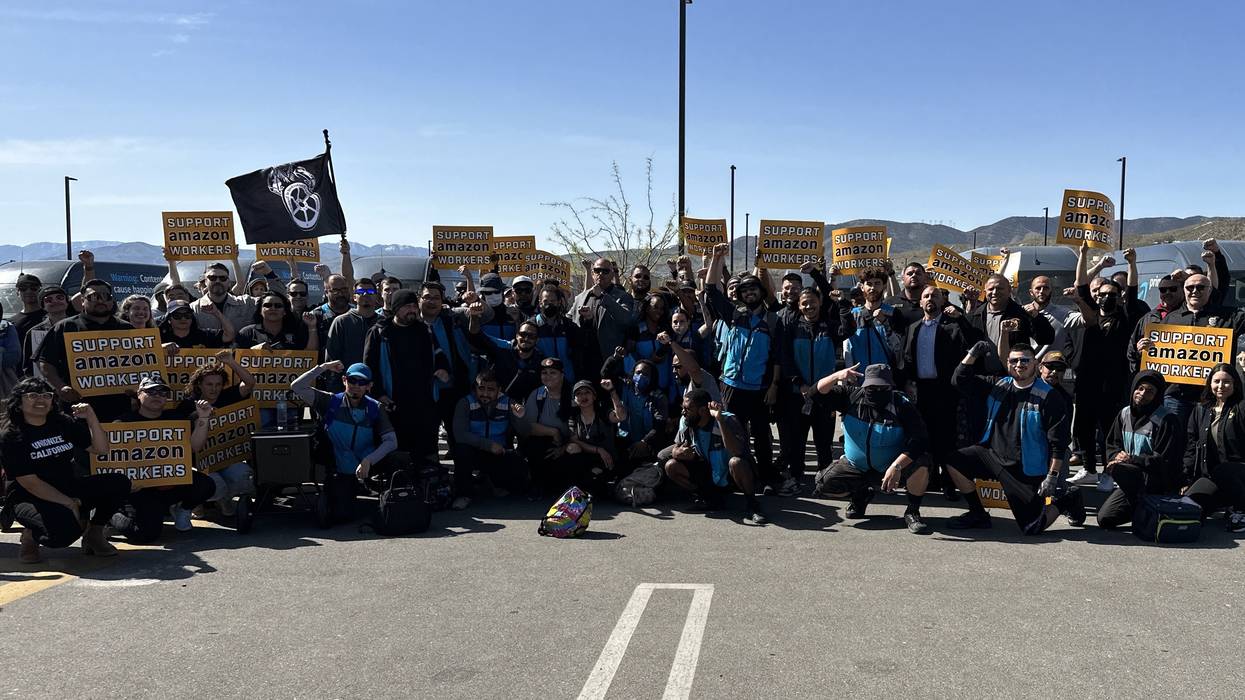
"We want fair pay and safe jobs, to be able to provide food for our families," said one driver. "We organized with the Teamsters to change our working conditions for the better."
In what the International Brotherhood of Teamsters on Monday called a "historic victory," 84 drivers and dispatchers in Palmdale, California have joined the union and reached a tentative deal with an Amazon "delivery service partner" that may be losing its contract with the online retail giant.
The contractor, Battle-Tested Strategies (BTS), voluntarily recognized the union, meaning workers can skip an election. However, the employees still need to vote on the agreement negotiated by Teamsters Local 396 and Joint Council 42, which includes pay increases, health and safety provisions, and a grievance procedure.
"Amazon workers are joining the Teamsters to demand more from this company, including good wages, safe working conditions, and respect," explained Randy Korgan, Teamsters Amazon division director and Joint Council 42 director of organizing.
"The Teamsters," Korgan continued, "are coordinating nationwide with Amazon workers, allies committed to holding this corporation accountable, and our union's 1.2 million members to make sure Amazon provides the benefits and protections that working people deserve."
Rajpal Singh, a driver in Palmdale, similarly stressed that "we want fair pay and safe jobs, to be able to provide food for our families. We want to know we will make it home to our families at night after delivering Amazon packages in the extreme heat."
"We organized with the Teamsters to change our working conditions for the better," Singh added. "We deliver in an Amazon van, wearing an Amazon uniform, but when we petition Amazon, they ignore us. We have a mass of support, we are a union, and now they need to listen."
Teamsters Local 396 secretary-treasurer Victor Mineros said that "I commend these workers for their courage to take on this greedy multibillion-dollar corporation," and "we are confident this will lead other Amazon workers nationwide to organize with the Teamsters."
Mineros also noted the historic nature of the development in California—which comes amid a unionization wave hitting other major corporations including Apple and Starbucks. While some Michigan-based drivers who worked for Silverstar Delivery voted to join the Teamsters in 2017, some union supporters were fired and the Amazon contractor ultimately shut down that location.
According to The Washington Post:
Johnathon Ervin, a veteran and the owner of Battle-Tested Strategies, said he decided to recognize the union after repeatedly asking Amazon to address his drivers' concerns about heat and vehicle safety. He currently receives $19.75 an hour to pay each driver, which he said prevents him from raising wages.
Over the past two summers, Battle-Tested Strategies drivers have had to deliver as temperatures have soared far above 100°F for multiple days in a row. One BTS driver was hospitalized for heat exhaustion last year, Ervin said.
[...]
Delivery routes, where drivers are expected to drop off between 250 to 400 packages, typically run 10 hours.
But when Ervin allowed drivers to end their shifts without completing their Amazon's delivery routes last year over what he said were health concerns, Amazon threatened to put Ervin on official notice that he could lose his contract, he said.
In a statement provided to multiple media outlets on Monday, Amazon spokesperson Eileen Hards said that "whether the Teamsters are being intentionally misleading or they just don't understand our business, the narrative they're spreading is false."
"This group of individuals do not work for Amazon," Hards said of the BTS employees. "Our delivery network is made up of thousands of independently owned and operated small businesses who provide delivery services for our company."
"This particular third-party company had a track record of failing to perform and had been notified of its termination for poor performance well before today's announcement," the spokesperson added. "This situation is more about an outside company trying to distract from their history of failing to meet their obligations."
Gizmodo reported Monday that Hards declined to offer specifics about the BTS contract—while Ervin told the outlet that "as far as I'm aware, my contract is legal until October 3, 2023," and denied having been given any notice about performance or termination.
"It's despicable" and an example of Amazon's "retaliation techniques" against unionizing workers, the BTS owner also told Gizmodo, referencing how the company has responded to union drives in places like Alabama and New York.
While his "lawyers are looking at all the information," BTS workers will "continue delivering packages," Ervin added. "That's the mission."
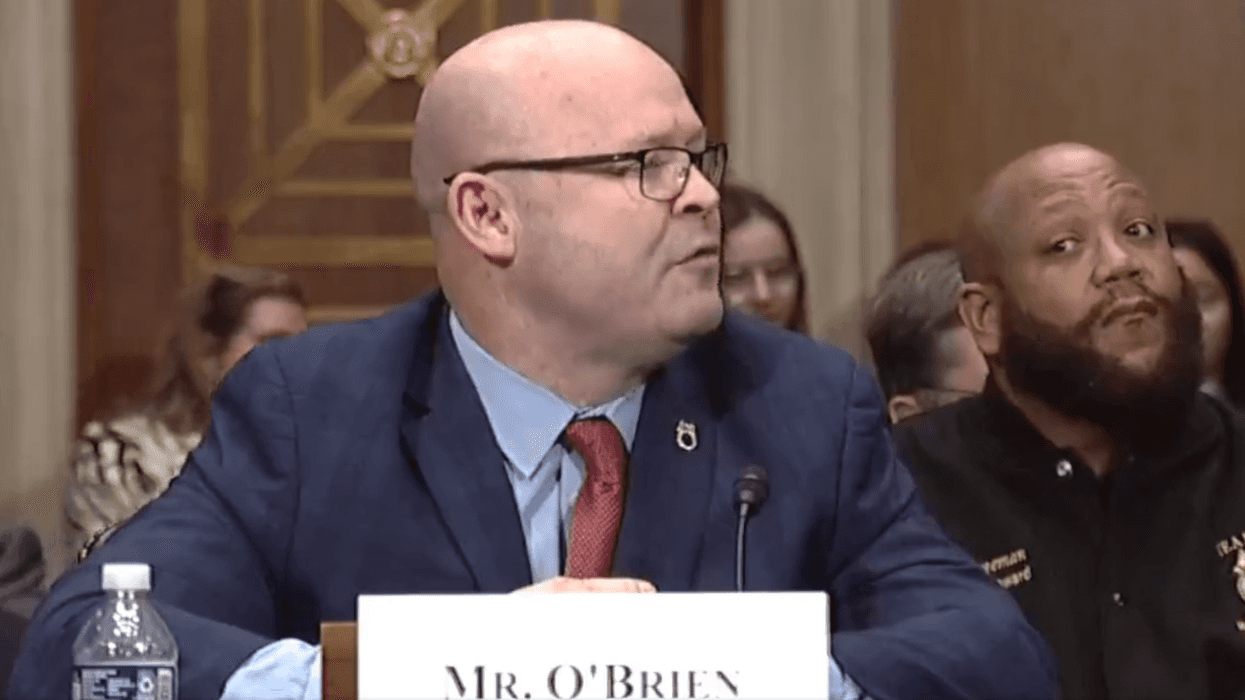
"Don't let them distract you," said Teamsters president Sean O'Brien. "Unions create jobs, make work safer, and put more money in workers' pockets."
Sparks flew at a congressional hearing Wednesday when International Brotherhood of Teamsters president Sean O'Brien told Republican Sen. Markwayne Mullin of Oklahoma—a multimillionaire whose family previously owned five non-union plumbing companies—that "we hold greedy CEOs like yourself accountable."
The exchange happened during a hearing convened by Sen. Bernie Sanders of Vermont—chair of the Senate Committee on Health, Education, Labor, and Pensions—titled "Defending the Right of Workers to Organize Unions Free from Illegal Corporate Union-Busting."
Watch:
Asked by O'Brien how much he made from his plumbing business, Mullin claimed, "I kept my salary down at about $50,000 a year because I invested every penny into it."
But in 2013, then-Rep. Mullin reportedly pocketed more than $600,000 from the companies in violation of House ethics rules and federal laws limiting how much outside income members of Congress are allowed to receive.
Although Mullin transferred ownership of the companies to his family, he continued to serve as a board member and chief advertiser while raking in hundreds of thousands of dollars.
As O'Brien pointed out on social media, Mullin saw his reported net worth surge from between $7.3 million and $29.9 million at the end of 2020 to between $31.6 million and $75.6 million after he sold his family's plumbing companies in late 2021.
"Don't let them distract you," O'Brien tweeted. "Unions create jobs, make work safer, and put more money in workers' pockets. Most importantly, everything we do is to improve the lives of our members. I wonder if some others can say the same about their constituents?"
Sanders, for his part, declared at the conclusion of Wednesday's hearing that "there's a class war going on whether we want to recognize it or not."
"People on top have the money, they have the power," said Sanders. "They're spending hundreds of millions of dollars to try to prevent ordinary workers from coming together to fight for dignity."