

SUBSCRIBE TO OUR FREE NEWSLETTER
Daily news & progressive opinion—funded by the people, not the corporations—delivered straight to your inbox.
5
#000000
#FFFFFF
To donate by check, phone, or other method, see our More Ways to Give page.
Daily news & progressive opinion—funded by the people, not the corporations—delivered straight to your inbox.
Israel, the US and the Islamic Republic of Iran must immediately cease or refrain from unlawful attacks on energy infrastructure, including facilities providing essential services such as electricity, heating and running water, said Amnesty International today, highlighting the risks of devastating civilian harm and environmental impact posed by such attacks.
In recent days Israeli-US air strikes have targeted multiple fuel storage and distribution facilities in Iran, and the Islamic Republic of Iran’s military has carried out attacks affecting fuel depots and oil and gas infrastructure in multiple Gulf states.
“The potential for vast, predictable, and devastating civilian harm arising from strikes targeting energy infrastructure, including uncontrolled deadly fires, major disruptions to essential services, environmental damage, and severe long-term health risks for millions, means there is a substantial risk such attacks would violate international humanitarian law and in some cases could amount to war crimes,” said Heba Morayef, Regional Director for the Middle East and North Africa at Amnesty International.
“Regardless of whether a military objective is cited to justify targeting energy infrastructure, under international humanitarian law all parties have a clear obligation to take all feasible precautions to reduce civilian harm and refrain from attacks that cause disproportionate death or injury to civilians or damage to civilian objects. This includes any foreseeable knock-on, indirect adverse effects on civilians’ life and health such as exposure to toxic chemicals.”
The potential for vast, predictable, and devastating civilian harm arising from strikes targeting energy infrastructure…means there is a substantial risk such attacks would violate international humanitarian law
Heba Morayef, MENA Regional Director
Under international humanitarian law, an oil refinery can be targeted only if it qualifies as a military objective, meaning it is being used to make an effective contribution to military action – for example by producing fuel for the attacking armed forces – and damaging it would yield a definite military advantage in the circumstances ruling at the time. Even if those two prerequisites exist, the attacking party must take all feasible precautions to avoid or minimize collateral damage to civilians, such as the release of toxic substances, and, before striking, consider whether any such damage would be excessive to the concrete and direct military advantage anticipated.
Attacks on oil depots in Iran
In Iran, horrifying video footage of the aftermath of Israeli-US attacks on several fuel depots, including in the neighborhoods of Shahran, Sohanak and Kouhak in Tehran and the city of Shahr-e Rey in Tehran province and Fardis in Alborz province, on 7 March shows massive flames and plumes of thick black smoke rising, as well as large uncontrolled fires damaging civilian areas. Eyewitnesses also described to Amnesty International chilling scenes of oil-tainted rainfall.
After the attacks Iran’s environmental agency and the Iranian Red Crescent Society advised people in Tehran to stay indoors warning of the risks posed by the spread of toxic chemicals that could cause acid rain as a result of the air strikes.
The Israeli military has issued a statement confirming they carried out attacks on “a number of fuel storage facilities in Tehran”, saying they were used by the Islamic Republic of Iran’s military “to operate military infrastructure”.
“We are deeply alarmed at the potential impact of these attacks on the civilian population. Medical warnings about hazardous materials and toxic substances being released into the air, put millions of people in Tehran at risk of serious health complications, including cancer, lung and respiratory diseases and skin burns. States are bound to uphold social and economic rights during both peacetime and armed conflict,” said Heba Morayef.
An informed source in Tehran told Amnesty International that residential buildings around the oil depots in Shahran were damaged, leaving some people homeless.
An eyewitness told Amnesty International “The sky over Tehran was black today [8 March]. Then black rain started to fall. The ground everywhere has turned black, as if a layer of light cement had been poured over.”
Another eyewitness said on 8 March “This morning, the air was pitch black. It is daytime, but it’s dark like night. The city is full of soot. I went outside. It was raining a little, and my hands became black immediately. Soot is falling from the sky. It is terrifying.”
On 8 March, the Political Deputy Provincial Governor of Alborz province, Ghodratollah Seif, announced that the strike on the oil depot in Fardis killed at least six people and injured 21 others, including nearby residents. On 9 March, the president of Alborz University of Medical Sciences said that a dialysis center near the oil depot in Fardis was destroyed in the ensuing fire.
Attacks on energy infrastructure in Iran risk compounding the suffering of a population traumatized by massacres at the hands of the Islamic Republic authorities and who have already endured years of declining access to electricity, water, clean air, and a safe environment due to chronic state mismanagement and systemic violation of the people’s human right to take part in public affairs. These grievances, along with severe political repression, have been at the heart of successive nationwide protests, including most recently in January 2026, demanding human rights, dignity, and downfall of the Islamic Republic system.
Attacks on oil infrastructure in Gulf countries
Since 28 February, multiple attacks affecting energy infrastructure have been reported in Gulf Cooperation Council countries. The Iranian foreign minister, Abbas Araghchi, has said that its forces are “attacking American bases, American installations, American assets” that were “unfortunately” based in their Gulf neighbouring countries, while the head of parliament, Mohammad Bagher Balifar, proclaimed that “as long as US bases exist in the region, countries will not see calm”.
Officials from Saudi Arabia, Qatar, UAE, Bahrain and Kuwait have said that Iranian drones and missiles have directly targeted oil and gas facilities in Gulf states, and that in other cases debris from intercepted attacks affected facilities. Governments across the Gulf severely restrict access to information and expression, which impedes reporting on the direct effects of attacks.
In Qatar, on 2 March, Qatari Ministry of Defence stated that Iranian drones had targeted energy facilities in the Ras Laffan Industrial City, Qatar’s main liquefied natural gas (LNG) export hub, but no casualties were reported. Following the attack, Qatar Energy suspended LNG production and declared force majeure, according to Reuters and Bloomberg News citing informed sources .
On 7 March, the Saudi Ministry of Defence announced that 21 drones headed toward Aramco’s Shaybah field, one the Kingdom’s largest oil fields, and includes facilities that produce natural gas liquids used in the petrochemical industry, in several waves were intercepted and destroyed in the Empty Quarter.
In Kuwait, on 7 March, a spokesperson for the Kuwait Ministry of Defence said that drones targeted fuel tanks at Kuwait International Airport.
In Oman, on 1 March, state media reported that two drones struck the commercial port in Duqm on the eastern coast, injuring one foreign worker. On 2 March, state media stated that a drone strike targeted an oil tanker off the coast of Muscat, killing one Indian crew member.
Fires have broken out at a number of facilities, which officials speaking to the media have attributed either to missile attacks or debris from drone interceptions. In some cases, state-owned fossil fuel companies have reported suspending production or shipments after attacks.
In Bahrain, on 5 March, a fire broke out in one of the refinery units of the state-owned Bapco Energies as a result of an Iranian missile attack, according to Bahrain News Agency. The company declared force majeure on its oil shipments.
In Saudi Arabia, on 2 March, the Saudi Ministry of Defense stated that two drones attempting to target the Saudi Aramco Ras Tanura oil refinery in the Eastern Province were intercepted, and the falling debris ignited a fire inside the facility.
In the UAE, on 10 March a fire broke out at Ruwais Industrial Complex in Abu Dhabi following a drone attack, according to Reuters. Fires also broke out at Musaffah fuel tank terminal on 2 March after it was targeted by a drone and at an oil industry zone in Fujairah on 3 March, after debris from a drone interception caused a fire.
On 9 March, the official Kuwait News Agency reported that drone debris caused a fire in a fuel tank at Al Subiya power plant.
In addition to attacks on the Gulf states, commercial shipping through the Strait of Hormuz has come to an almost complete halt. On 10 March, the High Commissioner for Human Rights warned that the plunge in commercial shipping was already having a severe impact on access to “energy, food and fertilizer for people in the region and beyond,” and that an oil price surge would have economic and social knock-on effects. He once again called for investment in renewable energy.
“Attacks on or severely affecting fuel supply and distribution networks can trigger food insecurity, as these systems currently play a critical role in transportation, the goods supply chain, and industrial activity. All parties must ensure they are refraining from any unlawful attacks and place the protection of civilians at the forefront of all military decisions,” said Heba Morayef.
Background
According to Iranian officials, at least 1,255 people have been killed in Iran since 28 February when US-Israeli attacks began. At least 17 people have been killed in the Gulf since Iran began its attacks on Gulf countries (two in Bahrain; six in Kuwait; one person in Oman; two in Saudi Arabia; and six in the UAE). Eleven out of the 17 people are foreign nationals from India, Iran, Indonesia and Bangladesh amongst other countries residing in the UAE, Saudi Arabia, Kuwait, Oman and Bahrain according to official state media reports. A least 570 people have been killed in Israeli attacks in Lebanon according to the authorities. At least 12 people have been killed by attacks in Israel according to media reports.
Orders from Commission rubber stamp agreements with zero guaranteed protection for consumers
The Federal Energy Regulatory Commission (FERC) last night issued orders that approved transmission rate agreements with data centers that explicitly put households at risk for hikes in the rates they pay for electricity.
The FERC orders approved bilateral electric transmission rate agreements between Exelon’s ComEd utility and five different data centers, four of which Public Citizen intervened as a party (PowerHouse, owned by American Real Estate Partners; Tract’s Grundy County Power in Morris, Illinois; Equinix; and Blackstone’s QTS).
In response, Tyson Slocum, director of Public Citizen’s Energy Program, issued the following statement:
“The Commission’s orders show what a total sham Trump’s Big Tech pledge is for protecting consumers. These reckless FERC orders are designed to quickly rubber stamp agreements with utilities and data centers with zero guaranteed protection that household consumers won’t be exposed to unjust and unreasonable price hikes.
“As acknowledged in Commissioner Judy Chang’s concurrence in support of the order, FERC’s acceptance of the transmission rate agreements rely on the fact that they were between ‘sophisticated parties who negotiated them freely at arm’s length,’ but did not investigate whether the contracts themselves could result in unjust and unreasonable cost shifts onto other customers such as households.
“While the agreements between the utility and the data centers result in the data centers making certain financial payments that attempt to cover the utility’s revenue requirements, Chang’s concurrence plainly concludes that they do not insulate rate hikes for household consumers should those costs change during the duration of the agreement. Utility obligations and commitments within its service territory can change dramatically – especially with the onslaught of data centers – where the estimated revenue requirements negotiated today could prove insufficient in the near future, exposing households to rate hikes from any revenue shortfall. All FERC had to do was hold formal hearings and investigate any needed changes to ensure households would be protected. Instead, FERC rushed the orders in order to prioritize expediency for data center developers at the expense of protecting consumers.
“Last night’s orders expose FERC and the Trump administration unprepared and unwilling to address America’s energy affordability crisis.”

Pentagon Secretary Pete Hegseth "should be potentially charged and prosecuted for war crimes," said the advocacy group Just Foreign Policy.
The preliminary findings of a Pentagon investigation into the deadly bombing of an Iranian elementary school reportedly indicate that the US was responsible for the massacre—and that the building was intentionally targeted.
The findings, reported by The New York Times on Wednesday, further undercut President Donald Trump's lie that Iran carried out the February 28 strike, which killed at least 175 people—mostly children. According to the Times, US investigators determined that the strike on the girls' school in the southern Iranian city of Minab "was the result of a targeting mistake by the US military, which was conducting strikes on an adjacent Iranian base of which the school building was formerly a part."
"Officers at US Central Command created the target coordinates for the strike using outdated data provided by the Defense Intelligence Agency," the Times reported, citing unnamed people briefed on the investigation. "Officials emphasized that the findings are preliminary and that there are important unanswered questions about why the outdated information had not been double checked."
In a social media post reacting to the new reporting, Sen. Elizabeth Warren (D-Mass.) wrote that the Iranian school massacre is "one of the most devastating military errors in decades."
"Trump lied about it. [Pentagon Secretary] Pete Hegseth gutted the office preventing civilian casualties. 175 are dead. Most were kids," wrote Warren. "Hegseth should be fired."
The advocacy organization Just Foreign Policy wrote in response to Warren, "Hegseth should be potentially charged and prosecuted for war crimes."
The Times' story is consistent with earlier reporting on internal Pentagon findings, US-marked missile fragments collected from the scene, video footage, outside investigations by news outlets, and analysis by human rights groups.
Al Jazeera concluded after examining satellite imagery, video footage, and other material that "either the bombing of the school was the result of a grave intelligence failure caused by reliance on outdated databases that did not keep pace with successive changes in the complex’s layout, or it was a deliberate strike based on a linkage that treats the school as part of the military system."
"Could be criminal negligence in a war that was illegal to begin with."
The Minab school appears to have been separated from the Iranian Navy compound a decade ago, NBC News reported last week.
Kenneth Roth, former executive director of Human Rights Watch, wrote in response to the Times' reporting that the Trump administration should not be allowed to get away with blaming the massacre on old targeting information.
"'Outdated data' is not an adequate explanation for why the US military attacked a girls' school in Iran, killing 175, mostly girls," Roth wrote on social media. "Why wasn’t the data updated before the attack? Do Iranian civilian lives not matter?"
Richard Painter, an attorney who served as the chief ethics lawyer in the George W. Bush White House, said the apparent US strike "could be criminal negligence in a war that was illegal to begin with."
Speaking to reporters aboard Air Force One this past weekend, Trump said definitively—and without any evidence—that the school massacre "was done by Iran."
"They are very inaccurate, as you know, with their munitions," the president said. "They have no accuracy."
But arms experts have argued that all available evidence indicates a precision attack, not an errant missile.
“The targeting of this site is incredibly accurate,” Jeffrey Lewis, an expert in arms control and open-source intelligence, told NBC News. “The explosion damage is incredibly precise, and it doesn’t look like really anything missed, so that would tend to argue for precision munitions delivered by aircraft.”
Rich Weir, senior adviser of the Crisis, Conflict and Arms Division at Human Rights Watch, told the outlet that “the number of individual strikes across the compound and the apparent accuracy with which they appear to have struck individual structures across the compound, shown in part through the relatively small circular holes that were points of entry for the munitions on multiple rooftops, indicate that the attack struck multiple structures on the compound base with highly accurate, guided munitions.”
The Times' reporting came shortly after every member of the Senate Democratic caucus except Sen. John Fetterman (D-Pa.) wrote a letter to Hegseth demanding a "swift" and transparent investigation into the school massacre.
"The findings must be released to the public as soon as possible, along with any measures to pursue accountability," the senators wrote.
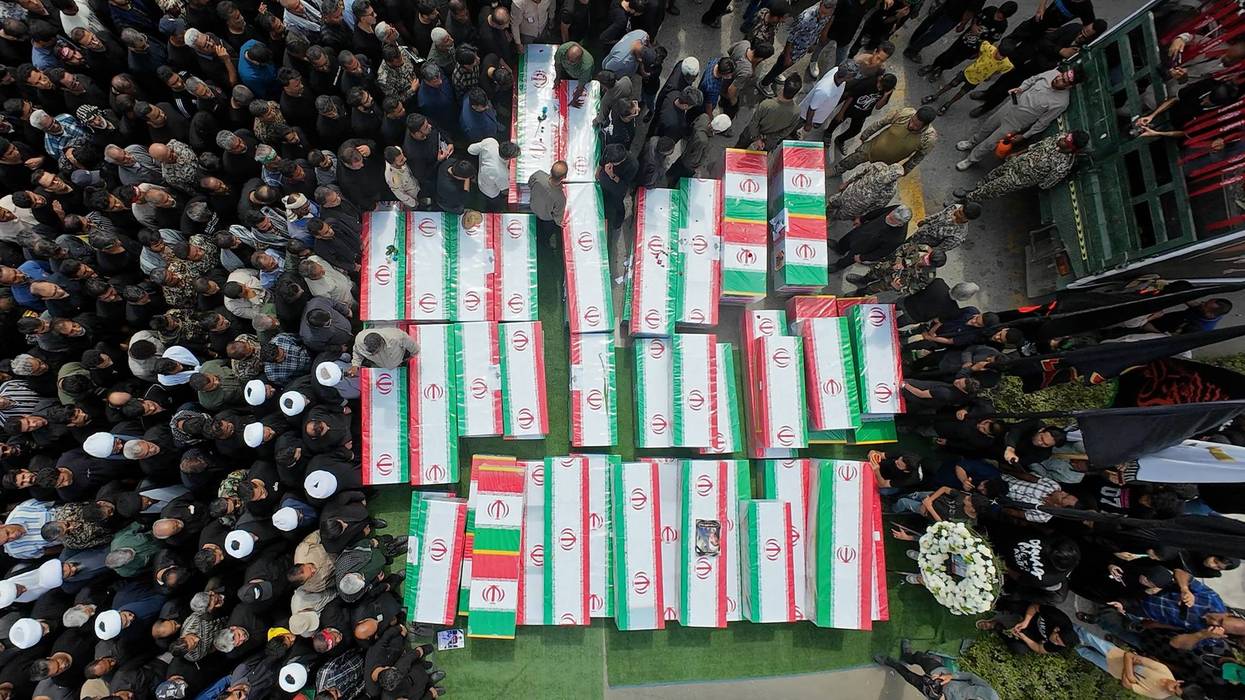
An ongoing US military probe has determined that the United States launched the Tomahawk missile attack that killed around 175 people—mostly children—in Minab on the first day of the war on Iran.
A Republican senator apologized this week for what US military investigators have reportedly determined was an American missile strike on a girls' school in southern Iran that killed around 175 people—mostly children—amid continued sidestepping by President Donald Trump, who has blamed Tehran for the massacre.
Sen. John Kennedy (R-La.)—who supports the US-Israeli war on Iran—first apologized for the attack on the Shajareh Tayyebeh girls’ elementary school in Minab during a Monday interview with NBC News senior national political reporter Sahil Kapur.
"It was terrible," Kennedy said. "We made a mistake... I'm just so sorry it happened."
Kennedy repeated his apology Tuesday on CNN, telling political correspondent Kasie Hunt: "The investigation may prove me wrong. I hope so. The kids are still dead, but I think it was a horrible, horrible mistake. I wish it hadn't happened. I'm sorry it happened."
1. GOP Senator John Kennedy on why he felt it was important to apologize and acknowledge the truth about the bombing of a school in Minab, Iran, which multiple reports indicate was caused by a U.S. military targeting error.
[image or embed]
— Yashar Ali 🐘 (@yasharali.bsky.social) March 10, 2026 at 4:51 PM
Reuters first reported last week that US military investigators believe American forces carried out the school strike, a preliminary conclusion that came on the heels of a New York Times analysis that found the US was “most likely to have carried out the strike" due to its near-simultaneous bombing of a nearby Iranian naval base.
This week, Iranian officials displayed fragments from what is believed to be the Tomahawk missile used in the school bombing. The remnants were marked with the names of two US arms companies, a Pentagon contract number, and the words "Made in USA."
On Wednesday, Tfhe New York Times reported that the ongoing military probe has determined that the US launched the Tomahawk strike, which paramedics and victims' relatives said was a so-called "double-tap," in which the attacker bombs a target and then follows up with a second strike meant to kill survivors and first responders. Investigators attribute the strike to a "targeting error," according to the Times.
This, as Trump—who warned as his illegal war started that "bombs will be dropping everywhere"—continued sidestepping blame for the attack.
On Saturday, Trump said aboard Air Force One that "based on what I’ve seen, that was done by Iran.”
Two days later, the president falsely claimed that Iran has "some" Tomahawk missiles and may have used one of them to bomb the school. Iran has no Tomahawks—which are highly restricted and sold only to a handful of close allies—and the US does not sell weapons to the Iranian government, with the notable exception of the Iran-Contra Affair, when the Reagan administration secretly sold arms to Tehran in order to fund anti-communist Contra terrorists in Nicaragua.
Other senior Trump administration officials including Defense Secretary Pete Hegseth and US Ambassador to the United Nations Michael Waltz have declined to back the president's claims and have instead deferred to the ongoing military investigation.
Kennedy told NBC News and CNN that the school bombing was unintentional.
"Other countries do that sort of thing intentionally, like Russia," he told Kapur. "We would never do that intentionally."
Since then-President George W. Bush launched the so-called Global War on Terror following the September 11, 2001 attacks on the United States, more than 430,000 civilians have been killed in over half a dozen countries, according to the Costs of War Project at Brown University's Watson Institute for International and Public Affairs.
In 2020, the Costs of War Project reported a 330% rise in civilian casualties in Afghanistan following the first Trump administration's move to loosen military rules of engagement meant to protect noncombatants. While campaigning for president in 2016, Trump infamously vowed to "bomb the shit" out of Islamic State militants and "take out their families"—a war crime—and after his election he ramped up bombing of Syria, Iraq, Afghanistan, and other countries, killing thousands of civilians.
The Biden administration subsequently attempted to tackle the issue, publishing the Civilian Harm Mitigation and Response Action Plan (CHMR-AP), which laid out a series of policy steps aimed at preventing and responding to the death and injury of civilians.
However, since returning to office, Trump has effectively sidelined the plan. Prioritizing "lethality," Hegseth said at the outset of the current war that US forces won't be bound by "stupid rules of engagement."
Israel, which is bombing Iran along with US forces while simultaneously striking Lebanon and Gaza—where more than 250,000 Palestinians have been killed or wounded during 29 months of genocidal war—dramatically loosened its rules of engagement following the October 7, 2023 Hamas-led attack, effectively allowing for an unlimited number of civilian deaths in any strike targeting any member of the militant resistance group, no matter how low-ranking.
According to leaked Israel Defense Forces data, 5 in 6 Palestinians killed by the IDF through the first 19 months of the US-backed war were civilians.
Hundreds of Iranian and Lebanese civilians have been killed by US and Israeli attacks since February 28. US and Israeli use of artificial intelligence systems to select bombing targets exponentially faster than any person has also raised concerns regarding a lack of meaningful human oversight. One former IDF officer said AI enabled a "mass assassination factory" in Gaza.
Last year's US and Israeli attacks on Iran also killed hundreds of civilians, according to the group Human Rights Activists in Iran.
Kennedy's apology—which some observers dismissed due to the senator's support for the war and rejection of a war powers resolution meant to limit Trump's ability to attack Iran without the legally required congressional approval—is still notable, as US leaders, and especially Republicans, are usually highly reluctant to say they're sorry for civilian deaths.
For example, after the USS Vincennes accidentally shot down Iran Air Flight 655 in 1988, killing all 290 civilians aboard, then-Vice President George H.W. Bush—who was running for president—infamously declared, "I'll never apologize for the United States of America, ever; I don't care what the facts are."
The history of US-Iran relations they don’t teach you:
A month after the US shot down Iran Air Flight 665, killing 290 passengers, George H.W. Bush proudly declared:
“I’ll never apologize for the United States, I don’t care what the facts are.” https://t.co/1nNvIYR9MX pic.twitter.com/iFa3Ydh4Fo
— Afshin Rattansi (@afshinrattansi) February 25, 2026
Two years later, Bush, then president, awarded the Vincennes officer in charge of air warfare a commendation medal for the “heroic achievement” of "quickly and precisely" downing the civilian airliner. The ship's captain was also honored with the Legion of Merit for his “outstanding service.”