

SUBSCRIBE TO OUR FREE NEWSLETTER
Daily news & progressive opinion—funded by the people, not the corporations—delivered straight to your inbox.
5
#000000
#FFFFFF
To donate by check, phone, or other method, see our More Ways to Give page.
Daily news & progressive opinion—funded by the people, not the corporations—delivered straight to your inbox.
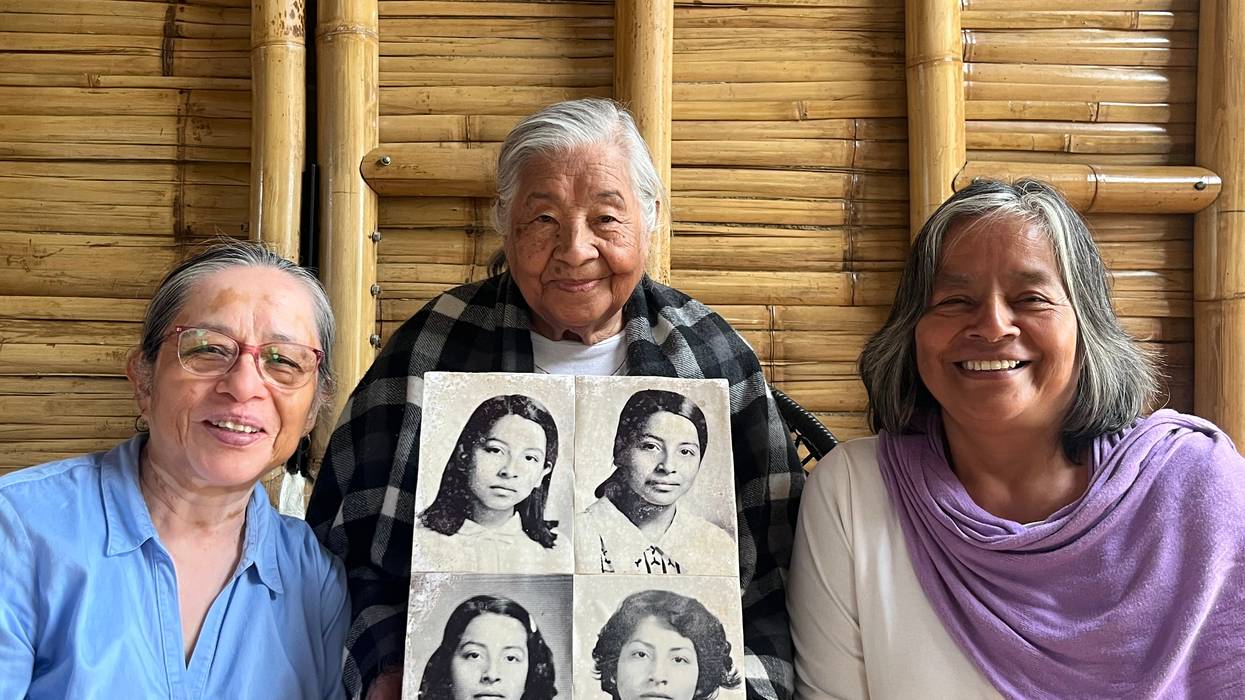
More than 44 years have now passed since Guatemalan state forces abducted Luz Leticia; every day since, her sisters have fought to preserve the truth and dignity of her life while demanding answers.
Under the beating sun on the morning of June 21, Mirtala del Rosario Hernández Agustín joins families of the disappeared and members of organizations including the Association of Family Members of the Detained and Disappeared in Guatemala, or FAMDEGUA, and Sons and Daughters for Identity and Justice against Oblivion and Silence, or HIJOS, in Guatemala City’s Plaza de la Constitución to commemorate the National Day Against Enforced Disappearances.
“We dream of a different Guatemala, and we fight for it. We cannot sit back and cross our arms. We have a person detained and disappeared.” Mirtala’s voice carries across the plaza. Behind her sit more than 400 empty chairs, each bearing the portrait of someone forcibly disappeared during Guatemala’s 36-year internal armed conflict. “I am the sister of Luz Leticia Hernández Agustín,” she continues. “To have peace in my heart, to be able to say we’ve been heard, we need my sister's remains returned.”
More than 44 years have now passed since Guatemalan state forces abducted Luz Leticia on November 22, 1982. It was her 25th birthday. And it was the last time she was seen.
Yet her sisters, Marta and Mirtala, refused to let her vanish completely. Every day since, they have fought to preserve the truth and dignity of Luz Leticia’s life while demanding answers not only for her, but for the tens of thousands who were disappeared, tortured, and killed during Guatemala’s US-backed campaign of state terror and genocide.
No amount of political power can permanently shield perpetrators from the demands for truth and justice made by the people they sought, and ultimately failed, to erase.
Now, their case is finally being heard in court. Three days a week, the Hernández Agustín sisters climb the stairs to the fifth floor of Guatemala City’s Palace of Justice. They sit through hours of testimony and legal argument, filling notebooks with observations and listening for the answers that have eluded their family for decades. Some days sting with the reopening of old wounds. Others dissolve into procedural delays, technical difficulties, and bureaucratic legal wrangling. They often leave frustrated and exhausted.
Still, they return. They do so because this case is about more than one family’s pursuit of justice. At a time when the United States is escalating violence at home and abroad, and governments like Guatemala’s continue to subordinate themselves to the imperatives of that long-standing imperial project, this trial carries particular significance. Most recently, this has included expanded military cooperation with Washington targeting alleged drug cartels in the country, a justification the US has invoked to extrajudicially kill more than 210 people over the past nine months.
The trial has therefore become a testament to all those who refused the silence imposed upon them. It is proof that those marked for erasure can reclaim their place in history. Above all, it is a reminder that no amount of political power can permanently shield perpetrators from the demands for truth and justice made by the people they sought, and ultimately failed, to erase.
The Guatemala into which the Hernández Agustín sisters were born bore the unmistakable imprint of empire. It was a country of staggering inequality, where generations inherited the desiccated remains of a nation picked clean by the vultures of foreign capital. The promise of reform had long since been extinguished. Gone was the Democratic Spring, the brief decade from 1944 to 1954 when popularly elected governments sought to expand democracy and direct the country’s wealth toward its people rather than multinational corporations and the landed oligarchy.
That dream was crushed with the 1954 CIA-backed overthrow of President Jacobo Árbenz. The coup sought not simply to remove a government but to restore the deeply unequal social order whose foundations had been laid under the dictatorship of Jorge Ubico. A pliant strongman who willingly auctioned off his country’s future to the highest bidder, Ubico granted sweeping concessions to US corporations while enriching himself. Under his rule, the Boston-based United Fruit Company became Guatemala’s largest landholder, acquiring more than 40% of its arable land and near-monopolistic control over not only its lucrative banana exports but also critical infrastructure, including the country's railroads and electrical network.
The threat posed by the Democratic Spring was not simply that it had challenged landowners and foreign corporations. It had shown workers, peasants, and Indigenous communities that collective action could transform society.
Ubico’s regime collapsed in 1944 with a popular uprising. Under elected Presidents Juan José Arévalo and then Árbenz, Guatemala embarked on an ambitious reform program. Building on Arévalo’s efforts, Árbenz expanded labor protections, social security, and universal suffrage while pursuing economic modernization that sought to transform Guatemala from what he referred to as “a semi-colonial dependency into an independent nation” and “a predominantly feudal economy into a modern capitalist state.”
It was this challenge to entrenched economic power that placed Árbenz in the crosshairs of both Washington and Wall Street. The flash point was Decree 900, his sweeping agrarian reform. The measure authorized the expropriation of uncultivated large estates, including United Fruit’s vast holdings, for redistribution to hundreds of thousands of peasants. Remuneration would be based on the value the company itself had declared, a figure it had deliberately undervalued to reduce its tax burden. While the reform was rooted in economic nationalism and guaranteed compensation for the land, officials in Washington cast it as evidence of communist subversion.
Secretary of State John Foster Dulles and CIA Director Allen Dulles, both closely tied to United Fruit, orchestrated Árbenz’s overthrow. The coup ended Guatemala’s democratic experiment and ushered in decades of military rule, repression, and civil war.
The dictatorship that emerged in the wake of the coup gave rise to a popular insurgency determined to reclaim the democratic aspirations that had been violently swept aside. It also ushered in a new era of repression. For Guatemala’s military rulers, the objective was to preserve their power. For their patrons in Washington, Guatemala became a Cold War proving ground, meant to demonstrate the consequences of challenging US political and economic power.
The threat posed by the Democratic Spring was not simply that it had challenged landowners and foreign corporations. It had shown workers, peasants, and Indigenous communities that collective action could transform society. That lesson had to be unlearned. In its place, they sought to teach another: that any attempt to remake Guatemala would be met with overwhelming violence. Terror became the principal pedagogy of the state.
From 1960 to 1996, Guatemala’s internal armed conflict claimed roughly 200,000 lives and left another 45,000 disappeared.
Repression failed to extinguish resistance. In 1960, dissident military officers launched an uprising against the regime. After it was crushed, many of its survivors retreated to the countryside, where they helped form the Rebel Armed Forces (FAR), the first of several guerrilla organizations. The state responded with a brutal, US-backed counterinsurgency waged through roving death squads, systematic torture, forced disappearances, and indiscriminate targeting of suspected dissidents.
Rather than destroying the insurgency, the violence pushed it deeper into rural Guatemala, where Indigenous Maya communities and peasant organizers assumed an increasingly central role in new guerrilla organizations. By the late 1970s, the military had embraced a genocidal scorched-earth campaign, particularly against the Ixil Maya. Entire communities were treated as inherently subversive. The objective was no longer simply to defeat guerrillas but to destroy the social fabric that sustained Indigenous life.
Villages were razed. Thousands were massacred. Survivors were displaced or forced into tightly controlled “model villages” under a policy known as Palestinianization, where military authorities sought to erase Indigenous languages, traditions, religious practices, and communal life in the name of anti-communist pacification and national modernization.
From 1960 to 1996, Guatemala’s internal armed conflict claimed roughly 200,000 lives and left another 45,000 disappeared. The bloodiest paroxysm of violence came between 1981 and 1983, when security forces killed an estimated 100,000 people, overwhelmingly Indigenous Maya, in a genocidal campaign that journalist Vincent Bevins has referred to as “the largest bloodbath unleashed by the Cold War in the Western Hemisphere.” The atrocities unfolded with US training and the material and diplomatic backing of the Reagan administration, which viewed Guatemala as a critical front in its campaign against leftist movements across Latin America, alongside its support for the Contras in Nicaragua and allied security forces in El Salvador and Honduras.
Luz Leticia Hernández Agustín, or Leti, as her sisters call her, was one of the many lives cut short by the Guatemalan state during this period of extreme violence. As the eldest sibling, she occupied an outsized place in her family’s life. Marta and Mirtala remember her as hardworking, intelligent, and deeply compassionate. In a household, and community, marked by intense economic precarity and hardship, she assumed responsibilities well beyond her years, helping care for her younger siblings and easing whatever burdens she could.
This experience shaped Leti’s politics. She came to understand that centuries of colonial conquest had produced enduring systems of racism, dispossession, and exploitation that were still being felt. “Leti could see all of that,” Marta explains. “All the deep-seated wrongs that have persisted for so long.” She imagined a different Guatemala, one where those structures no longer defined people's lives and where everyone, regardless of ethnicity or social standing, could live with dignity.
Leti’s sisters have never abandoned their search for truth and justice, nor their determination to affirm their sister’s existence.
Her commitment extended beyond her immediate family. As Mirtala recalled, Leti was motivated certainly “by her own experiences, and the way our parents lived,” but equally “by the suffering she witnessed among our people.” Despite all the evidence seemingly to the contrary, she never surrendered her belief that Guatemala could become a more just society. That conviction would draw her into the resistance. She joined Nuestro Movimiento (“Our Movement”), an underground organization affiliated with the Organization of People in Arms (ORPA).
In late 1982, Leti became involved in an effort to secure the release of a comrade, Ileana del Rosario Solares Castillo, who was illegally detained by the regime. On October 14, members of Nuestro Movimiento abducted Jorge Mario Ríos Muñoz, the nephew of General Efraín Ríos Montt, Guatemala’s de facto president who presided over the bloodiest phase of the genocide, for which he was convicted in 2013. The operation sought to force a prisoner exchange. Jorge Mario remained captive until November 21, when an intelligence unit, working alongside Israeli advisors, rescued him. In the process, Luz Leticia, Ana María López Rodríguez, María Cruz López Rodríguez, and Leandro Gabriel Calate Temu were all captured.
In that moment, Leti entered the opaque machinery of forced disappearance. She was taken into a clandestine detention system notorious for torture, sexual violence, and the systematic degradation of prisoners. Her family never saw or heard from her again.
Leti’s sisters have never abandoned their search for truth and justice, nor their determination to affirm their sister’s existence. In 2001, the Inter-American Commission on Human Rights (CIDH) concluded that the Guatemalan state had violated the rights to life, liberty, humane treatment, judicial protection, and a fair trial of Ileana, Luz Leticia, and Ana María. It recommended that Guatemala locate the women’s remains, compensate their families, and identify and prosecute those responsible.
Five years later, the Guatemalan government offered the Hernández Agustín family an “amicable settlement agreement,” consisting of financial compensation without accountability and without the return of Luz Leticia's remains. They refused on principle.
In 2023, prosecutors indicted Juan Francisco Cifuentes Cano, the former commander of the National Police’s Fifth Corps Special Operations Reaction Battalion (BROE), on charges of crimes against humanity and enforced disappearance. After years of defense appeals aimed at delaying or derailing the proceedings, the long-awaited trial finally began on May 5.
Will we accept a world in which some have the right to kill and others the right to die, or insist on one governed by justice and accountability?
Justice, for them, means a broader reckoning with the collective trauma inflicted by enforced disappearance. The crime was designed to leave families trapped in cycles of hope and grief, producing what Marta described as the “strange sensation” that “[Leti] had died, yet was somehow still alive,” condemning them to “so much uncertainty, anxiety, and immense, constant stress.”
For Mirtala, that torment was central to the crime itself. “Enforced disappearance,” she explained, “is an act committed by the state against its own citizens, often in collusion with the very groups meant to guarantee the population's safety.” It extends far beyond the individual. “They don't just make the person disappear,” she said. “They do so in a way that instills terror and fear, and that is precisely what they have sought to do: to plunge us and our entire family into that terror.”
“It is a crime, an undeniable crime, but one committed in a sophisticated manner against our humanity,” she continued. The violence is directed not only at the disappeared but those left behind, condemning families to live with uncertainty while knowing their loved one is in the hands of the state. “It's agonizing to know that she's with these people.” “It’s powerlessness,” Mirtala said, “unable to do anything to pull [the disappeared] out of that cycle of violence and cruelty.”
Yet they have found meaning in the struggle. Their search for Leti has become inseparable from a broader fight over historical memory and for accountability. As Mirtala put it, it is a “story that reflects everything fractured in our country, all the underlying tensions and societal pain, and the struggles being waged on various fronts everywhere.”
Still, they approach that work with humility, believing that lasting change is built through small acts of collective resistance. “We are like an ant carrying a single grain of salt,” Mirtala explained. Yet she sees power even in the smallest acts. “This is how dust turns into sand, then into a gust of wind, and finally into a storm. We believe it will change many people’s perceptions.”
But this is not merely a struggle over memory. It is also a struggle over the present, over the ways impunity continues to shape Guatemala. In the decades since Leti’s disappearance, Guatemala has remained marked by stark inequality, corruption, violence, and rights abuses. The state continues to repress dissent, fueling recurring political crises rooted in its failure to meet the needs of its people. Mirtala sees in today’s situation the echoes of the violence that took her sister. “All these things,” she said, “they weigh on you, drop by drop, little by little.”
That is why pursuing Leti’s case has become about far more than one family’s search for justice. It is an act of resistance, a “vindication,” against a state that, as Mirtala put it, “has turned against its own people. Those who take power rob and take money from the people to enrich themselves" while the people “lack education, healthcare, food, and the chance for decent housing.” “To me,” she said, “it is a slap in the face, a punch to the gut of the state.”
The struggle has not been without risks. As documentary filmmaker Nancy Peckenham observed, “In Guatemala, to remember is dangerous.” Yet Mirtala and her sister remain resolute. “Sometimes I think about the risks,” Mirtala reflected, “but then I remember this isn’t just about asserting my sister’s rights. It is about the rights of thousands of people, both within Guatemala and abroad, because this is something suffered by all of us who lack power.”
Ultimately, she said, “that is what this has meant for us. It is a collective struggle.”
The case will continue through July. Its verdict will test not only Guatemala, but also whether we are doomed to live in a world, as the Trump administration architect of the United States’ ongoing nativist assault Stephen Miller put it, “that is governed by strength, that is governed by force, that is governed by power.” Will we accept a world in which some have the right to kill and others the right to die, or insist on one governed by justice and accountability? The trial is one link in this broader struggle over whether a better world is possible: one free from the violence of impunity and imperialism, sustained by the conviction that those who commit atrocities will one day be held to account, from Guatemala to Venezuela, Palestine to Iran, and here in the United States.
All quotes from Marta and Mirtala Hernández Agustín are from a June 2026 speech and interview conducted by the authors and translated from Spanish.
Correction: The name of General Efraín Ríos Montt's nephew was Jorge Mario Ríos Muñoz, not Mario Ríos Montt. The piece has been updated to reflect this.