

SUBSCRIBE TO OUR FREE NEWSLETTER
Daily news & progressive opinion—funded by the people, not the corporations—delivered straight to your inbox.
5
#000000
#FFFFFF
To donate by check, phone, or other method, see our More Ways to Give page.
Daily news & progressive opinion—funded by the people, not the corporations—delivered straight to your inbox.

"Make no mistake Donald Trump's abortion ban did this," said one reproductive rights leader. "We must stop him."
Nevaeh Crain would have turned 20 on Friday. Instead, she is yet another American woman killed by a Republican abortion ban.
After reporting on Amber Nicole Thurman and Candi Miller, who died because of a Georgia ban enacted in the wake of the U.S. Supreme Court reversing Roe v. Wade in 2022, ProPublica turned to Texas, sharing the stories of Josseli Barnica and Crain, who died at 18 years old last year, having endured a sepsis complication, the miscarriage of a daughter she planned to name Lillian, and delayed medical care.
"On the morning of their baby shower, October 28, 2023, Crain woke with a headache," ProPublica reported Friday. Soon vomiting with a fever, she sought care at two Texas hospitals a total of three times over 20 hours. As the outlet detailed: "On her third trip, a doctor insisted on two ultrasounds to 'confirm fetal demise' before moving her to intensive care. Hours later, Crain died."
As journalists Lizzie Presser and Kavitha Surana explained:
ProPublica condensed more than 800 pages of Crain's medical records into a four-page timeline in consultation with two maternal-fetal medicine specialists; reporters reviewed it with nine doctors, including researchers at prestigious universities, OB-GYNs who regularly handle miscarriages, and experts in emergency medicine and maternal health.
Some said the first ER missed warning signs of infection that deserved attention. All said that the doctor at the second hospital should never have sent Crain home when her signs of sepsis hadn't improved. And when she returned for the third time, all said there was no medical reason to make her wait for two ultrasounds before taking aggressive action to save her.
"This is how these restrictions kill women," said Dr. Dara Kass, a former regional director at the Department of Health and Human Services and an emergency room physician in New York. "It is never just one decision, it's never just one doctor, it's never just one nurse."
Crain and her mother, Candace Fails, "believed abortion was morally wrong," according to ProPublica. "The teen could only support it in the context of rape or life-threatening illness, she used to tell her mother. They didn't care whether the government banned it, just how their Christian faith guided their own actions."
Fails told the reporters that she still thought the doctors were obligated to do everything they could to save Crain, even if it meant losing the pregnancy, but they seemed more concerned with the fetal heartbeat. "I know it sounds selfish, and God knows I would rather have both of them, but if I had to choose," she said, "I would have chosen my daughter."
Although a federal law, the Emergency Medical Treatment and Labor Act (EMTALA), requires emergency departments that accept Medicare to provide patients with "necessary stabilizing treatment," which the Biden-Harris administration argues includes abortions, The Associated Press revealed in August that over 100 patients nationwide have been "turned away or negligently treated since 2022."
Republican officials in multiple states, including Texas Attorney General Ken Paxton, have fought against the Biden-Harris administration's interpretation of EMTALA, and last month the U.S. Supreme Court declined to review a lower court decision barring emergency abortions that violate Texas law.
ProPublica's reporting on Crain's death comes as early voting is underway for the November 5 elections. American voters are set to choose the next president—former Republican President Donald Trump or Democratic Vice President Kamala Harris—and which party controls each chamber of Congress.
Democrats have heavily campaigned on reproductive freedom, highlighting that Trump appointed three of the justices behind the 2022 Dobbs v. Jackson Women's Health Organization decision that ended nationwide abortion rights and he plans to vote against a Florida ballot measure that would outlaw pre-viability abortion bans in the state, where a six-week restriction is now in effect. In September, Harris, a former U.S. senator, endorsed eliminating the filibuster to codify Roe.
The GOP controls the U.S. House of Representatives but Senate Majority Leader Chuck Schumer (D-N.Y.) has held recent votes forcing Republicans to go on record against federal bills that would protect abortion care, birth control, and fertility treatments. Texas Congressman Colin Allred, the Democrat challenging U.S. Sen. Ted Cruz (R-Texas), took note of Crain's story on Friday.
"This is tragic. My heart goes out to Nevaeh's family," Allred said on social media. "Texas doctors can't do their jobs because of Ted Cruz's cruel abortion ban. Cruz even lobbied SCOTUS to allow states to ban life-saving emergency abortions. We can't afford six more years of Ted Cruz."
Others also responded to the new reporting by directing ire at anti-choice Republican officials working to restrict reproductive care.
"This latest story from ProPublica about Nevaeh Crain is gutting," said Cecile Richards, co-founder of Abortion in America and former president of Planned Parenthood. "She was a teenager who should be alive today, and isn't, because of Texas' abortion bans and refusal to provide lifesaving care even in a dire emergency."
Congresswoman Gwen Moore (D-Wis.)—who has publicly shared her own pre-Roe abortion story—declared that "MAGA abortion bans KILL WOMEN."
Center for American Progress' Alex Wall similarly said: "This is sickening. Nevaeh Crain should be alive today. Donald Trump's MAGA abortion bans are killing women."
Mini Timmaraju, president and CEO of Reproductive Freedom for All, which has endorsed Harris, stressed that "these Republican monsters in Texas fought the Biden-Harris administration efforts to protect women like Nevaeh and Josseli."
"There is a special place in hell for Ken Paxton," she continued, calling out the Texas attorney general. "Make no mistake Donald Trump's abortion ban did this. We must stop him."

"I ended up losing half of my fertility and if I was made to wait any longer, it's very likely I would have died," said one Texas patient.
Monday reporting from The Associated Press and newly filed federal complaints highlight how abortion restrictions enacted in U.S. states since the 2022 reversal of Roe v. Wade endanger the health and lives of pregnant people nationwide.
Building on a report published earlier this year ahead of oral arguments in a relevant U.S. Supreme Court case, the AP's Amanda Seitz revealed that "more than 100 pregnant women in medical distress who sought help from emergency rooms were turned away or negligently treated since 2022," according to an analysis of federal hospital investigations.
Legal experts and medical providers argue that "nursing and doctor shortages that have plagued hospitals since the onset of Covid-19, trouble staffing ultrasounds around-the-clock, and new abortion laws are making the emergency room a dangerous place for pregnant women," Seitz reported. Even when laws make exceptions intended for cases of rape, incest, and emergencies, some doctors and facilities decline to provide care out of fear of state restrictions.
As the AP detailed:
A pregnant patient at a Bakersfield, California, emergency room was quickly triaged, but staff failed to realize the urgency of her condition, a uterine rupture. The delay, an investigator concluded, may have contributed to the baby’s death.
Doctors at emergency rooms in California, Nebraska, Arkansas, and South Carolina failed to check for fetal heartbeats or discharged patients who were in active labor, leaving them to deliver at home or in ambulances, according to the documents.
Seitz also shared stories from Florida, Idaho, Texas, and Washington. Two women from Texas—Kelsie Norris-De La Cruz and Kyleigh Thurman—had the Center for Reproductive Rights (CRR) file complaints on their behalf with the U.S. Department of Health and Human Services last week. They both had ectopic pregnancies and lost a fallopian tube.
"Despite the fact that my life was clearly in danger, the hospital told me that they could not help me. I ended up losing half of my fertility and if I was made to wait any longer, it's very likely I would have died," Norris-De La Cruz said Monday in a CRR statement.
"The doctors knew I needed an abortion, but these bans are making it nearly impossible to get basic emergency healthcare," she continued. "So, I'm filing this complaint because women like me deserve justice and accountability from those that hurt us. Texas state officials can't keep ignoring us. We can't let them."
Thurman said that "I never imagined I would find myself in the crosshairs of my home state's extreme abortion bans. For weeks, I was in and out of emergency rooms trying to get the abortion that I needed to save my future fertility and life. This should have been an open-and-shut case. Yet, I was left completely in the dark without any information or options for the care I deserved."
"Pregnancy is not straightforward, and I now have to live with the consequences of these extreme laws every day," she added. "None of this should have happened to me, and I want to make sure this doesn't happen to anyone else."
Beth Brinkmann, CRR's senior director of U.S. litigation, asked: "How many more people will nearly die before we see change? These women are proof that exceptions do not make abortion bans less dangerous, even when they are exceedingly clear."
"Texas law clearly allows for abortions to treat ectopic pregnancies, and federal law requires it," Brinkmann explained. "Yet, Kelsie and Kyleigh were denied absolutely urgent care. As long as these bans are in place, doctors will be terrified to provide abortions of any kind."
"It's impossible to have the best interest of your patient in mind when you're staring down a life sentence," she asserted. "Texas officials have put doctors in an impossible situation. It is clear that these exceptions are a farce, and that these laws are putting countless lives in jeopardy."
The relevant Supreme Court case focuses on Idaho's strict abortion ban and the Emergency Medical Treatment and Labor Act (EMTALA), a federal law requiring emergency departments that accept Medicare to provide patients with "necessary stabilizing treatment," which the Biden administration argues includes abortion care.
Two years after reversing Roe with the Dobbs v. Jackson Women's Health Organization ruling, the high court in June dismissed the Idaho case without ruling on its merits and sent it back to the lower courts. The decision temporarily restored emergency abortions in Idaho but, as CRR said at the time, "still leaves millions of people in states with abortion bans vulnerable."
In response to the "horrifying" AP reporting and CRR complaints, reproductive rights advocates, including some doctors, called out the Supreme Court's right-wing supermajority—led by Chief Justice John Roberts—and politicians who installed them and are trying to outlaw abortion care.
"In addition to these individual incidents is the horrifying recognition that they are not one-off consequences of some short-term disaster. They represent a reality created by the Supreme Court that will take a generation at minimum to undo. This is now our status quo," said Gillian Branstetter, a communications strategist at the ACLU, on her personal social media.
Denver Post opinion editor Megan Schrader declared that "pregnant women are suffering because of the twisted and corrupted jurisprudence of Justices Neil Gorsuch, Samuel Alito, Amy Coney Barrett, Brett Kavanaugh, and Clarence Thomas."
Dr. Michelle Au, an anesthesiologist and Democratic member of the Georgia House of Representatives for the 50th District, stressed that "standards of care haven't changed. EMTALA hasn't changed. What has changed are state laws inhibiting doctors from caring for patients."
Au took aim at former President Donald Trump, the Republican nominee for the November election, declaring that "Trump did this."
American Bridge 21st Century, a super political action committee and research group that supports Democrats, similarly said Monday that "Trump overturned Roe and American women are paying the price."
Although Trump has recently tried to downplay the significance of abortion rights in this cycle and distance himself from some restrictions, recognizing them as politically risky, he has previously backed anti-abortion laws and bragged about appointing half of the justices who overturned Roe. Rights advocates fear what his return to office would mean for reproductive freedom.
Trump and his vice presidential candidate, anti-choice U.S. Sen. JD Vance (R-Ohio), are set to face Democratic Vice President Kamala Harris and her running mate, Minnesota Gov. Tim Walz, on November 5.
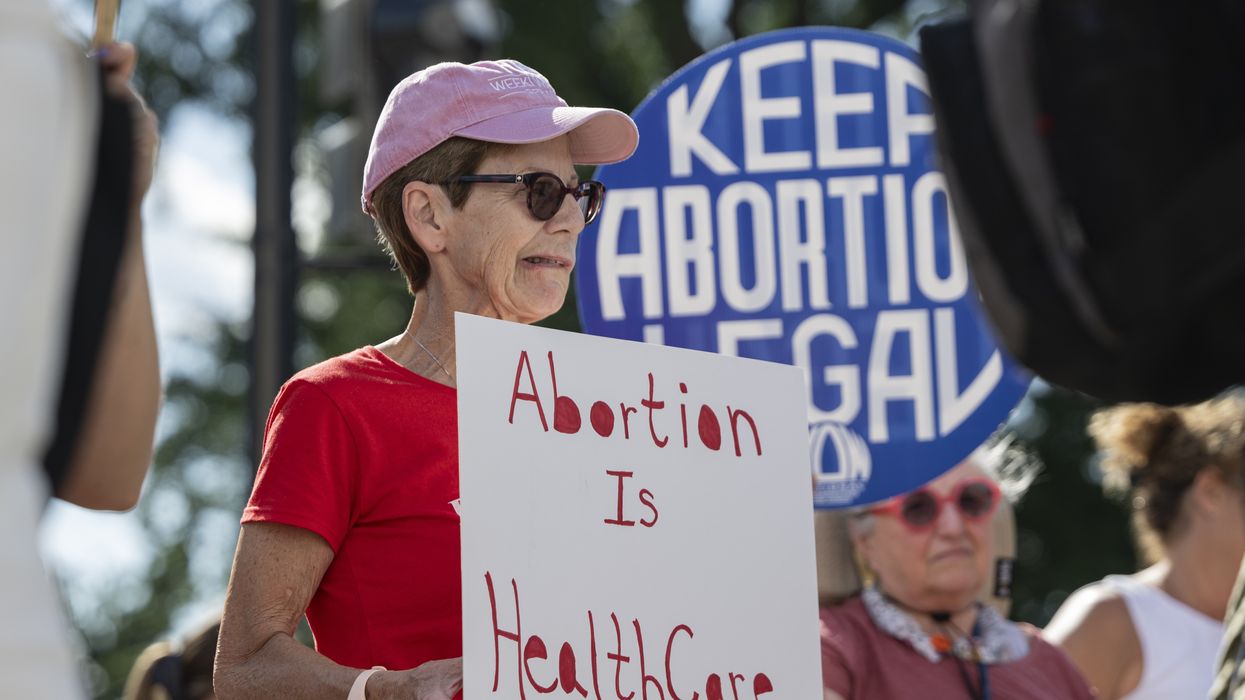
"If Trump is elected again, he will appoint even more justices who could uphold future abortion bans and endanger our fundamental freedoms for decades."
Reproductive rights advocates across the United States on Thursday were "hardly celebrating" the Supreme Court's one-sentence decision in a case regarding whether emergency departments can provide abortion care to people who have urgent pregnancy complications, and the court left open the possibility that such care could ultimately be banned.
In Moyle v. United States and Idaho v. United States, Idaho officials asked the court to intervene in an earlier decision by the U.S. Court of Appeals for the Ninth Circuit, which temporarily blocked the state's near-total abortion ban after the Biden administration argued it violated the Emergency Medical Treatment and Labor Act (EMTALA).
EMTALA requires hospital emergency departments that accept Medicare to provide "necessary stabilizing treatment" to all patients, and the Biden administration argued abortion care is included in that requirement and that federal law should override Idaho's abortion ban.
But a day after a draft decision was mistakenly posted on the Supreme Court's website, the release of the ruling confirmed that the court had dismissed the case without ruling on its merits and was sending it back to the lower courts.
The decision temporarily restores Idaho medical providers' ability to provide emergency abortions, but as the Center for Reproductive Rights (CRR) said, "it still leaves millions of people in states with abortion bans vulnerable."
"Hospitals in the 14 states that completely ban abortion, as well as many others with bans and restrictions, have shown they are afraid to provide emergency abortions due to the risk of severe criminal penalties under their states' vague and confusing abortion bans," said the organization. "For patients needing abortion care in those states, they will continue to largely rely on their state's medical exceptions, which often do not work in practice."
Nancy Northrup, CRR's president and CEO, explained that the court had "kicked the can down the road on whether states with abortion bans can override the federal law requirement that hospitals must provide abortion care to patients in the throes of life-threatening pregnancy complications."
"The court's refusal to clearly affirm the rights of all pregnant people to emergency abortion care, and put an unequivocal end to extremist attacks by anti-abortion politicians on this essential healthcare, is a dangerous preview for what could come."
"The Supreme Court created this healthcare crisis by overturning Roe v. Wade and should have decided the issue," said Northrup. "Women with dire pregnancy complications and the hospital staff who care for them need clarity right now."
Two of the court's liberal members, Justices Ketanji Brown Jackson and Elena Kagan, agreed with Northrup and other advocates in a dissenting opinion that the panel should have ruled on the merits of the case.
Kagan wrote that EMTALA "unambiguously requires" hospitals to provide emergency treatment including abortion care, while Jackson said Idaho's ban on nearly all abortions created a "monthslong catastrophe" when it was in effect.
"Idaho physicians were forced to step back and watch as their patients suffered, or arrange for their patients to be airlifted out," Jackson wrote of the state's law, which bans abortions except in cases of rape, incest, certain nonviable pregnancies, and those in which a pregnant patient's life is at risk. "There is simply no good reason not to resolve this conflict now."
"While this court dawdles and the country waits, pregnant people experiencing emergency medical conditions remain in a precarious position, as their doctors are kept in the dark about what the law requires," Jackson continued.
Right-wing Justice Samuel Alito also objected to the court's refusal to rule on the case's merits, but said Idaho's ban should apply to abortion care, arguing that EMTALA requires hospitals "to treat, not abort, an 'unborn child.'"
The American Civil Liberties Union (ACLU) said Alito's dissent, joined by Justices Neil Gorsuch and Clarence Thomas, "will embolden those who are pursuing a strategy to give legal rights to embryos and fetuses that will override the rights of the pregnant person and ban not only abortion, but other forms of reproductive healthcare like fertility treatment and birth control as well."
With the official release of the ruling, said Alexa Kolbi-Molinas, deputy director of the ACLU Reproductive Freedom Project, "it is now clear that the Supreme Court had the opportunity to hold once and for all that every pregnant person in this country is entitled to the emergency care they need to protect their health and lives, and it failed to do so."
"The court's refusal to clearly affirm the rights of all pregnant people to emergency abortion care, and put an unequivocal end to extremist attacks by anti-abortion politicians on this essential healthcare, is a dangerous preview for what could come," said Kolbi-Molinas. "This fight is far from over–anti-abortion politicians are trying to ban abortion in all 50 states, including in emergencies. These extremist politicians went all the way to the Supreme Court for the right to put doctors in jail for providing life- and health-saving emergency abortion care, and they will do it again, if we let them."
Since Roe v. Wade was overturned by the Supreme Court's right-wing majority in June 2022, a number of cases from states with abortion bans and restrictions have garnered national attention, with women speaking out about being denied abortion care when they were experiencing severe, sometimes life-threatening, complications or had learned their fetuses had fatal abnormalities.
Despite those cases, Indivisible co-executive director Leah Greenberg said Thursday's ruling leaves an "open question" on whether or not emergency rooms can "just let women die instead of treating them."
Mini Timmaraju, president and CEO of Reproductive Freedom for All, said the ruling should "serve as a reminder of what's at stake this November."
"While the Biden administration is fighting tooth and nail to ensure people can get the emergency abortion care they need, anti-abortion extremists will continue to do whatever they can to stop them," said Timmaraju. "We must secure reproductive freedom majorities in Congress and send President Biden back to the White House to restore the federal right to abortion and expand access for all."
Judicial reform group Stand Up America pointed to the Supreme Court Voter campaign it launched Monday, aiming to mobilize voters "on the impact the next president will have on the future of the U.S. Supreme Court."
"The Roberts court's decision to take up Idaho v. United States endangered the lives of pregnant Americans and did irreparable harm," said Stand Up America executive director Christina Harvey. "By staying the lower court's decision, the Supreme Court allowed Idaho's extreme abortion ban to take effect while it considered the case. In the meantime, for months, the lives of women in Idaho were callously put at risk, with multiple patients having to be medevacked out of the state to receive care.
"By overturning Roe, the MAGA majority on the court opened the door to extreme abortion bans like the one in Idaho," she added. "If Trump is elected again, he will appoint even more justices who could uphold future abortion bans and endanger our fundamental freedoms for decades."

"Women shouldn't have to wait to see if the Supreme Court will decide if they can get life-saving healthcare in all states," said one campaigner of a pending ruling on emergency abortion care.
Exactly two years after the right-wing majority on the U.S. Supreme Court cleared the way for nearly half of U.S. states so far to ban or severely restrict abortion care, reproductive justice advocates convened in Washington, D.C. on Monday to mark the anniversary and speak out ahead of another ruling that could have deadly consequences for pregnant people across the country.
As the country marks two years since the Dobbs v. Jackson Women's Health Organization decision, which overturned the 1973 ruling that affirmed Americans have the constitutional right to obtain abortions, advocates expressed a need to acknowledge the harm caused by Dobbs while also looking ahead to the pro-forced pregnancy movement's desire to further restrict reproductive rights.
"Women shouldn't have to wait to see if the Supreme Court will decide if they can get lifesaving healthcare in all states. This is a direct result of the disastrous Dobbs decision two years ago," said Margaret Viggiani, a campaigner who joined the National Mobilization for Reproductive Justice Monday at the rally and press conference in the nation's capital.
The decision expected by the end of the month is Idaho and Moyle, et al. v. United States, which stems from Idaho's near-total ban on abortion care. In August 2022, a federal judge barred the state from enforcing the ban due to its conflict with the Emergency Medical Treatment and Labor Act (EMTALA), which requires hospital emergency departments that accept Medicare to provide treatment to any patient with an emergency medical condition, including people facing pregnancy complications who need abortions.
Since the Dobbs decision was handed down two years ago, the real-world implications of abortion bans have become clear to many Americans as advocates have shared the stories of women like Kate Cox, who was forced to flee Texas to obtain abortion care when she learned her fetus had a fatal condition; Anya Cook and Shanae Smith-Cunningham, who faced the dangerous condition preterm prelabor rupture of the membranes (PPROM) but were unable to receive the standard of care recognized by obstetricians under Florida's 15-week abortion ban; and Amanda Zurawski, who was forced to become "sick enough" from a rapidly spreading infection before doctors would provide an abortion in Texas.
The life-threatening experiences of those women and others, said Human Rights Watch on Monday, exemplify "two years of outrage" since Roe v. Wade was overturned.
"The Supreme Court's revocation of national protections for abortion access, and the restrictive state laws that followed, means the United States is violating the rights to life, health, privacy, nondiscrimination, and freedom from cruel, inhuman, or degrading treatment, among others," said the global organization. "Access to legal abortion is essential to achieve gender equality. Every year, more leaders, legislatures, and courts abroad understand this. U.S. states should repeal restrictions on abortion, enshrine access to abortion in state constitutions, and advance the global trend of recognizing women's autonomy."
Last month, polling from the Pew Research Center suggested the stories of Zurawski, Cox, and other women have struck a chord with many Americans; more than 60% said they believed abortion should be legal in all or most cases, a four-percentage-point jump from 2021.
At the rally in Washington on Monday, reproductive rights advocates joined union members in calling on the American Federation of Labor and Congress of Industrial Organizations (AFL-CIO) to convene a national labor conference for reproductive justice, arguing that the largest federation of unions in the U.S. "is in the most powerful position to mobilize thousands of workers in defense of this fundamental right."
With 1 in 3 women of reproductive age in the U.S. now living in states with abortion bans, Reproductive Justice Maryland executive director Jakeya Johnson said at the rally that the Dobbs decision has "disproportionately impacted those who are marginalized and struggling to make ends meet."
"Today we're here to say, enough is enough," said Johnson. "The power of our collective voices cannot be underestimated. When labor and reproductive justice movements join forces, we are unstoppable. We're a force for change, and our strength lies in our numbers."
Meanwhile, groups including Reproductive Freedom for All, the Center for Reproductive Rights, the National Women's Law Center, and Planned Parenthood Federation of America marked the Dobbs anniversary by launching their Abortion Access Now campaign, pledging a $100 million investment to advance abortion rights and access through lobbying, grassroots organizing, public education, and other communications strategies.
"We envision a future where abortion, and all sexual and reproductive healthcare, is not only legal but also accessible, affordable, and free from stigma or fear," said the campaign. "This campaign is committed to building and leading a broad, inclusive vision for abortion access, ensuring everyone can make fundamental decisions about their health and bodies with dignity and support. Together, we will secure the freedom to control our own bodies and care for ourselves, our families, and our communities."
A separate campaign launched by the judicial reform group Stand Up America similarly marked the Dobbs anniversary and focused on warning U.S. voters that a victory by presumptive Republican presidential nominee Donald Trump in November would "ensure MAGA control of the [U.S. Supreme] Court for decades to come," with an impact on abortion rights and other crucial issues.
"We can't let that happen," said executive director Christina Harvey.

"At its core, this Supreme Court decision will reflect who we are becoming as a society."
Less than a month after a key abortion pill hearing, the right-wing U.S. Supreme Court on Wednesday heard arguments for another major reproductive rights case—one out of Idaho that could impact healthcare for pregnant women and people across the country.
Idaho is among the over 20 states that have tightened restrictions on abortion since the high court's right-wing majority reversed Roe v. Wade nearly two years ago with Dobbs v. Jackson Women's Health Organization. Since August 2022, abortions have been banned in the state except for reported cases of rape or incest or when "necessary to prevent the death" of the pregnant person.
"If the court does not uphold emergency abortion care protections, this ruling will have devastating consequences for pregnant people."
Before Idaho's near-total ban on abortion took effect, U.S. District Judge B. Lynn Winmill barred enforcement of it to the extent that it conflicts with the Emergency Medical Treatment and Labor Act (EMTALA), a 1986 federal law requiring emergency departments that accept Medicare to provide "necessary stabilizing treatment" to any patient with an emergency medical condition.
The Biden administration argues that such care includes abortion; Idaho's Republican policymakers—backed by the far-right Christian Alliance Defending Freedom—disagree. The U.S. Supreme Court in January paused Winmill's order and agreed to hear arguments in Moyle v. United States and Idaho v. United States.
As The New York Times reported Wednesday:
In a lively argument, questions by the justices suggested a divide along ideological lines, as well as a possible split by gender on the court. Justice Amy Coney Barrett, a conservative, appeared skeptical that Idaho's law, which bars doctors from providing abortions unless a woman's life is in danger or in specific nonviable pregnancies, superseded the federal law.
The argument also raised a broader question about whether some of the conservative justices, particularly Justice Samuel A. Alito Jr., may be prepared to embrace language of fetal personhood, that is, the notion that a fetus would have the same rights as a pregnant woman.
Also noting Barrett's apparent alignment with the three liberal women on the court, Law Dork's Chris Geidner predicted "it comes down to" Chief Justice John Roberts and fellow right-winger Brett Kavanaugh.
"Already, we see women miscarrying and giving birth to stillborn infants in restrooms and in their cars after hospitals have turned them away, and medical professionals put in impossible positions by extremist lawmakers," said MomsRising executive director and CEO Kristin Rowe-Finkbeiner, citing Associated Press reporting from last week.
"Of all the horrors SCOTUS unleashed with its appalling, dangerous, massively unpopular ruling overturning Roe v. Wade, the threat that pregnant people—most of whom are moms—will be denied emergency medical care is among the worst," she asserted. "An adverse ruling in this case will mean emergency rooms can deny urgently needed care to people experiencing serious pregnancy complications that can destroy their health, end their fertility, and take their lives."
Alexa Kolbi-Molinas, deputy director of the ACLU Reproductive Freedom Project, similarly stressed that under a decision that favors the Idaho GOP, "pregnant people will suffer severe, life-altering health consequences, and even death."
"We're already seeing the devastating impact of this case play out in Idaho, where medical evacuations to transport patients to other states for the care they need have dramatically spiked since the Supreme Court allowed state politicians to block emergency abortion care," she noted.
The has also been an exodus of healthcare providers. Pointing out that those who violate Idaho's ban face five years in prison, The Guardian reported Wednesday that "between 2022, when Roe was overturned, and 2023, about 50 OB-GYNs moved out of the state."
As Republican lawmakers in various states have ramped up attacks on reproductive freedom since Dobbs, states that still allow abortions have seen an influx of "healthcare refugees." A Planned Parenthood spokesperson confirmed in January that about 30% of its abortion patients in Nevada—which borders Idaho—are from other states.
"With several of Nevada's bordering states enforcing abortion bans, pushing many people seeking care to our state, we've seen firsthand the devastation that anti-abortion policies are already wreaking,"
Reproductive Freedom for All director of Nevada campaigns Denise Lopez said Tuesday. "The Supreme Court must not allow us to spiral further into this healthcare crisis."
If the high court rules in favor of Idaho's Republican lawmakers, she warned, "all states will be impacted, even in places like Nevada with more than 4 in 5 voters supporting reproductive freedom."
Destiny Lopez, acting co-CEO of the Guttmacher Institute, declared that "at its core, this Supreme Court decision will reflect who we are becoming as a society: Are we okay with requiring pregnant individuals who face severe complications to suffer life-threatening health consequences rather than granting them access to abortion? Are we okay with forcing doctors to choose between violating federal law by not providing emergency abortion care or violating state law if they do?"
"If the court does not uphold emergency abortion care protections, this ruling will have devastating consequences for pregnant people—particularly Black and Brown folks, immigrants, people with lower incomes, those without health insurance, and LGBTQ+ communities—while further emboldening extremists," she emphasized.
Arguments in the case have sparked multiple demonstrations, from a weekend rally in Boise, Idaho to a Wednesday gathering outside the U.S. Supreme Court in Washington, D.C., where Women's March organized a die-in to highlight the potential consequences of the forthcoming ruling.
"It's a horrifying time to be someone who needs critical abortion care in America right now," said Women's March executive director Rachel O'Leary Carmona. "The GOP is chipping away at women's bodily autonomy and livelihoods one illegitimate court case at a time—from fast-tracking a case on the authorization of a medication that's been safely administered for decades last month, to now bringing the fate of emergency abortion care to a Supreme Court captured by their radical, anti-choice agenda."
"We know what these cases really are: They're part of a series of efforts by Christian nationalist politicians to do anything they can to control women's bodies and cut back women's decisions about their healthcare, their family planning, and their lives," she added.
Similar warnings about far-right Christian nationalist attacks on a range of rights have dominated political contests this cycle—including the race for the White House. In November, Democratic President Joe Biden, who supports access to abortion care, is set to face former Republican President Donald Trump, who brags about appointing three of the six justices who reversed Roe.
The case has renewed arguments for considering changes to the country's top court, which over the past few years has not only seen plummeting levels of public trust but also been rocked by repeated ethics scandals.
"Idaho's abortion ban is a direct consequence of the court's radical decision to overturn Roe v. Wade and allow partisan state legislatures to determine Americans' access to abortion care," said Stand Up America managing director of policy and political affairs Brett Edkins. "If the Supreme Court once again sides with anti-abortion extremists, it will be further proof that this court is radically out of touch with the American people and must be reformed."

"MAGA abortion bans deny women lifesaving care," one critic said in response to reporting on patient stories.
New reporting from The Associated Press that complaints of pregnant patients turned away from emergency departments "spiked" after the reversal of Roe v. Wade sparked fresh condemnation of efforts to restrict abortion rights on Friday.
Since the right-wing U.S. Supreme Court ended nearly half a century of nationwide abortion rights with Dobbs v. Jackson Women's Health Organization in June 2022, over 20 states have enacted new restrictions on reproductive healthcare, creating a culture of confusion and fear at many medical facilities.
Early last year, the AP submitted a public records request for 2022 complaints filed under the Emergency Medical Treatment and Active Labor Act (EMTALA), a federal law that requires hospitals and emergency departments that accept Medicare to provide screenings to patients who request them and prohibits refusing to treat individuals with an emergency medical condition.
"This is the reality that extreme Republicans call 'pro-life.'"
"One year after submitting the request, the federal government agreed to release only some complaints and investigative documents filed across just 19 states," the AP's Amanda Seitz reported. "The names of patients, doctors, and medical staff were redacted from the documents."
"One woman miscarried in the lobby restroom of a Texas emergency room as front desk staff refused to admit her," the journalist detailed. "Another woman learned that her fetus had no heartbeat at a Florida hospital, the day after a security guard turned her away from the facility. And in North Carolina, a woman gave birth in a car after an emergency room couldn't offer an ultrasound. The baby later died."
According to Seitz:
Emergency rooms are subject to hefty fines when they turn away patients, fail to stabilize them, or transfer them to another hospital for treatment. Violations can also put hospitals' Medicare funding at risk.
But it's unclear what fines might be imposed on more than a dozen hospitals that the Biden administration says failed to properly treat pregnant patients in 2022.
It can take years for fines to be levied in these cases. The Health and Human Services agency, which enforces the law, declined to share if the hospitals have been referred to the agency's Office of Inspector General for penalties.
Responding to the reporting on social media, journalist Jane Mayer declared, "This is barbaric."
Texas Poor People's Campaign said that women in the state "are being left to die in ER waiting rooms. We cannot let this policy violence against women continue. Please join us as we mobilize voters for the '24 election."
Going into November, abortion has been a key issue at the state and federal level. Supporters of reproductive freedom are working to advance various ballot measures while Democratic President Joe Biden's campaign has highlighted his support for abortion rights and the presumptive Republican nominee, former President Donald Trump, has bragged about his role in reversing Roe—he appointed three of the six justices behind the majority opinion.
"MAGA abortion bans deny women lifesaving care," stressed Alex Wall, senior vice president for digital advocacy at the Center for American Progress. Citing examples from Texas and Florida in the AP report, he reiterated, "MAGA Republicans did this."
Congresswoman Becca Balint (D-Vt.) said that "this is the reality that extreme Republicans call 'pro-life'—pregnant women being turned away at hospitals and emergency centers. Absolutely disgraceful. No woman should ever be denied emergency care."
Slate's Mark Joseph Stern, who covers U.S. legal battles, noted that this "devastating and timely story" from Seitz comes "just days before the Supreme Court considers whether emergency rooms can legally force patients to the brink of death before terminating a failing pregnancy."
The high court is set to hear arguments in that case Wednesday. The Biden administration is challenging Idaho's near-total ban on abortion, which "would make it a criminal offense for doctors to comply with EMTALA's requirement to provide stabilizing treatment, even where a doctor determines that abortion is the medical treatment necessary to prevent a patient from suffering severe health risks or even death," as the U.S. Department of Justice's lawsuit explains.
The Justice Department is seeking a judgment that Idaho's law is invalid under the supremacy clause of the U.S. Constitution and "is preempted by federal law to the extent that it conflicts with EMTALA."