SUBSCRIBE TO OUR FREE NEWSLETTER
Daily news & progressive opinion—funded by the people, not the corporations—delivered straight to your inbox.
5
#000000
#FFFFFF
To donate by check, phone, or other method, see our More Ways to Give page.
Daily news & progressive opinion—funded by the people, not the corporations—delivered straight to your inbox.
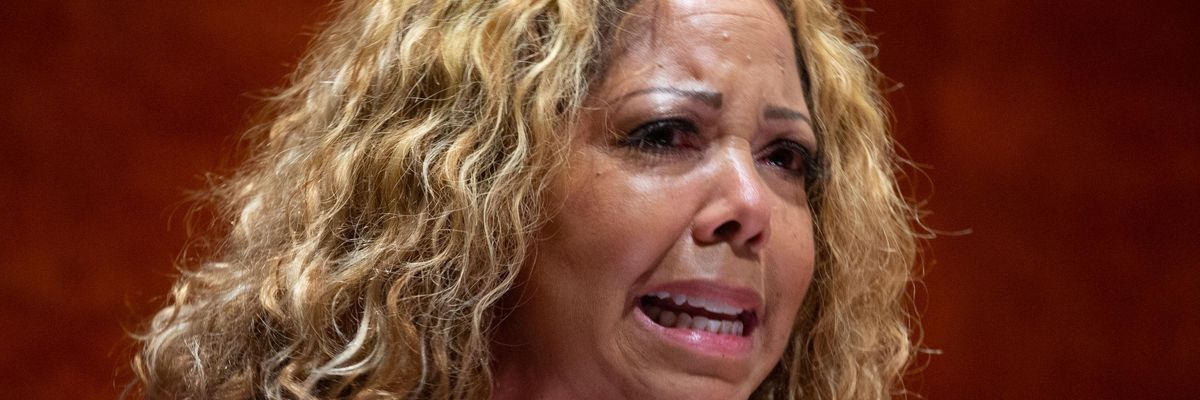
U.S. Rep. Lucy McBath (D-Ga.) speaks during the House Judiciary Committee hearing on June 10, 2020 in Washington, D.C. (Photo: Michael Reynolds - Pool/Getty Images)
Congresswoman Lucy McBath on Wednesday shared her own difficult experiences to point out how attacks on abortion rights by right-wing judges and legislators could impact what treatment doctors can provide to patients who, like her, endure miscarriage and stillbirth.
The Georgia Democrat's comments came during a U.S. House Judiciary Committee hearing entitled "Revoking Your Rights: The Ongoing Crisis in Abortion Care Access," an event held as the country prepares for the Supreme Court to issue a final ruling expected to reverse Roe v. Wade.
"For two weeks, I carried a lost pregnancy and the torment that comes with it," McBath said. "I never went into labor on my own. When my doctor finally induced me, I faced the pain of labor without hope for a living child."
"This is my story--it's uniquely my story--and yet it's not so unique," McBath continued, noting how common pregnancy loss is. "And so I ask, on behalf of these women: After which failed pregnancy should I have been imprisoned?"
"Would it have been after the first miscarriage, after doctors used what would be an illegal drug to abort the lost fetus?" she asked. "Would you have put me in jail after the second miscarriage?"
"Or would you have put me behind bars after my stillbirth--after I was forced to carry a dead fetus for weeks, after asking God if I was ever going to be able to raise a child?" she continued, explaining that her questions were relevant because "the same medicine used to treat my failed pregnancies is the same medicine states like Texas would make illegal."
In the United States, miscarriage is usually defined as pregnancy loss before the 20th week while stillbirth is one that occurs after, according to the U.S. Centers for Disease Control and Prevention.
New Hampshire Public Radio reported last week that a "recent experience in Texas illustrates that medical care for miscarriages and dangerous ectopic pregnancies would also be threatened if restrictions become more widespread."
As the outlet detailed:
One Texas law passed last year lists several medications as abortion-inducing drugs and largely bars their use for abortion after the seventh week of pregnancy. But two of those drugs, misoprostol and mifepristone, are the only drugs recommended in the American College of Obstetricians and Gynecologists guidelines for treating a patient after an early pregnancy loss.
The other miscarriage treatment is a procedure described as surgical uterine evacuation to remove the pregnancy tissue--the same approach as for an abortion.
"The challenge is that the treatment for an abortion and the treatment for a miscarriage are exactly the same," said Dr. Sarah Prager, a professor of obstetrics and gynecology at the University of Washington in Seattle and an expert in early pregnancy loss.
Republican state lawmakers have ramped up their assault on reproductive freedom in recent years with laws designed to not only limit or ban abortion but also give the U.S. Supreme Court's right-wing supermajority an opportunity to overturn Roe, which affirmed the constitutional right in 1973.
Amid a wave of anti-choice laws like one in Texas that empowers vigilantes to sue anyone who "aids or abets" an abortion after six weeks--before many people know they are pregnant--a draft Supreme Court opinion leaked earlier this month signaling the looming end of Roe and a related 1992 ruling.
In response to that draft majority opinion, U.S. Senate Democrats tried again to pass the Women's Health Protection Action, which would codify Roe--but due to the filibuster, Republican lawmakers, and Sen. Joe Manchin (D-W.Va.), the measure never made it to a final vote.
"We have a choice," McBath said Wednesday. "We can be the nation that rolls back the clock, that rolls back the rights of women, and that strips them of their very liberty. Or we can by the nation of choice--the nation where every woman can make her own choice. Freedom is our right to choose."
Planned Parenthood Action welcomed McBath's move, tweeting that hers was "an intense, heartbreaking story... and one she shouldn't have to tell."
"Thank you for your voice, congresswoman," the group added.
Other women in Congress have also responded to the anticipated reversal of Roe by sharing their experiences with reproductive healthcare.
Congresswoman Gwen Moore (D-Wis.) spoke with Elle about her choice--as a low-income 19-year-old mother--to end her second pregnancy in the days before Roe, emphasizing that she wanted "to share my story, not as a congresswoman, but as a poor person who had to go to great lengths to do what I did."
U.S. Rep. Marie Newman (D-Ill.) wrote for CNN's opinion section about also getting an abortion at 19, explaining that "it wasn't just my finances that drove my decision to end my pregnancy. In my heart, I knew one thing to be true: As a teenager barely out of childhood myself, I simply was not ready to take on the monumental responsibility of becoming a parent."
"I never intended to share the story of my abortion publicly," Newman tweeted last week. "But with the Supreme Court set to upend a half-century guaranteed right to an abortion in the United States, I felt it was necessary."
Dear Common Dreams reader, It’s been nearly 30 years since I co-founded Common Dreams with my late wife, Lina Newhouser. We had the radical notion that journalism should serve the public good, not corporate profits. It was clear to us from the outset what it would take to build such a project. No paid advertisements. No corporate sponsors. No millionaire publisher telling us what to think or do. Many people said we wouldn't last a year, but we proved those doubters wrong. Together with a tremendous team of journalists and dedicated staff, we built an independent media outlet free from the constraints of profits and corporate control. Our mission has always been simple: To inform. To inspire. To ignite change for the common good. Building Common Dreams was not easy. Our survival was never guaranteed. When you take on the most powerful forces—Wall Street greed, fossil fuel industry destruction, Big Tech lobbyists, and uber-rich oligarchs who have spent billions upon billions rigging the economy and democracy in their favor—the only bulwark you have is supporters who believe in your work. But here’s the urgent message from me today. It's never been this bad out there. And it's never been this hard to keep us going. At the very moment Common Dreams is most needed, the threats we face are intensifying. We need your support now more than ever. We don't accept corporate advertising and never will. We don't have a paywall because we don't think people should be blocked from critical news based on their ability to pay. Everything we do is funded by the donations of readers like you. When everyone does the little they can afford, we are strong. But if that support retreats or dries up, so do we. Will you donate now to make sure Common Dreams not only survives but thrives? —Craig Brown, Co-founder |
Congresswoman Lucy McBath on Wednesday shared her own difficult experiences to point out how attacks on abortion rights by right-wing judges and legislators could impact what treatment doctors can provide to patients who, like her, endure miscarriage and stillbirth.
The Georgia Democrat's comments came during a U.S. House Judiciary Committee hearing entitled "Revoking Your Rights: The Ongoing Crisis in Abortion Care Access," an event held as the country prepares for the Supreme Court to issue a final ruling expected to reverse Roe v. Wade.
"For two weeks, I carried a lost pregnancy and the torment that comes with it," McBath said. "I never went into labor on my own. When my doctor finally induced me, I faced the pain of labor without hope for a living child."
"This is my story--it's uniquely my story--and yet it's not so unique," McBath continued, noting how common pregnancy loss is. "And so I ask, on behalf of these women: After which failed pregnancy should I have been imprisoned?"
"Would it have been after the first miscarriage, after doctors used what would be an illegal drug to abort the lost fetus?" she asked. "Would you have put me in jail after the second miscarriage?"
"Or would you have put me behind bars after my stillbirth--after I was forced to carry a dead fetus for weeks, after asking God if I was ever going to be able to raise a child?" she continued, explaining that her questions were relevant because "the same medicine used to treat my failed pregnancies is the same medicine states like Texas would make illegal."
In the United States, miscarriage is usually defined as pregnancy loss before the 20th week while stillbirth is one that occurs after, according to the U.S. Centers for Disease Control and Prevention.
New Hampshire Public Radio reported last week that a "recent experience in Texas illustrates that medical care for miscarriages and dangerous ectopic pregnancies would also be threatened if restrictions become more widespread."
As the outlet detailed:
One Texas law passed last year lists several medications as abortion-inducing drugs and largely bars their use for abortion after the seventh week of pregnancy. But two of those drugs, misoprostol and mifepristone, are the only drugs recommended in the American College of Obstetricians and Gynecologists guidelines for treating a patient after an early pregnancy loss.
The other miscarriage treatment is a procedure described as surgical uterine evacuation to remove the pregnancy tissue--the same approach as for an abortion.
"The challenge is that the treatment for an abortion and the treatment for a miscarriage are exactly the same," said Dr. Sarah Prager, a professor of obstetrics and gynecology at the University of Washington in Seattle and an expert in early pregnancy loss.
Republican state lawmakers have ramped up their assault on reproductive freedom in recent years with laws designed to not only limit or ban abortion but also give the U.S. Supreme Court's right-wing supermajority an opportunity to overturn Roe, which affirmed the constitutional right in 1973.
Amid a wave of anti-choice laws like one in Texas that empowers vigilantes to sue anyone who "aids or abets" an abortion after six weeks--before many people know they are pregnant--a draft Supreme Court opinion leaked earlier this month signaling the looming end of Roe and a related 1992 ruling.
In response to that draft majority opinion, U.S. Senate Democrats tried again to pass the Women's Health Protection Action, which would codify Roe--but due to the filibuster, Republican lawmakers, and Sen. Joe Manchin (D-W.Va.), the measure never made it to a final vote.
"We have a choice," McBath said Wednesday. "We can be the nation that rolls back the clock, that rolls back the rights of women, and that strips them of their very liberty. Or we can by the nation of choice--the nation where every woman can make her own choice. Freedom is our right to choose."
Planned Parenthood Action welcomed McBath's move, tweeting that hers was "an intense, heartbreaking story... and one she shouldn't have to tell."
"Thank you for your voice, congresswoman," the group added.
Other women in Congress have also responded to the anticipated reversal of Roe by sharing their experiences with reproductive healthcare.
Congresswoman Gwen Moore (D-Wis.) spoke with Elle about her choice--as a low-income 19-year-old mother--to end her second pregnancy in the days before Roe, emphasizing that she wanted "to share my story, not as a congresswoman, but as a poor person who had to go to great lengths to do what I did."
U.S. Rep. Marie Newman (D-Ill.) wrote for CNN's opinion section about also getting an abortion at 19, explaining that "it wasn't just my finances that drove my decision to end my pregnancy. In my heart, I knew one thing to be true: As a teenager barely out of childhood myself, I simply was not ready to take on the monumental responsibility of becoming a parent."
"I never intended to share the story of my abortion publicly," Newman tweeted last week. "But with the Supreme Court set to upend a half-century guaranteed right to an abortion in the United States, I felt it was necessary."
Congresswoman Lucy McBath on Wednesday shared her own difficult experiences to point out how attacks on abortion rights by right-wing judges and legislators could impact what treatment doctors can provide to patients who, like her, endure miscarriage and stillbirth.
The Georgia Democrat's comments came during a U.S. House Judiciary Committee hearing entitled "Revoking Your Rights: The Ongoing Crisis in Abortion Care Access," an event held as the country prepares for the Supreme Court to issue a final ruling expected to reverse Roe v. Wade.
"For two weeks, I carried a lost pregnancy and the torment that comes with it," McBath said. "I never went into labor on my own. When my doctor finally induced me, I faced the pain of labor without hope for a living child."
"This is my story--it's uniquely my story--and yet it's not so unique," McBath continued, noting how common pregnancy loss is. "And so I ask, on behalf of these women: After which failed pregnancy should I have been imprisoned?"
"Would it have been after the first miscarriage, after doctors used what would be an illegal drug to abort the lost fetus?" she asked. "Would you have put me in jail after the second miscarriage?"
"Or would you have put me behind bars after my stillbirth--after I was forced to carry a dead fetus for weeks, after asking God if I was ever going to be able to raise a child?" she continued, explaining that her questions were relevant because "the same medicine used to treat my failed pregnancies is the same medicine states like Texas would make illegal."
In the United States, miscarriage is usually defined as pregnancy loss before the 20th week while stillbirth is one that occurs after, according to the U.S. Centers for Disease Control and Prevention.
New Hampshire Public Radio reported last week that a "recent experience in Texas illustrates that medical care for miscarriages and dangerous ectopic pregnancies would also be threatened if restrictions become more widespread."
As the outlet detailed:
One Texas law passed last year lists several medications as abortion-inducing drugs and largely bars their use for abortion after the seventh week of pregnancy. But two of those drugs, misoprostol and mifepristone, are the only drugs recommended in the American College of Obstetricians and Gynecologists guidelines for treating a patient after an early pregnancy loss.
The other miscarriage treatment is a procedure described as surgical uterine evacuation to remove the pregnancy tissue--the same approach as for an abortion.
"The challenge is that the treatment for an abortion and the treatment for a miscarriage are exactly the same," said Dr. Sarah Prager, a professor of obstetrics and gynecology at the University of Washington in Seattle and an expert in early pregnancy loss.
Republican state lawmakers have ramped up their assault on reproductive freedom in recent years with laws designed to not only limit or ban abortion but also give the U.S. Supreme Court's right-wing supermajority an opportunity to overturn Roe, which affirmed the constitutional right in 1973.
Amid a wave of anti-choice laws like one in Texas that empowers vigilantes to sue anyone who "aids or abets" an abortion after six weeks--before many people know they are pregnant--a draft Supreme Court opinion leaked earlier this month signaling the looming end of Roe and a related 1992 ruling.
In response to that draft majority opinion, U.S. Senate Democrats tried again to pass the Women's Health Protection Action, which would codify Roe--but due to the filibuster, Republican lawmakers, and Sen. Joe Manchin (D-W.Va.), the measure never made it to a final vote.
"We have a choice," McBath said Wednesday. "We can be the nation that rolls back the clock, that rolls back the rights of women, and that strips them of their very liberty. Or we can by the nation of choice--the nation where every woman can make her own choice. Freedom is our right to choose."
Planned Parenthood Action welcomed McBath's move, tweeting that hers was "an intense, heartbreaking story... and one she shouldn't have to tell."
"Thank you for your voice, congresswoman," the group added.
Other women in Congress have also responded to the anticipated reversal of Roe by sharing their experiences with reproductive healthcare.
Congresswoman Gwen Moore (D-Wis.) spoke with Elle about her choice--as a low-income 19-year-old mother--to end her second pregnancy in the days before Roe, emphasizing that she wanted "to share my story, not as a congresswoman, but as a poor person who had to go to great lengths to do what I did."
U.S. Rep. Marie Newman (D-Ill.) wrote for CNN's opinion section about also getting an abortion at 19, explaining that "it wasn't just my finances that drove my decision to end my pregnancy. In my heart, I knew one thing to be true: As a teenager barely out of childhood myself, I simply was not ready to take on the monumental responsibility of becoming a parent."
"I never intended to share the story of my abortion publicly," Newman tweeted last week. "But with the Supreme Court set to upend a half-century guaranteed right to an abortion in the United States, I felt it was necessary."