A Louisiana woman denied an abortion despite carrying a fetus with a fatally flawed skull revealed Wednesday that she traveled nearly 2,500 miles round trip to New York City in order to undergo the procedure.
"Basically, they said I had to carry my baby to bury my baby."
Nancy Davis, 36, told The Guardian that she traveled from her hometown of Baton Rouge to a Manhattan clinic, where she terminated her wanted pregnancy on September 1.
That's because Louisiana is one of more than a dozen states with so-called "trigger laws" immediately banning abortions that went into effect after the U.S. Supreme Court struck down Roe v. Wade and half a century of federally guaranteed reproductive freedom in June.
"I felt like we made the best decision for our baby as well as ourselves," Davis said during a Monday appearance on "Dr. Phil."
"It's still taken an emotional toll on me. I have problems sleeping at night, I have problems eating; it's been very emotionally draining," she added. "It was extremely traumatizing, it was mentally draining in all aspects, it was physically draining."
When she was about 10 weeks pregnant in late July, Davis underwent an ultrasound at Woman's Hospital in Baton Rouge that showed her fetus was missing the top of its skull--a fatal condition called acrania. Babies with the rare condition usually die within days--and sometimes minutes--of birth.
While Louisiana's abortion ban has a broad exception for fetuses that would die outside the womb, acrania is not included on the state's list of medical conditions that qualify for such an exception.
Staff at Woman's Hospital, therefore, refused to perform an abortion on Davis, apparently worried about potential prosecution, imprisonment, fines, and forfeiture of their professional licenses if they did.
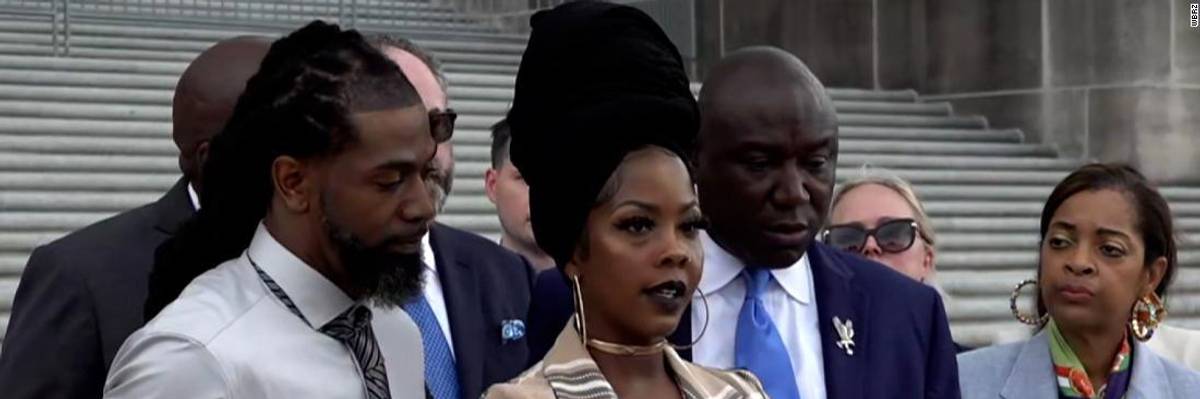
"Basically, they said I had to carry my baby to bury my baby," Davis said at an August 26 press conference. "I want you to imagine what it's been like to continue this pregnancy for another six weeks after this diagnosis. This is not fair to me and it should not happen to any other woman."
Civil rights attorney Benjamin Crump, who is representing Davis, said during the press conference that Louisiana's law was causing his client to suffer "unspeakable pain, emotional damage, and physical risk."
He added that the Republicans who implemented the state's ban "replaced care with confusion, privacy with politics, and options with ideology."
In the wake of Dobbs v. Jackson Women's Health Organization, 14 states have fully banned abortion or implemented six-week bans as of September 9, with a near-total ban looming in West Virginia.
Of those states, pregnant people in Louisiana seeking abortions must travel an average of 1,332 miles round trip for the medical procedure--the longest such trip in the nation, according to the Guttmacher Institute.
National medical groups have warned of the "irreparable harm" such laws will cause, while experts argue that poor and Black patients are disproportionately affected by such bans.
"Even in very obvious cases, cases the anti-abortion movement insists they don't oppose, these bans result in women being denied access to abortion," Joshua Stein, a postdoctoral student at Georgetown University in Washington, D.C., tweeted.
"That includes the case of the unnamed 10-year-old girl who was raped, unable to get an abortion in Ohio because of the state's laws, traveling to Indiana," he continued. "The state [attorney general] insisted the law didn't prohibit such cases, but the possible providers weren't sure and didn't want to risk liability."
Related Content

99% of House GOP Just Showed They Support Forcing Children to Birth 'Their Rapist's Child': Pascrell
"It also includes the many, many cases where doctors are forced to adopt the 'expectant management' (wait-and-see) approach even when abortion would be the greatest reduction of risk to the patient's safety, as in the Elise Taft case," Stein added, referring to a Wisconsin woman who suffered a miscarriage and subsequently required emergency lifesaving surgery that experts say will be denied to people in states with strict bans.
"The implementation of these bans means that people are seeing the real consequences, either when people they know try to access services or when brave women come forward to make their experiences public," said Stein.
"The GOP wants to change the topic away from that; the anti-abortion [movement] wants to change the topic away from that," he added. "They want to distract from the real, serious, and obvious consequences of their policies (consequences actual experts knew about for years). They shouldn't be allowed to."
Belying conservative claims that the abortion issue should be left up to the states to decide, influential Republican U.S. Sen. Lindsey Graham of South Carolina on Tuesday introduced what reproductive rights defenders have long warned is the GOP endgame: a national abortion ban.
A Louisiana woman denied an abortion despite carrying a fetus with a fatally flawed skull revealed Wednesday that she traveled nearly 2,500 miles round trip to New York City in order to undergo the procedure.
"Basically, they said I had to carry my baby to bury my baby."
Nancy Davis, 36, told The Guardian that she traveled from her hometown of Baton Rouge to a Manhattan clinic, where she terminated her wanted pregnancy on September 1.
That's because Louisiana is one of more than a dozen states with so-called "trigger laws" immediately banning abortions that went into effect after the U.S. Supreme Court struck down Roe v. Wade and half a century of federally guaranteed reproductive freedom in June.
"I felt like we made the best decision for our baby as well as ourselves," Davis said during a Monday appearance on "Dr. Phil."
"It's still taken an emotional toll on me. I have problems sleeping at night, I have problems eating; it's been very emotionally draining," she added. "It was extremely traumatizing, it was mentally draining in all aspects, it was physically draining."
When she was about 10 weeks pregnant in late July, Davis underwent an ultrasound at Woman's Hospital in Baton Rouge that showed her fetus was missing the top of its skull--a fatal condition called acrania. Babies with the rare condition usually die within days--and sometimes minutes--of birth.
While Louisiana's abortion ban has a broad exception for fetuses that would die outside the womb, acrania is not included on the state's list of medical conditions that qualify for such an exception.
Staff at Woman's Hospital, therefore, refused to perform an abortion on Davis, apparently worried about potential prosecution, imprisonment, fines, and forfeiture of their professional licenses if they did.
"Basically, they said I had to carry my baby to bury my baby," Davis said at an August 26 press conference. "I want you to imagine what it's been like to continue this pregnancy for another six weeks after this diagnosis. This is not fair to me and it should not happen to any other woman."
Civil rights attorney Benjamin Crump, who is representing Davis, said during the press conference that Louisiana's law was causing his client to suffer "unspeakable pain, emotional damage, and physical risk."
He added that the Republicans who implemented the state's ban "replaced care with confusion, privacy with politics, and options with ideology."
In the wake of Dobbs v. Jackson Women's Health Organization, 14 states have fully banned abortion or implemented six-week bans as of September 9, with a near-total ban looming in West Virginia.
Of those states, pregnant people in Louisiana seeking abortions must travel an average of 1,332 miles round trip for the medical procedure--the longest such trip in the nation, according to the Guttmacher Institute.
National medical groups have warned of the "irreparable harm" such laws will cause, while experts argue that poor and Black patients are disproportionately affected by such bans.
"Even in very obvious cases, cases the anti-abortion movement insists they don't oppose, these bans result in women being denied access to abortion," Joshua Stein, a postdoctoral student at Georgetown University in Washington, D.C., tweeted.
"That includes the case of the unnamed 10-year-old girl who was raped, unable to get an abortion in Ohio because of the state's laws, traveling to Indiana," he continued. "The state [attorney general] insisted the law didn't prohibit such cases, but the possible providers weren't sure and didn't want to risk liability."
Related Content
99% of House GOP Just Showed They Support Forcing Children to Birth 'Their Rapist's Child': Pascrell
"It also includes the many, many cases where doctors are forced to adopt the 'expectant management' (wait-and-see) approach even when abortion would be the greatest reduction of risk to the patient's safety, as in the Elise Taft case," Stein added, referring to a Wisconsin woman who suffered a miscarriage and subsequently required emergency lifesaving surgery that experts say will be denied to people in states with strict bans.
"The implementation of these bans means that people are seeing the real consequences, either when people they know try to access services or when brave women come forward to make their experiences public," said Stein.
"The GOP wants to change the topic away from that; the anti-abortion [movement] wants to change the topic away from that," he added. "They want to distract from the real, serious, and obvious consequences of their policies (consequences actual experts knew about for years). They shouldn't be allowed to."
Belying conservative claims that the abortion issue should be left up to the states to decide, influential Republican U.S. Sen. Lindsey Graham of South Carolina on Tuesday introduced what reproductive rights defenders have long warned is the GOP endgame: a national abortion ban.
A Louisiana woman denied an abortion despite carrying a fetus with a fatally flawed skull revealed Wednesday that she traveled nearly 2,500 miles round trip to New York City in order to undergo the procedure.
"Basically, they said I had to carry my baby to bury my baby."
Nancy Davis, 36, told The Guardian that she traveled from her hometown of Baton Rouge to a Manhattan clinic, where she terminated her wanted pregnancy on September 1.
That's because Louisiana is one of more than a dozen states with so-called "trigger laws" immediately banning abortions that went into effect after the U.S. Supreme Court struck down Roe v. Wade and half a century of federally guaranteed reproductive freedom in June.
"I felt like we made the best decision for our baby as well as ourselves," Davis said during a Monday appearance on "Dr. Phil."
"It's still taken an emotional toll on me. I have problems sleeping at night, I have problems eating; it's been very emotionally draining," she added. "It was extremely traumatizing, it was mentally draining in all aspects, it was physically draining."
When she was about 10 weeks pregnant in late July, Davis underwent an ultrasound at Woman's Hospital in Baton Rouge that showed her fetus was missing the top of its skull--a fatal condition called acrania. Babies with the rare condition usually die within days--and sometimes minutes--of birth.
While Louisiana's abortion ban has a broad exception for fetuses that would die outside the womb, acrania is not included on the state's list of medical conditions that qualify for such an exception.
Staff at Woman's Hospital, therefore, refused to perform an abortion on Davis, apparently worried about potential prosecution, imprisonment, fines, and forfeiture of their professional licenses if they did.
"Basically, they said I had to carry my baby to bury my baby," Davis said at an August 26 press conference. "I want you to imagine what it's been like to continue this pregnancy for another six weeks after this diagnosis. This is not fair to me and it should not happen to any other woman."
Civil rights attorney Benjamin Crump, who is representing Davis, said during the press conference that Louisiana's law was causing his client to suffer "unspeakable pain, emotional damage, and physical risk."
He added that the Republicans who implemented the state's ban "replaced care with confusion, privacy with politics, and options with ideology."
In the wake of Dobbs v. Jackson Women's Health Organization, 14 states have fully banned abortion or implemented six-week bans as of September 9, with a near-total ban looming in West Virginia.
Of those states, pregnant people in Louisiana seeking abortions must travel an average of 1,332 miles round trip for the medical procedure--the longest such trip in the nation, according to the Guttmacher Institute.
National medical groups have warned of the "irreparable harm" such laws will cause, while experts argue that poor and Black patients are disproportionately affected by such bans.
"Even in very obvious cases, cases the anti-abortion movement insists they don't oppose, these bans result in women being denied access to abortion," Joshua Stein, a postdoctoral student at Georgetown University in Washington, D.C., tweeted.
"That includes the case of the unnamed 10-year-old girl who was raped, unable to get an abortion in Ohio because of the state's laws, traveling to Indiana," he continued. "The state [attorney general] insisted the law didn't prohibit such cases, but the possible providers weren't sure and didn't want to risk liability."
Related Content
99% of House GOP Just Showed They Support Forcing Children to Birth 'Their Rapist's Child': Pascrell
"It also includes the many, many cases where doctors are forced to adopt the 'expectant management' (wait-and-see) approach even when abortion would be the greatest reduction of risk to the patient's safety, as in the Elise Taft case," Stein added, referring to a Wisconsin woman who suffered a miscarriage and subsequently required emergency lifesaving surgery that experts say will be denied to people in states with strict bans.
"The implementation of these bans means that people are seeing the real consequences, either when people they know try to access services or when brave women come forward to make their experiences public," said Stein.
"The GOP wants to change the topic away from that; the anti-abortion [movement] wants to change the topic away from that," he added. "They want to distract from the real, serious, and obvious consequences of their policies (consequences actual experts knew about for years). They shouldn't be allowed to."
Belying conservative claims that the abortion issue should be left up to the states to decide, influential Republican U.S. Sen. Lindsey Graham of South Carolina on Tuesday introduced what reproductive rights defenders have long warned is the GOP endgame: a national abortion ban.