

SUBSCRIBE TO OUR FREE NEWSLETTER
Daily news & progressive opinion—funded by the people, not the corporations—delivered straight to your inbox.
5
#000000
#FFFFFF
To donate by check, phone, or other method, see our More Ways to Give page.
Daily news & progressive opinion—funded by the people, not the corporations—delivered straight to your inbox.

The House bills are highly partisan and deviate sharply from the levels set in the bipartisan agreement to raise the federal debt limit in May.
The fiscal year 2024 appropriations bills approved by the House Appropriations Committee make major cuts in a wide range of domestic priorities. Among those hardest hit are programs crucial to the well-being of families with low incomes and their children, to public health, to job training and protection of workers’ rights, to a clean environment, and to fair administration of tax laws. The House bills are highly partisan and deviate sharply from the levels set in the bipartisan agreement to raise the federal debt limit in May.
In contrast, the Senate-passed appropriations bills are lean but include substantially fewer cuts and rescissions (which take back already enacted funding), are largely consistent with agreed-on levels, and have strong bipartisan support. They offer a better path toward funding that meets national needs, although there are some programmatic areas where the Senate levels are too low to meet those needs, such as with WIC (the Special Supplemental Nutrition Program for Women, Infants, and Children) and housing assistance.
As part of the debt limit deal, the House, Senate, and Biden administration agreed on defense and non-defense appropriations totals for 2024, calling for regular 2024 non-defense appropriations to be held to the same dollar total as in 2023. Reaching the 2023 non-defense level in 2024 requires not only setting appropriations at the cap established in the debt limit legislation but also adhering to the agreements negotiators had signed off on that provide offsets to accommodate additional funding. Such a freeze at last year’s level is fairly austere. It requires any increases that are necessary to meet rising costs, increasing needs, or new situations to be offset by cuts in other areas.
This report describes some of the serious cuts and shortfalls in the House appropriations bills.
While the Senate’s 2024 appropriations bills generally adhere to that approach (with small deviations agreed to on a bipartisan basis), the House’s Republican majority began writing non-defense appropriations bills with severe cuts to vital programs, at a total that is roughly $153 billion lower than had been agreed on. In the bills drafted by the House Appropriations Committee, the House Republicans achieve those cuts in two basic ways: by reducing many 2024 appropriations by about $59 billion (7%) below the 2023 levels, and by rescinding $94 billion of already enacted funding, almost all from the 2022 Inflation Reduction Act.
This report describes some of the serious cuts and shortfalls in the House appropriations bills, affecting areas such as education, child care, housing, job training, public health, medical research, nutrition assistance, environmental protection, renewable energy, enforcement of civil rights and worker protection laws, and operation of the Social Security system. It also describes the proposed rescissions of previously enacted funding, which include amounts that had been provided to fairly enforce tax laws and make sure that wealthy individuals and corporations pay their share, and to combat climate change, promote clean energy, and assist farmers.
The House bills shortchange the needs of pregnant people and families with young children who need help affording healthy food, of school children in low-income communities, of families needing help with child care costs or an affordable place to live, and of college students seeking financial aid.
The House bills would:
Take away food assistance from hundreds of thousands of new parents and young children by underfunding WIC. This Agriculture Department program supports millions of people in low-income families in important life stages—during and after pregnancy, and from birth until a child’s fifth birthday—by providing nutritious foods, nutrition education, referrals to healthcare, and other services. The House Agriculture bill’s WIC funding is well below the level needed to serve all eligible families who wish to participate, and would result in an estimated 600,000 new parents, toddlers, and preschoolers being turned away. The House bill would also cut WIC’s science-based fruit and vegetable benefit by between 58% and 71% (depending on the recipient’s age) for 4.7 million of the remaining participants.
Cut more than $15.6 billion in funding that schools use to help students in low-income communities learn and to help students whose first language is not English. The bills:
Make it harder for students to afford college by eliminating some forms of help, including federal work-study funding, and by freezing Pell Grants, which provide tuition assistance. The bills withdraw more than $2 billion in college assistance, straining families’ budgets and making it harder for many students to go to college. The bills:
Make it harder for families to afford child care, reduce the number of children who can participate in Head Start, and cut funding that supports state efforts to improve preschool offerings. Compared to the Senate bills, the House bills provide some $2.0 billion less for three main early learning programs—child care, Head Start, and Preschool Development Grants—on top of cuts to Title I (described above), which also funds early learning. These cuts undercut support for the early learning and child care that families and children need, at a time when Covid-related funding has expired, which is also threatening the stability of many providers. The bills would:
Cut the number of households that receive rental assistance and make it harder for households struggling with the rising cost of rent. The bills would:
The House bills cut back federal support for public health workers who detect disease outbreaks, vaccinate people against dangerous diseases, and promote disease prevention. They also cut back funding for medical research into better treatment and cures for diseases, as well as support for family planning clinics and care for people with HIV, among other healthcare needs.
The House bills would:
Reduce the nation’s preparedness for disease outbreaks and cut disease prevention efforts through an 18% ($1.6 billion) cut to the Centers for Disease Control and Prevention. CDC tracks and responds to disease outbreaks, fosters disease prevention, and supports the work of state and local public health agencies. Examples of cuts to CDC’s budget include a 16% reduction in funding for prevention of HIV, viral hepatitis, sexually transmitted infections, and tuberculosis; a 21% cut in chronic disease prevention programs; and a 17% cut in public health preparedness.
Reduce the nation’s commitment to groundbreaking medical research by cutting funding for the National Institutes of Health (NIH) by 8% ($3.8 billion). NIH is a major source of support for medical research, both conducting its own in-house research and funding the work of medical researchers throughout the country. The biggest dollar cut within this part of the legislation is a $1.5 billion (23%) reduction to the NIH institute that studies infectious diseases—this following a major pandemic with severe impacts on people’s health and the nation’s economy. The legislation also includes a two-thirds cut, from $1.5 billion to $500 million, to ARPA-H (Advanced Research Projects Agency for Health). ARPA-H’s purpose is to undertake long-shot but potentially high-reward projects not readily accomplished through traditional federal biomedical research, including participation in the Cancer Moonshot initiative seeking a cure for that disease.
Make it harder for people to access family planning services by eliminating funding for Title X grants to public and private nonprofit agencies that support family planning services for people with modest incomes. In 2021, this program provided contraceptive, infertility, and other family planning services to more than 1.6 million clients at more than 3,200 sites nationwide. Established 53 years ago, Title X received appropriations totaling $286 million in 2023. Fees are charged on a sliding scale based on clients’ ability to pay.
Cut care to people with HIV by reducing the Ryan White HIV/AIDS program by 9% ($239 million). This HHS program provides funding to state and local governments and local clinics and organizations to deliver care, treatment, and support to low-income people with HIV.
The House bills sharply scale back funding for job training for people seeking to learn new skills and boost their employment prospects. They also make big cuts to agencies that protect workers’ rights, including rights to minimum wages and overtime pay, to safe workplaces, and to engage in union activity.
The House bills would:
Eliminate federal job training funding for adults and youth provided through the Workforce Innovation and Opportunity Act, a major source of job training funding. These programs received $1.8 billion in 2023, which is expected to support training for more than 420,000 adults and youth.
Leave workers less protected against illegal employer behavior by cutting efforts to enforce the right to unionize and basic health and safety standards. The bills would:
The House bills make big cuts to environmental protection, including enforcement of environmental laws, programs to clean up pollution, and investments in safe drinking water, wastewater treatment, and other infrastructure. The House bills also make big cuts and rescissions to programs that promote clean energy and otherwise address climate change.
The House bills would:
Leave communities and people more vulnerable to water and air pollution, unsafe drinking water, toxic wastes, hazardous chemicals, and other threats to human health by cutting funding for the Environmental Protection Agency (EPA) by 39% ($4.0 billion). This cut would bring EPA funding to the lowest level since 1991, before adjusting for inflation. Cuts include 26% in Environmental Programs and Management (which funds activities such as development and enforcement of environmental protection rules and standards), 30% in Science and Technology (which performs scientific research and laboratory analysis to inform EPA’s work), and 42% in State and Tribal Assistance Grants (which include funding for wastewater treatment and drinking water facilities, water pollution control, and other environmental grant programs).
Take less care of our national parks with a 13% ($436 million) cut to the National Park Service budget. This includes a 9% cut in funds for operating the national parks and a 52% cut in the national parks construction budget.
Reduce efforts to facilitate our transition to clean energy by cutting funding for the Energy Department’s Energy Efficiency and Renewable Energy programs by 42% ($1.5 billion). This appropriations account supports research, development, demonstration, and deployment of technologies to enable transition to a net-zero greenhouse gas emissions economy. It gives special attention to the needs of workers and communities impacted by the energy transition and to those historically overburdened by pollution, who are disproportionately people of color due to policies like redlining that promoted exposure to industrial areas.
Shred multi-year efforts to promote clean energy and combat climate change by rescinding more than $29 billion in multi-year funding that had been provided in the 2022 Inflation Reduction Act to further those goals. The House bills would cut:
Scale back assistance to farmers and rural communities by rescinding approximately $5.8 billion in multi-year funding that had been provided in the 2022 Inflation Reduction Act for those purposes. Included in the House bills’ cuts:
The House bills make several cuts to transportation infrastructure, including funding for mass transit improvement projects, support for Amtrak, and grants to improve freight rail safety and reliability.
The House bills would:
Let bus, subway, and passenger rail service deteriorate by slashing federal support:
Do less to upgrade transportation infrastructure, including railroad safety:
The House bills worsen the underfunding of agencies that directly serve the public in critical ways, including the IRS and the Social Security Administration (SSA), leading to longer waits to get questions answered or for decisions about benefits. This will also continue to leave the IRS short of the staffing and expertise it needs to audit complex tax returns and make sure that corporations and wealthy people are paying their fair share—reversing an agency rebuilding process that is already seeing improvements in customer service and in revenue collected in the face of tax avoidance by some wealthy taxpayers.
The House bills would:
Gut efforts to improve customer service at the IRS and ensure that high-income households and corporations pay the taxes they legally owe by rescinding the vast majority of the multi-year funding provided for the long-term rebuilding of IRS capacity to enforce tax laws and serve taxpayers, while also cutting regular annual IRS funding by 9% ($1.1 billion). The Inflation Reduction Act of 2022 provided multi-year funding to counteract long-term underfunding that left the IRS with greatly diminished capacity to reduce tax cheating by properly auditing complex tax returns of wealthy taxpayers, or to respond to ordinary taxpayers’ questions. But of the $80 billion in ten-year funding that law provided, the House bills rescind $67 billion, devastating the rebuilding effort. The House bills compound this problem by cutting the regular annual IRS appropriation by $1.1 billion (or 9%), thus further reducing IRS capacity instead of rebuilding it.
Further erode customer service at the SSA by cutting the agency’s customer service budget by 2% ($250 million), when funding increases are needed to boost staffing and invest in IT as the number of beneficiaries grows. The House bills’ cuts would come on top of more than a decade of cuts that have forced the agency to face serving millions more beneficiaries at its lowest staffing level in over 25 years. Between 2010 and 2023, customer service funding at the SSA fell by 17% (adjusted for inflation), and the number of staff fell by 16%, while the number of beneficiaries rose by 22%. Wait times for disability decisions are at a record high, and hold times on the phone are now around 40 minutes. Flat funding under the current continuing resolution has led to a hiring freeze and suspension of IT investments.
Undermine enforcement of civil rights laws that ensure people can access public services without facing unlawful discrimination. The House bills cut funding for agency Offices of Civil Rights, which enforce civil rights requirements related to their agency’s mission and programs. Cuts include 39% at the Agriculture Department, 25% at the Education Department, and 20% at HHS.
The bills produced by the House majority are also replete with partisan legislative provisions or “riders,” mostly pursuing what have become common targets of Republican culture wars.
Examples of such riders include provisions in multiple bills that would stymie racial equity initiatives, such as prohibiting the use of funds to carry out the president’s executive orders on diversity, equity, and inclusion or for agency offices dedicated to furthering those goals, and prohibiting the use of funds to promote or advance critical race theory.
Other riders include anti-LGBTQ policies that would prohibit the use of funds for surgical procedures or hormone therapy for purposes of gender-affirming care, prohibit implementation of an executive order on combatting discrimination based on gender identity or sexual orientation, and prohibit flying LGBTQ pride flags at federal facilities.
The Republican bills also seek to further restrict abortion rights, including by overturning a decision by the Food and Drug Administration that facilitates access to the medication abortion drug mifepristone; blocking a Defense Department policy to cover travel costs of service members and members of their families to obtain abortions if they are stationed in states restricting abortion services; prohibiting clinics affiliated with Planned Parenthood from receiving funds appropriated in the Labor-HHS-Education bill unless they stop performing legally permissible abortions; and blocking the use of funds in the bills to implement two executive orders related to access to reproductive healthcare services.
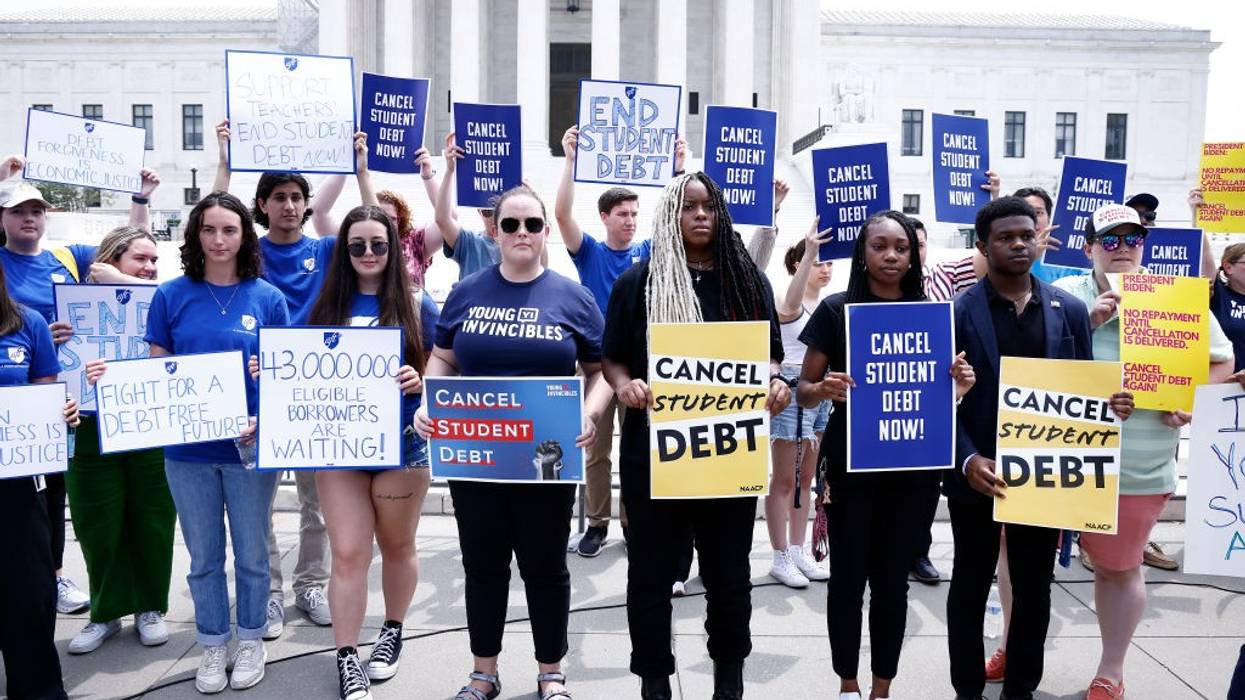
As resumption of educational debt repayment looms, more than 7 in 10 borrowers say they are taking on extra work, while half say they don't know whether they'll be able to make payments come October.
With U.S. federal student loan payments set to resume in a matter of weeks, more than 6 in 10 borrowers say they're likely to boycott repayments, an intelligent.com survey published Wednesday revealed.
Nearly half of the 1,000 borrowers surveyed believe boycotting could lead to all student debt being forgiven, while 3 in 4 respondents also said they think a boycott would be "somewhat" or "highly" likely to help elect politicians who support loan forgiveness.
Some of the write-in responses from borrowers inclined to boycott loan repayments include:
After years of activist organizing, President Joe Biden last August announced a plan to cancel $10,000 to $20,000 in federal student loan debt per borrower, a move that drew both praise and admonition from progressives—many of whom wanted to erase $50,000 or even all educational debt.
After right-wing Senate Democrats joined with Republicans to pass a joint resolution to block Biden's plan, the president vetoed the measure. House Republicans subsequently failed to override Biden's veto. In June, the U.S. Supreme Court's right-wing majority struck down the president's plan.
More than 7 in 10 borrowers polled by intelligent.com said they will have to take on extra work in order to prepare for the resumption of repayments. Half said they've started a "side hustle," while 34% are working longer hours and 20% have gotten an additional job.
Interest on student loans restarts on September 1, with repayments resuming the following month. Just under half—49%—of borrowers told intelligent.com they aren't sure they can afford the looming payments. In June, the U.S. Consumer Financial Protection Bureau warned that 1 in 5 of the 32 million federal student loan borrowers it tracked "have risk factors that suggest they could struggle when scheduled payments resume."
According to the Education Data Initiative, there are 43.6 million federal student borrowers owing a total of nearly $1.8 trillion. The average federal student loan debt balance is $37,717, with public university students borrowing an average of nearly $26,000 to earn their bachelor's degree.
The new survey also found that 81% of respondents likely to vote in the 2024 presidential election are "somewhat" or "strongly" influenced by candidates' views on student debt forgiveness.
The Biden administration has now initiated a lengthy rulemaking process that involves Higher Education Act of 1965, which legal experts argue empowers the secretary of education to eliminate loan balances. Some campaigners have expressed concern that the backup plan for debt forgiveness could also be struck down by right-wing lawsuits.
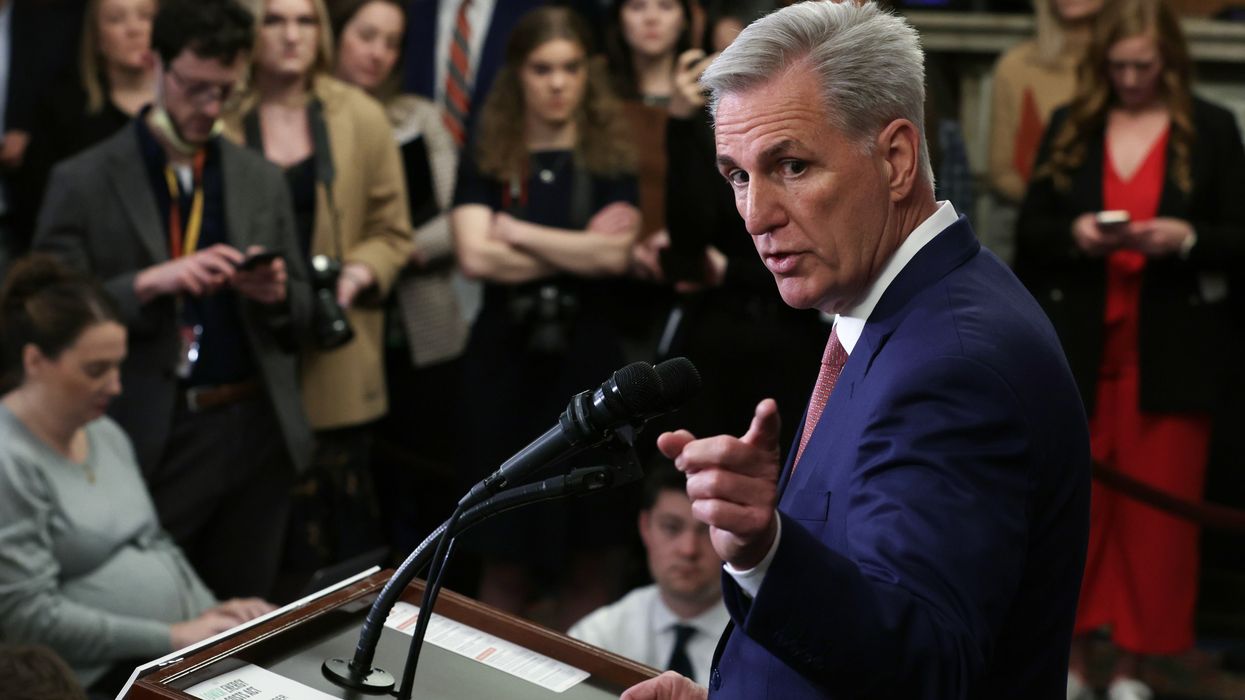
With House Republicans pledging to limit new spending on a range of programs, Democrats are "no longer obliged to move forward with the IRS cuts" in the handshake deal, said more than a dozen groups.
More than a dozen economic justice groups on Friday called on the U.S. Senate Appropriations Committee to move forward with fully funding the Internal Revenue Service, arguing that Republican actions have nullified a debt ceiling deal struck by the Biden White House and GOP leaders.
Under the terms of the handshake agreement, the nation's borrowing limit was suspended for two years in exchange for a two-year limit on non-military spending—rescinding Covid-19 relief funds; clawing back more than $20 billion in IRS funding that was a signature element of the Democrats' climate and healthcare law, the Inflation Reduction Act (IRA); and enforcing new work requirements for recipients of nutritional and economic aid.
Soon after the deal was reached, said groups including Groundwork Action, Americans for Tax Fairness, and the Institute on Taxation and Economic Policy (ITEP), House Speaker Kevin McCarthy (R-Calif.) and other powerful Republicans made clear they have no intention of sticking to the funding cuts that were agreed upon.
As Common Dreams reported in June, less than two weeks after the debt ceiling deal had been reached, House Appropriations Committee Chair Kay Granger (R-Texas) said the spending levels in the agreement were "a ceiling, not a floor" for 2024 spending and that Republicans are free to limit new spending in appropriations bills for the coming year.
"To be clear, Republican demands for IRS cuts were never sensible. The cuts will cost the government more than they will save and will make tax filing more complicated for middle-class Americans."
"In doing so, House Republicans are underfunding the very programs the agreed-upon IRS cuts are designed to protect," said the groups in their letter Friday. "Thus, your committee is no longer obliged to move forward with the IRS cuts in its appropriations and should instead fully fund the IRS at the levels President Biden requested in his FY2024 budget."
As the Senate committee prepares to mark up appropriations legislation, said the organizations, it should "include all of the funding for the IRS requested by President Biden in his FY2024 budget, amounting to $14.1 billion in annual discretionary appropriations for the IRS, and to preserve the $79.4 billion in long-term funding included in the Inflation Reduction Act."
"If Republicans have decided that the deal is off, then further IRS cuts should be completely off the table," ITEP federal policy analyst Joe Hughes told Common Dreams on Friday.
IRS funding aimed at cracking down on wealthy Americans who cost the federal government—and working families—tens of billions of dollars annually by evading taxes was a key provision of the IRA last year. After becoming House Speaker in January, McCarthy made clear his intention of cutting the funding.
Funding for the tax agency is "necessary to support a fair tax system, crack down on wealthy tax cheats, guarantee the highest quality of taxpayer services for all Americans, and ensure that the IRS can build an effective system that would empower taxpayers to file their taxes for free," said the groups.
As Common Dreams reported in June, the GOP's proposed cuts to the IRS would cost the federal government in $40 billion in lost revenue.
"To be clear, Republican demands for IRS cuts were never sensible," Hughes said. "The cuts will cost the government more than they will save and will make tax filing more complicated for middle-class Americans. Meanwhile, the top 1% and big multinational corporations will use their armies of accountants to cheat the system out of taxes that they legally owe."
While working to protect the wealthiest Americans from tax enforcement, the Republicans are also intent on scrapping an IRA provision which required the IRS to develop a tax filing system that would be free for all Americans—saving them hundreds of dollars per year in fees they currently pay to private companies like H&R Block and TaxSlayer to file their taxes.
A seven-month congressional investigation found this week that those companies send the private data of clients to tech giants like Meta and Google, constituting a "shocking breach" of privacy, according to Democratic lawmakers.
But the Republican-controlled House Appropriations Committee included a rider in its Financial Services and General Government (FSGG) legislation that would block the IRS from creating a simplified, free system for taxpayers.
"We strongly urge you to fully fund the IRS so that it can enforce tax laws against wealthy tax cheats and deliver 21st century customer services and oppose any efforts to incorporate harmful riders into the appropriations process," the groups told the Senate committee. "We have an opportunity to provide a free and fair option to millions of tax filers in America, making the tax system simpler and more equitable. Let's not miss this opportunity."

One climate advocate applauded the court for giving communities "a measure of reprieve" by stopping construction of the pipeline in Jefferson National Forest.
A three-judge panel from the U.S. Court of Appeals for the Fourth Circuit on Monday temporarily blocked the construction of a section of the Mountain Valley Pipeline that runs through Jefferson National Forest, pending a conservation group's petition to review the federal government's authorization of the fossil fuel infrastructure development.
"Time and time again, Mountain Valley has tried to force its dangerous pipeline through the Jefferson National Forest, devastating communities in its wake and racking up violations," Ben Tettlebaum, director and senior staff attorney at The Wilderness Society, said in a statement. "We're grateful that the court has given those communities a measure of reprieve by hitting the brakes on construction across our public lands, sparing them from further irreversible damage while this important case proceeds."
Work on unfinished portions of the 303-mile Mountain Valley Pipeline (MVP) was fast-tracked last month via the debt ceiling agreement that President Joe Biden, shunning his options for unilateral action, forged with House Republicans who took the global economy hostage.
Construction of the $6.6 billion fracked gas project—pushed hard by the GOP and Sen. Joe Manchin (D-W.Va.), a coal profiteer and Congress' top recipient of Big Oil money—has been halted by courts for years due to concerns about the harms it would unleash on people and ecosystems in Virginia, West Virginia, and beyond.
But Section 324 of the so-called Fiscal Responsibility Act of 2023 required federal authorities to approve all of MVP's outstanding permits, prohibited judicial review of those permits, and said only the D.C. Circuit Court of Appeals has jurisdiction to hear challenges to the provision's constitutionality.
Citing Section 324, MVP's developers and multiple government agencies filed motions last month to dismiss lawsuits against the pipeline. On behalf of The Wilderness Society, the Southern Environmental Law Center (SELC) filed a brief opposing those motions on June 26, arguing that Section 324 is unconstitutional because it violates the separation of powers.
In response to the stay issued by the Fourth Circuit on Monday, Mountain Valley Pipeline LLC said: "This is not the court to hear that claim. Congress, in plain terms, gave the D.C. Circuit 'exclusive jurisdiction' to hear such claims... Congress' message was crystal clear: If you want to challenge Section 324, you must do so in the D.C. Circuit."
In a similar vein, Manchin asserted that the Fourth Circuit lacks jurisdiction over MVP permits, rendering its new order unlawful.
But as The Wilderness Society and SELC explained last month, their two cases against the pipeline challenge "defective approvals by the United States Forest Service and the Bureau of Land Management allowing the MVP to cross the Jefferson National Forest in Virginia and West Virginia." Because both lawsuits predate the passage of Section 324 and allege violations of several environmental laws as well as the Administrative Procedure Act, the groups argued, the Fourth Circuit does have jurisdiction.
"Mountain Valley could not build their pipeline in compliance with the law, so they appealed to Congress to interfere with the courts, skirting both our legal system and Constitution," Chase Huntley, vice president of Strategy and Policy at The Wilderness Society, said two weeks ago. "The MVP rider buried in the Fiscal Responsibility Act attempts to ram through the pipeline, forcing it onto communities who have spoken out against its devastating impacts for nearly a decade."
"Because bedrock environmental laws stood in the pipeline's path, Mountain Valley convinced Congress to reach beyond its powers and decide in Mountain Valley's favor, circumventing the courts," said Huntley. "We're fighting to make sure our challenge to the Forest Service and Bureau of Land Management's approvals for the pipeline to cross the Jefferson National Forest has its rightful day in court."
The Wilderness Society and SELC weren't the only organizations to take action last month. Lawyers from the Sierra Club, Appalachian Mountain Advocates, and the Center for Biological Diversity filed a companion response opposing identical motions to dismiss another MVP case. That brief was submitted on behalf of 10 environmental groups—Wild Virginia, Appalachian Voices, Indian Creek Watershed Association, Preserve Bent Mountain, Preserve Giles County, West Virginia Highlands Conservancy, West Virginia Rivers Coalition, Chesapeake Climate Action Network, Sierra Club, and the Center for Biological Diversity.
In a Tuesday morning statement, Equitrans Midstream—which holds the largest interest among MVP stakeholders and plans to manage the pipeline once operational—said it was "disappointed" with the Fourth Circuit's stay and claimed the judges exceeded their authority.
"We are evaluating all legal options, which include filing an emergency appeal to the U.S. Supreme Court," the company said. "Unless this decision is promptly reversed, it would jeopardize Mountain Valley's ability to complete construction by year-end 2023."
MVP is one of several new fossil fuel projects being built or considered in the U.S. despite mounting evidence of the worsening climate crisis—and in direct conflict with the international scientific consensus, which has long warned that increasing the extraction and combustion of coal, oil, and gas will exacerbate deadly planetary heating.
As extreme weather disasters continue to wreak havoc across the U.S. and the world, Biden is facing growing pressure to declare a national climate emergency, which advocates say would unlock additional powers his administration could use to rein in the fossil fuel industry and ramp up clean energy production. Congressional Republicans, meanwhile, are currently trying to preempt the president from making such a move.

Without reforms, the DOD’s budget will almost certainly continue to soar, undoubtedly reaching $1 trillion or more annually within just the next few years.
On June 3, President Joe Bidensigned a bill into law that lifted the government’s debt ceiling and capped some categories of government spending. The big winner was—surprise, surprise!—the Pentagon.
Congress spared military-related programs any cuts while freezing all other categories of discretionary spending at the fiscal year 2023 level (except support for veterans). Indeed, lawmakers set the budget for the Pentagon and for other national security programs like nuclear-related work developing nuclear warheads at the Department of Energy at the level requested in the administration’s Fiscal Year 2024 budget proposal—a 3.3% increase in military spending to a whopping total of $886 billion. Consider that preferential treatment of the first order and, mind you, for the only government agency that’s failed to pass a single financial audit!
Even so, that $886 billion hike in Pentagon and related spending is likely to prove just a floor, not a ceiling, on what will be allocated for “national defense” next year. An analysis of the deal by The Wall Street Journal found that spending on the Pentagon and veterans’ care—neither of which is frozen in the agreement—is likely to pass $1 trillion next year.
As we should have learned from the 20 years of all-American wars in Afghanistan and Iraq, the term “overseas contingency” can be stretched to cover almost anything the Pentagon wants to spend your tax dollars on.
Compare that to the $637 billion left for the rest of the government’s discretionary budget. In other words, public health, environmental protection, housing, transportation, and almost everything else the government undertakes will have to make do with not even 45% of the federal government’s discretionary budget, less than what would be needed to keep up with inflation. (Forget addressing unmet needs in this country.)
And count on one thing: National security spending is likely to increase even more, thanks to a huge (if little-noticed) loophole in that budget deal, one that hawks in Congress are already salivating over how best to exploit. Yes, that loophole is easy to miss, given the bureaucratese used to explain it, but its potential impact on soaring military budgets couldn’t be clearer. In its analysis of the budget deal, the Congressional Budget Office noted that “funding designated as an emergency requirement or for overseas contingency operations would not be constrained” by anything the senators and House congressional representatives had agreed to.
As we should have learned from the 20 years of all-American wars in Afghanistan and Iraq, the term “overseas contingency” can be stretched to cover almost anything the Pentagon wants to spend your tax dollars on. In fact, there was even an “Overseas Contingency Operations” (OCO) account supposedly reserved for funding this country’s seemingly never-ending post-9/11 wars. And it certainly was used to fund them, but hundreds of billions of dollars of Pentagon projects that had nothing to do with the conflicts in Iraq or Afghanistan were funded that way as well. The critics of Pentagon overspending quickly dubbed it that department’s “slush fund.”
So, prepare yourself for “Slush Fund II” (coming soon to a theater near you). This time the vehicle for padding the Pentagon budget is likely to be the next military aid package for Ukraine, which will likely be put forward as an emergency bill later this year. Expect that package to include not only aid to help Ukraine fend off Russia’s ongoing brutal invasion but tens of billions of dollars more to—yes, of course!—pump up the Pentagon’s already bloated budget.
Senator Lindsey Graham (R-S.C.) made just such a point in talking with reporters shortly after the debt-ceiling deal was passed by Congress. “There will be a day before too long,” he told them, “where we’ll have to deal with the Ukrainian situation. And that will create an opportunity for me and others to fill in the deficiencies that exist from this budget deal.”
Senate Majority Leader Chuck Schumer (D-N.Y.) made a similar point in a statement on the Senate floor during the debate over that deal. “The debt ceiling deal,” he said, “does nothing to limit the Senate’s ability to appropriate emergency/supplemental funds to ensure our military capabilities are sufficient to deter China, Russia, and our other adversaries and respond to ongoing and growing national security threats.”
One potential (and surprising) snag in the future plans of those Pentagon budget boosters in both parties may be the position of House Speaker Kevin McCarthy (R-Calif.). He has, in fact, described efforts to increase Pentagon spending beyond the level set in the recent budget deal as “part of the problem.” For the moment at least, he openly opposes producing an emergency package to increase the Pentagon budget, saying:
“The last five audits the Department of Defense [have] failed. So there’s a lot of places for reform [where] we can have a lot of savings. We’ve plussed it up. This is the most money we’ve ever spent on defense—this is the most money anyone in the world has ever spent on defense. So I don’t think the first answer is to do a supplemental.”
The Department of Defense is, of course, already massively overfunded. That $886 billion figure is among the highest ever— hundreds of billions of dollars more than at the peak of the Korean or Vietnam wars or during the most intensely combative years of the Cold War. It’s higher than the combined military budgets of the next 10 countries combined, most of whom are, in any case, U.S. allies. And it’s estimated to be three times what the Chinese military, the Pentagon’s “pacing threat,” receives annually. Consider it an irony that actually “keeping pace” with China would involve a massive cut in military spending, not an increase in the Pentagon’s bloated budget.
It also should go without saying that preparations to effectively defend the United States and its allies could be achieved for so much less than is currently lavished on the Pentagon. A new approach could easily save significantly more than $100 billion in fiscal year 2024 , as proposed by Representatives Barbara Lee (D-Calif.) and Mark Pocan (D-Wis.) in the People Over Pentagon Act, the preeminent budget-cut proposal in Congress. An illustrative report released by the Congressional Budget Office (CBO) in late 2021 sketched out three scenarios, all involving a less interventionist, more restrained approach to defense that would include greater reliance on allies. Each option would reduce America’s 1.3-million-strong active military force (by up to one-fifth in one scenario). Total savings from the CBO’s proposed changes would, over a decade, be $1 trillion.
And a more comprehensive approach that shifted away from the current “cover the globe” strategy of being able to fight (though, as the history of this century shows, not always win) wars virtually anywhere on Earth on short notice—without allies, if necessary —could save hundreds of billions more over the next decade. Cutting bureaucracy and making other changes in defense policy could also yield yet more savings. To cite just two examples, reducing the Pentagon’s cohort of more than half-a-million private contract employees and scaling back its nuclear weapons “modernization” program would save significantly more than $300 billion extra over a decade.
But none of this is even remotely likely without concerted public pressure to, as a start, keep members of Congress from adding tens of billions of dollars in spending on parochial military projects that channel funding into their states or districts. And it would also mean pushing back against the propaganda of Pentagon contractors who claim they need ever more money to provide adequate tools to defend the country.
While demanding ever more of our tax dollars, the giant military-industrial corporations are spending all too much of their time simply stuffing the pockets of their shareholders rather than investing in the tools needed to actually defend this country. A recent Department of Defense report found that, from 2010-2019, such companies increased by 73% over the previous decade what they paid their shareholders. Meanwhile, their investment in research, development, and capital assets declined significantly. Still, such corporations claim that, without further Pentagon funding, they can’t afford to invest enough in their businesses to meet future national security challenges, which include ramping up weapons production to provide arms for Ukraine.
In reality, however, the financial data suggests that they simply chose to reward their shareholders over everything and everyone else, even as they experienced steadily improving profit margins and cash generation. In fact, the report pointed out that those companies “generate substantial amounts of cash beyond their needs for operations or capital investment.” So instead of investing further in their businesses, they choose to eat their “seed corn” by prioritizing short-term gains over long-term investments and by “investing” additional profits in their shareholders. And when you eat your seed corn, you have nothing left to plant next year.
Never fear, though, since Congress seems eternally prepared to bail them out. Their businesses, in fact, continue to thrive because Congress authorizes funding for the Pentagon to repeatedly grant them massive contracts, no matter their performance or lack of internal investment. No other industry could get away with such maximalist thinking.
Adding insult to injury, contractors are overcharging the government for the basic weaponry they produce while they rake in cash to enrich their shareholders.
Military contractors outperform similarly sized companies in non-defense industries in eight out of nine key financial metrics—including higher total returns to shareholders (a category where they leave much of the rest of the S&P 500 in the dust). They financially outshine their commercial counterparts for two obvious reasons: First, the government subsidizes so many of their costs; second, the weapons industry is so concentrated that its major firms have little or no competition.
Adding insult to injury, contractors are overcharging the government for the basic weaponry they produce while they rake in cash to enrich their shareholders. In the past 15 years, the Pentagon’s internal watchdog has exposed price gouging by contractors ranging from Boeing and Lockheed Martin to lesser-known companies like TransDigm Group. In 2011, Boeing made about $13 million in excess profits by overcharging the Army for 18 spare parts used in Apache and Chinook helicopters. To put that in perspective, the Army paid $1,678.61 each for a tiny helicopter part that the Pentagon already had in stock at its own warehouse for only $7.71.
The Pentagon found Lockheed Martin and Boeing price gouging together in 2015. They overcharged the military by “hundreds of millions of dollars” for missiles. TransDigm similarly made $16 million by overcharging for spare parts between 2015 and 2017 and even more in the following two years, generating nearly $21 million in excess profits. If you can believe it, there is no legal requirement for such companies to refund the government if they’re exposed for price gouging.
Of course, there’s nothing new about such corporate price gouging, nor is it unique to the arms industry. But it’s especially egregious there, given how heavily the major military contractors depend on the government’s business. Lockheed Martin, the biggest of them, got a staggering 73% of its $66 billion in net sales from the government in 2022. Boeing, which does far more commercial business, still generated 40% of its revenue from the government that year. (Down from 51% in 2020.)
Despite their reliance on government contracts, companies like Boeing seem to be doubling down on practices that often lead to price gouging. According to Bloomberg News, between 2020 and 2021, Boeing refused to provide the Pentagon with certified cost and pricing data for nearly 11,000 spare parts on a single Air Force contract. Senator Elizabeth Warren (D-Mass.) and Representative John Garamendi (D-Calif.) have demanded that the Pentagon investigate since, without such information, the department will continue to be hard-pressed to ensure that it’s paying anything like a fair price, whatever its purchases.
Reining in rip-offs and corruption on the part of weapons contractors large and small could save the American taxpayer untold billions of dollars. And curbing special-interest politics on the part of the denizens of the military-industrial-congressional complex (MICC) could help open the way towards the development of a truly defensive global military strategy rather than the current interventionist approach that has embroiled the United States in the devastating and counterproductive wars of this century.
One modest step towards reining in the power of the arms lobby would be to revamp the campaign finance system by providing federal matching funds, thereby diluting the influential nature of the tens of millions in campaign contributions the arms industry makes every election cycle. In addition, prohibiting retiring top military officers from going to work for arms-making companies—or, at least, extending the cooling off period to at least four years before they can do so, as proposed by Senator Warren—would also help reduce the undue influence exerted by the MICC.
Last but not least, steps could be taken to prevent the military services from giving Congress their annual wish lists—officially known as “unfunded priorities lists”—of items they want added to the Pentagon budget. After all, those are but another tool allowing members of Congress to add billions more than what the Pentagon has even asked for to that department’s budget.
Whether such reforms alone, if adopted, would be enough to truly roll back excess Pentagon spending remains to be seen. Without them, however, count on one thing: The department’s budget will almost certainly continue to soar, undoubtedly reaching $1 trillion or more annually within just the next few years. Americans can’t afford to let that happen.

The enormous sums lavished on the Pentagon are being marshaled in support of a flawed National Defense Strategy that attempts to go everywhere and do everything, making America and the world less safe.
The Biden administration requested $886 billion for national defense for Fiscal Year 2024, a sum far higher in real terms than the peaks of the Korean or Vietnam wars or at the height of the Cold War.
That figure could go even higher under the terms of the debt ceiling deal reached by President Joe Biden and House Speaker Kevin McCarthy (R-Calif.), as hawks in Congress push for an emergency package that could not only provide aid needed to defend Ukraine but also tens of billions of dollars in additional funding for the Pentagon’s regular budget.
This is a terrible idea. There is no reason to add funds to the Pentagon budget, as documented in a report released Thursday by the Quincy Institute.
The United States could mount a robust defense for far less money if it pursued a more restrained strategy that takes a more realistic view of the military challenges posed by Russia and China, relies more heavily on allies to provide for the defense of their own regions, shifts to a deterrence-only nuclear strategy, and emphasizes diplomacy over the threats or use of force to curb nuclear proliferation.
The enormous sums lavished on the Pentagon are being marshaled in support of a flawed National Defense Strategy that attempts to go everywhere and do everything, from winning a war with Russia or China, to intervening in Iran or North Korea, to continuing to fight a global war on terror that includes military activities in at least 85 countries.
Sticking to the current strategy is not only economically wasteful, but will also make America and the world less safe. It leads to unnecessary conflicts that drain lives and treasure and contribute to instability in the regions where those conflicts are waged, as occurred with the wars in Iraq and Afghanistan. In addition, elevating open-ended military commitments over other security challenges—from climate change to pandemics—risks intensifying the human and security consequences of those threats by reducing the resources available to address them.
The costs of America’s military overreach are compounded by the undue influence exerted by the arms industry and its allies in Congress, backed up by over $83 million in campaign contributions in the past two election cycles and the employment of over 820 lobbyists, or more than one for each and every member of Congress.
The industry also leverages the jobs its programs create to bring lawmakers on board to fund ever higher budgets, despite the fact that the economic role of the arms sector has declined dramatically over the past three decades—from 3.2 million direct jobs to just 1.1 million today, or six-tenths of 1% of a national labor force of over 160 million people. Meanwhile, last year alone, Congress added $45 billion to the Pentagon budget beyond what the department itself requested, much of it for systems built in the states or districts of key members, a process that puts special interests above the national interest.
The United States could mount a robust defense for far less money if it pursued a more restrained strategy that takes a more realistic view of the military challenges posed by Russia and China, relies more heavily on allies to provide for the defense of their own regions, shifts to a deterrence-only nuclear strategy, and emphasizes diplomacy over the threats or use of force to curb nuclear proliferation. This approach could save at least $1.3 trillion over the next decade, funds that could be invested in other areas of urgent national need. But making a shift of that magnitude will require political and budgetary reforms to reduce the immense power of the arms lobby.
In addition to shifting to a more restrained defense strategy, a number of initial steps—some small, some major—can be taken to weaken the economic grip of the arms industry on Pentagon spending and policy.
First, top military officers and senior Pentagon officials should be barred from going to work for any military contractor that receives more than $1 billion per year from the Pentagon. At a minimum, there should be a four year ban on major contractors hiring Defense Department officials once they leave government, as set out in Senator Elizabeth Warren’s Department of Defense Ethics and Anti-corruption Act.
Second, the practice of the arms industry funding the campaigns of members of the armed services committees and defense appropriations subcommittees of each house of Congress should be ended. Ideally, there should be a legal ban on such contributions, but if such a measure doesn’t pass legal muster the practice should be stigmatized to the point that relevant members voluntarily forgo such donations.
And third, regional economic strategies that create civilian alternatives for heavily defense-dependent areas should be developed. Given the urgent threat posed by climate change, much of this activity can be centered on creating new hubs for the development and production of green technologies.
The Pentagon budget is headed in the wrong direction, to the detriment of our security and our economic prospects. We should redouble efforts to rein it in, led by citizen’s organizations joined by congressional leaders who are not in thrall to the military-industrial complex that President Dwight D. Eisenhower warned about 62 years ago.
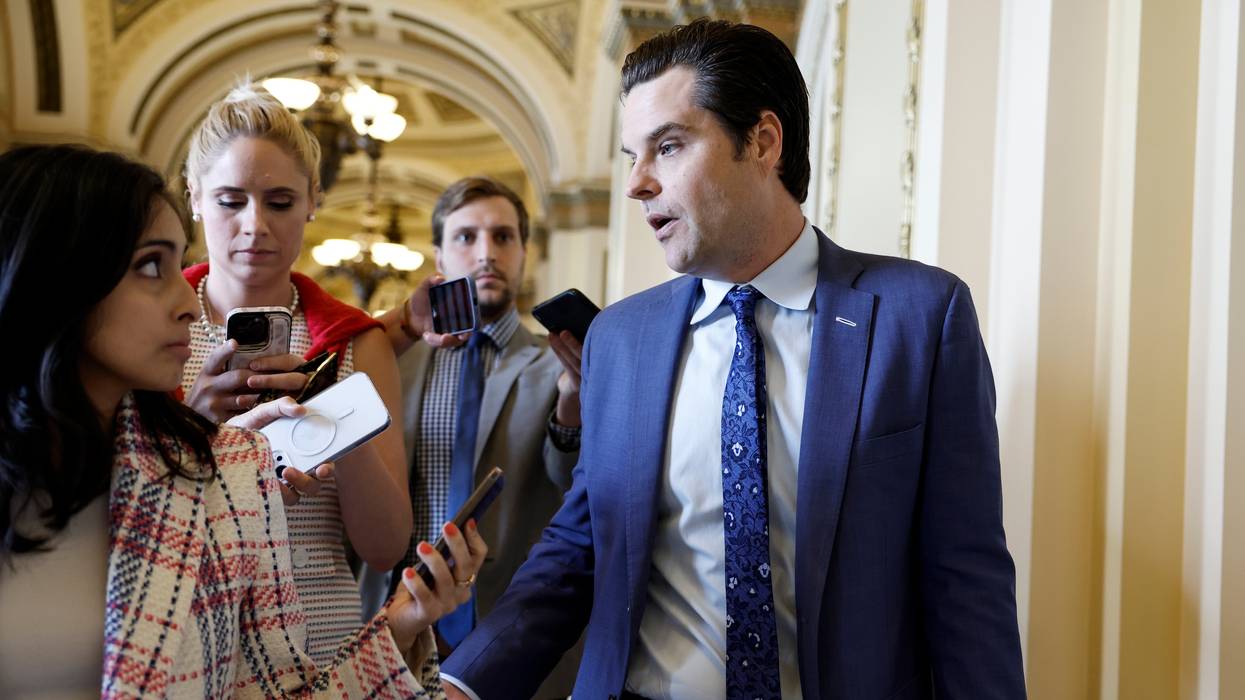
"An incredible embarrassment for the House Republican leadership," said one observer. "The morning McCarthy tries to turn the page, conservatives slap him and his leadership team in the face."
Progressive pundits on Tuesday derided what one commentator called a "complete shitshow" as a group of hard-right House Republicans voted with their Democratic colleagues in tanking GOP-backed bills to block regulation of gas stoves.
Members of the far-right House Freedom Caucus joined Democrats in voting against a rule to advance four bills, two of them related to shielding gas stoves from federal regulation. Industry groups including the American Gas Association—which has known and tried to hide for decades that gas stoves can harm human health—support the legislation.
"Today, we took down the rule because we're frustrated at the way this place is operating," Rep. Matt Gaetz (R-Fla.) told reporters, according to The Hill. "We took a stand in January to end the era of the imperial speakership. We're concerned that the fundamental commitments that allowed Kevin McCarthy to assume the speakership have been violated as a consequence of the debt limit deal."
While many progressives were infuriated by the deal struck between President Joe Biden and McCarthy (R-Calif.) to raise the nation's debt limit and avoid a first-ever default because the agreement helps protect wealth tax dodgers while slashing social safety net and climate spending, far-right Republicans also loathe the deal because they believe its belt-tightening measures are largely cosmetic.
"We warned them not to cut that deal without coming down and sit down and talk to us. So this is all about restoring a process that will fundamentally change things back to what was working," said Rep. Chip Roy (R-Texas), who also voted against advancing the gas stove bills.
In addition to Gaetz and Roy, the following Republicans voted to block the bills' advancement: House Majority Leader Steve Scalise (La.) and Reps. Andy Biggs (Ariz.), Dan Bishop (N.C.), Lauren Boebert (Colo.), Ken Buck (Colo.), Tim Burchett (Tenn.), Eli Crane (Ariz.), Bob Good (Va.), Ralph Norman (S.C.), and Matt Rosendale (Mont.).
"Haha. Republicans don't even have the votes to advance their own bill creating fake hysteria around banning gas stoves—which no one is trying to do," tweeted Democratic strategist Sawyer Hackett. "The House GOP majority hard at work on the issues that matter most!"

"We're taking the streets to shut it down and send the message to Sen. Schumer that he must STOP the #DirtyDeal being included in the debt ceiling bill!"
As progressives excoriated President Joe Biden's debt ceiling deal with Republican lawmakers over "polluter giveaways" including the Mountain Valley Pipeline, activists rallied outside Sen. Chuck Schumer's Brooklyn home on Tuesday evening with a message for the majority leader: "Stop the dirty pipeline deal, or we shut down your block."
The protesters—led by Climate Defiance and backed by Food & Water Watch, Climate Defenders, Climate Families NYC, New York Communities for Change (NYCC), and others—chanted messages including "Schumer, stop the dirty deal" as they marched in the Park Slope neighborhood where he lives.
"Schumer is on the cusp of making a deal with the devil, stripping down our bedrock environmental laws and review processes for the Sisyphean task of trying to appease fossil fuel oligarch [Senate Energy Committee Chair] Joe Manchin," the rally's organizers said in a statement published on Action Network. "This is not ok!"
The group Indivisible tweeted: "We're taking the streets to shut it down and send the message to Sen. Schumer that he must STOP the #DirtyDeal being included in the debt ceiling bill! It's time to stop building fossil fuel infrastructure and that means no more pipelines. Chuck, stop appeasing Manchin!"
While OpenSecrets.org lists Manchin (D-W.Va.) as the biggest congressional recipient of fossil fuel campaign donations during the 2021-22 election cycle, The New Republic reported last September that Schumer (D-N.Y.) took more donations than Manchin from NextEra Capital Holdings, one of the companies behind the $6.6 billion Mountain Valley Pipeline (MVP).
The debt ceiling bill states that "Congress hereby finds and declares that the timely completion of construction and operation of the Mountain Valley Pipeline is required in the national interest."
Manchin, whose family is heavily invested in fossil fuels, is a staunch booster of the MVP, as is the state's other U.S. senator, Republican Shelley Moore Capito. Manchin has been trying—so far without success—to gain congressional approval of the project since early last year. Last December, he tried to attach what was also being described as a "zombie deal" to the $858 billion military spending package. It was Manchin's third time floating the measure.
The organizers of Tuesday's protest called the MVP an "ecocidal project" that "would transport 2 billion cubic feet of fracked gas every single day."
"It would have the same climate impact as multiple dozens of brand-new coal plants," the groups warned. "We cannot allow Chuck Schumer to sell out our future to Joe Manchin. And we won't."
The MVP's inclusion in the bill to avoid a first-ever U.S. default does not mean the pipeline will ultimately be part of the package. On Tuesday, six House Democrats from Virginia—Don Beyer, Gerry Connolly, Jennifer McClellan, Bobby Scott, Abigail Spanberger, and Jennifer Wexton—introduced an amendment that would strip MVP approval from the legislation.