SUBSCRIBE TO OUR FREE NEWSLETTER
Daily news & progressive opinion—funded by the people, not the corporations—delivered straight to your inbox.
5
#000000
#FFFFFF
To donate by check, phone, or other method, see our More Ways to Give page.
Daily news & progressive opinion—funded by the people, not the corporations—delivered straight to your inbox.
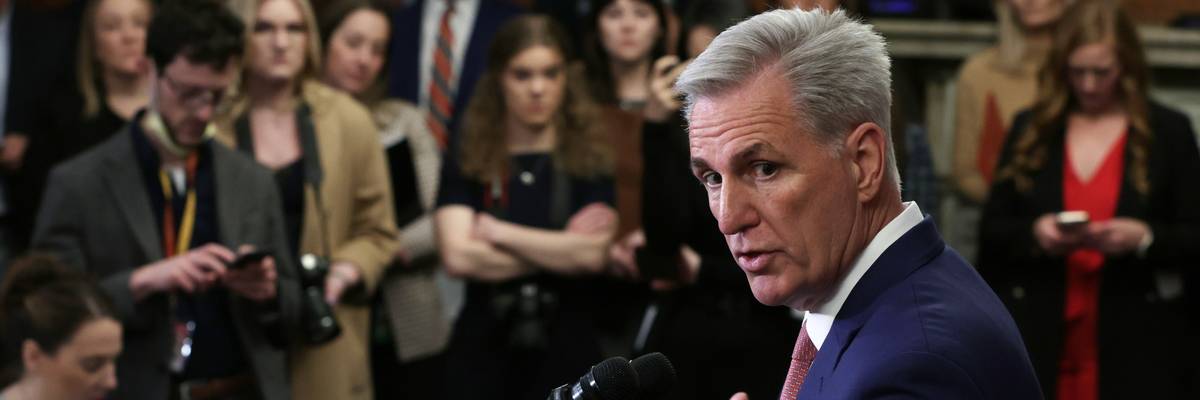
U.S. Speaker of the House Rep. Kevin McCarthy (R-Calif.) speaks to members of the press during a news conference at the U.S. Capitol on March 30, 2023 in Washington, D.C.
With House Republicans pledging to limit new spending on a range of programs, Democrats are "no longer obliged to move forward with the IRS cuts" in the handshake deal, said more than a dozen groups.
More than a dozen economic justice groups on Friday called on the U.S. Senate Appropriations Committee to move forward with fully funding the Internal Revenue Service, arguing that Republican actions have nullified a debt ceiling deal struck by the Biden White House and GOP leaders.
Under the terms of the handshake agreement, the nation's borrowing limit was suspended for two years in exchange for a two-year limit on non-military spending—rescinding Covid-19 relief funds; clawing back more than $20 billion in IRS funding that was a signature element of the Democrats' climate and healthcare law, the Inflation Reduction Act (IRA); and enforcing new work requirements for recipients of nutritional and economic aid.
Soon after the deal was reached, said groups including Groundwork Action, Americans for Tax Fairness, and the Institute on Taxation and Economic Policy (ITEP), House Speaker Kevin McCarthy (R-Calif.) and other powerful Republicans made clear they have no intention of sticking to the funding cuts that were agreed upon.
As Common Dreams reported in June, less than two weeks after the debt ceiling deal had been reached, House Appropriations Committee Chair Kay Granger (R-Texas) said the spending levels in the agreement were "a ceiling, not a floor" for 2024 spending and that Republicans are free to limit new spending in appropriations bills for the coming year.
"To be clear, Republican demands for IRS cuts were never sensible. The cuts will cost the government more than they will save and will make tax filing more complicated for middle-class Americans."
"In doing so, House Republicans are underfunding the very programs the agreed-upon IRS cuts are designed to protect," said the groups in their letter Friday. "Thus, your committee is no longer obliged to move forward with the IRS cuts in its appropriations and should instead fully fund the IRS at the levels President Biden requested in his FY2024 budget."
As the Senate committee prepares to mark up appropriations legislation, said the organizations, it should "include all of the funding for the IRS requested by President Biden in his FY2024 budget, amounting to $14.1 billion in annual discretionary appropriations for the IRS, and to preserve the $79.4 billion in long-term funding included in the Inflation Reduction Act."
"If Republicans have decided that the deal is off, then further IRS cuts should be completely off the table," ITEP federal policy analyst Joe Hughes told Common Dreams on Friday.
IRS funding aimed at cracking down on wealthy Americans who cost the federal government—and working families—tens of billions of dollars annually by evading taxes was a key provision of the IRA last year. After becoming House Speaker in January, McCarthy made clear his intention of cutting the funding.
Funding for the tax agency is "necessary to support a fair tax system, crack down on wealthy tax cheats, guarantee the highest quality of taxpayer services for all Americans, and ensure that the IRS can build an effective system that would empower taxpayers to file their taxes for free," said the groups.
As Common Dreams reported in June, the GOP's proposed cuts to the IRS would cost the federal government in $40 billion in lost revenue.
"To be clear, Republican demands for IRS cuts were never sensible," Hughes said. "The cuts will cost the government more than they will save and will make tax filing more complicated for middle-class Americans. Meanwhile, the top 1% and big multinational corporations will use their armies of accountants to cheat the system out of taxes that they legally owe."
While working to protect the wealthiest Americans from tax enforcement, the Republicans are also intent on scrapping an IRA provision which required the IRS to develop a tax filing system that would be free for all Americans—saving them hundreds of dollars per year in fees they currently pay to private companies like H&R Block and TaxSlayer to file their taxes.
A seven-month congressional investigation found this week that those companies send the private data of clients to tech giants like Meta and Google, constituting a "shocking breach" of privacy, according to Democratic lawmakers.
But the Republican-controlled House Appropriations Committee included a rider in its Financial Services and General Government (FSGG) legislation that would block the IRS from creating a simplified, free system for taxpayers.
"We strongly urge you to fully fund the IRS so that it can enforce tax laws against wealthy tax cheats and deliver 21st century customer services and oppose any efforts to incorporate harmful riders into the appropriations process," the groups told the Senate committee. "We have an opportunity to provide a free and fair option to millions of tax filers in America, making the tax system simpler and more equitable. Let's not miss this opportunity."
Dear Common Dreams reader, It’s been nearly 30 years since I co-founded Common Dreams with my late wife, Lina Newhouser. We had the radical notion that journalism should serve the public good, not corporate profits. It was clear to us from the outset what it would take to build such a project. No paid advertisements. No corporate sponsors. No millionaire publisher telling us what to think or do. Many people said we wouldn't last a year, but we proved those doubters wrong. Together with a tremendous team of journalists and dedicated staff, we built an independent media outlet free from the constraints of profits and corporate control. Our mission has always been simple: To inform. To inspire. To ignite change for the common good. Building Common Dreams was not easy. Our survival was never guaranteed. When you take on the most powerful forces—Wall Street greed, fossil fuel industry destruction, Big Tech lobbyists, and uber-rich oligarchs who have spent billions upon billions rigging the economy and democracy in their favor—the only bulwark you have is supporters who believe in your work. But here’s the urgent message from me today. It's never been this bad out there. And it's never been this hard to keep us going. At the very moment Common Dreams is most needed, the threats we face are intensifying. We need your support now more than ever. We don't accept corporate advertising and never will. We don't have a paywall because we don't think people should be blocked from critical news based on their ability to pay. Everything we do is funded by the donations of readers like you. When everyone does the little they can afford, we are strong. But if that support retreats or dries up, so do we. Will you donate now to make sure Common Dreams not only survives but thrives? —Craig Brown, Co-founder |
More than a dozen economic justice groups on Friday called on the U.S. Senate Appropriations Committee to move forward with fully funding the Internal Revenue Service, arguing that Republican actions have nullified a debt ceiling deal struck by the Biden White House and GOP leaders.
Under the terms of the handshake agreement, the nation's borrowing limit was suspended for two years in exchange for a two-year limit on non-military spending—rescinding Covid-19 relief funds; clawing back more than $20 billion in IRS funding that was a signature element of the Democrats' climate and healthcare law, the Inflation Reduction Act (IRA); and enforcing new work requirements for recipients of nutritional and economic aid.
Soon after the deal was reached, said groups including Groundwork Action, Americans for Tax Fairness, and the Institute on Taxation and Economic Policy (ITEP), House Speaker Kevin McCarthy (R-Calif.) and other powerful Republicans made clear they have no intention of sticking to the funding cuts that were agreed upon.
As Common Dreams reported in June, less than two weeks after the debt ceiling deal had been reached, House Appropriations Committee Chair Kay Granger (R-Texas) said the spending levels in the agreement were "a ceiling, not a floor" for 2024 spending and that Republicans are free to limit new spending in appropriations bills for the coming year.
"To be clear, Republican demands for IRS cuts were never sensible. The cuts will cost the government more than they will save and will make tax filing more complicated for middle-class Americans."
"In doing so, House Republicans are underfunding the very programs the agreed-upon IRS cuts are designed to protect," said the groups in their letter Friday. "Thus, your committee is no longer obliged to move forward with the IRS cuts in its appropriations and should instead fully fund the IRS at the levels President Biden requested in his FY2024 budget."
As the Senate committee prepares to mark up appropriations legislation, said the organizations, it should "include all of the funding for the IRS requested by President Biden in his FY2024 budget, amounting to $14.1 billion in annual discretionary appropriations for the IRS, and to preserve the $79.4 billion in long-term funding included in the Inflation Reduction Act."
"If Republicans have decided that the deal is off, then further IRS cuts should be completely off the table," ITEP federal policy analyst Joe Hughes told Common Dreams on Friday.
IRS funding aimed at cracking down on wealthy Americans who cost the federal government—and working families—tens of billions of dollars annually by evading taxes was a key provision of the IRA last year. After becoming House Speaker in January, McCarthy made clear his intention of cutting the funding.
Funding for the tax agency is "necessary to support a fair tax system, crack down on wealthy tax cheats, guarantee the highest quality of taxpayer services for all Americans, and ensure that the IRS can build an effective system that would empower taxpayers to file their taxes for free," said the groups.
As Common Dreams reported in June, the GOP's proposed cuts to the IRS would cost the federal government in $40 billion in lost revenue.
"To be clear, Republican demands for IRS cuts were never sensible," Hughes said. "The cuts will cost the government more than they will save and will make tax filing more complicated for middle-class Americans. Meanwhile, the top 1% and big multinational corporations will use their armies of accountants to cheat the system out of taxes that they legally owe."
While working to protect the wealthiest Americans from tax enforcement, the Republicans are also intent on scrapping an IRA provision which required the IRS to develop a tax filing system that would be free for all Americans—saving them hundreds of dollars per year in fees they currently pay to private companies like H&R Block and TaxSlayer to file their taxes.
A seven-month congressional investigation found this week that those companies send the private data of clients to tech giants like Meta and Google, constituting a "shocking breach" of privacy, according to Democratic lawmakers.
But the Republican-controlled House Appropriations Committee included a rider in its Financial Services and General Government (FSGG) legislation that would block the IRS from creating a simplified, free system for taxpayers.
"We strongly urge you to fully fund the IRS so that it can enforce tax laws against wealthy tax cheats and deliver 21st century customer services and oppose any efforts to incorporate harmful riders into the appropriations process," the groups told the Senate committee. "We have an opportunity to provide a free and fair option to millions of tax filers in America, making the tax system simpler and more equitable. Let's not miss this opportunity."
More than a dozen economic justice groups on Friday called on the U.S. Senate Appropriations Committee to move forward with fully funding the Internal Revenue Service, arguing that Republican actions have nullified a debt ceiling deal struck by the Biden White House and GOP leaders.
Under the terms of the handshake agreement, the nation's borrowing limit was suspended for two years in exchange for a two-year limit on non-military spending—rescinding Covid-19 relief funds; clawing back more than $20 billion in IRS funding that was a signature element of the Democrats' climate and healthcare law, the Inflation Reduction Act (IRA); and enforcing new work requirements for recipients of nutritional and economic aid.
Soon after the deal was reached, said groups including Groundwork Action, Americans for Tax Fairness, and the Institute on Taxation and Economic Policy (ITEP), House Speaker Kevin McCarthy (R-Calif.) and other powerful Republicans made clear they have no intention of sticking to the funding cuts that were agreed upon.
As Common Dreams reported in June, less than two weeks after the debt ceiling deal had been reached, House Appropriations Committee Chair Kay Granger (R-Texas) said the spending levels in the agreement were "a ceiling, not a floor" for 2024 spending and that Republicans are free to limit new spending in appropriations bills for the coming year.
"To be clear, Republican demands for IRS cuts were never sensible. The cuts will cost the government more than they will save and will make tax filing more complicated for middle-class Americans."
"In doing so, House Republicans are underfunding the very programs the agreed-upon IRS cuts are designed to protect," said the groups in their letter Friday. "Thus, your committee is no longer obliged to move forward with the IRS cuts in its appropriations and should instead fully fund the IRS at the levels President Biden requested in his FY2024 budget."
As the Senate committee prepares to mark up appropriations legislation, said the organizations, it should "include all of the funding for the IRS requested by President Biden in his FY2024 budget, amounting to $14.1 billion in annual discretionary appropriations for the IRS, and to preserve the $79.4 billion in long-term funding included in the Inflation Reduction Act."
"If Republicans have decided that the deal is off, then further IRS cuts should be completely off the table," ITEP federal policy analyst Joe Hughes told Common Dreams on Friday.
IRS funding aimed at cracking down on wealthy Americans who cost the federal government—and working families—tens of billions of dollars annually by evading taxes was a key provision of the IRA last year. After becoming House Speaker in January, McCarthy made clear his intention of cutting the funding.
Funding for the tax agency is "necessary to support a fair tax system, crack down on wealthy tax cheats, guarantee the highest quality of taxpayer services for all Americans, and ensure that the IRS can build an effective system that would empower taxpayers to file their taxes for free," said the groups.
As Common Dreams reported in June, the GOP's proposed cuts to the IRS would cost the federal government in $40 billion in lost revenue.
"To be clear, Republican demands for IRS cuts were never sensible," Hughes said. "The cuts will cost the government more than they will save and will make tax filing more complicated for middle-class Americans. Meanwhile, the top 1% and big multinational corporations will use their armies of accountants to cheat the system out of taxes that they legally owe."
While working to protect the wealthiest Americans from tax enforcement, the Republicans are also intent on scrapping an IRA provision which required the IRS to develop a tax filing system that would be free for all Americans—saving them hundreds of dollars per year in fees they currently pay to private companies like H&R Block and TaxSlayer to file their taxes.
A seven-month congressional investigation found this week that those companies send the private data of clients to tech giants like Meta and Google, constituting a "shocking breach" of privacy, according to Democratic lawmakers.
But the Republican-controlled House Appropriations Committee included a rider in its Financial Services and General Government (FSGG) legislation that would block the IRS from creating a simplified, free system for taxpayers.
"We strongly urge you to fully fund the IRS so that it can enforce tax laws against wealthy tax cheats and deliver 21st century customer services and oppose any efforts to incorporate harmful riders into the appropriations process," the groups told the Senate committee. "We have an opportunity to provide a free and fair option to millions of tax filers in America, making the tax system simpler and more equitable. Let's not miss this opportunity."