SUBSCRIBE TO OUR FREE NEWSLETTER
Daily news & progressive opinion—funded by the people, not the corporations—delivered straight to your inbox.
5
#000000
#FFFFFF
To donate by check, phone, or other method, see our More Ways to Give page.
Daily news & progressive opinion—funded by the people, not the corporations—delivered straight to your inbox.
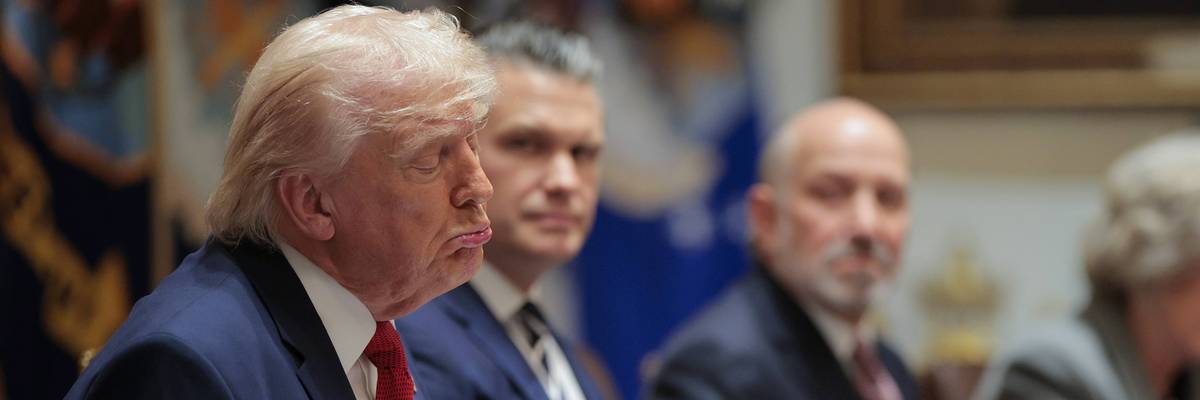
US President Donald Trump reacts as he speaks during a Cabinet meeting in the Cabinet Room of the White House on March 26, 2026 in Washington, DC.
Bottom line: If the war accomplished anything, it accelerated the decline of US power, influence, and economic security.
The Memorandum of Understanding, which ostensibly ends the four-month war between the US and Iran, illuminated the profound US defeat. In addition, a Quincy Institute webinar on military lessons from the war, shortly before the MOU’s release, enumerated numerous ways in which the US failures in its misbegotten war reveal how drastically US military dominance has been undermined for the long term.
On the subject of the relative decline of US power and influence, the impacts of the war on world energy supplies—especially in Asia—will reinforce political and economic pressures for alternative—non-fossil—energy sources. China is already light years ahead of the US in clean energy production technologies, while President Donald Trump thinks only in the very short term as he maximizes oil and gas production and exports while attempting to revitalize filthy coal mining.
Bottom line: The US loss in this totally avoidable imperial war of choice was severe. That said, countries and territories as small and weak as Cuba and Greenland remain profoundly vulnerable.
The MOU’s commitments include:
Perhaps like the “decent interval” with which the Nixon administration sought to minimize the domestic political costs of the US defeat in Vietnam, by dragging out negotiations and agreeing to a remarkably vague framework, President Trump hopes to minimize the impacts of his lost war on the November midterm elections. Iran will dominate and ultimately control the Strait of Hormuz for the foreseeable future. How it exercises that power, with its global economic implications, will be a new feature of the emerging multipolar world disorder. The escape clause that allows for the extension of negotiations beyond the 60-day timeline should prepare us for a long, difficult, and drawn-out process. And in true Trumpian form, despite the commitment to “refrain from the threat or use of force against each other,” within hours of the MOU’s release, our president threatened to resume bombing if he was not satisfied with the outcome of negotiations. (This may have been more for domestic political consumption than a threat that Iran will take seriously.)
With 1,000 Gazans having been killed since the declaration of that ceasefire, and with Israeli Prime Minister Benjamin Netanyahu more concerned with winning his nation’s October election and staying out of jail, the US ability to enforce the termination of Israeli military operations in or its occupation of its northern neighbor is in doubt. Iran’s confirmation that it will it not procure or develop nuclear weapons is nothing new. That was the case before President Trump withdraw from the Joint Comprehensive Plan of Action nuclear agreement negotiated by President Barack Obama and was reiterated numerous times by Iranian leaders before the Trump-Netanyahu regime change attempt, which resulted in a harder-line government. Like Japan, South Korea, Sweden, and Poland, Iran will remain a threshold nuclear state, and the MOU allows for enrichment for medical and power generation use, as Iran has insisted for years.
But Trump’s defeat will reverberate globally. Elites in many nations will be taking a North Korean lesson from this and the Ukrainian wars: If you have nuclear weapons, nuclear weapons states won’t attack you. Diplomatically, between this globally disastrous war, Trump’s total disregard of allies in launching and fighting the war, the US cessation of military aid to Ukraine and its inability to facilitate either a ceasefire or peace negotiations in that war, the Euro-Atlantic alliance is on life support and solidarity among US people and Europeans is but a memory. And as we look to possible future crises, Europeans are overestimating Russia’s military power and are racing to create a European Union superpower—either within or independent of NATO.
Then there is the lesson from the Iran War for the US-Chinese competition for Asia-Pacific regional hegemony. The failure of Trump’s Iran war illuminated US-Chinese dynamics and realities at play over the last decade or more.
As enumerated in the Quincy Institute’s webinar with military analysts Brandon Carr, Jennifer Kavanagh, and Kelly Grieco, the war demonstrates that the US is not in a position to militarily defend Taiwan, nor will it be able to credibly threaten to defeat China in a non-nuclear war. (No one wins a nuclear war!!!)
Bottom line: If the war accomplished anything, it accelerated the decline of US power, influence, and economic security. Instead of wasting billions on White House human cockfights, futile efforts to regain military superiority, subsidizing the military-industrial-congressional complex, and turning the clock back to Jim Crow America, we would do better to take a page from President Franklin Roosevelt’s New Deal and rebuild economic and human security for the US people.
Dear Common Dreams reader, It’s been nearly 30 years since I co-founded Common Dreams with my late wife, Lina Newhouser. We had the radical notion that journalism should serve the public good, not corporate profits. It was clear to us from the outset what it would take to build such a project. No paid advertisements. No corporate sponsors. No millionaire publisher telling us what to think or do. Many people said we wouldn't last a year, but we proved those doubters wrong. Together with a tremendous team of journalists and dedicated staff, we built an independent media outlet free from the constraints of profits and corporate control. Our mission has always been simple: To inform. To inspire. To ignite change for the common good. Building Common Dreams was not easy. Our survival was never guaranteed. When you take on the most powerful forces—Wall Street greed, fossil fuel industry destruction, Big Tech lobbyists, and uber-rich oligarchs who have spent billions upon billions rigging the economy and democracy in their favor—the only bulwark you have is supporters who believe in your work. But here’s the urgent message from me today. It's never been this bad out there. And it's never been this hard to keep us going. At the very moment Common Dreams is most needed, the threats we face are intensifying. We need your support now more than ever. We don't accept corporate advertising and never will. We don't have a paywall because we don't think people should be blocked from critical news based on their ability to pay. Everything we do is funded by the donations of readers like you. When everyone does the little they can afford, we are strong. But if that support retreats or dries up, so do we. Will you donate now to make sure Common Dreams not only survives but thrives? —Craig Brown, Co-founder |
The Memorandum of Understanding, which ostensibly ends the four-month war between the US and Iran, illuminated the profound US defeat. In addition, a Quincy Institute webinar on military lessons from the war, shortly before the MOU’s release, enumerated numerous ways in which the US failures in its misbegotten war reveal how drastically US military dominance has been undermined for the long term.
On the subject of the relative decline of US power and influence, the impacts of the war on world energy supplies—especially in Asia—will reinforce political and economic pressures for alternative—non-fossil—energy sources. China is already light years ahead of the US in clean energy production technologies, while President Donald Trump thinks only in the very short term as he maximizes oil and gas production and exports while attempting to revitalize filthy coal mining.
Bottom line: The US loss in this totally avoidable imperial war of choice was severe. That said, countries and territories as small and weak as Cuba and Greenland remain profoundly vulnerable.
The MOU’s commitments include:
Perhaps like the “decent interval” with which the Nixon administration sought to minimize the domestic political costs of the US defeat in Vietnam, by dragging out negotiations and agreeing to a remarkably vague framework, President Trump hopes to minimize the impacts of his lost war on the November midterm elections. Iran will dominate and ultimately control the Strait of Hormuz for the foreseeable future. How it exercises that power, with its global economic implications, will be a new feature of the emerging multipolar world disorder. The escape clause that allows for the extension of negotiations beyond the 60-day timeline should prepare us for a long, difficult, and drawn-out process. And in true Trumpian form, despite the commitment to “refrain from the threat or use of force against each other,” within hours of the MOU’s release, our president threatened to resume bombing if he was not satisfied with the outcome of negotiations. (This may have been more for domestic political consumption than a threat that Iran will take seriously.)
With 1,000 Gazans having been killed since the declaration of that ceasefire, and with Israeli Prime Minister Benjamin Netanyahu more concerned with winning his nation’s October election and staying out of jail, the US ability to enforce the termination of Israeli military operations in or its occupation of its northern neighbor is in doubt. Iran’s confirmation that it will it not procure or develop nuclear weapons is nothing new. That was the case before President Trump withdraw from the Joint Comprehensive Plan of Action nuclear agreement negotiated by President Barack Obama and was reiterated numerous times by Iranian leaders before the Trump-Netanyahu regime change attempt, which resulted in a harder-line government. Like Japan, South Korea, Sweden, and Poland, Iran will remain a threshold nuclear state, and the MOU allows for enrichment for medical and power generation use, as Iran has insisted for years.
But Trump’s defeat will reverberate globally. Elites in many nations will be taking a North Korean lesson from this and the Ukrainian wars: If you have nuclear weapons, nuclear weapons states won’t attack you. Diplomatically, between this globally disastrous war, Trump’s total disregard of allies in launching and fighting the war, the US cessation of military aid to Ukraine and its inability to facilitate either a ceasefire or peace negotiations in that war, the Euro-Atlantic alliance is on life support and solidarity among US people and Europeans is but a memory. And as we look to possible future crises, Europeans are overestimating Russia’s military power and are racing to create a European Union superpower—either within or independent of NATO.
Then there is the lesson from the Iran War for the US-Chinese competition for Asia-Pacific regional hegemony. The failure of Trump’s Iran war illuminated US-Chinese dynamics and realities at play over the last decade or more.
As enumerated in the Quincy Institute’s webinar with military analysts Brandon Carr, Jennifer Kavanagh, and Kelly Grieco, the war demonstrates that the US is not in a position to militarily defend Taiwan, nor will it be able to credibly threaten to defeat China in a non-nuclear war. (No one wins a nuclear war!!!)
Bottom line: If the war accomplished anything, it accelerated the decline of US power, influence, and economic security. Instead of wasting billions on White House human cockfights, futile efforts to regain military superiority, subsidizing the military-industrial-congressional complex, and turning the clock back to Jim Crow America, we would do better to take a page from President Franklin Roosevelt’s New Deal and rebuild economic and human security for the US people.
The Memorandum of Understanding, which ostensibly ends the four-month war between the US and Iran, illuminated the profound US defeat. In addition, a Quincy Institute webinar on military lessons from the war, shortly before the MOU’s release, enumerated numerous ways in which the US failures in its misbegotten war reveal how drastically US military dominance has been undermined for the long term.
On the subject of the relative decline of US power and influence, the impacts of the war on world energy supplies—especially in Asia—will reinforce political and economic pressures for alternative—non-fossil—energy sources. China is already light years ahead of the US in clean energy production technologies, while President Donald Trump thinks only in the very short term as he maximizes oil and gas production and exports while attempting to revitalize filthy coal mining.
Bottom line: The US loss in this totally avoidable imperial war of choice was severe. That said, countries and territories as small and weak as Cuba and Greenland remain profoundly vulnerable.
The MOU’s commitments include:
Perhaps like the “decent interval” with which the Nixon administration sought to minimize the domestic political costs of the US defeat in Vietnam, by dragging out negotiations and agreeing to a remarkably vague framework, President Trump hopes to minimize the impacts of his lost war on the November midterm elections. Iran will dominate and ultimately control the Strait of Hormuz for the foreseeable future. How it exercises that power, with its global economic implications, will be a new feature of the emerging multipolar world disorder. The escape clause that allows for the extension of negotiations beyond the 60-day timeline should prepare us for a long, difficult, and drawn-out process. And in true Trumpian form, despite the commitment to “refrain from the threat or use of force against each other,” within hours of the MOU’s release, our president threatened to resume bombing if he was not satisfied with the outcome of negotiations. (This may have been more for domestic political consumption than a threat that Iran will take seriously.)
With 1,000 Gazans having been killed since the declaration of that ceasefire, and with Israeli Prime Minister Benjamin Netanyahu more concerned with winning his nation’s October election and staying out of jail, the US ability to enforce the termination of Israeli military operations in or its occupation of its northern neighbor is in doubt. Iran’s confirmation that it will it not procure or develop nuclear weapons is nothing new. That was the case before President Trump withdraw from the Joint Comprehensive Plan of Action nuclear agreement negotiated by President Barack Obama and was reiterated numerous times by Iranian leaders before the Trump-Netanyahu regime change attempt, which resulted in a harder-line government. Like Japan, South Korea, Sweden, and Poland, Iran will remain a threshold nuclear state, and the MOU allows for enrichment for medical and power generation use, as Iran has insisted for years.
But Trump’s defeat will reverberate globally. Elites in many nations will be taking a North Korean lesson from this and the Ukrainian wars: If you have nuclear weapons, nuclear weapons states won’t attack you. Diplomatically, between this globally disastrous war, Trump’s total disregard of allies in launching and fighting the war, the US cessation of military aid to Ukraine and its inability to facilitate either a ceasefire or peace negotiations in that war, the Euro-Atlantic alliance is on life support and solidarity among US people and Europeans is but a memory. And as we look to possible future crises, Europeans are overestimating Russia’s military power and are racing to create a European Union superpower—either within or independent of NATO.
Then there is the lesson from the Iran War for the US-Chinese competition for Asia-Pacific regional hegemony. The failure of Trump’s Iran war illuminated US-Chinese dynamics and realities at play over the last decade or more.
As enumerated in the Quincy Institute’s webinar with military analysts Brandon Carr, Jennifer Kavanagh, and Kelly Grieco, the war demonstrates that the US is not in a position to militarily defend Taiwan, nor will it be able to credibly threaten to defeat China in a non-nuclear war. (No one wins a nuclear war!!!)
Bottom line: If the war accomplished anything, it accelerated the decline of US power, influence, and economic security. Instead of wasting billions on White House human cockfights, futile efforts to regain military superiority, subsidizing the military-industrial-congressional complex, and turning the clock back to Jim Crow America, we would do better to take a page from President Franklin Roosevelt’s New Deal and rebuild economic and human security for the US people.