SUBSCRIBE TO OUR FREE NEWSLETTER
Daily news & progressive opinion—funded by the people, not the corporations—delivered straight to your inbox.
5
#000000
#FFFFFF
To donate by check, phone, or other method, see our More Ways to Give page.
Daily news & progressive opinion—funded by the people, not the corporations—delivered straight to your inbox.
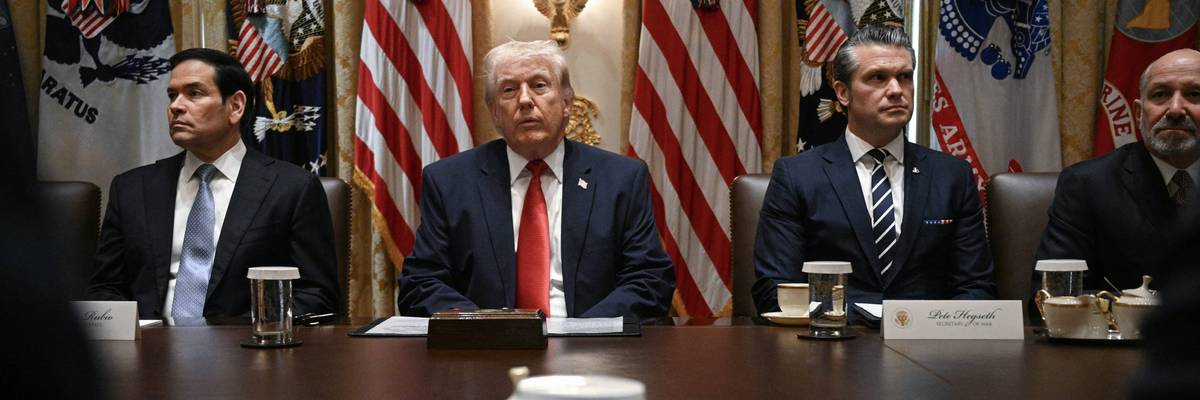
US President Donald Trump hosts a cabinet meeting in the Cabinet Room of the White House in Washington, DC, on March 26, 2026.
"The United States is inarguably in a weaker position than when it began this war of choice, with core US strategic objectives harmed."
President Donald Trump's illegal war of choice with Iran has dealt the United States an even bigger strategic defeat than the one it suffered in the Vietnam War, according to one expert.
In an essay published on Tuesday by Foreign Policy, Paul Musgrave, associate professor of government at Georgetown University in Qatar, made the case that the damage done to the United States' reputation and credibility in the wake of the Iran war are significantly more severe than anything the country suffered in the wake of Vietnam.
Even though the Vietnam War went on for far longer and resulted in far more deaths than Trump's Iran war, Musgrave argued, the US nonetheless exited it with little long-term damage to its global power.
"Compare that situation with the aftermath of Trump’s war," Musgrave continued. "The United States is inarguably in a weaker position than when it began this war of choice, with core US strategic objectives harmed."
Musgrave noted that while the US and Israel had initial success in decapitating Iran's leadership at the beginning of the conflict, this only left the hardliners in the Islamic Revolutionary Guard Corps (IRGC) to run the country.
By failing to achieve the stated aim of regime change and by empowering even more radical elements within Iran, Musgrave added, Trump has severely damaged other nations' willingness to trust the US for national security protection.
"Regional allies, many of whom reportedly argued against the venture, bore the brunt of the costs of the fighting," the scholar wrote. "Most tellingly, Iran learned that its capacity to throttle the Strait of Hormuz could deliver economic leverage on a worldwide scale."
Writing in The New York Times on Wednesday, national security journalist WJ Hennigan argued that the United States' strategic defeat has laid bare the limits of US military power to bend weaker nations to its will.
In particular, he pointed out that the US, which spent $1 trillion on its military last year, could not take out even a majority of Iran's missile stockpiles.
"Yes, the wonder weapons that American industry cranks out, like cruise missiles and air-defense interceptors, have proven impressive on the battlefield," Hennigan wrote. "But the war has exposed the underlying weaknesses of depending on weaponry that’s extremely expensive and time-consuming to deliver. During an April 30 congressional hearing, Defense Secretary Pete Hegseth estimated it could take 'months and years' to replenish the stocks that had been used in the war."
Matt Duss, executive vice president at the Center for International Policy, similarly said that Trump's Iran war had resulted in a strategic defeat for the US. However, he also expressed hope that this defeat could mark a turning point in US foreign policy circles regarding the applications of American power throughout the world.
"There’s a longstanding US bipartisan consensus around wildly inflating the Iranian threat," Duss wrote in a social media post. "Trump’s war, a strategic defeat, was an expression of that consensus. If... ending the war puts the US and Iran on path to a more normal relationship, that will be a positive thing."
Dear Common Dreams reader, It’s been nearly 30 years since I co-founded Common Dreams with my late wife, Lina Newhouser. We had the radical notion that journalism should serve the public good, not corporate profits. It was clear to us from the outset what it would take to build such a project. No paid advertisements. No corporate sponsors. No millionaire publisher telling us what to think or do. Many people said we wouldn't last a year, but we proved those doubters wrong. Together with a tremendous team of journalists and dedicated staff, we built an independent media outlet free from the constraints of profits and corporate control. Our mission has always been simple: To inform. To inspire. To ignite change for the common good. Building Common Dreams was not easy. Our survival was never guaranteed. When you take on the most powerful forces—Wall Street greed, fossil fuel industry destruction, Big Tech lobbyists, and uber-rich oligarchs who have spent billions upon billions rigging the economy and democracy in their favor—the only bulwark you have is supporters who believe in your work. But here’s the urgent message from me today. It's never been this bad out there. And it's never been this hard to keep us going. At the very moment Common Dreams is most needed, the threats we face are intensifying. We need your support now more than ever. We don't accept corporate advertising and never will. We don't have a paywall because we don't think people should be blocked from critical news based on their ability to pay. Everything we do is funded by the donations of readers like you. When everyone does the little they can afford, we are strong. But if that support retreats or dries up, so do we. Will you donate now to make sure Common Dreams not only survives but thrives? —Craig Brown, Co-founder |
President Donald Trump's illegal war of choice with Iran has dealt the United States an even bigger strategic defeat than the one it suffered in the Vietnam War, according to one expert.
In an essay published on Tuesday by Foreign Policy, Paul Musgrave, associate professor of government at Georgetown University in Qatar, made the case that the damage done to the United States' reputation and credibility in the wake of the Iran war are significantly more severe than anything the country suffered in the wake of Vietnam.
Even though the Vietnam War went on for far longer and resulted in far more deaths than Trump's Iran war, Musgrave argued, the US nonetheless exited it with little long-term damage to its global power.
"Compare that situation with the aftermath of Trump’s war," Musgrave continued. "The United States is inarguably in a weaker position than when it began this war of choice, with core US strategic objectives harmed."
Musgrave noted that while the US and Israel had initial success in decapitating Iran's leadership at the beginning of the conflict, this only left the hardliners in the Islamic Revolutionary Guard Corps (IRGC) to run the country.
By failing to achieve the stated aim of regime change and by empowering even more radical elements within Iran, Musgrave added, Trump has severely damaged other nations' willingness to trust the US for national security protection.
"Regional allies, many of whom reportedly argued against the venture, bore the brunt of the costs of the fighting," the scholar wrote. "Most tellingly, Iran learned that its capacity to throttle the Strait of Hormuz could deliver economic leverage on a worldwide scale."
Writing in The New York Times on Wednesday, national security journalist WJ Hennigan argued that the United States' strategic defeat has laid bare the limits of US military power to bend weaker nations to its will.
In particular, he pointed out that the US, which spent $1 trillion on its military last year, could not take out even a majority of Iran's missile stockpiles.
"Yes, the wonder weapons that American industry cranks out, like cruise missiles and air-defense interceptors, have proven impressive on the battlefield," Hennigan wrote. "But the war has exposed the underlying weaknesses of depending on weaponry that’s extremely expensive and time-consuming to deliver. During an April 30 congressional hearing, Defense Secretary Pete Hegseth estimated it could take 'months and years' to replenish the stocks that had been used in the war."
Matt Duss, executive vice president at the Center for International Policy, similarly said that Trump's Iran war had resulted in a strategic defeat for the US. However, he also expressed hope that this defeat could mark a turning point in US foreign policy circles regarding the applications of American power throughout the world.
"There’s a longstanding US bipartisan consensus around wildly inflating the Iranian threat," Duss wrote in a social media post. "Trump’s war, a strategic defeat, was an expression of that consensus. If... ending the war puts the US and Iran on path to a more normal relationship, that will be a positive thing."
President Donald Trump's illegal war of choice with Iran has dealt the United States an even bigger strategic defeat than the one it suffered in the Vietnam War, according to one expert.
In an essay published on Tuesday by Foreign Policy, Paul Musgrave, associate professor of government at Georgetown University in Qatar, made the case that the damage done to the United States' reputation and credibility in the wake of the Iran war are significantly more severe than anything the country suffered in the wake of Vietnam.
Even though the Vietnam War went on for far longer and resulted in far more deaths than Trump's Iran war, Musgrave argued, the US nonetheless exited it with little long-term damage to its global power.
"Compare that situation with the aftermath of Trump’s war," Musgrave continued. "The United States is inarguably in a weaker position than when it began this war of choice, with core US strategic objectives harmed."
Musgrave noted that while the US and Israel had initial success in decapitating Iran's leadership at the beginning of the conflict, this only left the hardliners in the Islamic Revolutionary Guard Corps (IRGC) to run the country.
By failing to achieve the stated aim of regime change and by empowering even more radical elements within Iran, Musgrave added, Trump has severely damaged other nations' willingness to trust the US for national security protection.
"Regional allies, many of whom reportedly argued against the venture, bore the brunt of the costs of the fighting," the scholar wrote. "Most tellingly, Iran learned that its capacity to throttle the Strait of Hormuz could deliver economic leverage on a worldwide scale."
Writing in The New York Times on Wednesday, national security journalist WJ Hennigan argued that the United States' strategic defeat has laid bare the limits of US military power to bend weaker nations to its will.
In particular, he pointed out that the US, which spent $1 trillion on its military last year, could not take out even a majority of Iran's missile stockpiles.
"Yes, the wonder weapons that American industry cranks out, like cruise missiles and air-defense interceptors, have proven impressive on the battlefield," Hennigan wrote. "But the war has exposed the underlying weaknesses of depending on weaponry that’s extremely expensive and time-consuming to deliver. During an April 30 congressional hearing, Defense Secretary Pete Hegseth estimated it could take 'months and years' to replenish the stocks that had been used in the war."
Matt Duss, executive vice president at the Center for International Policy, similarly said that Trump's Iran war had resulted in a strategic defeat for the US. However, he also expressed hope that this defeat could mark a turning point in US foreign policy circles regarding the applications of American power throughout the world.
"There’s a longstanding US bipartisan consensus around wildly inflating the Iranian threat," Duss wrote in a social media post. "Trump’s war, a strategic defeat, was an expression of that consensus. If... ending the war puts the US and Iran on path to a more normal relationship, that will be a positive thing."