SUBSCRIBE TO OUR FREE NEWSLETTER
Daily news & progressive opinion—funded by the people, not the corporations—delivered straight to your inbox.
5
#000000
#FFFFFF
To donate by check, phone, or other method, see our More Ways to Give page.
Daily news & progressive opinion—funded by the people, not the corporations—delivered straight to your inbox.
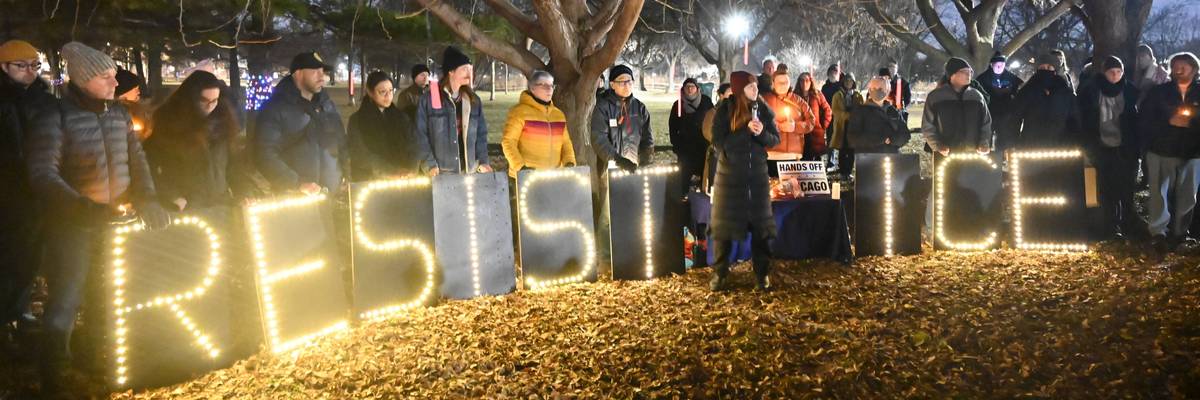
Demonstrators hold candles during an emergency vigil organized by the Ward 40+ Community Response Team at Winnemac Park in Chicago, Illinois, United States, on January 7, 2026.
Despite Donald Trump and all the other horrors of this century, I still believe that the essential human trajectory is upwards: We continue to widen the circle of beings that matter; we continue to become braver, and maybe even a bit wiser.
This is my last article for TomDispatch. For over a decade, Tom Engelhardt has given me a platform to write about pretty much anything that grabs my—I’ll admit it, easily attracted—attention. It’s been a wonderful partnership for me, offering not just a place to publish, but a chance to think, talk, and often argue with the best editor I’ve ever worked with.
A rarity in the age of Internet insta-publishing, TomDispatch subjects every article to the scrutiny of three separate proofreaders. Not for Tom the misplaced apostrophe or the confusion between “their” and “they’re.” Unlike The New York Times in a May 12, 2026 headline, no article appearing in TomDispatch would ever go rogue and ask the question, “Did the Fifth Circuit Go Rouge With Its Abortion Pills Ruling?” (The face of the copyeditor who let that one pass should have looked as if some blusher had been applied.)
While over the last 12 years, I’ve written about a wide variety of subjects, a number of themes stand out to me for their recurrence: racial justice, war (and US military misadventures), and the insistence of women on claiming our humanity. Mostly, I’ve tried to reflect the many ways that we human beings continue to struggle for a good life in a just world, despite all the forces ranged against us. More than once I’ve had recourse to a sentiment frequently attributed to the Reverend Martin Luther King (though it didn’t originate with him): the idea that the arc of the moral universe is long, but invariably bends toward justice.
A couple of weeks ago, I had a conversation with a woman I’d met a few times before. She’s a Black veteran in her 90s, the newish lover of an old friend of mine. We were reflecting on the fact that so much of what we’ve fought for in our lifetimes—civil rights, women’s rights, LGBTQ rights—has been all but demolished in the first year of Donald Trump’s second term. “People died for those victories,” she said to me, “and now they’ve been undone so fast.”
After all these years, it feels like the arc of the moral universe is bending not toward justice, but in the opposite direction, toward inequality and fascism, nationally and globally.
It was the Sunday after the Supreme Court finished dismembering the 1965 Voting Rights Act (VRA) with its decision in Louisiana v. Callais. That prolonged judicial murder by the Roberts court began with its 2013 decision in Shelby County v. Holder, which snuffed out a key provision of the VRA. Prior to Shelby County, jurisdictions identified in the VRA as having a history of suppressing the vote in Black, Latino, or Native American communities had to obtain federal “preclearance” before changing their voting laws. In the Shelby decision, however, the court’s conservative majority held that the passage of time had made such preclearance unnecessary, because voter suppression was no longer a problem in such places. In her dissent, Justice Ruth Bader Ginsburg famously described that position as “throwing out your umbrella in a rainstorm because you’re not getting wet.”
As the Brennan Center for Justice put it 10 years later, it was clear that Ginsberg had been right—that it was still raining in the Southern states. “The effects of the ruling were immediate. The same day, Texas officials announced that they would implement the nation’s most restrictive voter ID law, which had previously been blocked in the preclearance process.” In fact, “without that ‘preclearance’ regime, the revival of discriminatory tactics was immediate: In the last 10 years, at least 29 states have passed 94 laws that make it more difficult to vote, particularly for communities of color.”
Then, in its next major attack on the VRA, the court gave two of Arizona’s laws its stamp of approval. As I wrote in 2022, a year earlier, a court that was by then already significantly shaped by Donald Trump “issued a ruling in Brnovich v. Democratic National Committee upholding Arizona’s right to pass laws requiring people to vote only in precincts where they live, while prohibiting anyone who wasn’t a relative of the voter from hand delivering mail-in ballots to the polls. The court held that, even though in practice such measures would have a disproportionate effect on non-White voters, as long as a law was technically the same for all voters, it didn’t matter that, in practice, it would become harder for some groups to vote.”
Now, in 2026, the court has essentially finished the job with its decision in Callais, which allows states to redraw their voting maps to eliminate majority-minority districts. Not a month later, Southern states (including Alabama, Louisiana, South Carolina, and Tennessee) have rushed to redistrict. Florida, Georgia, Mississippi, Missouri, North Carolina, and Texas are likely to follow suit between now and the 2028 general election. As The Guardian reports, Michael Li, a redistricting expert at the Brennan Center, observed that “this is a five-alarm fire for Black representation in the south.”
I’m glad that congressman and civil rights hero John Lewis didn’t live to see this day.
It turns out that white racism has been a consistent theme of my writing for TomDispatch, which is hardly surprising, given what a constant reality it’s proven to be in 21st-century America (especially in the Trump years). In 2025, I described how the Department of Government Efficiency’s decimation of the federal workforce constituted a direct attack on the Black middle class, and especially Black women. In “No More Dog Whistles,” I wrote that, under Trump, “racism isn’t just the subtext, it’s the text.” A decade earlier, I was examining race and police violence in my home city of San Francisco, which had seen a spate of police murders of Black and Latino residents. And so it went, and so it still goes.
That subhead is actually the title of a college course I used to teach. It’s also been the focus of my “scholarly” work since the 9/11 attacks shocked the world and pushed the George W. Bush-Dick Cheney administration over to “the dark side.” My first piece for TomDispatch described how, a decade and a half after the 9/11 attacks and the launching of the Global War on Terror, the United States was still torturing people. President Barack Obama might have closed the CIA’s infamous black sites—its global chain of secret torture bases—but the practice continued, including at the US prison at Guantánamo Bay, Cuba. Subsequent articles of mine covered torture here at home, including at police stations and in our jails and prisons.
Now, we’re seeing a new kind of black site: hundreds of Immigration and Customs Enforcement detention centers, many already established, some still in the planning stage, strung out across the country as our own American gulag archipelago. And like the Soviet gulag, some of those sites are intended not just as holding pens, but as labor camps. As Public Citizen reported this month, “Working for $1 a day in the government’s so-called Voluntary Work Program (VWP) while detained is the only option available to earn any money for the more than 60,000 immigrants held in hundreds of active detention centers across the United States by the Immigration and Customs Enforcement (ICE) agency.” It seems that the program is “voluntary” in name only, as it’s the only way detainees can get money for basic hygiene items like toothpaste, and because refusal risks retaliation, such as being placed in solitary confinement.
I’ve labeled such centers “black sites” because, like the ones run by the CIA during the “war on terror,” they remain opaque to ordinary US citizens—or even many members of our federal and local governments. The Department of Homeland Security (DHS), which administers the ICE detention camps nationwide, has made a show of not permitting local officials or members of Congress to enter them. Like the CIA’s black sites, those camps represent an elaborate version of homeland security theater, designed to remind Americans of just how dangerous unauthorized immigrants supposedly are, as evidenced by how harshly DHS must treat them. They function both as a direct form of repression and as a warning to the rest of us about what could happen to anyone who resists the Trump regime. In that sense, such concentration camps (for that’s indeed what they are and what I’ve called them) are very much like another tool of repression, institutionalized state torture, about which (some years ago) I wrote a book called Mainstreaming Torture.
Another continuity between the Bush torture program and today’s ICE concentration camps is the outsourcing of the work of imprisonment and interrogation to private contractors. In the “war on terror,” private contractors—operatives from private outfits like Erik Prince’s oft-renamed Blackwater—engaged in such “interrogations.” Today’s ICE centers are also run by private contractors: the country’s two main for-profit prison companies, the GEO Group and CORE-Civic. The latter is responsible for the infamous Dilley Immigration Processing Center in Texas. ICE cemented its status as a public-private partnership in May 2026 when David Venturella was appointed its acting director. He left a job at GEO Group to take the post (after leaving ICE to join GEO in the first place). Some things are beyond irony.
Other war-related themes have recurred in my writing for TomDispatch. I’ve written about US military interventions in Latin America, the Middle East, and Africa. And now we’ve witnessed perhaps the ultimate pointless intervention—Trump’s war on Iran, which, if it doesn’t end up frying us all, seems likely to wreck the world economy and plunge millions into starvation.
When unpiloted aircraft were still new, I wrote about how the Obama administration had used drones for assassinations in places like Yemen. Today, we’ve become jaded by their use—and by extrajudicial killings in general. Now, there’s hardly a journalistic ripple when the Trump administration sinks yet another tiny boat allegedly carrying drugs—and occasionally just carrying fish—in the Caribbean Sea or Eastern Pacific Ocean. Almost 200 people had died that way by the first week of May 2026.
I’ve long thought that liberation is sort of like an imprisoned genie: Once it escapes, it’s awfully hard to get back in the bottle.
The exponential rise of artificial intelligence has refueled a discussion I entered back in 2022 with an article on LAWS (lethal autonomous weapons systems). The United States has been pursuing its dream of deploying an “automated battlefield” since the Vietnam War. One major AI company, Anthropic, seems to have taken itself out of the running to assist the Department of Defense (still its name, despite Trump’s proclamations to the contrary) in fully automated kill decisions. However, Peter Thiel’s Palantir will undoubtedly be happy to step in to fill the spot. It has, after all, already been helping Israel in its genocide in Gaza. Palantir will likely be ready as well to assist in another realm Anthropic refused to enter: using AI for mass domestic surveillance. After all, this is what its flagship program, Gotham, is for.
I didn’t grow up in a religious household. My father, though raised in an Orthodox Jewish home, had abandoned most religious practice by the time he and my mother got together. She was a lapsed Episcopalian, so I suppose it’s not entirely weird that I call myself a nice Jewish girl who goes to an Episcopal church. The point is, there was no reason for me to be praying as a six-year-old, but I often did, asking God to let me wake up the next morning as a boy. As second-wave feminists used to say, I didn’t envy the penis. I envied what it could get you: opportunity, freedom, and most of all, respect.
I lived through the movement for women’s liberation, which saved my life. It brought me the right to control my own body; to decide if and when I would have sex; to decide if and when I would have children; to decide if and when—and whom—I would marry. In truth, I never wanted to do that last one, but the vagaries of US tax law made married life much easier than a California domestic partnership. Still, I used to wonder why my gay leaders thought the two things I wanted most in the world were to join the army and get married.
So, it’s not surprising that I’ve used my TomDispatch platform to write about feminist concerns like abortion rights, my own experience of abortion, and staring down misogyny in the aftermath of Trump’s second election victory. Now, of course, his administration is advised by men who want to repeal women’s suffrage and follow up on the Supreme Court’s rollback of Roe v. Wade with white natalist dreams like an end to no-fault divorce and restrictions on birth control.
So much of what I’ve written about over the last 12 years is now at least as bad as it ever was and possibly significantly worse. We’ve lost so much with the rise of Trump. After all these years, it feels like the arc of the moral universe is bending not toward justice, but in the opposite direction, toward inequality and fascism, nationally and globally. And yet…
All over the country, people are indeed fighting back. Minnesotans inspired a nation with their resistance to an occupying ICE army. Local communities are mobilizing to try to keep energy-eating AI data centers and detention camps out. (Just recently, ordinary people in Florida forced the closure of the notorious Alligator Alcatraz detention center.) Millions have turned out for No Kings demonstrations. And maybe it was fear of a growing backlash that kept the Supreme Court from allowing Louisiana to outlaw the abortion medication Mifepristone. I’ve long thought that liberation is sort of like an imprisoned genie: Once it escapes, it’s awfully hard to get back in the bottle.
So, about that arc of the moral universe: Maybe it’s not a single curve but something more like a river winding its way toward a great ocean. Or maybe it’s like a sine wave on a slant. It has both peaks and valleys, and we’re definitely sitting in one of those valleys right now. Nonetheless, despite Donald Trump and all the other horrors of this century, I still believe that the essential human trajectory is upwards. We continue to widen the circle of beings that matter. We continue to become braver, and maybe even a bit wiser.
That’s been my story all these years and, dire as things seem today, I’m sticking to it.
Dear Common Dreams reader, It’s been nearly 30 years since I co-founded Common Dreams with my late wife, Lina Newhouser. We had the radical notion that journalism should serve the public good, not corporate profits. It was clear to us from the outset what it would take to build such a project. No paid advertisements. No corporate sponsors. No millionaire publisher telling us what to think or do. Many people said we wouldn't last a year, but we proved those doubters wrong. Together with a tremendous team of journalists and dedicated staff, we built an independent media outlet free from the constraints of profits and corporate control. Our mission has always been simple: To inform. To inspire. To ignite change for the common good. Building Common Dreams was not easy. Our survival was never guaranteed. When you take on the most powerful forces—Wall Street greed, fossil fuel industry destruction, Big Tech lobbyists, and uber-rich oligarchs who have spent billions upon billions rigging the economy and democracy in their favor—the only bulwark you have is supporters who believe in your work. But here’s the urgent message from me today. It's never been this bad out there. And it's never been this hard to keep us going. At the very moment Common Dreams is most needed, the threats we face are intensifying. We need your support now more than ever. We don't accept corporate advertising and never will. We don't have a paywall because we don't think people should be blocked from critical news based on their ability to pay. Everything we do is funded by the donations of readers like you. When everyone does the little they can afford, we are strong. But if that support retreats or dries up, so do we. Will you donate now to make sure Common Dreams not only survives but thrives? —Craig Brown, Co-founder |
This is my last article for TomDispatch. For over a decade, Tom Engelhardt has given me a platform to write about pretty much anything that grabs my—I’ll admit it, easily attracted—attention. It’s been a wonderful partnership for me, offering not just a place to publish, but a chance to think, talk, and often argue with the best editor I’ve ever worked with.
A rarity in the age of Internet insta-publishing, TomDispatch subjects every article to the scrutiny of three separate proofreaders. Not for Tom the misplaced apostrophe or the confusion between “their” and “they’re.” Unlike The New York Times in a May 12, 2026 headline, no article appearing in TomDispatch would ever go rogue and ask the question, “Did the Fifth Circuit Go Rouge With Its Abortion Pills Ruling?” (The face of the copyeditor who let that one pass should have looked as if some blusher had been applied.)
While over the last 12 years, I’ve written about a wide variety of subjects, a number of themes stand out to me for their recurrence: racial justice, war (and US military misadventures), and the insistence of women on claiming our humanity. Mostly, I’ve tried to reflect the many ways that we human beings continue to struggle for a good life in a just world, despite all the forces ranged against us. More than once I’ve had recourse to a sentiment frequently attributed to the Reverend Martin Luther King (though it didn’t originate with him): the idea that the arc of the moral universe is long, but invariably bends toward justice.
A couple of weeks ago, I had a conversation with a woman I’d met a few times before. She’s a Black veteran in her 90s, the newish lover of an old friend of mine. We were reflecting on the fact that so much of what we’ve fought for in our lifetimes—civil rights, women’s rights, LGBTQ rights—has been all but demolished in the first year of Donald Trump’s second term. “People died for those victories,” she said to me, “and now they’ve been undone so fast.”
After all these years, it feels like the arc of the moral universe is bending not toward justice, but in the opposite direction, toward inequality and fascism, nationally and globally.
It was the Sunday after the Supreme Court finished dismembering the 1965 Voting Rights Act (VRA) with its decision in Louisiana v. Callais. That prolonged judicial murder by the Roberts court began with its 2013 decision in Shelby County v. Holder, which snuffed out a key provision of the VRA. Prior to Shelby County, jurisdictions identified in the VRA as having a history of suppressing the vote in Black, Latino, or Native American communities had to obtain federal “preclearance” before changing their voting laws. In the Shelby decision, however, the court’s conservative majority held that the passage of time had made such preclearance unnecessary, because voter suppression was no longer a problem in such places. In her dissent, Justice Ruth Bader Ginsburg famously described that position as “throwing out your umbrella in a rainstorm because you’re not getting wet.”
As the Brennan Center for Justice put it 10 years later, it was clear that Ginsberg had been right—that it was still raining in the Southern states. “The effects of the ruling were immediate. The same day, Texas officials announced that they would implement the nation’s most restrictive voter ID law, which had previously been blocked in the preclearance process.” In fact, “without that ‘preclearance’ regime, the revival of discriminatory tactics was immediate: In the last 10 years, at least 29 states have passed 94 laws that make it more difficult to vote, particularly for communities of color.”
Then, in its next major attack on the VRA, the court gave two of Arizona’s laws its stamp of approval. As I wrote in 2022, a year earlier, a court that was by then already significantly shaped by Donald Trump “issued a ruling in Brnovich v. Democratic National Committee upholding Arizona’s right to pass laws requiring people to vote only in precincts where they live, while prohibiting anyone who wasn’t a relative of the voter from hand delivering mail-in ballots to the polls. The court held that, even though in practice such measures would have a disproportionate effect on non-White voters, as long as a law was technically the same for all voters, it didn’t matter that, in practice, it would become harder for some groups to vote.”
Now, in 2026, the court has essentially finished the job with its decision in Callais, which allows states to redraw their voting maps to eliminate majority-minority districts. Not a month later, Southern states (including Alabama, Louisiana, South Carolina, and Tennessee) have rushed to redistrict. Florida, Georgia, Mississippi, Missouri, North Carolina, and Texas are likely to follow suit between now and the 2028 general election. As The Guardian reports, Michael Li, a redistricting expert at the Brennan Center, observed that “this is a five-alarm fire for Black representation in the south.”
I’m glad that congressman and civil rights hero John Lewis didn’t live to see this day.
It turns out that white racism has been a consistent theme of my writing for TomDispatch, which is hardly surprising, given what a constant reality it’s proven to be in 21st-century America (especially in the Trump years). In 2025, I described how the Department of Government Efficiency’s decimation of the federal workforce constituted a direct attack on the Black middle class, and especially Black women. In “No More Dog Whistles,” I wrote that, under Trump, “racism isn’t just the subtext, it’s the text.” A decade earlier, I was examining race and police violence in my home city of San Francisco, which had seen a spate of police murders of Black and Latino residents. And so it went, and so it still goes.
That subhead is actually the title of a college course I used to teach. It’s also been the focus of my “scholarly” work since the 9/11 attacks shocked the world and pushed the George W. Bush-Dick Cheney administration over to “the dark side.” My first piece for TomDispatch described how, a decade and a half after the 9/11 attacks and the launching of the Global War on Terror, the United States was still torturing people. President Barack Obama might have closed the CIA’s infamous black sites—its global chain of secret torture bases—but the practice continued, including at the US prison at Guantánamo Bay, Cuba. Subsequent articles of mine covered torture here at home, including at police stations and in our jails and prisons.
Now, we’re seeing a new kind of black site: hundreds of Immigration and Customs Enforcement detention centers, many already established, some still in the planning stage, strung out across the country as our own American gulag archipelago. And like the Soviet gulag, some of those sites are intended not just as holding pens, but as labor camps. As Public Citizen reported this month, “Working for $1 a day in the government’s so-called Voluntary Work Program (VWP) while detained is the only option available to earn any money for the more than 60,000 immigrants held in hundreds of active detention centers across the United States by the Immigration and Customs Enforcement (ICE) agency.” It seems that the program is “voluntary” in name only, as it’s the only way detainees can get money for basic hygiene items like toothpaste, and because refusal risks retaliation, such as being placed in solitary confinement.
I’ve labeled such centers “black sites” because, like the ones run by the CIA during the “war on terror,” they remain opaque to ordinary US citizens—or even many members of our federal and local governments. The Department of Homeland Security (DHS), which administers the ICE detention camps nationwide, has made a show of not permitting local officials or members of Congress to enter them. Like the CIA’s black sites, those camps represent an elaborate version of homeland security theater, designed to remind Americans of just how dangerous unauthorized immigrants supposedly are, as evidenced by how harshly DHS must treat them. They function both as a direct form of repression and as a warning to the rest of us about what could happen to anyone who resists the Trump regime. In that sense, such concentration camps (for that’s indeed what they are and what I’ve called them) are very much like another tool of repression, institutionalized state torture, about which (some years ago) I wrote a book called Mainstreaming Torture.
Another continuity between the Bush torture program and today’s ICE concentration camps is the outsourcing of the work of imprisonment and interrogation to private contractors. In the “war on terror,” private contractors—operatives from private outfits like Erik Prince’s oft-renamed Blackwater—engaged in such “interrogations.” Today’s ICE centers are also run by private contractors: the country’s two main for-profit prison companies, the GEO Group and CORE-Civic. The latter is responsible for the infamous Dilley Immigration Processing Center in Texas. ICE cemented its status as a public-private partnership in May 2026 when David Venturella was appointed its acting director. He left a job at GEO Group to take the post (after leaving ICE to join GEO in the first place). Some things are beyond irony.
Other war-related themes have recurred in my writing for TomDispatch. I’ve written about US military interventions in Latin America, the Middle East, and Africa. And now we’ve witnessed perhaps the ultimate pointless intervention—Trump’s war on Iran, which, if it doesn’t end up frying us all, seems likely to wreck the world economy and plunge millions into starvation.
When unpiloted aircraft were still new, I wrote about how the Obama administration had used drones for assassinations in places like Yemen. Today, we’ve become jaded by their use—and by extrajudicial killings in general. Now, there’s hardly a journalistic ripple when the Trump administration sinks yet another tiny boat allegedly carrying drugs—and occasionally just carrying fish—in the Caribbean Sea or Eastern Pacific Ocean. Almost 200 people had died that way by the first week of May 2026.
I’ve long thought that liberation is sort of like an imprisoned genie: Once it escapes, it’s awfully hard to get back in the bottle.
The exponential rise of artificial intelligence has refueled a discussion I entered back in 2022 with an article on LAWS (lethal autonomous weapons systems). The United States has been pursuing its dream of deploying an “automated battlefield” since the Vietnam War. One major AI company, Anthropic, seems to have taken itself out of the running to assist the Department of Defense (still its name, despite Trump’s proclamations to the contrary) in fully automated kill decisions. However, Peter Thiel’s Palantir will undoubtedly be happy to step in to fill the spot. It has, after all, already been helping Israel in its genocide in Gaza. Palantir will likely be ready as well to assist in another realm Anthropic refused to enter: using AI for mass domestic surveillance. After all, this is what its flagship program, Gotham, is for.
I didn’t grow up in a religious household. My father, though raised in an Orthodox Jewish home, had abandoned most religious practice by the time he and my mother got together. She was a lapsed Episcopalian, so I suppose it’s not entirely weird that I call myself a nice Jewish girl who goes to an Episcopal church. The point is, there was no reason for me to be praying as a six-year-old, but I often did, asking God to let me wake up the next morning as a boy. As second-wave feminists used to say, I didn’t envy the penis. I envied what it could get you: opportunity, freedom, and most of all, respect.
I lived through the movement for women’s liberation, which saved my life. It brought me the right to control my own body; to decide if and when I would have sex; to decide if and when I would have children; to decide if and when—and whom—I would marry. In truth, I never wanted to do that last one, but the vagaries of US tax law made married life much easier than a California domestic partnership. Still, I used to wonder why my gay leaders thought the two things I wanted most in the world were to join the army and get married.
So, it’s not surprising that I’ve used my TomDispatch platform to write about feminist concerns like abortion rights, my own experience of abortion, and staring down misogyny in the aftermath of Trump’s second election victory. Now, of course, his administration is advised by men who want to repeal women’s suffrage and follow up on the Supreme Court’s rollback of Roe v. Wade with white natalist dreams like an end to no-fault divorce and restrictions on birth control.
So much of what I’ve written about over the last 12 years is now at least as bad as it ever was and possibly significantly worse. We’ve lost so much with the rise of Trump. After all these years, it feels like the arc of the moral universe is bending not toward justice, but in the opposite direction, toward inequality and fascism, nationally and globally. And yet…
All over the country, people are indeed fighting back. Minnesotans inspired a nation with their resistance to an occupying ICE army. Local communities are mobilizing to try to keep energy-eating AI data centers and detention camps out. (Just recently, ordinary people in Florida forced the closure of the notorious Alligator Alcatraz detention center.) Millions have turned out for No Kings demonstrations. And maybe it was fear of a growing backlash that kept the Supreme Court from allowing Louisiana to outlaw the abortion medication Mifepristone. I’ve long thought that liberation is sort of like an imprisoned genie: Once it escapes, it’s awfully hard to get back in the bottle.
So, about that arc of the moral universe: Maybe it’s not a single curve but something more like a river winding its way toward a great ocean. Or maybe it’s like a sine wave on a slant. It has both peaks and valleys, and we’re definitely sitting in one of those valleys right now. Nonetheless, despite Donald Trump and all the other horrors of this century, I still believe that the essential human trajectory is upwards. We continue to widen the circle of beings that matter. We continue to become braver, and maybe even a bit wiser.
That’s been my story all these years and, dire as things seem today, I’m sticking to it.
This is my last article for TomDispatch. For over a decade, Tom Engelhardt has given me a platform to write about pretty much anything that grabs my—I’ll admit it, easily attracted—attention. It’s been a wonderful partnership for me, offering not just a place to publish, but a chance to think, talk, and often argue with the best editor I’ve ever worked with.
A rarity in the age of Internet insta-publishing, TomDispatch subjects every article to the scrutiny of three separate proofreaders. Not for Tom the misplaced apostrophe or the confusion between “their” and “they’re.” Unlike The New York Times in a May 12, 2026 headline, no article appearing in TomDispatch would ever go rogue and ask the question, “Did the Fifth Circuit Go Rouge With Its Abortion Pills Ruling?” (The face of the copyeditor who let that one pass should have looked as if some blusher had been applied.)
While over the last 12 years, I’ve written about a wide variety of subjects, a number of themes stand out to me for their recurrence: racial justice, war (and US military misadventures), and the insistence of women on claiming our humanity. Mostly, I’ve tried to reflect the many ways that we human beings continue to struggle for a good life in a just world, despite all the forces ranged against us. More than once I’ve had recourse to a sentiment frequently attributed to the Reverend Martin Luther King (though it didn’t originate with him): the idea that the arc of the moral universe is long, but invariably bends toward justice.
A couple of weeks ago, I had a conversation with a woman I’d met a few times before. She’s a Black veteran in her 90s, the newish lover of an old friend of mine. We were reflecting on the fact that so much of what we’ve fought for in our lifetimes—civil rights, women’s rights, LGBTQ rights—has been all but demolished in the first year of Donald Trump’s second term. “People died for those victories,” she said to me, “and now they’ve been undone so fast.”
After all these years, it feels like the arc of the moral universe is bending not toward justice, but in the opposite direction, toward inequality and fascism, nationally and globally.
It was the Sunday after the Supreme Court finished dismembering the 1965 Voting Rights Act (VRA) with its decision in Louisiana v. Callais. That prolonged judicial murder by the Roberts court began with its 2013 decision in Shelby County v. Holder, which snuffed out a key provision of the VRA. Prior to Shelby County, jurisdictions identified in the VRA as having a history of suppressing the vote in Black, Latino, or Native American communities had to obtain federal “preclearance” before changing their voting laws. In the Shelby decision, however, the court’s conservative majority held that the passage of time had made such preclearance unnecessary, because voter suppression was no longer a problem in such places. In her dissent, Justice Ruth Bader Ginsburg famously described that position as “throwing out your umbrella in a rainstorm because you’re not getting wet.”
As the Brennan Center for Justice put it 10 years later, it was clear that Ginsberg had been right—that it was still raining in the Southern states. “The effects of the ruling were immediate. The same day, Texas officials announced that they would implement the nation’s most restrictive voter ID law, which had previously been blocked in the preclearance process.” In fact, “without that ‘preclearance’ regime, the revival of discriminatory tactics was immediate: In the last 10 years, at least 29 states have passed 94 laws that make it more difficult to vote, particularly for communities of color.”
Then, in its next major attack on the VRA, the court gave two of Arizona’s laws its stamp of approval. As I wrote in 2022, a year earlier, a court that was by then already significantly shaped by Donald Trump “issued a ruling in Brnovich v. Democratic National Committee upholding Arizona’s right to pass laws requiring people to vote only in precincts where they live, while prohibiting anyone who wasn’t a relative of the voter from hand delivering mail-in ballots to the polls. The court held that, even though in practice such measures would have a disproportionate effect on non-White voters, as long as a law was technically the same for all voters, it didn’t matter that, in practice, it would become harder for some groups to vote.”
Now, in 2026, the court has essentially finished the job with its decision in Callais, which allows states to redraw their voting maps to eliminate majority-minority districts. Not a month later, Southern states (including Alabama, Louisiana, South Carolina, and Tennessee) have rushed to redistrict. Florida, Georgia, Mississippi, Missouri, North Carolina, and Texas are likely to follow suit between now and the 2028 general election. As The Guardian reports, Michael Li, a redistricting expert at the Brennan Center, observed that “this is a five-alarm fire for Black representation in the south.”
I’m glad that congressman and civil rights hero John Lewis didn’t live to see this day.
It turns out that white racism has been a consistent theme of my writing for TomDispatch, which is hardly surprising, given what a constant reality it’s proven to be in 21st-century America (especially in the Trump years). In 2025, I described how the Department of Government Efficiency’s decimation of the federal workforce constituted a direct attack on the Black middle class, and especially Black women. In “No More Dog Whistles,” I wrote that, under Trump, “racism isn’t just the subtext, it’s the text.” A decade earlier, I was examining race and police violence in my home city of San Francisco, which had seen a spate of police murders of Black and Latino residents. And so it went, and so it still goes.
That subhead is actually the title of a college course I used to teach. It’s also been the focus of my “scholarly” work since the 9/11 attacks shocked the world and pushed the George W. Bush-Dick Cheney administration over to “the dark side.” My first piece for TomDispatch described how, a decade and a half after the 9/11 attacks and the launching of the Global War on Terror, the United States was still torturing people. President Barack Obama might have closed the CIA’s infamous black sites—its global chain of secret torture bases—but the practice continued, including at the US prison at Guantánamo Bay, Cuba. Subsequent articles of mine covered torture here at home, including at police stations and in our jails and prisons.
Now, we’re seeing a new kind of black site: hundreds of Immigration and Customs Enforcement detention centers, many already established, some still in the planning stage, strung out across the country as our own American gulag archipelago. And like the Soviet gulag, some of those sites are intended not just as holding pens, but as labor camps. As Public Citizen reported this month, “Working for $1 a day in the government’s so-called Voluntary Work Program (VWP) while detained is the only option available to earn any money for the more than 60,000 immigrants held in hundreds of active detention centers across the United States by the Immigration and Customs Enforcement (ICE) agency.” It seems that the program is “voluntary” in name only, as it’s the only way detainees can get money for basic hygiene items like toothpaste, and because refusal risks retaliation, such as being placed in solitary confinement.
I’ve labeled such centers “black sites” because, like the ones run by the CIA during the “war on terror,” they remain opaque to ordinary US citizens—or even many members of our federal and local governments. The Department of Homeland Security (DHS), which administers the ICE detention camps nationwide, has made a show of not permitting local officials or members of Congress to enter them. Like the CIA’s black sites, those camps represent an elaborate version of homeland security theater, designed to remind Americans of just how dangerous unauthorized immigrants supposedly are, as evidenced by how harshly DHS must treat them. They function both as a direct form of repression and as a warning to the rest of us about what could happen to anyone who resists the Trump regime. In that sense, such concentration camps (for that’s indeed what they are and what I’ve called them) are very much like another tool of repression, institutionalized state torture, about which (some years ago) I wrote a book called Mainstreaming Torture.
Another continuity between the Bush torture program and today’s ICE concentration camps is the outsourcing of the work of imprisonment and interrogation to private contractors. In the “war on terror,” private contractors—operatives from private outfits like Erik Prince’s oft-renamed Blackwater—engaged in such “interrogations.” Today’s ICE centers are also run by private contractors: the country’s two main for-profit prison companies, the GEO Group and CORE-Civic. The latter is responsible for the infamous Dilley Immigration Processing Center in Texas. ICE cemented its status as a public-private partnership in May 2026 when David Venturella was appointed its acting director. He left a job at GEO Group to take the post (after leaving ICE to join GEO in the first place). Some things are beyond irony.
Other war-related themes have recurred in my writing for TomDispatch. I’ve written about US military interventions in Latin America, the Middle East, and Africa. And now we’ve witnessed perhaps the ultimate pointless intervention—Trump’s war on Iran, which, if it doesn’t end up frying us all, seems likely to wreck the world economy and plunge millions into starvation.
When unpiloted aircraft were still new, I wrote about how the Obama administration had used drones for assassinations in places like Yemen. Today, we’ve become jaded by their use—and by extrajudicial killings in general. Now, there’s hardly a journalistic ripple when the Trump administration sinks yet another tiny boat allegedly carrying drugs—and occasionally just carrying fish—in the Caribbean Sea or Eastern Pacific Ocean. Almost 200 people had died that way by the first week of May 2026.
I’ve long thought that liberation is sort of like an imprisoned genie: Once it escapes, it’s awfully hard to get back in the bottle.
The exponential rise of artificial intelligence has refueled a discussion I entered back in 2022 with an article on LAWS (lethal autonomous weapons systems). The United States has been pursuing its dream of deploying an “automated battlefield” since the Vietnam War. One major AI company, Anthropic, seems to have taken itself out of the running to assist the Department of Defense (still its name, despite Trump’s proclamations to the contrary) in fully automated kill decisions. However, Peter Thiel’s Palantir will undoubtedly be happy to step in to fill the spot. It has, after all, already been helping Israel in its genocide in Gaza. Palantir will likely be ready as well to assist in another realm Anthropic refused to enter: using AI for mass domestic surveillance. After all, this is what its flagship program, Gotham, is for.
I didn’t grow up in a religious household. My father, though raised in an Orthodox Jewish home, had abandoned most religious practice by the time he and my mother got together. She was a lapsed Episcopalian, so I suppose it’s not entirely weird that I call myself a nice Jewish girl who goes to an Episcopal church. The point is, there was no reason for me to be praying as a six-year-old, but I often did, asking God to let me wake up the next morning as a boy. As second-wave feminists used to say, I didn’t envy the penis. I envied what it could get you: opportunity, freedom, and most of all, respect.
I lived through the movement for women’s liberation, which saved my life. It brought me the right to control my own body; to decide if and when I would have sex; to decide if and when I would have children; to decide if and when—and whom—I would marry. In truth, I never wanted to do that last one, but the vagaries of US tax law made married life much easier than a California domestic partnership. Still, I used to wonder why my gay leaders thought the two things I wanted most in the world were to join the army and get married.
So, it’s not surprising that I’ve used my TomDispatch platform to write about feminist concerns like abortion rights, my own experience of abortion, and staring down misogyny in the aftermath of Trump’s second election victory. Now, of course, his administration is advised by men who want to repeal women’s suffrage and follow up on the Supreme Court’s rollback of Roe v. Wade with white natalist dreams like an end to no-fault divorce and restrictions on birth control.
So much of what I’ve written about over the last 12 years is now at least as bad as it ever was and possibly significantly worse. We’ve lost so much with the rise of Trump. After all these years, it feels like the arc of the moral universe is bending not toward justice, but in the opposite direction, toward inequality and fascism, nationally and globally. And yet…
All over the country, people are indeed fighting back. Minnesotans inspired a nation with their resistance to an occupying ICE army. Local communities are mobilizing to try to keep energy-eating AI data centers and detention camps out. (Just recently, ordinary people in Florida forced the closure of the notorious Alligator Alcatraz detention center.) Millions have turned out for No Kings demonstrations. And maybe it was fear of a growing backlash that kept the Supreme Court from allowing Louisiana to outlaw the abortion medication Mifepristone. I’ve long thought that liberation is sort of like an imprisoned genie: Once it escapes, it’s awfully hard to get back in the bottle.
So, about that arc of the moral universe: Maybe it’s not a single curve but something more like a river winding its way toward a great ocean. Or maybe it’s like a sine wave on a slant. It has both peaks and valleys, and we’re definitely sitting in one of those valleys right now. Nonetheless, despite Donald Trump and all the other horrors of this century, I still believe that the essential human trajectory is upwards. We continue to widen the circle of beings that matter. We continue to become braver, and maybe even a bit wiser.
That’s been my story all these years and, dire as things seem today, I’m sticking to it.