SUBSCRIBE TO OUR FREE NEWSLETTER
Daily news & progressive opinion—funded by the people, not the corporations—delivered straight to your inbox.
5
#000000
#FFFFFF
To donate by check, phone, or other method, see our More Ways to Give page.
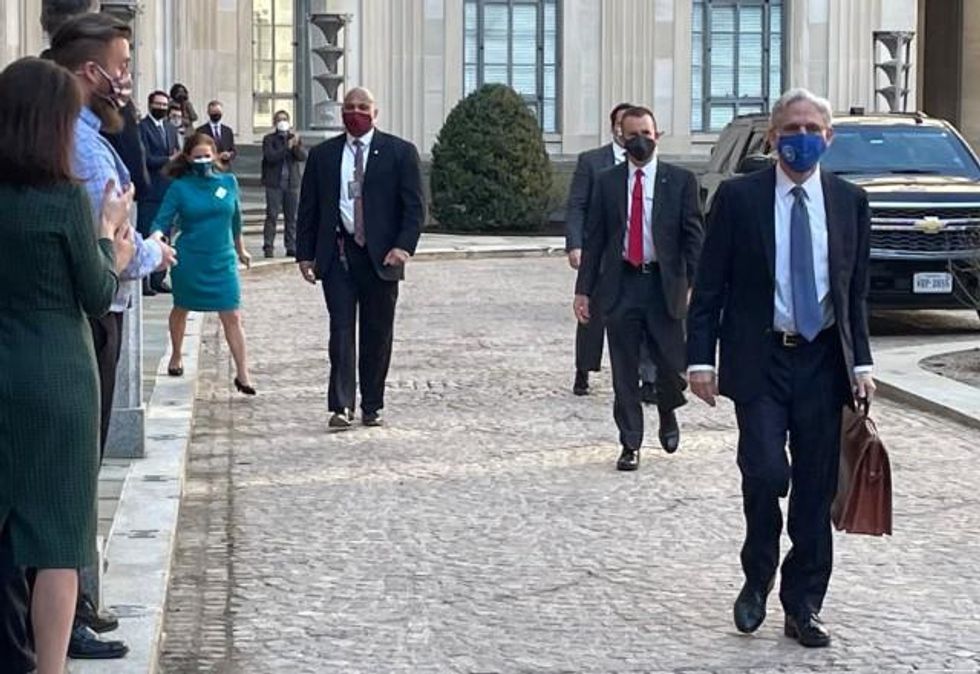
Screenshot of Garland arriving at work
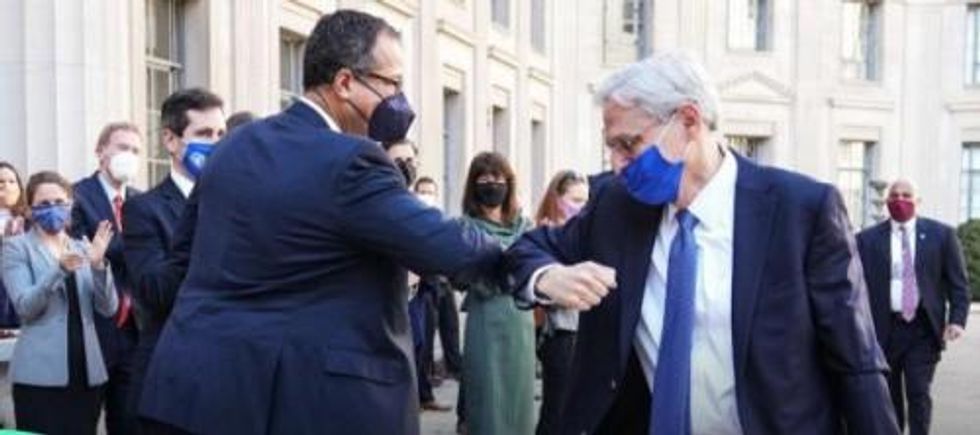
Talk about turning the bleak page: On his first day as Attorney General, the honorable, long maltreated Merrick Garland was movingly welcomed by an applauding crowd of jubilant DOJ employees and survivors of the last regime visibly relieved to witness the return of competence and normalcy. Garland, 68, began his career at the DOJ in the 1970s under Jimmy Carter; he described his first interview there at 26 as "awe-inspiring." He already stood out among peers for his integrity: As valedictorian at his high school graduation, he departed from his prepared remarks to give an eloquent oration on the 1st Amendment after an earlier speaker enraged the audience by condemning the Vietnam War. As a prosecutor, he oversaw the trial of Oklahoma bomber Timothy McVeigh; since 1997, he has served as a judge on D.C.'s US Court of Appeals. In March 2016, Obama nominated him to replace Antonin Scalia on the Supreme Court, urging hostile Republicans to grant him a hearing and vote, but Mitch 'I-Have-Always-Been-An-Unprincipled-Scumbag' McConnell famously, sneeringly refused; may he live to regret it. During Garland's confirmation hearing, New Jersey Sen. Cory Booker asked why he wanted to serve as attorney general, and Garland became emotional. "I come from a family where my grandparents fled anti-Semitism and persecution," he said. "The country took us in and protected us, and I feel an obligation to the country to pay back."
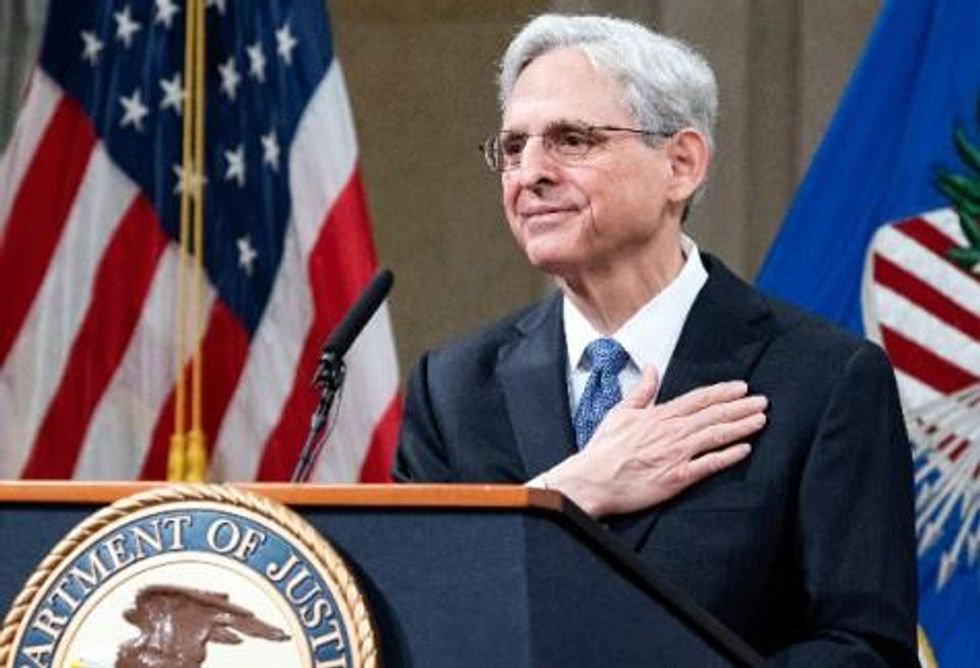
Before his swearing-in by VP Kamala Harris, Garland gave a brief speech to about 30 distanced people, of the over 100,000 who work there, in the DOJ's Great Hall. He vowed the department would return to "the norms that are part of the DNA of the Justice Department," which call for adherence to the rule of law free of political malfeasance by, say, mad kings who might wander in. Those norms, he said, "require that like cases be treated alike" - not one rule for Democrats and one for Republicans, or for friends and foes, powerful and powerless, rich and poor, depending on ethnicity. He cited the need for "a government of laws, and not men (and women" (to) show the American people by word and deed the DOJ pursues equal justice and adheres to the rule of law." Online, the glad sense of reprieve from hacks and crooks and lackeys was palpable. "Merrick Garland is in the building," proclaimed one. "Justice is coming." People celebrated "Hold Insurrectionists Accountable" month, "The Revenge of the Garland," that "a grotesque injustice has finally been somewhat remediated," that it's time "to turn over some stones and see what crawls out." One posted a clip of a grinning, invincible John Travolta sashaying down the street to "Stayin' Alive." In the name of MLK's hopeful claim, "The arc of the moral universe is long, but it bends toward justice," another longingly wondered, "So can we start arresting people today or do we have to wait? Asking for a nation."
Screenshot of Garland arriving at work
Talk about turning the bleak page: On his first day as Attorney General, the honorable, long maltreated Merrick Garland was movingly welcomed by an applauding crowd of jubilant DOJ employees and survivors of the last regime visibly relieved to witness the return of competence and normalcy. Garland, 68, began his career at the DOJ in the 1970s under Jimmy Carter; he described his first interview there at 26 as "awe-inspiring." He already stood out among peers for his integrity: As valedictorian at his high school graduation, he departed from his prepared remarks to give an eloquent oration on the 1st Amendment after an earlier speaker enraged the audience by condemning the Vietnam War. As a prosecutor, he oversaw the trial of Oklahoma bomber Timothy McVeigh; since 1997, he has served as a judge on D.C.'s US Court of Appeals. In March 2016, Obama nominated him to replace Antonin Scalia on the Supreme Court, urging hostile Republicans to grant him a hearing and vote, but Mitch 'I-Have-Always-Been-An-Unprincipled-Scumbag' McConnell famously, sneeringly refused; may he live to regret it. During Garland's confirmation hearing, New Jersey Sen. Cory Booker asked why he wanted to serve as attorney general, and Garland became emotional. "I come from a family where my grandparents fled anti-Semitism and persecution," he said. "The country took us in and protected us, and I feel an obligation to the country to pay back."
Before his swearing-in by VP Kamala Harris, Garland gave a brief speech to about 30 distanced people, of the over 100,000 who work there, in the DOJ's Great Hall. He vowed the department would return to "the norms that are part of the DNA of the Justice Department," which call for adherence to the rule of law free of political malfeasance by, say, mad kings who might wander in. Those norms, he said, "require that like cases be treated alike" - not one rule for Democrats and one for Republicans, or for friends and foes, powerful and powerless, rich and poor, depending on ethnicity. He cited the need for "a government of laws, and not men (and women" (to) show the American people by word and deed the DOJ pursues equal justice and adheres to the rule of law." Online, the glad sense of reprieve from hacks and crooks and lackeys was palpable. "Merrick Garland is in the building," proclaimed one. "Justice is coming." People celebrated "Hold Insurrectionists Accountable" month, "The Revenge of the Garland," that "a grotesque injustice has finally been somewhat remediated," that it's time "to turn over some stones and see what crawls out." One posted a clip of a grinning, invincible John Travolta sashaying down the street to "Stayin' Alive." In the name of MLK's hopeful claim, "The arc of the moral universe is long, but it bends toward justice," another longingly wondered, "So can we start arresting people today or do we have to wait? Asking for a nation."
Screenshot of Garland arriving at work
Talk about turning the bleak page: On his first day as Attorney General, the honorable, long maltreated Merrick Garland was movingly welcomed by an applauding crowd of jubilant DOJ employees and survivors of the last regime visibly relieved to witness the return of competence and normalcy. Garland, 68, began his career at the DOJ in the 1970s under Jimmy Carter; he described his first interview there at 26 as "awe-inspiring." He already stood out among peers for his integrity: As valedictorian at his high school graduation, he departed from his prepared remarks to give an eloquent oration on the 1st Amendment after an earlier speaker enraged the audience by condemning the Vietnam War. As a prosecutor, he oversaw the trial of Oklahoma bomber Timothy McVeigh; since 1997, he has served as a judge on D.C.'s US Court of Appeals. In March 2016, Obama nominated him to replace Antonin Scalia on the Supreme Court, urging hostile Republicans to grant him a hearing and vote, but Mitch 'I-Have-Always-Been-An-Unprincipled-Scumbag' McConnell famously, sneeringly refused; may he live to regret it. During Garland's confirmation hearing, New Jersey Sen. Cory Booker asked why he wanted to serve as attorney general, and Garland became emotional. "I come from a family where my grandparents fled anti-Semitism and persecution," he said. "The country took us in and protected us, and I feel an obligation to the country to pay back."
Before his swearing-in by VP Kamala Harris, Garland gave a brief speech to about 30 distanced people, of the over 100,000 who work there, in the DOJ's Great Hall. He vowed the department would return to "the norms that are part of the DNA of the Justice Department," which call for adherence to the rule of law free of political malfeasance by, say, mad kings who might wander in. Those norms, he said, "require that like cases be treated alike" - not one rule for Democrats and one for Republicans, or for friends and foes, powerful and powerless, rich and poor, depending on ethnicity. He cited the need for "a government of laws, and not men (and women" (to) show the American people by word and deed the DOJ pursues equal justice and adheres to the rule of law." Online, the glad sense of reprieve from hacks and crooks and lackeys was palpable. "Merrick Garland is in the building," proclaimed one. "Justice is coming." People celebrated "Hold Insurrectionists Accountable" month, "The Revenge of the Garland," that "a grotesque injustice has finally been somewhat remediated," that it's time "to turn over some stones and see what crawls out." One posted a clip of a grinning, invincible John Travolta sashaying down the street to "Stayin' Alive." In the name of MLK's hopeful claim, "The arc of the moral universe is long, but it bends toward justice," another longingly wondered, "So can we start arresting people today or do we have to wait? Asking for a nation."