SUBSCRIBE TO OUR FREE NEWSLETTER
Daily news & progressive opinion—funded by the people, not the corporations—delivered straight to your inbox.
5
#000000
#FFFFFF
To donate by check, phone, or other method, see our More Ways to Give page.


Daily news & progressive opinion—funded by the people, not the corporations—delivered straight to your inbox.

Catherine Collentine (303)454-3363 (Sierra Club Colorado Campaign Representative)
Bruce Baizel (970) 259-3353 x 2 (Earthworks Director)
Today the Colorado Oil and Gas Conservation Commission (COGCC) and the Colorado Oil and Gas Association (COGA) dropped their lawsuit to invalidate a Longmont City Ordinance that protects residents from the pollution and associated health threats of oil and gas development. The State dismissed the suit after more than two years of litigation, as a part of a deal brokered in August 2014 to keep two anti-fracking initiatives off the November ballot.
"Upholding this ordinance is a victory for the people of Longmont and the right of local government to regulate oil and gas development. Industry has run roughshod over community concerns for decades. This decision is a step towards balancing the scales of justice," said Earthworks Director Bruce Baizel.
The challenged Ordinance, passed by the City Council in July 2012, prohibits oil and gas surface activities from occurring in zoned residential areas and establishes voluntary, enhanced standards for fast-track administrative approval that create setbacks greater than the State's for homes, schools, hospitals, waterways and parks. The Ordinance also requires disclosure to emergency responders of hazardous chemicals transported through the City and consultation with local wildlife experts before any operations begin.
"In light of continued scientific research showing that oil and gas development risks the health of those living nearby, it's clear that ordinances like the one put in place by Longmont are necessary for community well-being," said Sierra Club Colorado Campaign Representative Catherine Collentine. She continued, "In the absence of adequate state rules governing oil and gas development, local governments must be able to step in to protect public health and the environment."
Over the past decade Colorado has experienced a historic boom in oil and gas drilling. Colorado currently has more than 52,000 active oil and gas wells covering much of the state's landscape. Across Colorado's northern plains, oil and gas companies are increasingly operating not only in sparsely populated areas, but also in towns and suburbs.
"Living with oil and gas drilling and fracking near your home or your children's school is not something anyone wants. These are very minimal protections for residents in Longmont and
are the first step to protect public health and safety , We are glad to see the State and the industry agree," said Karen Dike, Longmont resident and member of the Sierra Club.
This growing trend of drilling near homes and schools prompted the City of Longmont, located 37 miles north of Denver and on the western edge of Colorado's most productive oil and gas field, to update its land use rules to prohibit certain surface activities in residential areas.
The new rules immediately came under legal attack by the State of Colorado calling into question the City's authority to protect its own citizens from the adverse effects of oil and gas development. This lawsuit was one of many that are ongoing in other Colorado communities working to protect the health and environment of residents across the state from the threats of rampant oil and gas development.
For more information on Sierra Club's efforts to protect communities from harmful oil and gas operations go to https://content.sierraclub.org/naturalgas and to https://rmc.sierraclub.org/ ; for Earthworks visit https://www.earthworksaction.org/
The Sierra Club is the most enduring and influential grassroots environmental organization in the United States. We amplify the power of our 3.8 million members and supporters to defend everyone's right to a healthy world.
(415) 977-5500"This is a huge moment, a win that builds a foundation for a new precedent in the US," said one plaintiff. "Those who believe they are above the law will now think twice before violating human rights."
A federal appellate court on Thursday upheld a historic verdict against CACI Premier Technology, a military contractor found liable for its role in the torture of three prisoners at Abu Ghraib during the George W. Bush administration's invasion of Iraq in the early 2000s.
The three plaintiffs—middle school principal Suhail Al Shimari, fruit vendor Asa'ad Zuba'e, and journalist Salah Al-Ejaili—are represented by the Center for Constitutional Rights and two law firms. CCR noted Thursday that Al Shimari v. CACI was first filed in 2008 under the Alien Tort Statute and "is the only lawsuit brought by Abu Ghraib torture victims to make it to trial."
These three survivors of Abu Ghraib—where US captors subjected prisoners to broken bones, death threats, electric shocks, extreme temperatures, sexual abuse, and more torture—finally got their day in court in April 2024. The following November, a federal jury in Virginia ordered CACI to pay each plaintiff $3 million in compensatory damages and $11 million in punitive damages, for a total of $42 million.
"This victory isn't only for the three plaintiffs in this case against a corporation," Al-Ejaili said after the verdict. "This victory is a shining light for everyone who has been oppressed and a strong warning to any company or contractor practicing different forms of torture and abuse."
CACI unsuccessfully sought a new trial at the US District Court for the District of Virginia, then turned to the 4th Circuit, which heard arguments last September.
"We affirm the jury’s verdict in full," wrote Senior Judge Henry Floyd, joined by Judge Stephanie Thacker—both appointees of former President Barack Obama. Judge A. Marvin Quattlebaum Jr., who was appointed by President Donald Trump, dissented.
CCR legal director Baher Azmy, who argued the appeal, said Thursday that "we are gratified yet again that the 4th Circuit rejected CACI's cynical arguments for impunity for its responsibility for the torture of our clients, which the jury confirmed in a historic judgment last year. Our courageous clients have waited so long for recognition and justice, and we are happy for them that this judgment affirmed their entitlement to it."
Al-Ejaili also celebrated the development, declaring that "this is a huge moment, a win that builds a foundation for a new precedent in the US."
"This will cause a positive difference in the future. Those who believe they are above the law will now think twice before violating human rights," the plaintiff added. "Thank you to the US legal system and thank you to everyone who had anything to do with this win."
The appellate court's decision notably comes as the Trump administration and Israel have launched another war in the Middle East: a joint assault of Iran, alongside Israeli bombing of Lebanon. Evidence of war crimes—including attacks on schools, hospitals, and other civilian infrastructure—has quickly mounted, fueling global demands for a diplomatic resolution.
The BBC has long been accused of centering Israel and dismissing the humanity of Palestinians in its coverage of Gaza.
British journalist Owen Jones on Thursday celebrated a UK High Court judge's ruling in his favor in a libel lawsuit that a BBC editor brought against him—and said that should the editor choose to move forward with his case despite the decision, he was looking forward "to defending my article in court."
The High Court ruled that Jones was expressing an opinion when he wrote an article for Drop Site News in December 2024 titled "The BBC's Civil War Over Gaza," in which he spoke to BBC staffers about Middle East online editor Raffi Berg's influence over the news outlet's coverage of Israel and Palestine.
The court also said Jones had expressed his opinion and that of his sources based on concrete examples of Berg's editorial role and journalism.
Jones' article described staffers' allegations that "internal complaints about how the BBC covers Gaza have been repeatedly brushed aside" as Berg "sets the tone" for the outlet's online coverage of Israel's onslaught in the exclave, where more than 75,000 Palestinians have been killed since October 2023 in what's been called a genocide by top Holocaust scholars and human rights groups.
It noted that the BBC failed to report on Amnesty International's finding that Israel was committing genocide in Gaza and displayed an on-screen chyron reading, "Israel rejects 'fabricated' claims of genocide.'"
"Journalists expressed concerns over bias in the shaping of the Middle East index of the BBC news website," wrote Jones. "Several allege that Berg 'micromanages' this section, ensuring that it fails to uphold impartiality."
The BBC has long been criticized for centering Israel and "dehumanizing" Palestinians, as more than 1,000 artists said in a letter last year when they condemned the network for refusing to air a documentary about the impact of Israel's attacks on children in Gaza, on the grounds that it featured the child of the exclave's deputy minister of agriculture—suggesting "that Palestinians holding administrative roles are inherently complicit in violence."
The article also pointed to Berg's own history of pro-Israel coverage, including a 2002 story "that presented young [Israel Defense Forces] soldiers as courageous defenders of their country while failing to mention the occupation and settlement of Palestinian land or the widespread allegations of crimes" documented by human rights groups and the US government.
Berg also presented Israeli settlers in the West Bank as "victims seeking 'a better quality of life' and did not mention the fact that the settlements have been repeatedly deemed illegal," and wrote about the Mossad "in glowing terms" in a book he wrote with extensive cooperation from the Israeli intelligence agency.
He also posted a photo on social media showing Prime Minister Benjamin Netanyahu with a copy of Berg's book on his bookshelf, Jones reported.
Berg's lawyer said last year that Jones' reporting attacked Berg's "professional reputation as a journalist and editor," and led to death threats.
In order for his case against Jones to proceed, Berg would now need to prove in court that "Jones did not genuinely hold the opinion he expressed in his reporting, or demonstrate that the opinion is not one an honest person could hold on the basis of any fact that existed at the time of its publication," Middle East Eye reported.
"I am proud to stand by my journalism," said Jones Thursday.
"Human life cannot be left to the mercy of a president’s whim."
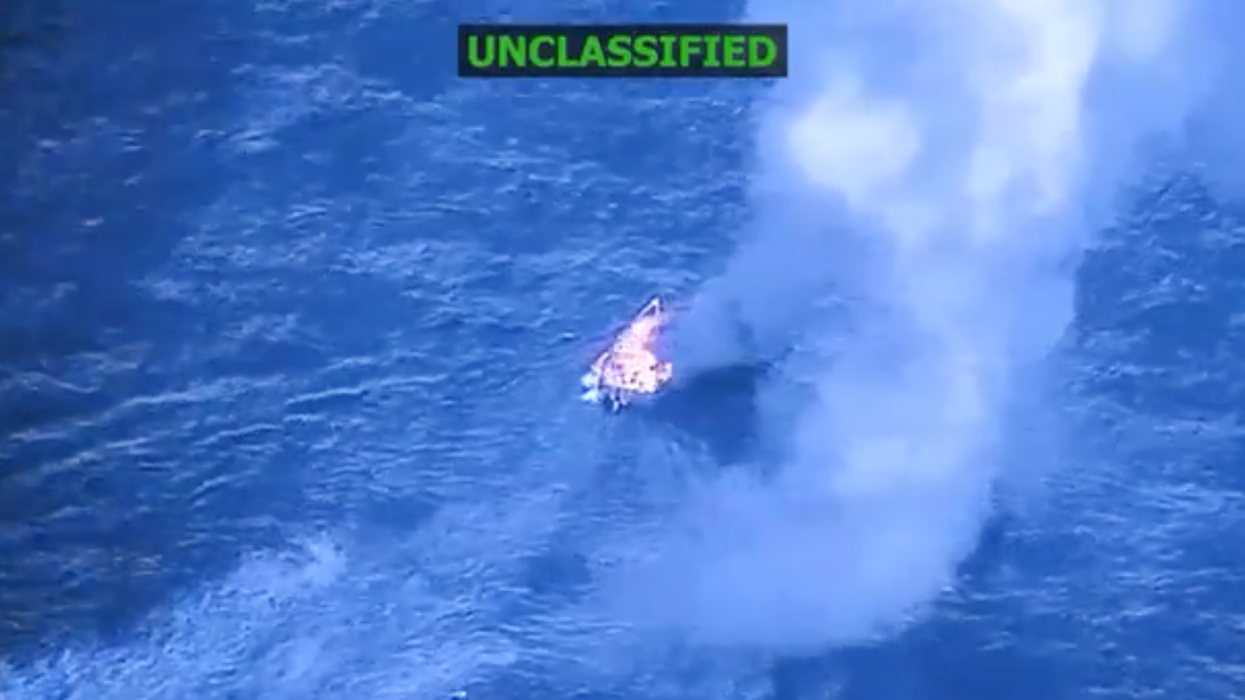
Amnesty International on Wednesday denounced this week's killing of six more people as US forces bombed another boat the Trump administration said—without evidence—was operated by narco-traffickers.
"Joint Task Force Southern Spear conducted a lethal kinetic strike on a vessel operated by Designated Terrorist Organizations," US Southern Command (SOUTHCOM) said Sunday on social media. "Intelligence confirmed the vessel was transiting along known narco-trafficking routes in the Eastern Pacific and was engaged in narco-trafficking operations. Six male narco-terrorists were killed during this action."
The US has bombed at least 40 vessels in the Caribbean Sea and Pacific Ocean since last September, killing at least 156 people, according to the Trump administration.
"Amnesty International strongly condemns these acts and reiterates that they constitute extrajudicial killings, a form of murder, prohibited under international law, and represent a grave affront to the most basic principles of humanity and legality," Amnesty said in a statement. "No circumstances justify the arbitrary deprivation of life."
The boat strikes were fraught from the start. In the first known attack, US forces killed nine people in an initial strike and then two men clinging to the boat's wreckage in a follow-up bombing. Legal experts have debated whether those strikes were a war crime or simply murder, and many argue that all of the boat bombings violate international law.
“The United States cannot claim the right to blow up boats with people on board based solely on suspicions of drug trafficking or other allegedly illicit activities," Amnesty International Americas director Ana Piquer said Wednesday. "The rest of the international community cannot normalize these extrajudicial killings, in which the United States military is judge and executioner."
"No president or military has the right to arbitrarily take life."
"Human life cannot be left to the mercy of a president’s whim," Piquer stressed. "No president or military has the right to arbitrarily take life. The level of dehumanization and cynicism reflected in these acts is deeply alarming and should be of global concern."
"It is urgent to demand accountability and immediately end these types of attacks," she added. "Due to the current acquiescence of the attorney general’s office, Congress must step in with its oversight power and investigate."
In addition to bombing boats—and 10 countries—President Donald Trump launched an invasion of Venezuela to abduct its president, Nicolás Maduro, and his wife, who are jailed in the US awaiting trial for dubious narco-trafficking charges.
Earlier this month, Trump also authorized a joint campaign with Ecuador to combat "narco-terrorists" in which US ground troops have been deployed in the Andean nation.