SUBSCRIBE TO OUR FREE NEWSLETTER
Daily news & progressive opinion—funded by the people, not the corporations—delivered straight to your inbox.
5
#000000
#FFFFFF
To donate by check, phone, or other method, see our More Ways to Give page.
Daily news & progressive opinion—funded by the people, not the corporations—delivered straight to your inbox.
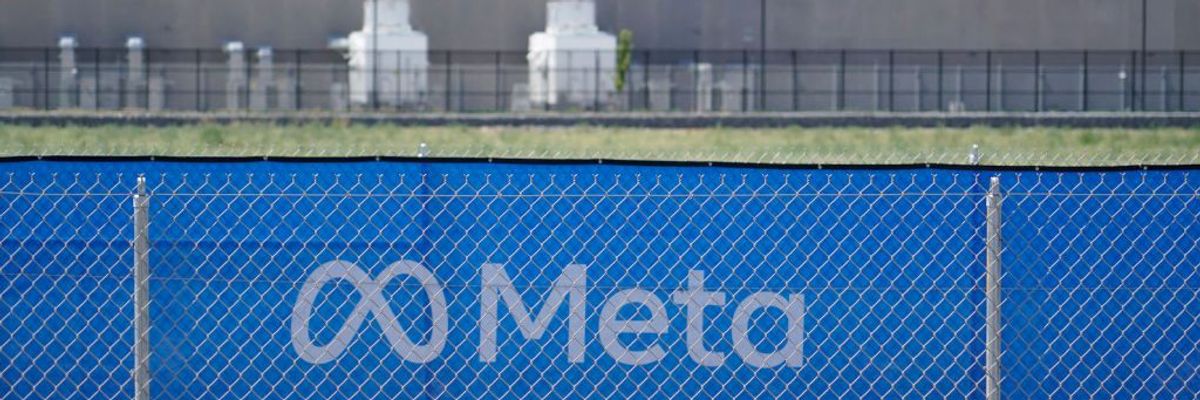
Outside view of the newly completed Meta's Facebook data center in Eagle Mountain, Utah on July 18, 2024.
Meta is financing the data center using accounting tricks that the Wall Street Journal reports appear "too good to be true."
The tiny town of Holly Ridge, Louisiana will soon be home to a massive $27 billion artificial intelligence data center being built by Facebook parent company Meta that, when finished, will be the largest in the world.
However, residents of Holly Ridge do not feel honored that they are at the epicenter of Meta's ambitious data center buildout, which they say has upended their entire community.
As reported by New Orleans-based public radio station WWNO last week, the nonstop parade of trucks driving through Holly Ridge has led to a 600% increase in vehicle crashes over the last year, including three truck crashes that occurred just outside Holly Ridge Elementary School.
Penelope Hull, a fourth-grade student at the school, told WWNO that the data center construction trucks are highly disruptive to learning even on days when they don't get into accidents, as they often cause the classroom walls to shake.
"You can't pay attention," she said. "And then you get off track and you lose what the teacher was telling you to do."
Hull also said that the school has had to shut down its playground out of concern that Meta construction trucks will crash into children playing during recess.
The threat of trucks crashing into schools isn't the only problem that the data center has brought. Local residents Joseph and Robin Williams told WWNO that they've noticed their tap water is frequently rust colored since Meta started building the data center, and they say their electricity frequently goes off for hours on end with no warning.
Similar issues were documented by progressive media outlet More Perfect Union, which sent its reporters down to Holly Ridge and found residents felt their concerns were being completely ignored by both Meta and their local elected officials.
"We had no voting on it, no community meetings, no nothing," one local woman told More Perfect Union. "It was done all under the table."
Another local resident told More Perfect Union that Holly Ridge has become "totally different" ever since Meta began AI data center construction.
"Who wants to live like this?" he asked as he looked on at more construction trucks barreling through the community.
Zuckerberg is building a data center in Louisiana the size of Manhattan — while Meta runs ads about how small towns love their data centers, we found furious locals who plan to leave town completely. pic.twitter.com/xHLG4KJMLO
— More Perfect Union (@MorePerfectUS) November 19, 2025
According to a Monday report in the Wall Street Journal, the massive Meta Louisiana data center is being funded through debt that is being papered over with accounting gimmicks that the paper notes are likely "too good to be true."
Specifically, the Journal said that Meta has created a joint venture known as a variable interest entity with investment manager Blue Owl Capital, in which Meta will rent the data center for up to 20 years as a way to keep the debt from its construction off its books.
"This lease structure minimizes the lease liabilities and related assets Meta will recognize, and enables Meta to use 'operating lease,' rather than 'finance lease,' treatment," the Journal explained. "If Meta used the latter, it would look more like Meta owns the asset and is financing it with debt."
However, the report noted that Meta is relying on "some convenient assumptions" in justifying its use of this accounting tactic, some of which "appear implausible" and "are in tension with one another," which makes it hard to justify keeping debt from the data center off its books.
"Ultimately, the fact pattern Meta relies on to meet its conflicting objectives strains credibility," reports the Journal. "To believe Meta’s books, one must accept that Meta lacks the power to call the shots that matter most, that there’s reasonable doubt it will stay beyond four years, and that it probably won’t have to honor its guarantee—all at the same time."
Commenting on the Journal's story about the data center financing, Wired editor Tim Marchman described it in a post on Bluesky as "the equivalent of a 500-foot neon sign reading 'FRAUD.'"
Dear Common Dreams reader, It’s been nearly 30 years since I co-founded Common Dreams with my late wife, Lina Newhouser. We had the radical notion that journalism should serve the public good, not corporate profits. It was clear to us from the outset what it would take to build such a project. No paid advertisements. No corporate sponsors. No millionaire publisher telling us what to think or do. Many people said we wouldn't last a year, but we proved those doubters wrong. Together with a tremendous team of journalists and dedicated staff, we built an independent media outlet free from the constraints of profits and corporate control. Our mission has always been simple: To inform. To inspire. To ignite change for the common good. Building Common Dreams was not easy. Our survival was never guaranteed. When you take on the most powerful forces—Wall Street greed, fossil fuel industry destruction, Big Tech lobbyists, and uber-rich oligarchs who have spent billions upon billions rigging the economy and democracy in their favor—the only bulwark you have is supporters who believe in your work. But here’s the urgent message from me today. It's never been this bad out there. And it's never been this hard to keep us going. At the very moment Common Dreams is most needed, the threats we face are intensifying. We need your support now more than ever. We don't accept corporate advertising and never will. We don't have a paywall because we don't think people should be blocked from critical news based on their ability to pay. Everything we do is funded by the donations of readers like you. When everyone does the little they can afford, we are strong. But if that support retreats or dries up, so do we. Will you donate now to make sure Common Dreams not only survives but thrives? —Craig Brown, Co-founder |
The tiny town of Holly Ridge, Louisiana will soon be home to a massive $27 billion artificial intelligence data center being built by Facebook parent company Meta that, when finished, will be the largest in the world.
However, residents of Holly Ridge do not feel honored that they are at the epicenter of Meta's ambitious data center buildout, which they say has upended their entire community.
As reported by New Orleans-based public radio station WWNO last week, the nonstop parade of trucks driving through Holly Ridge has led to a 600% increase in vehicle crashes over the last year, including three truck crashes that occurred just outside Holly Ridge Elementary School.
Penelope Hull, a fourth-grade student at the school, told WWNO that the data center construction trucks are highly disruptive to learning even on days when they don't get into accidents, as they often cause the classroom walls to shake.
"You can't pay attention," she said. "And then you get off track and you lose what the teacher was telling you to do."
Hull also said that the school has had to shut down its playground out of concern that Meta construction trucks will crash into children playing during recess.
The threat of trucks crashing into schools isn't the only problem that the data center has brought. Local residents Joseph and Robin Williams told WWNO that they've noticed their tap water is frequently rust colored since Meta started building the data center, and they say their electricity frequently goes off for hours on end with no warning.
Similar issues were documented by progressive media outlet More Perfect Union, which sent its reporters down to Holly Ridge and found residents felt their concerns were being completely ignored by both Meta and their local elected officials.
"We had no voting on it, no community meetings, no nothing," one local woman told More Perfect Union. "It was done all under the table."
Another local resident told More Perfect Union that Holly Ridge has become "totally different" ever since Meta began AI data center construction.
"Who wants to live like this?" he asked as he looked on at more construction trucks barreling through the community.
Zuckerberg is building a data center in Louisiana the size of Manhattan — while Meta runs ads about how small towns love their data centers, we found furious locals who plan to leave town completely. pic.twitter.com/xHLG4KJMLO
— More Perfect Union (@MorePerfectUS) November 19, 2025
According to a Monday report in the Wall Street Journal, the massive Meta Louisiana data center is being funded through debt that is being papered over with accounting gimmicks that the paper notes are likely "too good to be true."
Specifically, the Journal said that Meta has created a joint venture known as a variable interest entity with investment manager Blue Owl Capital, in which Meta will rent the data center for up to 20 years as a way to keep the debt from its construction off its books.
"This lease structure minimizes the lease liabilities and related assets Meta will recognize, and enables Meta to use 'operating lease,' rather than 'finance lease,' treatment," the Journal explained. "If Meta used the latter, it would look more like Meta owns the asset and is financing it with debt."
However, the report noted that Meta is relying on "some convenient assumptions" in justifying its use of this accounting tactic, some of which "appear implausible" and "are in tension with one another," which makes it hard to justify keeping debt from the data center off its books.
"Ultimately, the fact pattern Meta relies on to meet its conflicting objectives strains credibility," reports the Journal. "To believe Meta’s books, one must accept that Meta lacks the power to call the shots that matter most, that there’s reasonable doubt it will stay beyond four years, and that it probably won’t have to honor its guarantee—all at the same time."
Commenting on the Journal's story about the data center financing, Wired editor Tim Marchman described it in a post on Bluesky as "the equivalent of a 500-foot neon sign reading 'FRAUD.'"
The tiny town of Holly Ridge, Louisiana will soon be home to a massive $27 billion artificial intelligence data center being built by Facebook parent company Meta that, when finished, will be the largest in the world.
However, residents of Holly Ridge do not feel honored that they are at the epicenter of Meta's ambitious data center buildout, which they say has upended their entire community.
As reported by New Orleans-based public radio station WWNO last week, the nonstop parade of trucks driving through Holly Ridge has led to a 600% increase in vehicle crashes over the last year, including three truck crashes that occurred just outside Holly Ridge Elementary School.
Penelope Hull, a fourth-grade student at the school, told WWNO that the data center construction trucks are highly disruptive to learning even on days when they don't get into accidents, as they often cause the classroom walls to shake.
"You can't pay attention," she said. "And then you get off track and you lose what the teacher was telling you to do."
Hull also said that the school has had to shut down its playground out of concern that Meta construction trucks will crash into children playing during recess.
The threat of trucks crashing into schools isn't the only problem that the data center has brought. Local residents Joseph and Robin Williams told WWNO that they've noticed their tap water is frequently rust colored since Meta started building the data center, and they say their electricity frequently goes off for hours on end with no warning.
Similar issues were documented by progressive media outlet More Perfect Union, which sent its reporters down to Holly Ridge and found residents felt their concerns were being completely ignored by both Meta and their local elected officials.
"We had no voting on it, no community meetings, no nothing," one local woman told More Perfect Union. "It was done all under the table."
Another local resident told More Perfect Union that Holly Ridge has become "totally different" ever since Meta began AI data center construction.
"Who wants to live like this?" he asked as he looked on at more construction trucks barreling through the community.
Zuckerberg is building a data center in Louisiana the size of Manhattan — while Meta runs ads about how small towns love their data centers, we found furious locals who plan to leave town completely. pic.twitter.com/xHLG4KJMLO
— More Perfect Union (@MorePerfectUS) November 19, 2025
According to a Monday report in the Wall Street Journal, the massive Meta Louisiana data center is being funded through debt that is being papered over with accounting gimmicks that the paper notes are likely "too good to be true."
Specifically, the Journal said that Meta has created a joint venture known as a variable interest entity with investment manager Blue Owl Capital, in which Meta will rent the data center for up to 20 years as a way to keep the debt from its construction off its books.
"This lease structure minimizes the lease liabilities and related assets Meta will recognize, and enables Meta to use 'operating lease,' rather than 'finance lease,' treatment," the Journal explained. "If Meta used the latter, it would look more like Meta owns the asset and is financing it with debt."
However, the report noted that Meta is relying on "some convenient assumptions" in justifying its use of this accounting tactic, some of which "appear implausible" and "are in tension with one another," which makes it hard to justify keeping debt from the data center off its books.
"Ultimately, the fact pattern Meta relies on to meet its conflicting objectives strains credibility," reports the Journal. "To believe Meta’s books, one must accept that Meta lacks the power to call the shots that matter most, that there’s reasonable doubt it will stay beyond four years, and that it probably won’t have to honor its guarantee—all at the same time."
Commenting on the Journal's story about the data center financing, Wired editor Tim Marchman described it in a post on Bluesky as "the equivalent of a 500-foot neon sign reading 'FRAUD.'"