SUBSCRIBE TO OUR FREE NEWSLETTER
Daily news & progressive opinion—funded by the people, not the corporations—delivered straight to your inbox.
5
#000000
#FFFFFF
To donate by check, phone, or other method, see our More Ways to Give page.
Daily news & progressive opinion—funded by the people, not the corporations—delivered straight to your inbox.
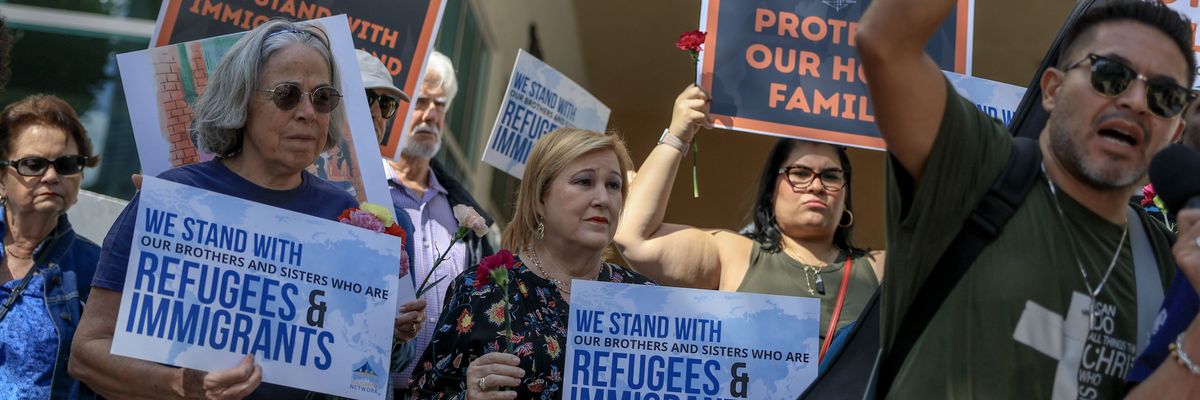
People pray during an interfaith service, held adjacent to the Miami Immigration Court, on behalf of immigrants on November 13, 2025, in Miami, Florida.
"These are refugees who fled persecution... refugees who had been more thoroughly vetted than any other population before entering our country," said the head of the Refugee Council USA.
The Trump administration has halted the distribution of green cards to around 235,000 refugees admitted during the Biden administration, requiring all their claims to be reassessed, according to a memo obtained by the Associated Press.
The AP reported on Tuesday that the abrupt change will not only apply to refugees awaiting green cards, but that some who have already received them could have their permanent residency status revoked.
The memo, signed by the director of US Citizenship and Immigration Services (USCIS), Joseph Edlow, claims that during the previous administration, “expediency” and “quantity” were prioritized over the “detailed screening and vetting" of those who applied for refugee status.
Refugee status can be claimed by those outside the United States who fear persecution on the basis of race, religion, nationality, political opinion, or membership in a social group. Most refugees who have entered the US in recent years come from nations in the midst of severe upheaval from civil war or other forms of political instability.
Between October 2021 and September 2024, the Biden administration admitted 185,640 refugees. Last year, more than 100,000 were admitted, with the largest numbers coming from the Democratic Republic of Congo, Afghanistan, Venezuela, and Syria.
The memo states that these refugees will be subject to new investigations into their claims of past persecution or fear of persecution in their home countries. It also says USCIS will review the possible grounds for inadmissibility, which could place them at risk of losing their status. Those the agency determines did not meet the criteria for admission will have "no right to appeal."
In addition to reassessing the validity of their claims of persecution, the review process will also reportedly involve an assessment of a refugee's potential for "assimilation" into the United States.
The Refugee Council USA (RCUSA) said the directive violates the Refugee Act of 1980, which states that refugees shall be considered for a green card after one year of residence in the US.
"By ordering reinterviews and halting permanent residence processing for those admitted during the previous administration, the Trump administration is placing the entire resettlement system into legal limbo," the group said.
The AP reports that the lives of many refugees in the US have been thrown into chaos by the rule change. One Syrian refugee who fled the nation's deadly civil war roughly a decade ago said he now feared that he and his family would be sent back.
“It was, and it still is a dream to be in America,” said the man, who remained anonymous for fear of being targeted by US authorities. “If they start sending back people to their home countries, you don’t have the rights that you have here and the opportunities.”
Despite the administration's claims, refugees already undergo an extraordinarily long and thorough vetting process to enter the US, which can take up to 36 months. The process involves screening of biographic and biometric information, extensive interviews, and security screenings by the FBI, the Department of Homeland Security, and the Department of Defense.
“This administration’s disdain for refugees and newcomers is well-documented, yet it continues to find new ways to outdo itself," said Rick Santos, president and CEO of Church World Service (CWS), which provides support for refugees around the globe. "The decision to review and reinterview resettled refugees—who have already passed through the most stringent of vetting processes—is not merely a relitigation, but a retraumatizing of individuals who were assured of their safety and a chance to live free of persecution."
“Just the threat of this is unspeakably cruel," said Mark Hetfield, the president of the Hebrew Immigrant Aid Society, in a comment to CNN. "To threaten refugees with taking away their status would be retraumatizing and a vicious misuse of taxpayer money."
CWS argued that "the resources it will take to relitigate refugees’ cases could be much better spent addressing USCIS’s backlog of approximately 4 million cases."
As Aaron Reichlin-Melnick, a senior fellow at the American Immigration Council, noted, "The same administration that redefined refugee status to cover white South Africans is now going to drown in red tape tens of thousands of refugees approved years ago, potentially even seeking to strip some of their status and deport them."
In October, the Trump administration announced that it would limit the number of refugees accepted during this fiscal year to a historic low of 7,500, down from over 100,000 under former President Joe Biden, with most spots going to the white descendants of the Europeans who subjected South Africa's majority Black population to apartheid for decades. The first of those refugees was admitted to the US earlier this week, just before the green card freeze was announced.
“The latest refugee policy announcement from the Trump administration is astounding, unprecedented, heartbreaking, and cruel,” said John Slocum, executive director of RCUSA. "These are refugees who fled persecution on account of their religion, race, nationality, membership in a particular social group, or political opinion. Refugees who had been more thoroughly vetted than any other population before entering our country. Refugees who had been promised, not a temporary sojourn, but a permanent grant of freedom, safety, and opportunity."
Dear Common Dreams reader, It’s been nearly 30 years since I co-founded Common Dreams with my late wife, Lina Newhouser. We had the radical notion that journalism should serve the public good, not corporate profits. It was clear to us from the outset what it would take to build such a project. No paid advertisements. No corporate sponsors. No millionaire publisher telling us what to think or do. Many people said we wouldn't last a year, but we proved those doubters wrong. Together with a tremendous team of journalists and dedicated staff, we built an independent media outlet free from the constraints of profits and corporate control. Our mission has always been simple: To inform. To inspire. To ignite change for the common good. Building Common Dreams was not easy. Our survival was never guaranteed. When you take on the most powerful forces—Wall Street greed, fossil fuel industry destruction, Big Tech lobbyists, and uber-rich oligarchs who have spent billions upon billions rigging the economy and democracy in their favor—the only bulwark you have is supporters who believe in your work. But here’s the urgent message from me today. It's never been this bad out there. And it's never been this hard to keep us going. At the very moment Common Dreams is most needed, the threats we face are intensifying. We need your support now more than ever. We don't accept corporate advertising and never will. We don't have a paywall because we don't think people should be blocked from critical news based on their ability to pay. Everything we do is funded by the donations of readers like you. When everyone does the little they can afford, we are strong. But if that support retreats or dries up, so do we. Will you donate now to make sure Common Dreams not only survives but thrives? —Craig Brown, Co-founder |
The Trump administration has halted the distribution of green cards to around 235,000 refugees admitted during the Biden administration, requiring all their claims to be reassessed, according to a memo obtained by the Associated Press.
The AP reported on Tuesday that the abrupt change will not only apply to refugees awaiting green cards, but that some who have already received them could have their permanent residency status revoked.
The memo, signed by the director of US Citizenship and Immigration Services (USCIS), Joseph Edlow, claims that during the previous administration, “expediency” and “quantity” were prioritized over the “detailed screening and vetting" of those who applied for refugee status.
Refugee status can be claimed by those outside the United States who fear persecution on the basis of race, religion, nationality, political opinion, or membership in a social group. Most refugees who have entered the US in recent years come from nations in the midst of severe upheaval from civil war or other forms of political instability.
Between October 2021 and September 2024, the Biden administration admitted 185,640 refugees. Last year, more than 100,000 were admitted, with the largest numbers coming from the Democratic Republic of Congo, Afghanistan, Venezuela, and Syria.
The memo states that these refugees will be subject to new investigations into their claims of past persecution or fear of persecution in their home countries. It also says USCIS will review the possible grounds for inadmissibility, which could place them at risk of losing their status. Those the agency determines did not meet the criteria for admission will have "no right to appeal."
In addition to reassessing the validity of their claims of persecution, the review process will also reportedly involve an assessment of a refugee's potential for "assimilation" into the United States.
The Refugee Council USA (RCUSA) said the directive violates the Refugee Act of 1980, which states that refugees shall be considered for a green card after one year of residence in the US.
"By ordering reinterviews and halting permanent residence processing for those admitted during the previous administration, the Trump administration is placing the entire resettlement system into legal limbo," the group said.
The AP reports that the lives of many refugees in the US have been thrown into chaos by the rule change. One Syrian refugee who fled the nation's deadly civil war roughly a decade ago said he now feared that he and his family would be sent back.
“It was, and it still is a dream to be in America,” said the man, who remained anonymous for fear of being targeted by US authorities. “If they start sending back people to their home countries, you don’t have the rights that you have here and the opportunities.”
Despite the administration's claims, refugees already undergo an extraordinarily long and thorough vetting process to enter the US, which can take up to 36 months. The process involves screening of biographic and biometric information, extensive interviews, and security screenings by the FBI, the Department of Homeland Security, and the Department of Defense.
“This administration’s disdain for refugees and newcomers is well-documented, yet it continues to find new ways to outdo itself," said Rick Santos, president and CEO of Church World Service (CWS), which provides support for refugees around the globe. "The decision to review and reinterview resettled refugees—who have already passed through the most stringent of vetting processes—is not merely a relitigation, but a retraumatizing of individuals who were assured of their safety and a chance to live free of persecution."
“Just the threat of this is unspeakably cruel," said Mark Hetfield, the president of the Hebrew Immigrant Aid Society, in a comment to CNN. "To threaten refugees with taking away their status would be retraumatizing and a vicious misuse of taxpayer money."
CWS argued that "the resources it will take to relitigate refugees’ cases could be much better spent addressing USCIS’s backlog of approximately 4 million cases."
As Aaron Reichlin-Melnick, a senior fellow at the American Immigration Council, noted, "The same administration that redefined refugee status to cover white South Africans is now going to drown in red tape tens of thousands of refugees approved years ago, potentially even seeking to strip some of their status and deport them."
In October, the Trump administration announced that it would limit the number of refugees accepted during this fiscal year to a historic low of 7,500, down from over 100,000 under former President Joe Biden, with most spots going to the white descendants of the Europeans who subjected South Africa's majority Black population to apartheid for decades. The first of those refugees was admitted to the US earlier this week, just before the green card freeze was announced.
“The latest refugee policy announcement from the Trump administration is astounding, unprecedented, heartbreaking, and cruel,” said John Slocum, executive director of RCUSA. "These are refugees who fled persecution on account of their religion, race, nationality, membership in a particular social group, or political opinion. Refugees who had been more thoroughly vetted than any other population before entering our country. Refugees who had been promised, not a temporary sojourn, but a permanent grant of freedom, safety, and opportunity."
The Trump administration has halted the distribution of green cards to around 235,000 refugees admitted during the Biden administration, requiring all their claims to be reassessed, according to a memo obtained by the Associated Press.
The AP reported on Tuesday that the abrupt change will not only apply to refugees awaiting green cards, but that some who have already received them could have their permanent residency status revoked.
The memo, signed by the director of US Citizenship and Immigration Services (USCIS), Joseph Edlow, claims that during the previous administration, “expediency” and “quantity” were prioritized over the “detailed screening and vetting" of those who applied for refugee status.
Refugee status can be claimed by those outside the United States who fear persecution on the basis of race, religion, nationality, political opinion, or membership in a social group. Most refugees who have entered the US in recent years come from nations in the midst of severe upheaval from civil war or other forms of political instability.
Between October 2021 and September 2024, the Biden administration admitted 185,640 refugees. Last year, more than 100,000 were admitted, with the largest numbers coming from the Democratic Republic of Congo, Afghanistan, Venezuela, and Syria.
The memo states that these refugees will be subject to new investigations into their claims of past persecution or fear of persecution in their home countries. It also says USCIS will review the possible grounds for inadmissibility, which could place them at risk of losing their status. Those the agency determines did not meet the criteria for admission will have "no right to appeal."
In addition to reassessing the validity of their claims of persecution, the review process will also reportedly involve an assessment of a refugee's potential for "assimilation" into the United States.
The Refugee Council USA (RCUSA) said the directive violates the Refugee Act of 1980, which states that refugees shall be considered for a green card after one year of residence in the US.
"By ordering reinterviews and halting permanent residence processing for those admitted during the previous administration, the Trump administration is placing the entire resettlement system into legal limbo," the group said.
The AP reports that the lives of many refugees in the US have been thrown into chaos by the rule change. One Syrian refugee who fled the nation's deadly civil war roughly a decade ago said he now feared that he and his family would be sent back.
“It was, and it still is a dream to be in America,” said the man, who remained anonymous for fear of being targeted by US authorities. “If they start sending back people to their home countries, you don’t have the rights that you have here and the opportunities.”
Despite the administration's claims, refugees already undergo an extraordinarily long and thorough vetting process to enter the US, which can take up to 36 months. The process involves screening of biographic and biometric information, extensive interviews, and security screenings by the FBI, the Department of Homeland Security, and the Department of Defense.
“This administration’s disdain for refugees and newcomers is well-documented, yet it continues to find new ways to outdo itself," said Rick Santos, president and CEO of Church World Service (CWS), which provides support for refugees around the globe. "The decision to review and reinterview resettled refugees—who have already passed through the most stringent of vetting processes—is not merely a relitigation, but a retraumatizing of individuals who were assured of their safety and a chance to live free of persecution."
“Just the threat of this is unspeakably cruel," said Mark Hetfield, the president of the Hebrew Immigrant Aid Society, in a comment to CNN. "To threaten refugees with taking away their status would be retraumatizing and a vicious misuse of taxpayer money."
CWS argued that "the resources it will take to relitigate refugees’ cases could be much better spent addressing USCIS’s backlog of approximately 4 million cases."
As Aaron Reichlin-Melnick, a senior fellow at the American Immigration Council, noted, "The same administration that redefined refugee status to cover white South Africans is now going to drown in red tape tens of thousands of refugees approved years ago, potentially even seeking to strip some of their status and deport them."
In October, the Trump administration announced that it would limit the number of refugees accepted during this fiscal year to a historic low of 7,500, down from over 100,000 under former President Joe Biden, with most spots going to the white descendants of the Europeans who subjected South Africa's majority Black population to apartheid for decades. The first of those refugees was admitted to the US earlier this week, just before the green card freeze was announced.
“The latest refugee policy announcement from the Trump administration is astounding, unprecedented, heartbreaking, and cruel,” said John Slocum, executive director of RCUSA. "These are refugees who fled persecution on account of their religion, race, nationality, membership in a particular social group, or political opinion. Refugees who had been more thoroughly vetted than any other population before entering our country. Refugees who had been promised, not a temporary sojourn, but a permanent grant of freedom, safety, and opportunity."