

SUBSCRIBE TO OUR FREE NEWSLETTER
Daily news & progressive opinion—funded by the people, not the corporations—delivered straight to your inbox.
5
#000000
#FFFFFF
To donate by check, phone, or other method, see our More Ways to Give page.
Daily news & progressive opinion—funded by the people, not the corporations—delivered straight to your inbox.
Ten years ago today the debate over the Iraq War came to Congress in the form of a resolution promoted by the Bush Administration. The war in Iraq will cost the United States as much as $5 trillion. It played a role in spurring the global financial crisis. Four thousand, four hundred, eighty eight Americans were killed. More than 33,000 were injured.
As many as 1,000,000 innocent Iraqi civilians were killed. The monetary cost of the war to Iraq is incalculable. A sectarian civil war has ravaged Iraq for nearly a decade. Iraq has become home to Al Qaeda.
The war in Iraq was sold to Congress and the American people with easily disproved lies. We must learn from this dark period in American history to ensure that we do not repeat the same mistakes. And we must hold accountable those who misled the American public.
On October 2, 2002, the day the legislation to authorize war in Iraq was introduced, I sent and personally distributed a memo to my colleagues in Congress refuting point-by-point every reason given by the Bush Administration to go to war.
On October 3, 2002, I held a press conference with 25 Members of Congress and then presented an hour long explanation to Congress on the House Floor, refuting the lies upon which the cause of war was predicated.
It was clear from information publicly available at the time that Iraq did not have Weapons of Mass Destruction (WMDs), that Iraq had no connection to 9/11, and that Iraq was not a threat to the United States. Anyone who wanted to look could have seen the same information that I did.
Yet some of America's top political leaders bought into the Bush-Cheney-Rumsfeld drumbeat of war. Two leading Democrats were among those taken in by the White House hype and the WMD argument:
"I believe the facts that have brought us to this fateful vote are not in doubt. Saddam Hussein is a tyrant who has tortured and killed his own people ... [I]ntelligence reports show that Saddam Hussein has worked to rebuild his chemical and biological weapons stock, his missile delivery capability and his nuclear program. He has also given aid, comfort and sanctuary to terrorists including Al Qaeda members." Senator Hillary Clinton (D-NY), October 10, 2002.
"September 11 was the ultimate wake-up call. We must now do everything in our power to prevent further terrorist attacks and ensure that an attack with a weapon of mass destruction cannot happen. ... the first candidate we must worry about is Iraq... [Saddam Hussein] continues to develop weapons of mass destruction, including nuclear devices." Leader of the Democratic Caucus in the House, Richard Gephardt (D-MO), October 10, 2002.
Even the most trusted newspapers around the country blindly repeated as fact grossly incorrect assertions by leaders of both parties.
"No further debate is needed to establish that Saddam Hussein is an evil dictator whose continued effort to build unconventional weapons in defiance of clear United Nations prohibitions threatens the Middle East and beyond." The New York Times, Editorial Board, October 3, 2002.
Notwithstanding the blizzard of disinformation, one hundred thirty three Members of Congress voted against the resolution that authorized the use of military force in Iraq, including nearly two-thirds of the Democratic Caucus in the House. Seven Republicans, including Ron Paul (R-TX), also voted against the resolution. In the Senate, the vote was 77 to 23 in favor of a war of choice.
Ten years ago Congress voted to wage war on a nation that did not attack us. That decision undermined our fiscal and national security. To this day we are suffering from the blowback. While most of the troops are home, the United States maintains a significant presence in Iraq through the State Department and its thousands of private security contractors.
The war against Iraq was based on lies. Thousands of Americans and perhaps a million Iraqis were sacrificed for those lies. The war in Afghanistan continues. New wars have been propagated in Pakistan, Yemen and Somalia pursuant to the never-ending "War on Terror". This mindset puts us at the edge of war against Iran. Ten years and trillions of dollars later, the American people by and large still do not know the truth. It is time to usher in a new period of truth and reconciliation.
Dennis Kucinich is an American politician. A U.S. Representative from Ohio from 1997 to 2013, he was also a candidate for the Democratic nomination for president of the United States in 2004 and 2008.
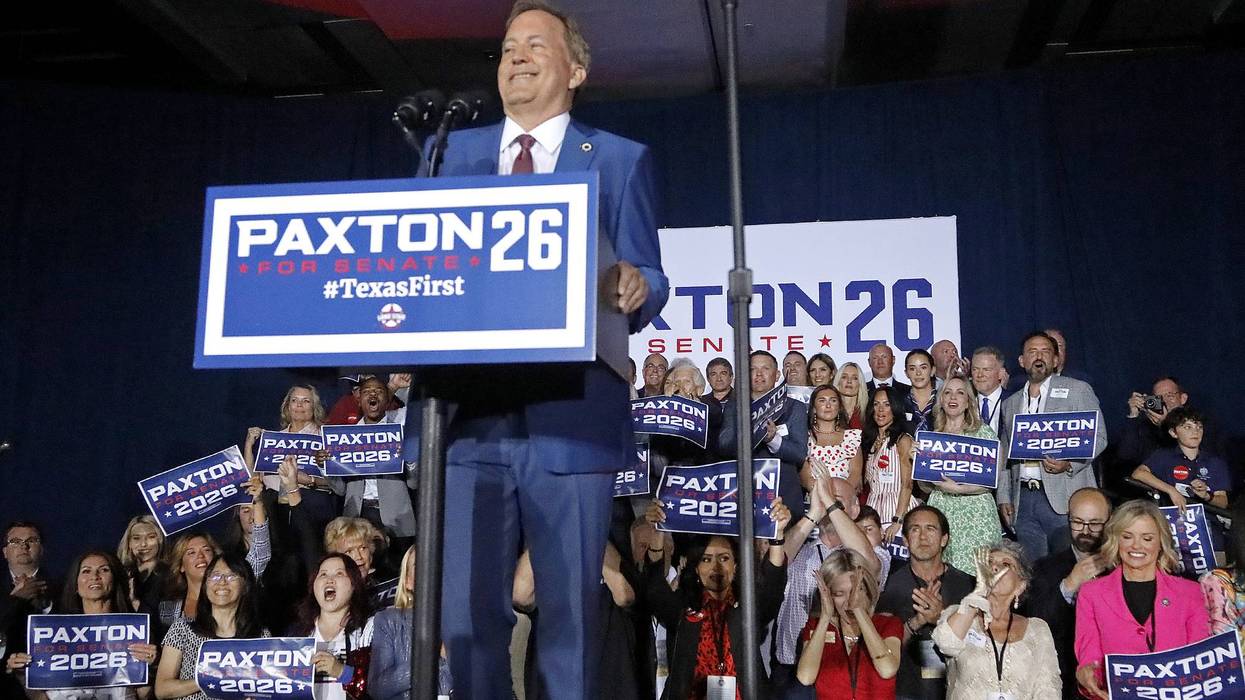
"Ken Paxton embodies the broken political system that we're running against," said James Talarico, the Democratic nominee for the Senate seat.
Ken Paxton, the scandal-plagued Texas attorney general backed by President Donald Trump, handily won a Republican US Senate primary runoff on Tuesday, ousting incumbent Sen. John Cornyn and setting up a critical race with Democratic nominee James Talarico—who wasted no time blasting Paxton's long record of self-dealing.
"Ken Paxton embodies the broken political system that we're running against," Talarico, a Texas state representative, said in an MS NOW appearance following Paxton's victory. "He is the most corrupt politician in America. Three years ago tomorrow, he was impeached by his own party for using his public office, his position of public trust, to enrich himself and his donors at our expense."
Talarico highlighted that Paxton has been indicted on securities fraud charges and said he "has shown over and over again that he's only concerned about himself."
"And that is exactly the problem in our politics," said the Democratic candidate. "It's puppet politicians who serve themselves and their billionaire megadonors instead of serving us. It's why we can't afford anything. It's why we can't get ahead no matter how hard we work. The system is rigged by corrupt politicians like Ken Paxton. And so it's going to be all of us. It's going to be Democrats, independents, and Republicans. It's going to be urban Texans, rural Texans, suburban Texans. It's going to be all of us coming together, the people versus Ken Paxton."
Ken Paxton is the most corrupt politician in America.
He embodies the broken system we’re running against.
It’s time to come together: The People vs. Ken Paxton pic.twitter.com/xL3cckibX9
— James Talarico (@jamestalarico) May 27, 2026
US Rep. Greg Casar (D-Texas), the chair of the Congressional Progressive Caucus, echoed Talarico, dubbing Paxton "the most corrupt politician in America" and adding, "Calling Ken Paxton just a crook is like calling Texas summers a little bit warm."
"The guy makes Richard Nixon look like a Boy Scout," said Casar. "We cannot allow him to become a United States Senator."
The Texas Tribune noted in its coverage of the primary outcome that Paxton is "known for his checkered history of personal ethics and legal troubles: He was once indicted for felony securities fraud (charges that were later dropped) and impeached by the GOP-controlled Texas House for corruption and abuse of office (and acquitted by the Republican majority in the Senate). And he has come under fire for alleged infidelity and an accumulation of assets during his time in office."
A Wall Street Journal report published last year detailed how Paxton "went from being a middle-class lawyer to a multimillionaire during his two decades on a public official’s salary."
"Paxton, who entered state government in 2003 with a modest income and few assets, by 2018 told a lender he had amassed a net worth of about $5.5 million, not including millions in assets he and his wife had previously moved into a blind trust," the Journal reported. "The following year, Paxton reaped an additional $2.2 million gain—never previously disclosed—from his investment in a local company with a lucrative Texas state contract."
Talarico—who, if victorious in November, could be a decisive factor in helping Democrats retake control of the US Senate—said in his television appearance late Tuesday that Paxton "owns 11 homes while we can't afford one."
"Ken Paxton's net worth went up by 7,000% while our pay has been stagnant," he added. "This is not just about Ken Paxton—it's about the corrupt system that he embodies, that he represents. If we can defeat the most corrupt politician in America in this year, in this race, in this state, then we can defeat this entire corrupt system."

Noting that "70+ countries and one US state" have banned the chemical, the Michael J. Fox Foundation said that "this is a clear and critical message" to federal and state lawmakers that "the time to ban paraquat is now."
In a move cheered by advocates for public health and the environment, Vermont on Tuesday became the first US state to ban paraquat, a neurotoxic herbicide banned in over 70 countries but protected by the Trump administration despite being linked to Parkinson's disease.
Democratic Vermont Gov. Phil Scott signed H. 739, which bans the sale and use of paraquat, after the legislation was passed by the state Legislature with strong bipartisan support. The ban—which contains a provision allowing for limited use of the chemical on fruit orchards through the end of 2030—is set to take effect on November 1.
As Public Interest Research Group (PIRG) campaigner Liam Sacino recently noted, the US Environmental Protection Agency [EPA] acknowledges that "even a small amount" of paraquat "can be fatal, and there is no known antidote."
"The agency has also decided that due to health risks, it should never be used around home gardens, schools, recreational parks, golf courses, or playgrounds," Sacino added. "Regardless of these conclusions, the EPA still allows paraquat to be sprayed on farms, posing a potentially increased risk to those who work on the farms and live nearby."
The EPA paradoxically calls paraquat "an important tool for the control of weeds in many agricultural and non-agricultural settings," a stance promoted by the chemical industry, some of whose highly toxic products the pesticide-friendly Trump administration has designated as vital to US national security.
Ban advocates point to mounting evidence that paraquat exposure greatly increases the risk of developing Parkinson's disease, a neurodegenerative illness. One recent UCLA study found that the odds of developing Parkinson's could more than double for people living within 500 meters of paraquat application.
That study added to a body of research linking paraquat to Parkinson's that dates back to at least 2011, when National Institutes of Health researchers concluded that the brain disorder is “positively associated” with the herbicide. A 2013 paper published in the peer-reviewed journal Neurology found that exposure to paraquat roughly doubled the risk of developing Parkinson’s. In 2020, four of the world’s leading neurologists published a book citing paraquat as a cause of the ailment.
Parkinson's advocacy groups, including the Parkinson's Foundation and Michael J. Fox Foundation, hailed the Vermont ban.
The Michael J. Fox Foundation noted that "70+ countries and one US state have now banned paraquat."
"This is a clear and critical message to other states and our federal government: The time to ban paraquat is now," the group added.
Environmental groups also cheered the ban.
"We applaud Gov. Scott and the champions in the Legislature that made this moment possible that will protect all Vermonters, including farmers and children, from being exposed to this dangerous chemical,” Environmental Working Group legislative director Geoff Horsfield said in a statement.
“With Vermont leading the way, states across the country now have a clear path to end the use of one of the most toxic herbicides still on the market,” Horsfield added. “This is a turning point in the effort to protect public health from a chemical that has been tied to devastating neurological harm.”
Other states including California, New Jersey, New York, and Pennsylvania have either introduced bills to ban or strictly limit paraquat, or are considering doing so.
"We should not wait for federal action when we can act now to protect farmworkers and families," PIRG's Sacino said Tuesday.

"The torture of US citizens and humanitarian volunteers with American-made tools... is the direct outcome of unconditional US support for a regime continuously committing war crimes and crimes against humanity.”
Testimonies published Tuesday from activists, journalists, medical professionals, and others who took part in the latest international flotilla attempting to break Israel's genocidal siege of Gaza called for an investigation into US complicity in their illegal high-seas abduction and alleged torture, sexual assault, and other abuse by Israeli forces.
"As testimonies from the 428 participants illegally kidnapped by the Israeli regime continue to surface, the United States' critical role in the abuses and torture of humanitarian volunteers and journalists has become undeniable," Global Sumud Flotilla's (GSF) media team said in a statement.
"This role goes beyond the State Department’s diplomatic shielding and the US Embassy’s refusal to assist American families seeking information," GSF continued. "It includes the very ship on which volunteer participants were illegally detained and tortured, and the weapons used to inflict life-threatening trauma against them."
That vessel, the amphibious landing ship INS Nahshon, was built by Bollinger Mississippi Shipbuilding in Louisiana and was fully financed by the US government. GSF activists first became aware of what they now call the "torture boat" when it was used to detain members of the previous Gaza-bound flotilla, dozens of whom required medical attention for broken ribs, noses, and other injuries inflicted by Israeli forces.
This time, according to GSF, "detained humanitarians, doctors, and journalists were processed one by one through a darkened shipping container. Inside, groups of three to five soldiers systematically brutalized each person who came through the door while those waiting outside listened to the screams."
Flotilla participant Yassine Benjelloun described his mistreatment by his Israeli captors.
"All of a sudden I hear, 'Welcome to Israel.' And I start getting hit, like first hit on the head, second hit in the ribs, then I fall, then they kick me," he said. "What lasts maybe three or five minutes seems like a lifetime. You don't know that the door is going to open, and they're going to kick you out."
Dr. Jihan Alya Mohd Nordin, a Malaysian physician aboard the flotilla, documented 35 GSF members with fractured or dislocated bones, as well as severe head injuries including concussions and eye or ear trauma, and 14 cases of sexual assault.
"Being a doctor, the main aim is to reduce the sufferings of people," Jihan said. "But when we cannot do anything to help them, it was the worst and most horrible feeling that I have. It was so devastating."
Jihan said she was shoved, struck, punched, kicked, and choked by her captors, who forcibly stripped off her hijab.
In addition to the ship, the weapons used against the civilian flotilla members were also made in the USA.
"Stun grenades and metal-bearing projectile rounds were identified by manufacturer markings as products of Combined Tactical Systems (CTS), a brand of the Jamestown, Pennsylvania-based weapons manufacturer Combined Systems Inc. (CSI)," GSF said. "These weapons were fired at close range in enclosed spaces against participants who were sitting down or trying to sleep, a direct violation of the manufacturer’s own usage guidelines."
GSF argues that "none of this was accidental."
According to former State Department official Josh Paul—who resigned in protest in 2023 over US arms transfers to Israel as it began waging a genocidal war against Gaza in response to the Hamas-led attack of October 7 of that year—"Under US law, arms transfers must only be made for purposes authorized by law."
"INS Nahshon's use by Israel to conduct an illegal seizure in international waters, and then to act as a base for the torture and sexual assault of foreign civilians, including Americans, who had broken no laws, and were acting from conscience to serve an urgent humanitarian need, plainly and grievously violates those terms," he continued.
"When this sale was authorized, US officials will have asked themselves how Israel might use this platform," Paul added. "The basis on which they should have denied this transfer has been there since at least the Mavi Marmara incident... but is now more clear than ever, and the lesson here is a simple one: that anything we transfer to Israel, Israel will find a way to misuse—whether it is a bomb, a bulldozer, or a boat.”
Paul was referring to the May 2010 raid on one of the first Gaza Freedom Flotilla convoys, during which Israeli forces killed nine volunteers aboard the MV Mavi Marmara, including Turkish-American teenager Furkan Doğan.
"While international law has been flagrantly violated and legal proceedings are now active in Turkey, Italy, and Spain, with Italian prosecutors opening an investigation into kidnapping and sexual assault, the US government continues to look away," GSF said in regard to the latest flotilla.
Americans aboard past Gaza flotillas said the Trump administration failed to provide any consular support during their abduction and abuse.
This time, US Ambassador to Israel Mike Huckabee—a Christian Zionist who has denied the very existence of the Palestinian people—joined senior officials from other countries in condemning Israel's abuse of abducted flotilla members.
GSF said Tuesday that "the Israeli regime continues to commit genocide using US-built ships and US-made weapons. The torture of US citizens and humanitarian volunteers with American-made tools is not an anomaly. It is the direct outcome of unconditional US support for a regime continuously committing war crimes and crimes against humanity."
That support includes tens of billions of dollars in armed aid during the Biden and Trump administrations, which both also provided diplomatic cover for Israel, including vetoes of numerous Gaza ceasefire resolutions passed by the United Nations Security Council.
Since October 2023, Israeli forces have killed or wounded more than 250,000 Palestinians in Gaza—including thousands of people who are missing and presumed dead and buried beneath rubble—while forcibly displacing, intentionally starving, or sickening around 2 million others.
Israel's actions are the subject of an International Court of Justice genocide case filed by South Africa and formally supported by nearly 20 other nations. The International Criminal Court has also issued arrest warrants for Israeli Prime Minister Benjamin Netanyahu and former Defense Minister Yoav Gallant for alleged crimes against humanity and war crimes in Gaza, including murder and forced starvation.
Last year, a UN panel of experts said that Israel is committing genocide in Gaza, a conclusion also reached by numerous governments, human rights groups, jurists, and scholars—including prominent Israeli and other Jewish Holocaust experts.
Flotilla participants have stressed that their ordeal pales in comparison to the plight of thousands of Palestinian men, women, and children imprisoned by Israel, often without charge or trial under the country's administrative detention regime. Israeli authorities are investigating the deaths of dozens of Palestinian prisoners, some of whom were allegedly tortured to death and executed. Others have allegedly been subjected to widespread rape and sexual abuse in Israeli detention.
"What GSF participants survived for days, many Palestinians endure indefinitely without lawyers or consular access," the flotilla organizers said.
GSF is calling on the US government to take actions including the investigation of Israel's use of US-origin arms and other equipment to abuse American citizens, a suspension of arms transfers to Israel pending the outcome of the probe, and "end unconditional military and diplomatic support for a regime committing genocide."