SUBSCRIBE TO OUR FREE NEWSLETTER
Daily news & progressive opinion—funded by the people, not the corporations—delivered straight to your inbox.
5
#000000
#FFFFFF
To donate by check, phone, or other method, see our More Ways to Give page.
Daily news & progressive opinion—funded by the people, not the corporations—delivered straight to your inbox.

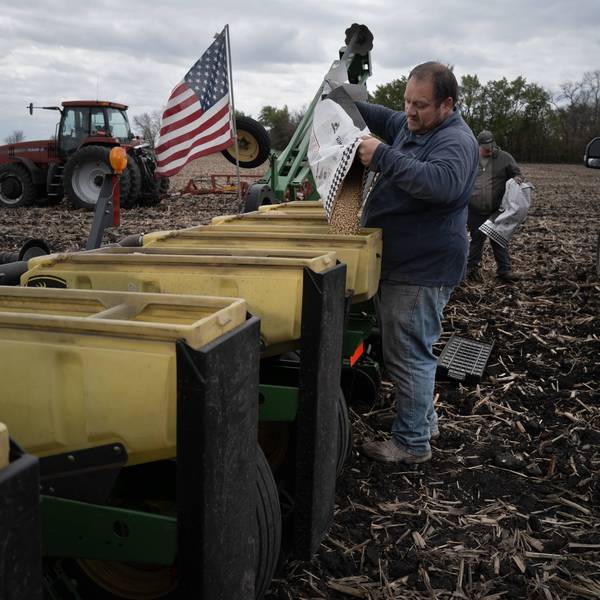
A combine harvests corn in a field near Jarrettsville, Maryland.
"Hiding behind the rhetoric of MAHA, a poison that's likely to keep Americans sick for generations is moving forward full steam," said one leader at the Center for Biological Diversity.
A leading US conservation organization blasted the Trump administration on Wednesday for an announcement that "doubles down" on the alleged safety of atrazine, a pesticide widely used in the United States but banned in dozens of other countries due to concerns including birth defects, infertility, and cancer.
During President Donald Trump's first administration, the Center for Biological Diversity was among the groups sounding the alarm after the Environmental Protection Agency (EPA) reauthorized the use of atrazine in 2020. This past March, as part of a case brought by CBD, a federal judge ordered the Trump administration to conduct biological opinions on how five pesticides, including atrazine, harm protected species.
The draft opinion for atrazine was released Tuesday by the US Fish and Wildlife Service, which concluded that the herbicide often used on corn, sugarcane, and sorghum "does not pose an extinction risk to a single protected animal or plant, despite widespread contamination of the nation's rivers, lakes, and streams," as CBD summarized.
Ripping the announcement as "an absolute joke," Nathan Donley, CBD's environmental health science director, said that "you'd have an easier time convincing me that the government isn't really shut down than persuading me that atrazine isn't putting a single endangered species at risk of extinction."
"Despite rhetoric to the contrary, there is no better friend of atrazine than the Trump administration."
Donley's comments come as Trump and Health and Human Services Secretary Robert F. Kennedy Jr. face mounting criticism for promising to "Make America Healthy Again" and then releasing a series of reports that critics say offered "half-baked finger-pointing that blames the sick" and "the pesticide industry's talking points."
As The Washington Post reported earlier this week:
In May, the Trump administration's MAHA commission released a report raising questions about the health effects of two commonly used pesticides, glyphosate and atrazine. The report's rhetoric frustrated powerful agriculture groups such as CropLife America and the American Soybean Association, prompting them to launch a concerted lobbying blitz to promote the chemicals farmers rely on to produce large crops, according to interviews with industry officials.
Major trade groups scrambled to meet with White House officials. They urged the commission in a coordinated social media campaign to take a "fact-based approach," and sent letters to key federal departments. A top industry group helped coordinate a visit of Trump officials to a Maryland farm to see farming techniques in action. And in June, an industry lobbyist was appointed to a key position at the Environmental Protection Agency.
Their efforts seemingly paid off. The Trump administration's MAHA strategy document released last month did not call for restrictions on pesticides and instead said the EPA would work to ensure the public is aware of its "robust" review procedures, a marked shift from Kennedy’s past criticism of chemicals as contaminating the nation’s food supply.
"We were heard," Alexandra Dunn, the CEO of pesticide trade group CropLife America, told the Post. "They listened very carefully to a lot of the input that they received over the past months."
The commission's children-focused September report "notably avoids proposing restrictions on commonly used products such as glyphosate and atrazine," the newspaper noted. "The report pledges that the EPA will work with the food and agriculture industries to ensure the public has 'awareness and confidence' in the agency's 'robust review procedures.'"
Real Trump MAHA agenda: performative in face of corporate money:How Big Agriculture got its way in the latest MAHA report. Alarmed by the 1st MAHA commission report, agriculture industry mobilized to shape next installment. Those efforts seemingly paid off. www.washingtonpost.com/climate-envi...
[image or embed]
— John Walke (@johndwalke.bsky.social) October 6, 2025 at 9:31 AM
Lori Ann Burd, CBD's environmental health director, said last month that "the commission's directive for the EPA and Big Ag to coordinate on a PR campaign aimed at convincing Americans that our pesticide regulatory process is robust is frankly insulting."
"The reality is that our pesticide regulatory process is as full of holes as Swiss cheese, and a slick PR campaign can't change that. The US uses a billion pounds of pesticides a year, and about a quarter of that total is pesticides banned in China, Brazil, and the EU," she continued. "If the EPA wants to convince us that our pesticide regulatory process is robust, they should make it robust."
"They should start by actually evaluating whole pesticide formulas and not just active ingredients and not routinely waiving the child safety factor for dangerous pesticides," she added. "And they should immediately ban the worst pesticides, like atrazine and paraquat, that are already banned in dozens of other countries and are imperiling the health of Americans right now."
After the Wednesday announcement, Donley declared that "despite rhetoric to the contrary, there is no better friend of atrazine than the Trump administration."
"Hiding behind the rhetoric of MAHA," he added, "a poison that's likely to keep Americans sick for generations is moving forward full steam."
The Trump administration's atrazine opinion came just a few weeks before the World Health Organization's next review of it. The last review from WHO's International Agency for Research on Cancer was in 1999, and at the time IARC said that atrazine was "not classifiable as to its carcinogenicity to humans." The meeting is scheduled for October 28-November 4.
Dear Common Dreams reader, It’s been nearly 30 years since I co-founded Common Dreams with my late wife, Lina Newhouser. We had the radical notion that journalism should serve the public good, not corporate profits. It was clear to us from the outset what it would take to build such a project. No paid advertisements. No corporate sponsors. No millionaire publisher telling us what to think or do. Many people said we wouldn't last a year, but we proved those doubters wrong. Together with a tremendous team of journalists and dedicated staff, we built an independent media outlet free from the constraints of profits and corporate control. Our mission has always been simple: To inform. To inspire. To ignite change for the common good. Building Common Dreams was not easy. Our survival was never guaranteed. When you take on the most powerful forces—Wall Street greed, fossil fuel industry destruction, Big Tech lobbyists, and uber-rich oligarchs who have spent billions upon billions rigging the economy and democracy in their favor—the only bulwark you have is supporters who believe in your work. But here’s the urgent message from me today. It's never been this bad out there. And it's never been this hard to keep us going. At the very moment Common Dreams is most needed, the threats we face are intensifying. We need your support now more than ever. We don't accept corporate advertising and never will. We don't have a paywall because we don't think people should be blocked from critical news based on their ability to pay. Everything we do is funded by the donations of readers like you. When everyone does the little they can afford, we are strong. But if that support retreats or dries up, so do we. Will you donate now to make sure Common Dreams not only survives but thrives? —Craig Brown, Co-founder |
A leading US conservation organization blasted the Trump administration on Wednesday for an announcement that "doubles down" on the alleged safety of atrazine, a pesticide widely used in the United States but banned in dozens of other countries due to concerns including birth defects, infertility, and cancer.
During President Donald Trump's first administration, the Center for Biological Diversity was among the groups sounding the alarm after the Environmental Protection Agency (EPA) reauthorized the use of atrazine in 2020. This past March, as part of a case brought by CBD, a federal judge ordered the Trump administration to conduct biological opinions on how five pesticides, including atrazine, harm protected species.
The draft opinion for atrazine was released Tuesday by the US Fish and Wildlife Service, which concluded that the herbicide often used on corn, sugarcane, and sorghum "does not pose an extinction risk to a single protected animal or plant, despite widespread contamination of the nation's rivers, lakes, and streams," as CBD summarized.
Ripping the announcement as "an absolute joke," Nathan Donley, CBD's environmental health science director, said that "you'd have an easier time convincing me that the government isn't really shut down than persuading me that atrazine isn't putting a single endangered species at risk of extinction."
"Despite rhetoric to the contrary, there is no better friend of atrazine than the Trump administration."
Donley's comments come as Trump and Health and Human Services Secretary Robert F. Kennedy Jr. face mounting criticism for promising to "Make America Healthy Again" and then releasing a series of reports that critics say offered "half-baked finger-pointing that blames the sick" and "the pesticide industry's talking points."
As The Washington Post reported earlier this week:
In May, the Trump administration's MAHA commission released a report raising questions about the health effects of two commonly used pesticides, glyphosate and atrazine. The report's rhetoric frustrated powerful agriculture groups such as CropLife America and the American Soybean Association, prompting them to launch a concerted lobbying blitz to promote the chemicals farmers rely on to produce large crops, according to interviews with industry officials.
Major trade groups scrambled to meet with White House officials. They urged the commission in a coordinated social media campaign to take a "fact-based approach," and sent letters to key federal departments. A top industry group helped coordinate a visit of Trump officials to a Maryland farm to see farming techniques in action. And in June, an industry lobbyist was appointed to a key position at the Environmental Protection Agency.
Their efforts seemingly paid off. The Trump administration's MAHA strategy document released last month did not call for restrictions on pesticides and instead said the EPA would work to ensure the public is aware of its "robust" review procedures, a marked shift from Kennedy’s past criticism of chemicals as contaminating the nation’s food supply.
"We were heard," Alexandra Dunn, the CEO of pesticide trade group CropLife America, told the Post. "They listened very carefully to a lot of the input that they received over the past months."
The commission's children-focused September report "notably avoids proposing restrictions on commonly used products such as glyphosate and atrazine," the newspaper noted. "The report pledges that the EPA will work with the food and agriculture industries to ensure the public has 'awareness and confidence' in the agency's 'robust review procedures.'"
Real Trump MAHA agenda: performative in face of corporate money:How Big Agriculture got its way in the latest MAHA report. Alarmed by the 1st MAHA commission report, agriculture industry mobilized to shape next installment. Those efforts seemingly paid off. www.washingtonpost.com/climate-envi...
[image or embed]
— John Walke (@johndwalke.bsky.social) October 6, 2025 at 9:31 AM
Lori Ann Burd, CBD's environmental health director, said last month that "the commission's directive for the EPA and Big Ag to coordinate on a PR campaign aimed at convincing Americans that our pesticide regulatory process is robust is frankly insulting."
"The reality is that our pesticide regulatory process is as full of holes as Swiss cheese, and a slick PR campaign can't change that. The US uses a billion pounds of pesticides a year, and about a quarter of that total is pesticides banned in China, Brazil, and the EU," she continued. "If the EPA wants to convince us that our pesticide regulatory process is robust, they should make it robust."
"They should start by actually evaluating whole pesticide formulas and not just active ingredients and not routinely waiving the child safety factor for dangerous pesticides," she added. "And they should immediately ban the worst pesticides, like atrazine and paraquat, that are already banned in dozens of other countries and are imperiling the health of Americans right now."
After the Wednesday announcement, Donley declared that "despite rhetoric to the contrary, there is no better friend of atrazine than the Trump administration."
"Hiding behind the rhetoric of MAHA," he added, "a poison that's likely to keep Americans sick for generations is moving forward full steam."
The Trump administration's atrazine opinion came just a few weeks before the World Health Organization's next review of it. The last review from WHO's International Agency for Research on Cancer was in 1999, and at the time IARC said that atrazine was "not classifiable as to its carcinogenicity to humans." The meeting is scheduled for October 28-November 4.
A leading US conservation organization blasted the Trump administration on Wednesday for an announcement that "doubles down" on the alleged safety of atrazine, a pesticide widely used in the United States but banned in dozens of other countries due to concerns including birth defects, infertility, and cancer.
During President Donald Trump's first administration, the Center for Biological Diversity was among the groups sounding the alarm after the Environmental Protection Agency (EPA) reauthorized the use of atrazine in 2020. This past March, as part of a case brought by CBD, a federal judge ordered the Trump administration to conduct biological opinions on how five pesticides, including atrazine, harm protected species.
The draft opinion for atrazine was released Tuesday by the US Fish and Wildlife Service, which concluded that the herbicide often used on corn, sugarcane, and sorghum "does not pose an extinction risk to a single protected animal or plant, despite widespread contamination of the nation's rivers, lakes, and streams," as CBD summarized.
Ripping the announcement as "an absolute joke," Nathan Donley, CBD's environmental health science director, said that "you'd have an easier time convincing me that the government isn't really shut down than persuading me that atrazine isn't putting a single endangered species at risk of extinction."
"Despite rhetoric to the contrary, there is no better friend of atrazine than the Trump administration."
Donley's comments come as Trump and Health and Human Services Secretary Robert F. Kennedy Jr. face mounting criticism for promising to "Make America Healthy Again" and then releasing a series of reports that critics say offered "half-baked finger-pointing that blames the sick" and "the pesticide industry's talking points."
As The Washington Post reported earlier this week:
In May, the Trump administration's MAHA commission released a report raising questions about the health effects of two commonly used pesticides, glyphosate and atrazine. The report's rhetoric frustrated powerful agriculture groups such as CropLife America and the American Soybean Association, prompting them to launch a concerted lobbying blitz to promote the chemicals farmers rely on to produce large crops, according to interviews with industry officials.
Major trade groups scrambled to meet with White House officials. They urged the commission in a coordinated social media campaign to take a "fact-based approach," and sent letters to key federal departments. A top industry group helped coordinate a visit of Trump officials to a Maryland farm to see farming techniques in action. And in June, an industry lobbyist was appointed to a key position at the Environmental Protection Agency.
Their efforts seemingly paid off. The Trump administration's MAHA strategy document released last month did not call for restrictions on pesticides and instead said the EPA would work to ensure the public is aware of its "robust" review procedures, a marked shift from Kennedy’s past criticism of chemicals as contaminating the nation’s food supply.
"We were heard," Alexandra Dunn, the CEO of pesticide trade group CropLife America, told the Post. "They listened very carefully to a lot of the input that they received over the past months."
The commission's children-focused September report "notably avoids proposing restrictions on commonly used products such as glyphosate and atrazine," the newspaper noted. "The report pledges that the EPA will work with the food and agriculture industries to ensure the public has 'awareness and confidence' in the agency's 'robust review procedures.'"
Real Trump MAHA agenda: performative in face of corporate money:How Big Agriculture got its way in the latest MAHA report. Alarmed by the 1st MAHA commission report, agriculture industry mobilized to shape next installment. Those efforts seemingly paid off. www.washingtonpost.com/climate-envi...
[image or embed]
— John Walke (@johndwalke.bsky.social) October 6, 2025 at 9:31 AM
Lori Ann Burd, CBD's environmental health director, said last month that "the commission's directive for the EPA and Big Ag to coordinate on a PR campaign aimed at convincing Americans that our pesticide regulatory process is robust is frankly insulting."
"The reality is that our pesticide regulatory process is as full of holes as Swiss cheese, and a slick PR campaign can't change that. The US uses a billion pounds of pesticides a year, and about a quarter of that total is pesticides banned in China, Brazil, and the EU," she continued. "If the EPA wants to convince us that our pesticide regulatory process is robust, they should make it robust."
"They should start by actually evaluating whole pesticide formulas and not just active ingredients and not routinely waiving the child safety factor for dangerous pesticides," she added. "And they should immediately ban the worst pesticides, like atrazine and paraquat, that are already banned in dozens of other countries and are imperiling the health of Americans right now."
After the Wednesday announcement, Donley declared that "despite rhetoric to the contrary, there is no better friend of atrazine than the Trump administration."
"Hiding behind the rhetoric of MAHA," he added, "a poison that's likely to keep Americans sick for generations is moving forward full steam."
The Trump administration's atrazine opinion came just a few weeks before the World Health Organization's next review of it. The last review from WHO's International Agency for Research on Cancer was in 1999, and at the time IARC said that atrazine was "not classifiable as to its carcinogenicity to humans." The meeting is scheduled for October 28-November 4.