

SUBSCRIBE TO OUR FREE NEWSLETTER
Daily news & progressive opinion—funded by the people, not the corporations—delivered straight to your inbox.
5
#000000
#FFFFFF
To donate by check, phone, or other method, see our More Ways to Give page.
Daily news & progressive opinion—funded by the people, not the corporations—delivered straight to your inbox.

Note: Public Citizen played a key role in the Citizens United
case; Public Citizen attorney Scott Nelson was a member of the legal
team that represented the key congressional sponsors of the
McCain-Feingold law.
Shed a tear for our democracy.
Today, in the case Citizens United v. FEC, the U.S. Supreme Court
has ruled that corporations have a First Amendment right to spend
unlimited amounts of money to influence election outcomes.
Money from Exxon, Goldman Sachs, Pfizer and the rest of the Fortune
500 is already corroding the policy making process in Washington, state
capitals and city halls. Today, the Supreme Court tells these corporate
giants that they have a constitutional right to trample our democracy.
In eviscerating longstanding rules prohibiting corporations from
using their own monies to influence elections, the court invites giant
corporations to open up their treasuries to buy election outcomes.
Corporations are sure to accept the invitation.
The predictable result will be corporate money flooding the
election process; huge targeted campaigns by corporations and their
front groups attacking principled candidates who challenge parochial
corporate interests; and a chilling effect on candidates and election
officials, who will be deterred from advocating and implementing
policies that advance the public interest but injure deep-pocket
corporations.
Because today's decision is made on First Amendment constitutional
grounds, the impact will be felt not only at the federal level, but in
the states and localities, including in state judicial elections.
In one sense, today's decision was a long time in coming. Over the
past 30 years, the Supreme Court has created and steadily expanded the
First Amendment protections that it has afforded for-profit
corporations.
But in another sense, the decision is a startling break from
Supreme Court tradition. Even as it has mistakenly equated money with
speech in the political context, the court has long upheld regulations
on corporate spending in the electoral context. The Citizens United
decision is also an astonishing overreach by the court. No one thought
the issue of corporations' purported right to spend money to influence
election outcomes was at stake in this case until the Supreme Court so
decreed. The case had been argued in lower courts, and was originally
argued before the Supreme Court, on narrow grounds related to
application of the McCain-Feingold campaign finance law.
The court has invented the idea that corporations have First
Amendment rights to influence election outcomes out of whole cloth.
There is surely no originalist interpretation to support this outcome,
since the court created the rights only in recent decades. Nor can the
outcome be justified in light of the underlying purpose and spirit of
the First Amendment. Corporations are state-created entities, not real
people. They do not have expressive interests like humans; and, unlike
humans, they are uniquely motivated by a singular focus on their
economic bottom line. Corporate spending on elections defeats rather
than advances the democratic thrust of the First Amendment.
We, the People cannot allow this decision to go unchallenged. We,
the People cannot allow corporations to take control of our democracy.
Public Citizen is going to do everything we can to mitigate the
damage from today's decision, and to overturn this misguided ruling.
First, we must have public financing of elections. Public financing
will give independent candidates a base from which they may be able to
compete against candidates benefiting from corporate expenditures. We
will intensify our efforts to win rapid passage of the Fair Elections
Now Act, which would provide congressional candidates with an
alternative to corporate-funded campaigns before fundraising for the
2010 election is in full swing. Sponsored by Sen. Richard Durbin
(D.-Ill.) and Rep. John Larson (D.-Conn.), the bill would encourage
unlimited small-dollar donations from individuals and provide
candidates with public funding in exchange for refusing corporate
contributions or private contributions in amounts of more than $100.
The proposal has broad support, including more than 110 co-sponsors in
the House.
In the wake of the court's decision, it is also essential that the
presidential public financing system be made viable again. Cities and
states will also need to enact public financing of elections.
Second, we will urge Congress to ensure that corporate CEOs do not
use corporate funds for political purposes, against the wishes of
shareholders. We will support legislation requiring an absolute
majority of shares to be voted in favor, before any corporate political
expenditure is permitted.
These mitigating measures will not be enough to offset today's decision, however. The decision itself must be overturned.
Public Citizen will aggressively work in support of a constitutional
amendment specifying that for-profit corporations are not entitled to
First Amendment protections, except for freedom of the press. We do not
lightly call for a constitutional amendment. But today's decision so
imperils our democratic well-being, and so severely distorts the
rightful purpose of the First Amendment, that a constitutional
corrective is demanded.
We are formulating language for possible amendments, asking members
of the public to sign a petition to affirm their support for the idea
of constitutional change, and planning to convene leading thinkers in
the areas of constitutional law and corporate accountability to begin a
series of in-depth conversations about winning a constitutional
amendment.
The Supreme Court has lost its way today. Democracy is rule of the
people - real, live humans, not artificial entity corporations. Now
it's time for the people to reassert their rights.
Public Citizen is a nonprofit consumer advocacy organization that champions the public interest in the halls of power. We defend democracy, resist corporate power and work to ensure that government works for the people - not for big corporations. Founded in 1971, we now have 500,000 members and supporters throughout the country.
(202) 588-1000
"A 1-year-old child is dead because police officers in Mississippi opened fire on a car in a crowded Walmart parking lot," said attorney Ben Crump.
Relatives of a toddler shot dead on Sunday by police in rural Mississippi are demanding answers and accountability.
"I don’t know anything right now," Carlos Haynes told Memphis channel WMC. "My grandson gone. I just want justice."
Carolyn Sokes, the slain toddler's great-grandmother, said: "The police department not telling us anything. They removed the baby's body without anybody seeing it. All we know is that a car was shot up and a 1-year-old baby was killed, and then nobody tells us anything, like we're not anybody."
One-year-old Kohen Wiley, who was being held by his mother in the front passenger seat while his aunt was behind the wheel, was shot and killed by police in Senatobia, 40 miles south of Memphis, during an incident in a Walmart parking lot. The baby's aunt was also shot and critically injured.
Cellphone video footage obtained by Fox 13 Memphis shows a vehicle driving away from officers, but does not appear to capture the moment of the shooting. A photo of the car shows bullet holes in the windshield.
An eyewitness told WREG that “I seen the officers take off running, not in the car, I’m talking about on feet."
“They’re running through the parking lot and I see the car take off, you know, so in my head, I’m like, I know they’re not chasing the car, they don’t think they’re going to catch the car. Then I hear gunshots, and I’m like, I know they’re not shooting at a car that’s leaving in public; this is Walmart."
Another witness said that he heard two gunshots fired by officers who were already waiting in the Walmart parking lot as the two women left the store holding a box of diapers and the baby.
According to the Mississippi Department of Public Safety (DPS):
Law enforcement officers responded to a shoplifting call at Walmart on US 51. Upon arrival, officers encountered two subjects and a juvenile child fleeing from the store into a vehicle. Officers attempted to stop the vehicle, but the driver drove in the direction of the officers, almost striking one. An officer then discharged their weapon and the vehicle fled the scene. The subjects arrived at a local hospital where one juvenile child in the vehicle was pronounced deceased, and another subject had critical injuries. No law enforcement officers received any serious physical injury.
The responding law enforcement agencies—the Senatobia Police Department (SPD) and Tate County Sheriff's Office (TCSO)—have yet to release the names of the involved officers or any video footage of the incident.
TCSO said deputies were in the area investigating an unrelated matter when their assistance was requested. On Monday, Tate County Sheriff Luke Shepherd declined to comment about the shooting, including whether anyone had been charged, citing pending investigations, according to Mississippi Today.
SPD issued a statement saying it is "committed to full transparency" and "will share as much information as possible" with the public.
Walmart said in a written statement, “We’re saddened by what took place at our Senatobia, MS store."
Relatives of the slain toddler said his mother and aunt were not shoplifting and expressed wariness about local police, who have been embroiled in multiple brutality scandals involving Black victims in recent years.
“Senatobia Police Department get away with too much stuff,” Stokes, the great-grandmother, told WREG. “I hear about it all the time, it’s in the news all the time."
Licole Wiley, the child’s grandmother and the sister of the critically injured woman, lamented that the toddler died "allegedly over some Pampers."
"Whatever the incident may have come to, it still didn’t need for you to shoot two adults and a baby that was not even a threat to you," she added.
Another one of the child's grandmothers, Lasandra Williams, said that “everybody that was involved needs to be held accountable."
"I’m not giving up until I get justice,” she added. “Justice will be served. If it has anything to do with me, it will be served.”
Mississippi Today reported Tuesday that Wiley's relatives have hired national civil rights attorney Ben Crump.
"A 1-year-old child is dead because police officers in Mississippi opened fire on a car in a crowded Walmart parking lot," Crump said in a statement. "Kohen Wiley was a baby. His mother, who has not been charged with any crime, says she was trying to communicate to officers that there was a baby in the car. They fired anyway, leading to the death of an innocent 1-year-old. We intend to seek justice for baby Kohen and the life that was stolen from him.”

"They cut your healthcare while spending taxpayer dollars on a golden ballroom for Donald Trump," said Rep. Greg Casar. "And they lied about it."
Internal documents show that President Donald Trump was lying when he said taxpayers would not be footing the bill for his massive White House ballroom.
Reiterating what he'd already said countless times, the president claimed in March that the project was "taxpayer-free" and entirely funded by private donors, who'd spend $400 million to build it in the now-demolished East Wing of the White House.
But at the time he made these comments, he knew that was untrue.
The Washington Post reported on Tuesday that a detailed project summary made three weeks earlier showed the total construction cost at $600 million, with more than half of the funds coming from taxpayers.
Here is a montage of Trump promising his ballroom won't cost taxpayers any money, despite new reports that taxpayers will be paying for half of the $600M project https://t.co/51scEAuOfX pic.twitter.com/EqUPUUSxqX
— Headquarters (@HQNewsNow) June 16, 2026
The Post continued:
By the time Trump made his comments in March, the federal government had already approved more than a dozen payments to the contractor overseeing the work, Clark Construction, totaling tens of millions of dollars in public funds, according to a log of the contractor’s invoices obtained by The Post...
Multiple project summaries provided to the White House by Clark Construction show that internal cost estimates have been significantly higher than administration officials have acknowledged in public comments or court filings. They also show that the work was projected to rely heavily on taxpayer dollars from the moment it was announced.
According to the March 5 estimate reviewed by the Post, $293 million worth of funding is coming from donors—many of whom have received new or extended federal contracts over the past six months.
The rest of the money comes from taxpayer-funded sources: $155 million would come from the Secret Service, $149 million from the White House Military Office, and $3 million from the Executive Residence.
In May, Republicans in Congress proposed an additional $1 billion from taxpayers to fund “security adjustments and upgrades" for which Trump has said would be comprised of a subterranean six-story bunker complete with everything from bomb shelters to military medical facilities and a base to launch "unlimited numbers of drones."
Although that funding was ultimately excluded from the bill, taxpayer money is still being used through agency accounts, the Post's reporting shows.
The claim that the ballroom would not use taxpayer dollars has been repeated by other Republicans in Congress, including Speaker of the House Mike Johnson (R-La.), who described it in May as "totally privately funded."
Asked by a reporter on Tuesday about the Post's revelation, Senate Majority Leader John Thune (R-SD) contradicted this assurance, acknowledging that there "is certainly some expectation that there would be dollars allocated that would go above and beyond the private money that's been raised."
White House spokesperson Davis Ingle told the Post that "President Trump and generous American patriots are funding the ballroom to the tune of approximately $400 million, which will be a secure and appropriate venue for presidents for generations to come." He did not address questions about the taxpayer funding or the cost of the project.
The news has put many Republicans, particularly those who've voted to cut taxpayer-funded social welfare programs in the name of fiscal prudence, in an uncomfortable position.
A new investigation in the Washington Post examines an internal estimate in March evaluating the cost of President Trump’s White House ballroom and reveals that the project’s internal cost estimate is $600 million, half of which will be covered by taxpayers. Trump had previously… https://t.co/HbMxmQHOty pic.twitter.com/e5RoMsJWlN
— Drop Site (@DropSiteNews) June 16, 2026
Asked about the revelations by a reporter from Drop Site News, Sen. John Kennedy (R-La.) scoffed, "You believe everything in the Washington Post." Stating he had not seen the report, he said, "I'm sure they have anonymous sources."
Notably, the White House itself did not dispute the Post's story, nor did the story rely on anonymous sources.
Others fell back on the White House's security justification. Asked if he supported using taxpayer dollars for the project, Sen. Rick Scott (R-Fla.) responded, "I support protecting the president," and said he supports funding for "more Secret Service agents, something like that." The spending outlined in the Post's story does not include funding for more agents.
Public Citizen democracy advocate Jon Golinger called for an immediate investigation by Congress following revelations that taxpayer money was being spent.
"These secret records reveal that Trump’s ballroom is being built on a foundation of lies, fraud, and corruption," he said. "We are also calling for an investigation to uncover the names and actions of every Trump White House and administration official who was involved in this plot to circumvent congressional approval and spent unauthorized taxpayer dollars on Trump’s ballroom."
Golinger said the unauthorized use of taxpayer money could violate the Antideficiency Act, which "makes executive officials who engage in unlawful taxpayer spending schemes personally, and potentially criminally, liable for their actions."
Rep. Greg Casar (D-Texas), the chair of the Congressional Progressive Caucus, said the unauthorized use of taxpayer funds was "a huge scandal."
"They cut your healthcare while spending taxpayer dollars on a golden ballroom for Donald Trump," he said, "And they lied about it.
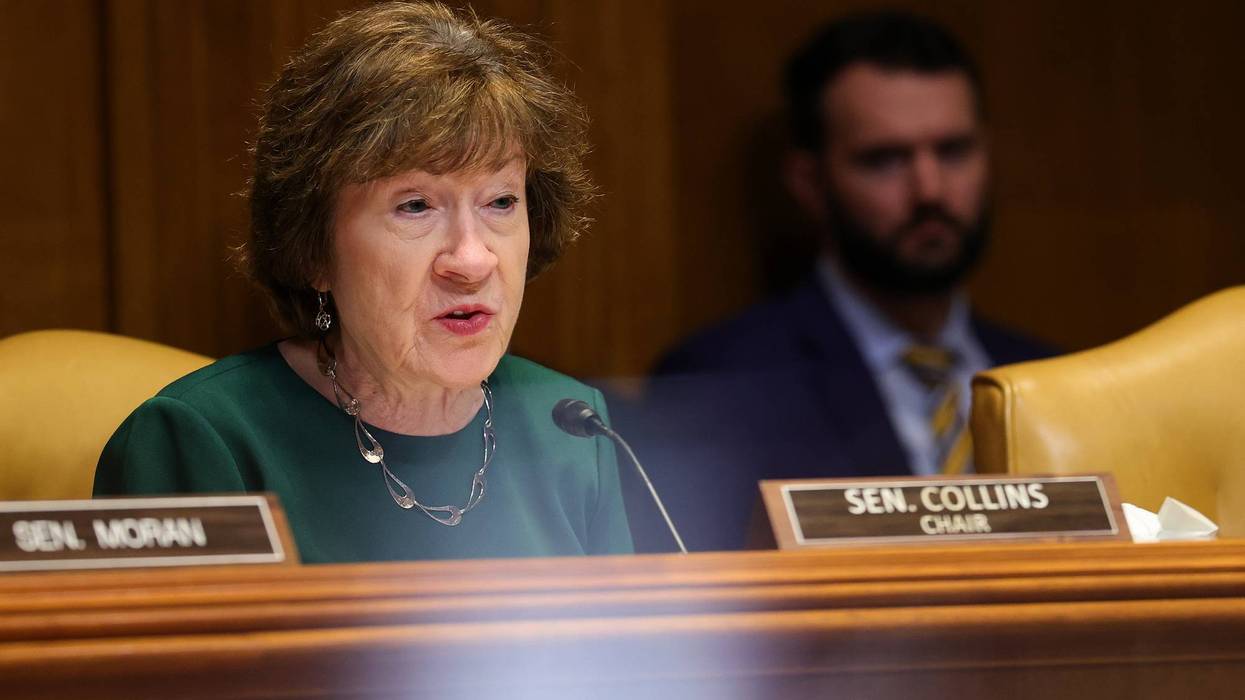
The Maine Democrat has said that "in the years since Roe was overturned, Susan Collins has done everything she can to skirt responsibility and avoid accountability—from skipping hearings to avoiding town halls at all costs."
After Maine's Republican Sen. Susan Collins told a reporter on Tuesday that she does not regret voting to confirm US Supreme Court Justice Brett Kavanaugh, despite the resulting reversal of Roe v. Wade, her Democratic challenger Graham Platner had a two-word response: "You should."
Noting that this is the five-term senator's first reelection campaign since the Dobbs v. Jackson Women’s Health Organization decision overturned Roe, a journalist from News Center Maine asked Collins whether she regrets voting for Kavanaugh—who was accused of sexual misconduct during the confirmation process.
"I do not regret that vote," Collins said of confirming the right-wing justice, while also claiming that "I do disagree with Justice Kavanaugh's vote" in the Dobbs case.
Collins then tried to pivot, highlighting her votes for liberal justices and saying that the Dobbs decision "has not had an impact on the state of Maine," without mentioning that Democrats control both chambers of the state Legislature and the governor's seat.
Also responding to the video of Collins on social media Tuesday, Lauren French of the Senate Majority PAC, a political action committee dedicated to electing a Democratic majority in the chamber, said: "Unsurprising. Collins' abysmal abortion record goes far beyond Kavanaugh and Roe."
"She voted to confirm at least 19 anti-abortion Cabinet nominees and 43 anti-abortion federal judges, including nominees who explicitly support fetal personhood and called birth control 'abortifacients,'" French highlighted. "And just days after the Dobbs draft leak, Collins cast the deciding vote against the Women's Health Protection Act—a bill that would have codified Roe into law."
Throughout his campaign, Platner has repeatedly called out Collins for backing Kavanaugh, who has sided with the high court's right-wing supermajority on a range of issues, from abortion to voting rights. After an April decision with massive implications for future elections, he said: "Don't piss on our boots and tell us it's raining: Under their bullshit legalese, the far-right Supreme Court gutted the Voting Rights Act today. Another disastrous decision brought to you by the court Susan Collins built, one terrible confirmation vote after another."
The following month, Platner took aim at the senator for not attending Senate Health, Education, Labor, and Pensions Committee hearings on reproductive healthcare, including abortion, post-Dobbs, declaring that "in the years since Roe was overturned, Susan Collins has done everything she can to skirt responsibility and avoid accountability—from skipping hearings to avoiding town halls at all costs."
"In November, Susan Collins will learn she can only run and hide from her damaging votes for so long. Because whether she knows it or not—her charade is over," added the oyster farmer and combat veteran, who has discussed his family's fertility struggles and the high costs of treatments during the campaign.
Platner's campaign has focused on not only how Collins has made life harder for Mainers and people across the country, but also his support for policies that would benefit the working class and challenge the oligarchs as well as the politicians they fund—including his Republican opponent, whose reelection bid has been backed by nearly 100 billionaires and their spouses.
As Common Dreams reported earlier Tuesday, amid a wave of new state-level restrictions after Dobbs, reproductive rights advocates have emphasized the economic impact of abortion bans—which, according to a new analysis by the Institute for Women's Policy Research, cost the US economy over $140 billion annually.
The Dobbs decisions and many others from the current court have fueled calls for change. Platner has argued that if his party reclaims control of Congress in the November midterms, there is a "compelling case" to impeach at least two justices—an apparent swipe at Clarence Thomas and Samuel Alito, right-wing ideologues who have faced ethics scandals in recent years.
Platner has further called for expanding the high court the next time Democrats control Congress and the White House—and stressed that in order to do so, "we need to elect people to the Senate who want to wield power like that, who understand that power matters, that it's real and you can use it."