SUBSCRIBE TO OUR FREE NEWSLETTER
Daily news & progressive opinion—funded by the people, not the corporations—delivered straight to your inbox.
5
#000000
#FFFFFF
To donate by check, phone, or other method, see our More Ways to Give page.
Daily news & progressive opinion—funded by the people, not the corporations—delivered straight to your inbox.
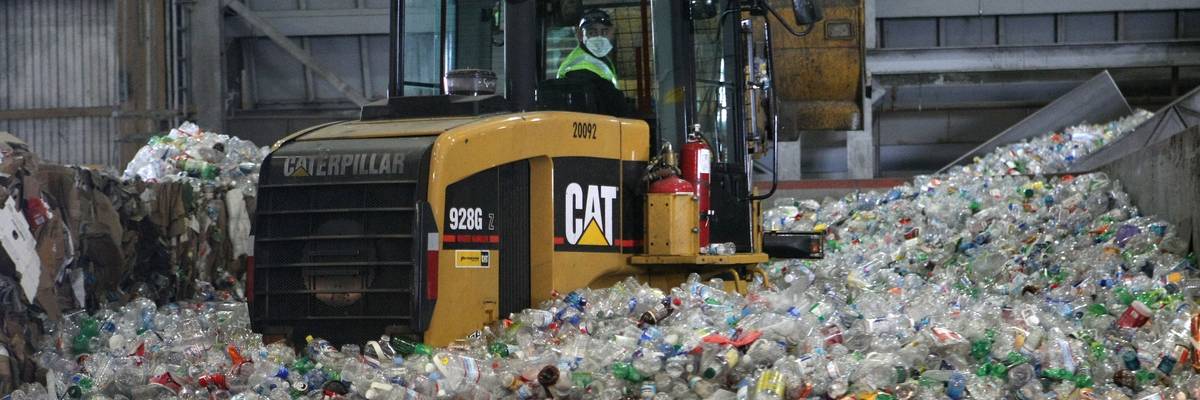
A tractor drives through a giant pile of plastic bottles at the San Francisco Recycling Center in San Francisco, California.
"These corporations and their partners continue to sell the public a comforting lie to hide the hard truth: that we simply have to stop producing so much plastic," said one campaigner.
A report published Wednesday by Greenpeace exposes the plastics industry as "merchants of myth" still peddling the false promise of recycling as a solution to the global pollution crisis, even as the vast bulk of commonly produced plastics remain unrecyclable.
"After decades of meager investments accompanied by misleading claims and a very well-funded industry public relations campaign aimed at persuading people that recycling can make plastic use sustainable, plastic recycling remains a failed enterprise that is economically and technically unviable and environmentally unjustifiable," the report begins.
"The latest US government data indicates that just 5% of US plastic waste is recycled annually, down from a high of 9.5% in 2014," the publication continues. "Meanwhile, the amount of single-use plastics produced every year continues to grow, driving the generation of ever greater amounts of plastic waste and pollution."
Among the report's findings:
"Recycling is a toxic lie pushed by the plastics industry that is now being propped up by a pro-plastic narrative emanating from the White House," Greenpeace USA oceans campaign director John Hocevar said in a statement. "These corporations and their partners continue to sell the public a comforting lie to hide the hard truth: that we simply have to stop producing so much plastic."
"Instead of investing in real solutions, they’ve poured billions into public relations campaigns that keep us hooked on single-use plastic while our communities, oceans, and bodies pay the price," he added.
Greenpeace is among the many climate and environmental groups supporting a global plastics treaty, an accord that remains elusive after six rounds of talks due to opposition from the United States, Saudi Arabia, and other nations that produce the petroleum products from which almost all plastics are made.
Honed from decades of funding and promoting dubious research aimed at casting doubts about the climate crisis caused by its products, the petrochemical industry has sent a small army of lobbyists to influence global treaty negotiations.
In addition to environmental and climate harms, plastics—whose chemicals often leach into the food and water people eat and drink—are linked to a wide range of health risks, including infertility, developmental issues, metabolic disorders, and certain cancers.
Plastics also break down into tiny particles found almost everywhere on Earth—including in human bodies—called microplastics, which cause ailments such as inflammation, immune dysfunction, and possibly cardiovascular disease and gut biome imbalance.
A study published earlier this year in the British medical journal The Lancet estimated that plastics are responsible for more than $1.5 trillion in health-related economic losses worldwide annually—impacts that disproportionately affect low-income and at-risk populations.
As Jo Banner, executive director of the Descendants Project—a Louisiana advocacy group dedicated to fighting environmental racism in frontline communities—said in response to the new Greenpeace report, "It’s the same story everywhere: poor, Black, Brown, and Indigenous communities turned into sacrifice zones so oil companies and big brands can keep making money."
"They call it development—but it’s exploitation, plain and simple," Banner added. "There’s nothing acceptable about poisoning our air, water, and food to sell more throwaway plastic. Our communities are not sacrifice zones, and we are not disposable people.”
Writing for Time this week, Judith Enck, a former regional administrator at the US Environmental Protection Agency and current president of the environmental justice group Beyond Plastics, said that "throwing your plastic bottles in the recycling bin may make you feel good about yourself, or ease your guilt about your climate impact. But recycling plastic will not address the plastic pollution crisis—and it is time we stop pretending as such."
"So what can we do?" Enck continued. "First, companies need to stop producing so much plastic and shift to reusable and refillable systems. If reducing packaging or using reusable packaging is not possible, companies should at least shift to paper, cardboard, glass, or metal."
"Companies are not going to do this on their own, which is why policymakers—the officials we elected to protect us—need to require them to do so," she added.
Although lawmakers in the 119th US Congress have introduced a handful of bills aimed at tackling plastic pollution, such proposals are all but sure to fail given Republican control of both the House of Representatives and Senate and the Trump administration's pro-petroleum policies.
Dear Common Dreams reader, It’s been nearly 30 years since I co-founded Common Dreams with my late wife, Lina Newhouser. We had the radical notion that journalism should serve the public good, not corporate profits. It was clear to us from the outset what it would take to build such a project. No paid advertisements. No corporate sponsors. No millionaire publisher telling us what to think or do. Many people said we wouldn't last a year, but we proved those doubters wrong. Together with a tremendous team of journalists and dedicated staff, we built an independent media outlet free from the constraints of profits and corporate control. Our mission has always been simple: To inform. To inspire. To ignite change for the common good. Building Common Dreams was not easy. Our survival was never guaranteed. When you take on the most powerful forces—Wall Street greed, fossil fuel industry destruction, Big Tech lobbyists, and uber-rich oligarchs who have spent billions upon billions rigging the economy and democracy in their favor—the only bulwark you have is supporters who believe in your work. But here’s the urgent message from me today. It's never been this bad out there. And it's never been this hard to keep us going. At the very moment Common Dreams is most needed, the threats we face are intensifying. We need your support now more than ever. We don't accept corporate advertising and never will. We don't have a paywall because we don't think people should be blocked from critical news based on their ability to pay. Everything we do is funded by the donations of readers like you. When everyone does the little they can afford, we are strong. But if that support retreats or dries up, so do we. Will you donate now to make sure Common Dreams not only survives but thrives? —Craig Brown, Co-founder |
A report published Wednesday by Greenpeace exposes the plastics industry as "merchants of myth" still peddling the false promise of recycling as a solution to the global pollution crisis, even as the vast bulk of commonly produced plastics remain unrecyclable.
"After decades of meager investments accompanied by misleading claims and a very well-funded industry public relations campaign aimed at persuading people that recycling can make plastic use sustainable, plastic recycling remains a failed enterprise that is economically and technically unviable and environmentally unjustifiable," the report begins.
"The latest US government data indicates that just 5% of US plastic waste is recycled annually, down from a high of 9.5% in 2014," the publication continues. "Meanwhile, the amount of single-use plastics produced every year continues to grow, driving the generation of ever greater amounts of plastic waste and pollution."
Among the report's findings:
"Recycling is a toxic lie pushed by the plastics industry that is now being propped up by a pro-plastic narrative emanating from the White House," Greenpeace USA oceans campaign director John Hocevar said in a statement. "These corporations and their partners continue to sell the public a comforting lie to hide the hard truth: that we simply have to stop producing so much plastic."
"Instead of investing in real solutions, they’ve poured billions into public relations campaigns that keep us hooked on single-use plastic while our communities, oceans, and bodies pay the price," he added.
Greenpeace is among the many climate and environmental groups supporting a global plastics treaty, an accord that remains elusive after six rounds of talks due to opposition from the United States, Saudi Arabia, and other nations that produce the petroleum products from which almost all plastics are made.
Honed from decades of funding and promoting dubious research aimed at casting doubts about the climate crisis caused by its products, the petrochemical industry has sent a small army of lobbyists to influence global treaty negotiations.
In addition to environmental and climate harms, plastics—whose chemicals often leach into the food and water people eat and drink—are linked to a wide range of health risks, including infertility, developmental issues, metabolic disorders, and certain cancers.
Plastics also break down into tiny particles found almost everywhere on Earth—including in human bodies—called microplastics, which cause ailments such as inflammation, immune dysfunction, and possibly cardiovascular disease and gut biome imbalance.
A study published earlier this year in the British medical journal The Lancet estimated that plastics are responsible for more than $1.5 trillion in health-related economic losses worldwide annually—impacts that disproportionately affect low-income and at-risk populations.
As Jo Banner, executive director of the Descendants Project—a Louisiana advocacy group dedicated to fighting environmental racism in frontline communities—said in response to the new Greenpeace report, "It’s the same story everywhere: poor, Black, Brown, and Indigenous communities turned into sacrifice zones so oil companies and big brands can keep making money."
"They call it development—but it’s exploitation, plain and simple," Banner added. "There’s nothing acceptable about poisoning our air, water, and food to sell more throwaway plastic. Our communities are not sacrifice zones, and we are not disposable people.”
Writing for Time this week, Judith Enck, a former regional administrator at the US Environmental Protection Agency and current president of the environmental justice group Beyond Plastics, said that "throwing your plastic bottles in the recycling bin may make you feel good about yourself, or ease your guilt about your climate impact. But recycling plastic will not address the plastic pollution crisis—and it is time we stop pretending as such."
"So what can we do?" Enck continued. "First, companies need to stop producing so much plastic and shift to reusable and refillable systems. If reducing packaging or using reusable packaging is not possible, companies should at least shift to paper, cardboard, glass, or metal."
"Companies are not going to do this on their own, which is why policymakers—the officials we elected to protect us—need to require them to do so," she added.
Although lawmakers in the 119th US Congress have introduced a handful of bills aimed at tackling plastic pollution, such proposals are all but sure to fail given Republican control of both the House of Representatives and Senate and the Trump administration's pro-petroleum policies.
A report published Wednesday by Greenpeace exposes the plastics industry as "merchants of myth" still peddling the false promise of recycling as a solution to the global pollution crisis, even as the vast bulk of commonly produced plastics remain unrecyclable.
"After decades of meager investments accompanied by misleading claims and a very well-funded industry public relations campaign aimed at persuading people that recycling can make plastic use sustainable, plastic recycling remains a failed enterprise that is economically and technically unviable and environmentally unjustifiable," the report begins.
"The latest US government data indicates that just 5% of US plastic waste is recycled annually, down from a high of 9.5% in 2014," the publication continues. "Meanwhile, the amount of single-use plastics produced every year continues to grow, driving the generation of ever greater amounts of plastic waste and pollution."
Among the report's findings:
"Recycling is a toxic lie pushed by the plastics industry that is now being propped up by a pro-plastic narrative emanating from the White House," Greenpeace USA oceans campaign director John Hocevar said in a statement. "These corporations and their partners continue to sell the public a comforting lie to hide the hard truth: that we simply have to stop producing so much plastic."
"Instead of investing in real solutions, they’ve poured billions into public relations campaigns that keep us hooked on single-use plastic while our communities, oceans, and bodies pay the price," he added.
Greenpeace is among the many climate and environmental groups supporting a global plastics treaty, an accord that remains elusive after six rounds of talks due to opposition from the United States, Saudi Arabia, and other nations that produce the petroleum products from which almost all plastics are made.
Honed from decades of funding and promoting dubious research aimed at casting doubts about the climate crisis caused by its products, the petrochemical industry has sent a small army of lobbyists to influence global treaty negotiations.
In addition to environmental and climate harms, plastics—whose chemicals often leach into the food and water people eat and drink—are linked to a wide range of health risks, including infertility, developmental issues, metabolic disorders, and certain cancers.
Plastics also break down into tiny particles found almost everywhere on Earth—including in human bodies—called microplastics, which cause ailments such as inflammation, immune dysfunction, and possibly cardiovascular disease and gut biome imbalance.
A study published earlier this year in the British medical journal The Lancet estimated that plastics are responsible for more than $1.5 trillion in health-related economic losses worldwide annually—impacts that disproportionately affect low-income and at-risk populations.
As Jo Banner, executive director of the Descendants Project—a Louisiana advocacy group dedicated to fighting environmental racism in frontline communities—said in response to the new Greenpeace report, "It’s the same story everywhere: poor, Black, Brown, and Indigenous communities turned into sacrifice zones so oil companies and big brands can keep making money."
"They call it development—but it’s exploitation, plain and simple," Banner added. "There’s nothing acceptable about poisoning our air, water, and food to sell more throwaway plastic. Our communities are not sacrifice zones, and we are not disposable people.”
Writing for Time this week, Judith Enck, a former regional administrator at the US Environmental Protection Agency and current president of the environmental justice group Beyond Plastics, said that "throwing your plastic bottles in the recycling bin may make you feel good about yourself, or ease your guilt about your climate impact. But recycling plastic will not address the plastic pollution crisis—and it is time we stop pretending as such."
"So what can we do?" Enck continued. "First, companies need to stop producing so much plastic and shift to reusable and refillable systems. If reducing packaging or using reusable packaging is not possible, companies should at least shift to paper, cardboard, glass, or metal."
"Companies are not going to do this on their own, which is why policymakers—the officials we elected to protect us—need to require them to do so," she added.
Although lawmakers in the 119th US Congress have introduced a handful of bills aimed at tackling plastic pollution, such proposals are all but sure to fail given Republican control of both the House of Representatives and Senate and the Trump administration's pro-petroleum policies.