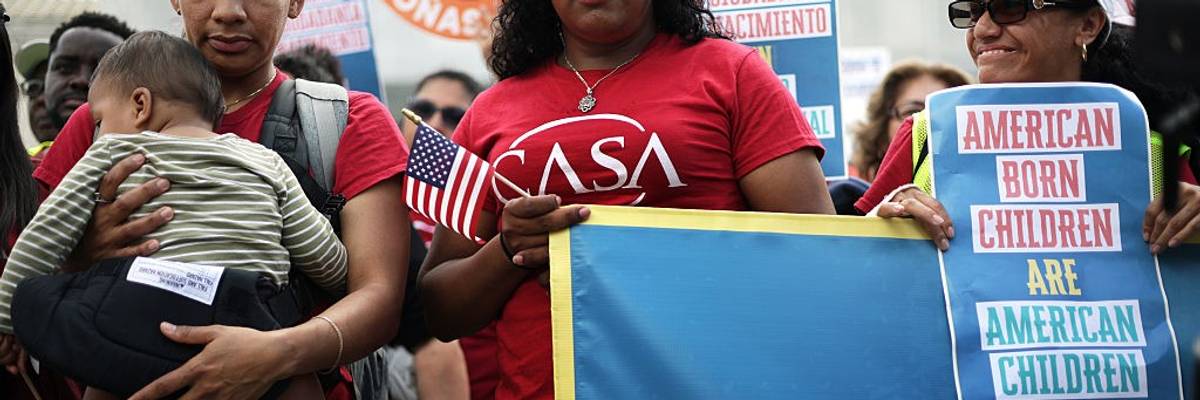
People take part in a May 14, 2025 protest defending birthright citizenship outside the US Supreme Court in Washington, DC.
Supreme Court Agrees to Hear Case That Could Bless Trump's Bid to End Birthright Citizenship
"That the Supreme Court is actually entertaining Trump’s unconstitutional attack on birthright citizenship is the clearest example yet that the Roberts Court is broken beyond repair," said one critic.
The United States Supreme Court on Friday agreed to decide whether US President Donald Trump's executive order ending birthright citizenship—as guaranteed under the 14th Amendment for more than 150 years—is constitutional.
Next spring, the justices will hear oral arguments in Trump's appeal of a lower court ruling that struck down parts of an executive order—titled Protecting the Meaning and Value of American Citizenship—signed on the first day of the president's second term. Under the directive, which has not taken effect due to legal challenges, people born in the United States would not be automatically entitled to US citizenship if their parents are in the country temporarily or without legal authorization.
Enacted in 1868, the 14th Amendment affirms that "all persons born or naturalized in the United States, and subject to the jurisdiction thereof, are citizens of the United States and of the state wherein they reside."
While the Trump administration argues that the 14th Amendment was adopted to grant US citizenship to freed slaves, not travelers or undocumented immigrants, two key Supreme Court cases have affirmed birthright citizenship under the Constitution—United States v. Wong Kim Ark (1898) and Afroyim v. Rusk (1967).
Here is the question presented. It's a relatively clean vehicle for the Supreme Court to finally decide whether it is lawful for the president to deny birthright citizenship to the children of immigrants. www.supremecourt.gov/DocketPDF/25...
[image or embed]
— Mark Joseph Stern (@mjsdc.bsky.social) December 5, 2025 at 10:55 AM
Several district court judges have issued universal preliminary injunctions to block Trump's order. However, the Supreme Court's right-wing supermajority found in June that “universal injunctions likely exceed the equitable authority that Congress has given to federal courts."
In July, a three-judge panel of the US Court of Appeals for the 9th Circuit unanimously ruled that executive order is an unconstitutional violation of the plain language of the 14th Amendment. In total, four federal courts and two appellate courts have blocked Trump's order.
“No president can change the 14th Amendment’s fundamental promise of citizenship,” Cecillia Wang, national legal director at the ACLU—which is leading the nationwide class action challenge to Trump's order—said in a statement Friday. “We look forward to putting this issue to rest once and for all in the Supreme Court this term.”
Brett Edkins, managing director of policy and political affairs at the advocacy group Stand Up America, was among those who suggested that the high court justices should have refused to hear the case given the long-settled precedent regarding the 14th Amendment.
“This case is a right-wing fantasy, full stop. That the Supreme Court is actually entertaining Trump’s unconstitutional attack on birthright citizenship is the clearest example yet that the Roberts Court is broken beyond repair," Edkins continued, referring to Chief Justice John Roberts.
"Even if the court ultimately rules against Trump, in a laughable display of its supposed independence, the fact that fringe attacks on our most basic rights as citizens are being seriously considered is outrageous and alarming," he added.
Aarti Kohli, executive director of the Asian Law Caucus, said that “it’s deeply troubling that we must waste precious judicial resources relitigating what has been settled constitutional law for over a century," adding that "every federal judge who has considered this executive order has found it unconstitutional."
Tianna Mays, legal director for Democracy Defenders Fund, asserted, “The attack on the fundamental right of birthright citizenship is an attack on the 14th Amendment and our Constitution."
"We are confident the court will affirm this basic right, which has stood for over a century," Mays added. "Millions of families across the country deserve and require that clarity and stability.”
We are at a crossroads
This country and this world are at a monumental crossroads. In a few short weeks, US voters will have an opportunity to beat back the forces of fascism and confront the billionaires who are rigging the economy, our media system, and our democracy, making it increasingly impossible for ordinary people to get by. We’re not just talking about the election. We’re talking about what must be done once these fascist elements are vanquished from power. We need a bolder set of solutions than what either major party has so far been willing to offer and a working-class movement ready to fight like hell for it. Trump didn't emerge from nowhere. The conditions that fueled MAGA authoritarianism were created by decades of radical neoliberal economic policies and a corrupt political system dominated by corporate interests. They slashed taxes on the super-rich, promising that the benefits would trickle down. They said giveaways to the corporate titans would make life more affordable for the rest of us. It was all bullshit. And when a bitter, betrayed populace searches for someone to blame, right-wing demagogues have little trouble finding scapegoats. People know when they're being lied to, but you won't hear any of this from the corporate media. Only independent journalism—powered and funded by people who believe in building a better world—can deliver truly trustworthy daily news. Our Fall Campaign is underway, and we need your help. To power our newsroom through the rest of the year, we need to raise $125,000 by midnight on October 31. So if you share our vision, please contribute whatever you can to sustain our work. |
The United States Supreme Court on Friday agreed to decide whether US President Donald Trump's executive order ending birthright citizenship—as guaranteed under the 14th Amendment for more than 150 years—is constitutional.
Next spring, the justices will hear oral arguments in Trump's appeal of a lower court ruling that struck down parts of an executive order—titled Protecting the Meaning and Value of American Citizenship—signed on the first day of the president's second term. Under the directive, which has not taken effect due to legal challenges, people born in the United States would not be automatically entitled to US citizenship if their parents are in the country temporarily or without legal authorization.
Enacted in 1868, the 14th Amendment affirms that "all persons born or naturalized in the United States, and subject to the jurisdiction thereof, are citizens of the United States and of the state wherein they reside."
While the Trump administration argues that the 14th Amendment was adopted to grant US citizenship to freed slaves, not travelers or undocumented immigrants, two key Supreme Court cases have affirmed birthright citizenship under the Constitution—United States v. Wong Kim Ark (1898) and Afroyim v. Rusk (1967).
Here is the question presented. It's a relatively clean vehicle for the Supreme Court to finally decide whether it is lawful for the president to deny birthright citizenship to the children of immigrants. www.supremecourt.gov/DocketPDF/25...
[image or embed]
— Mark Joseph Stern (@mjsdc.bsky.social) December 5, 2025 at 10:55 AM
Several district court judges have issued universal preliminary injunctions to block Trump's order. However, the Supreme Court's right-wing supermajority found in June that “universal injunctions likely exceed the equitable authority that Congress has given to federal courts."
In July, a three-judge panel of the US Court of Appeals for the 9th Circuit unanimously ruled that executive order is an unconstitutional violation of the plain language of the 14th Amendment. In total, four federal courts and two appellate courts have blocked Trump's order.
“No president can change the 14th Amendment’s fundamental promise of citizenship,” Cecillia Wang, national legal director at the ACLU—which is leading the nationwide class action challenge to Trump's order—said in a statement Friday. “We look forward to putting this issue to rest once and for all in the Supreme Court this term.”
Brett Edkins, managing director of policy and political affairs at the advocacy group Stand Up America, was among those who suggested that the high court justices should have refused to hear the case given the long-settled precedent regarding the 14th Amendment.
“This case is a right-wing fantasy, full stop. That the Supreme Court is actually entertaining Trump’s unconstitutional attack on birthright citizenship is the clearest example yet that the Roberts Court is broken beyond repair," Edkins continued, referring to Chief Justice John Roberts.
"Even if the court ultimately rules against Trump, in a laughable display of its supposed independence, the fact that fringe attacks on our most basic rights as citizens are being seriously considered is outrageous and alarming," he added.
Aarti Kohli, executive director of the Asian Law Caucus, said that “it’s deeply troubling that we must waste precious judicial resources relitigating what has been settled constitutional law for over a century," adding that "every federal judge who has considered this executive order has found it unconstitutional."
Tianna Mays, legal director for Democracy Defenders Fund, asserted, “The attack on the fundamental right of birthright citizenship is an attack on the 14th Amendment and our Constitution."
"We are confident the court will affirm this basic right, which has stood for over a century," Mays added. "Millions of families across the country deserve and require that clarity and stability.”
- With Its Birthright Non-Decision, the Supreme Court Chickened Out and Left a Mess Behind ›
- Third Court This Month Blocks Trump's 'Flagrantly Unconstitutional' Birthright Order ›
- As Supreme Court Hears Birthright Citizenship Case, Trump Ripped for Attack on Core Constitutional Right ›
- Opinion | Birthright Citizenship Is a Promise We Cannot Break | Common Dreams ›
- 'The Constitution Is Not a Suggestion': Supreme Court Told to Protect Birthright Citizenship | Common Dreams ›
- Supreme Court Observers See Trump Birthright Citizenship Order on Thin Ice After Skeptical Reception | Common Dreams ›
- Supreme Court Blocking Trump Birthright Citizen Attack a 'Real Relief,' But Also 'Bare Minimum' | Common Dreams ›
- Opinion | SCOTUS’ Ruling Spares Birthright Citizenship For Now, But the Battle Is Far From Over | Common Dreams ›
The United States Supreme Court on Friday agreed to decide whether US President Donald Trump's executive order ending birthright citizenship—as guaranteed under the 14th Amendment for more than 150 years—is constitutional.
Next spring, the justices will hear oral arguments in Trump's appeal of a lower court ruling that struck down parts of an executive order—titled Protecting the Meaning and Value of American Citizenship—signed on the first day of the president's second term. Under the directive, which has not taken effect due to legal challenges, people born in the United States would not be automatically entitled to US citizenship if their parents are in the country temporarily or without legal authorization.
Enacted in 1868, the 14th Amendment affirms that "all persons born or naturalized in the United States, and subject to the jurisdiction thereof, are citizens of the United States and of the state wherein they reside."
While the Trump administration argues that the 14th Amendment was adopted to grant US citizenship to freed slaves, not travelers or undocumented immigrants, two key Supreme Court cases have affirmed birthright citizenship under the Constitution—United States v. Wong Kim Ark (1898) and Afroyim v. Rusk (1967).
Here is the question presented. It's a relatively clean vehicle for the Supreme Court to finally decide whether it is lawful for the president to deny birthright citizenship to the children of immigrants. www.supremecourt.gov/DocketPDF/25...
[image or embed]
— Mark Joseph Stern (@mjsdc.bsky.social) December 5, 2025 at 10:55 AM
Several district court judges have issued universal preliminary injunctions to block Trump's order. However, the Supreme Court's right-wing supermajority found in June that “universal injunctions likely exceed the equitable authority that Congress has given to federal courts."
In July, a three-judge panel of the US Court of Appeals for the 9th Circuit unanimously ruled that executive order is an unconstitutional violation of the plain language of the 14th Amendment. In total, four federal courts and two appellate courts have blocked Trump's order.
“No president can change the 14th Amendment’s fundamental promise of citizenship,” Cecillia Wang, national legal director at the ACLU—which is leading the nationwide class action challenge to Trump's order—said in a statement Friday. “We look forward to putting this issue to rest once and for all in the Supreme Court this term.”
Brett Edkins, managing director of policy and political affairs at the advocacy group Stand Up America, was among those who suggested that the high court justices should have refused to hear the case given the long-settled precedent regarding the 14th Amendment.
“This case is a right-wing fantasy, full stop. That the Supreme Court is actually entertaining Trump’s unconstitutional attack on birthright citizenship is the clearest example yet that the Roberts Court is broken beyond repair," Edkins continued, referring to Chief Justice John Roberts.
"Even if the court ultimately rules against Trump, in a laughable display of its supposed independence, the fact that fringe attacks on our most basic rights as citizens are being seriously considered is outrageous and alarming," he added.
Aarti Kohli, executive director of the Asian Law Caucus, said that “it’s deeply troubling that we must waste precious judicial resources relitigating what has been settled constitutional law for over a century," adding that "every federal judge who has considered this executive order has found it unconstitutional."
Tianna Mays, legal director for Democracy Defenders Fund, asserted, “The attack on the fundamental right of birthright citizenship is an attack on the 14th Amendment and our Constitution."
"We are confident the court will affirm this basic right, which has stood for over a century," Mays added. "Millions of families across the country deserve and require that clarity and stability.”
- With Its Birthright Non-Decision, the Supreme Court Chickened Out and Left a Mess Behind ›
- Third Court This Month Blocks Trump's 'Flagrantly Unconstitutional' Birthright Order ›
- As Supreme Court Hears Birthright Citizenship Case, Trump Ripped for Attack on Core Constitutional Right ›
- Opinion | Birthright Citizenship Is a Promise We Cannot Break | Common Dreams ›
- 'The Constitution Is Not a Suggestion': Supreme Court Told to Protect Birthright Citizenship | Common Dreams ›
- Supreme Court Observers See Trump Birthright Citizenship Order on Thin Ice After Skeptical Reception | Common Dreams ›
- Supreme Court Blocking Trump Birthright Citizen Attack a 'Real Relief,' But Also 'Bare Minimum' | Common Dreams ›
- Opinion | SCOTUS’ Ruling Spares Birthright Citizenship For Now, But the Battle Is Far From Over | Common Dreams ›