SUBSCRIBE TO OUR FREE NEWSLETTER
Daily news & progressive opinion—funded by the people, not the corporations—delivered straight to your inbox.
5
#000000
#FFFFFF
To donate by check, phone, or other method, see our More Ways to Give page.
Daily news & progressive opinion—funded by the people, not the corporations—delivered straight to your inbox.
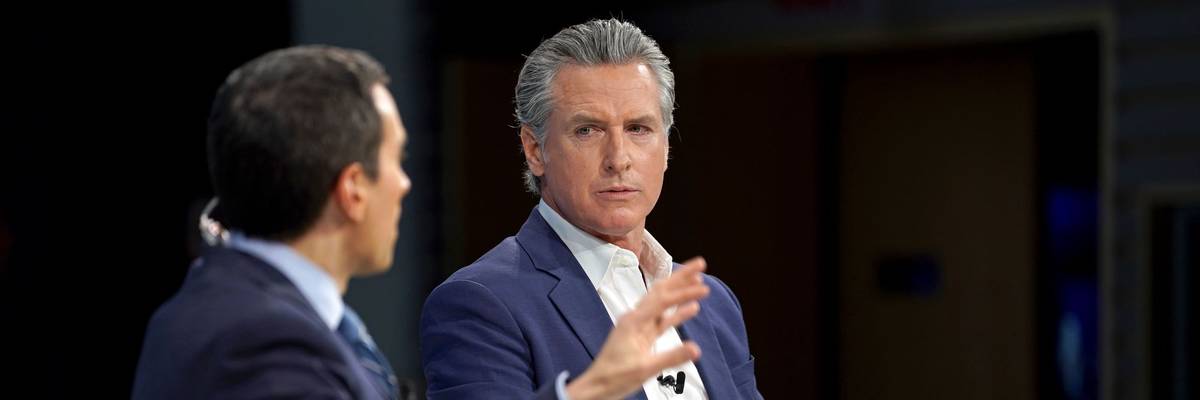
Andrew Ross Sorkin and California Gov. Gavin Newsom speak onstage during the New York Times DealBook Summit 2025 at Jazz at Lincoln Center on December 3, 2025, in New York City.
"A wealth tax is a big tent policy unless the only people you care about are billionaires," said one progressive organizer.
California Gov. Gavin Newsom, considered by some to be the frontrunner to be the next Democratic presidential nominee, said during a panel on Wednesday that he wants his party to be a “big tent” that welcomes large numbers of people into the fold. But he’s “adamantly against” one of the most popular proposals Democrats have to offer: a wealth tax.
In October, progressive economists Emmanuel Saez and Robert Reich joined forces with one of California's most powerful unions, the Service Employees International Union's (SEIU) United Healthcare Workers West, to propose that California put the nation’s first-ever wealth tax on the ballot in November 2026.
They described the measure as an "emergency billionaires tax" aimed at recouping the tens of billions of dollars that will be stripped from California's 15 million Medicaid recipients over the next five years, after Republicans enacted historic cuts to the program in July with President Donald Trump's One Big Beautiful Bill Act, which dramatically reduced taxes for the wealthiest Americans.
Among those beneficiaries were the approximately 200 billionaires living in California, whose average annual income, Saez pointed out, has risen by 7.5% per year, compared with 1.5% for median-income residents.
Under the proposal, they would pay a one-time 5% tax on their total net worth, which is estimated to raise $100 billion. The vast majority of the funds, about 90%, would be used to restore Medicaid funding, while the rest would go towards funding K-12 education, which the GOP has also slashed.
The proposal in California has strong support from unions and healthcare groups. But Newsom has called it “bad policy” and “another attempt to grab money for special purposes.”
Meanwhile, several of his longtime consultants, including Dan Newman and Brian Brokaw, have launched a campaign alongside “business and tech leaders” to kill the measure, which they’ve dubbed “Stop the Squeeze." They've issued familiar warnings that pinching the wealthy too hard will drive them from the state, along with the critical tax base they provide.
At Wednesday's New York Times DealBook Summit, Andrew Ross Sorkin asked Newsom about his opposition to the wealth tax idea, comparing it to a proposal by recent New York City Mayor-elect Zohran Mamdani, who pledged to increase the income taxes of New Yorkers who earn more than $1 million per year by 2% in order to fund his city-wide free buses, universal childcare, and city-owned grocery store programs.
Mamdani's proposal was met with a litany of similar warnings from Big Apple bigwigs who threatened to flee the city and others around the country who said they'd never move in.
But as Robin Kaiser-Schatzlein explained in October for the American Prospect: "The evidence for this is thin: mostly memes shared by tech and finance people... Research shows that the truth of the matter is closer to the opposite. Wealthy individuals and their income move at lower rates than other income brackets, even in response to an increase of personal income tax." Many of those who sulked about Mamdani's victory have notably begun making amends with the incoming mayor.
Moreover, the comparison between Mamdani's plan and the one proposed in California is faulty to begin with. As Harold Meyerson explained, also for the Prospect: "It is a one-time-only tax, to be levied exclusively on billionaires’ current (i.e., 2025) net worth. Even if they move to Tasmania, they will still be liable for 5% of this year’s net worth."
"Crucially, the tax won’t crimp the fortunes of any billionaire who moves into the state next year or any later year, as it only applies to the billionaires living in the state this year," he added. "Therefore... the horrific specter of billionaire flight can’t be levied against the California proposal."
Nevertheless, Sorkin framed Newsom as being in an existential battle of ideas with Mamdani, asking how the two could both represent the Democratic Party when they are so "diametrically opposed."
"Well, I want to be a big-tent party," Newsom replied. "It's about addition, not subtraction."
Pushed on the question of whether there should be a "unifying theory of the case," Newsom responded that “we all want to be protected, we all want to be respected, we all want to be connected to something bigger than ourselves. We have fundamental values that I think define our party, about social justice, economic justice.”
"We have pre-distribution Democrats, and we have re-distribution Democrats," he continued. "Therein lies the dialectic and therein lies the debate."
Polling is scarce so far on the likelihood of such a measure passing in California. But nationally, polls suggest that the vast majority of Democrats fall on the "re-distribution" side of Newsom's "dialectic." In fact, the majority of all Americans do, regardless of party affiliation.
Last year, Inequality.org examined 55 national and state polls about a number of different taxation policies and found:
A billionaire income tax garnered the most support across party identification. On average, two out of three (67%) of Americans supported the tax including 84% of Democrats, 64% of Independents, and 51% of Republicans.
In national polls, a wealth tax had similarly high levels of support. More than three out of five Americans supported the tax including 78% of Democrats, 62% of Independents, and 51% of Republicans.
That sentiment only seems to have grown since the return of President Donald Trump. An Economist/YouGov poll released in early November found that 72% of Americans said that taxes on billionaires should be raised—including 95% of Democrats, 75% of independents, and 48% of Republicans. Across the board, just 15% said they should not be raised.
Support remains high when the proposal is more specific as well. On the eve of Mamdani's election, despitre months of fearmongering, 64% of New Yorkers said they backed his proposal, including a slight plurality of self-identified conservatives, according to a Siena College poll.
Many observers were perplexed by how Newsom proposes to maintain a “big tent” while opposing policies supported by most of the people inside it.
"A wealth tax is a big tent policy unless the only people you care about are billionaires," wrote Jonathan Cohn, the political director for Progressive Mass, a grassroots organization in Massachusetts, on social media.
"Gavin Newsom—estimated net worth between $20 and $30 million—says he's opposed to a billionaire wealth tax. Color me shocked," wrote the Columbia University lecturer Anthony Zenkus. "Democrats holding him up as a potential savior for 2028 is a clear example of not reading the room."
Dear Common Dreams reader, It’s been nearly 30 years since I co-founded Common Dreams with my late wife, Lina Newhouser. We had the radical notion that journalism should serve the public good, not corporate profits. It was clear to us from the outset what it would take to build such a project. No paid advertisements. No corporate sponsors. No millionaire publisher telling us what to think or do. Many people said we wouldn't last a year, but we proved those doubters wrong. Together with a tremendous team of journalists and dedicated staff, we built an independent media outlet free from the constraints of profits and corporate control. Our mission has always been simple: To inform. To inspire. To ignite change for the common good. Building Common Dreams was not easy. Our survival was never guaranteed. When you take on the most powerful forces—Wall Street greed, fossil fuel industry destruction, Big Tech lobbyists, and uber-rich oligarchs who have spent billions upon billions rigging the economy and democracy in their favor—the only bulwark you have is supporters who believe in your work. But here’s the urgent message from me today. It's never been this bad out there. And it's never been this hard to keep us going. At the very moment Common Dreams is most needed, the threats we face are intensifying. We need your support now more than ever. We don't accept corporate advertising and never will. We don't have a paywall because we don't think people should be blocked from critical news based on their ability to pay. Everything we do is funded by the donations of readers like you. When everyone does the little they can afford, we are strong. But if that support retreats or dries up, so do we. Will you donate now to make sure Common Dreams not only survives but thrives? —Craig Brown, Co-founder |
California Gov. Gavin Newsom, considered by some to be the frontrunner to be the next Democratic presidential nominee, said during a panel on Wednesday that he wants his party to be a “big tent” that welcomes large numbers of people into the fold. But he’s “adamantly against” one of the most popular proposals Democrats have to offer: a wealth tax.
In October, progressive economists Emmanuel Saez and Robert Reich joined forces with one of California's most powerful unions, the Service Employees International Union's (SEIU) United Healthcare Workers West, to propose that California put the nation’s first-ever wealth tax on the ballot in November 2026.
They described the measure as an "emergency billionaires tax" aimed at recouping the tens of billions of dollars that will be stripped from California's 15 million Medicaid recipients over the next five years, after Republicans enacted historic cuts to the program in July with President Donald Trump's One Big Beautiful Bill Act, which dramatically reduced taxes for the wealthiest Americans.
Among those beneficiaries were the approximately 200 billionaires living in California, whose average annual income, Saez pointed out, has risen by 7.5% per year, compared with 1.5% for median-income residents.
Under the proposal, they would pay a one-time 5% tax on their total net worth, which is estimated to raise $100 billion. The vast majority of the funds, about 90%, would be used to restore Medicaid funding, while the rest would go towards funding K-12 education, which the GOP has also slashed.
The proposal in California has strong support from unions and healthcare groups. But Newsom has called it “bad policy” and “another attempt to grab money for special purposes.”
Meanwhile, several of his longtime consultants, including Dan Newman and Brian Brokaw, have launched a campaign alongside “business and tech leaders” to kill the measure, which they’ve dubbed “Stop the Squeeze." They've issued familiar warnings that pinching the wealthy too hard will drive them from the state, along with the critical tax base they provide.
At Wednesday's New York Times DealBook Summit, Andrew Ross Sorkin asked Newsom about his opposition to the wealth tax idea, comparing it to a proposal by recent New York City Mayor-elect Zohran Mamdani, who pledged to increase the income taxes of New Yorkers who earn more than $1 million per year by 2% in order to fund his city-wide free buses, universal childcare, and city-owned grocery store programs.
Mamdani's proposal was met with a litany of similar warnings from Big Apple bigwigs who threatened to flee the city and others around the country who said they'd never move in.
But as Robin Kaiser-Schatzlein explained in October for the American Prospect: "The evidence for this is thin: mostly memes shared by tech and finance people... Research shows that the truth of the matter is closer to the opposite. Wealthy individuals and their income move at lower rates than other income brackets, even in response to an increase of personal income tax." Many of those who sulked about Mamdani's victory have notably begun making amends with the incoming mayor.
Moreover, the comparison between Mamdani's plan and the one proposed in California is faulty to begin with. As Harold Meyerson explained, also for the Prospect: "It is a one-time-only tax, to be levied exclusively on billionaires’ current (i.e., 2025) net worth. Even if they move to Tasmania, they will still be liable for 5% of this year’s net worth."
"Crucially, the tax won’t crimp the fortunes of any billionaire who moves into the state next year or any later year, as it only applies to the billionaires living in the state this year," he added. "Therefore... the horrific specter of billionaire flight can’t be levied against the California proposal."
Nevertheless, Sorkin framed Newsom as being in an existential battle of ideas with Mamdani, asking how the two could both represent the Democratic Party when they are so "diametrically opposed."
"Well, I want to be a big-tent party," Newsom replied. "It's about addition, not subtraction."
Pushed on the question of whether there should be a "unifying theory of the case," Newsom responded that “we all want to be protected, we all want to be respected, we all want to be connected to something bigger than ourselves. We have fundamental values that I think define our party, about social justice, economic justice.”
"We have pre-distribution Democrats, and we have re-distribution Democrats," he continued. "Therein lies the dialectic and therein lies the debate."
Polling is scarce so far on the likelihood of such a measure passing in California. But nationally, polls suggest that the vast majority of Democrats fall on the "re-distribution" side of Newsom's "dialectic." In fact, the majority of all Americans do, regardless of party affiliation.
Last year, Inequality.org examined 55 national and state polls about a number of different taxation policies and found:
A billionaire income tax garnered the most support across party identification. On average, two out of three (67%) of Americans supported the tax including 84% of Democrats, 64% of Independents, and 51% of Republicans.
In national polls, a wealth tax had similarly high levels of support. More than three out of five Americans supported the tax including 78% of Democrats, 62% of Independents, and 51% of Republicans.
That sentiment only seems to have grown since the return of President Donald Trump. An Economist/YouGov poll released in early November found that 72% of Americans said that taxes on billionaires should be raised—including 95% of Democrats, 75% of independents, and 48% of Republicans. Across the board, just 15% said they should not be raised.
Support remains high when the proposal is more specific as well. On the eve of Mamdani's election, despitre months of fearmongering, 64% of New Yorkers said they backed his proposal, including a slight plurality of self-identified conservatives, according to a Siena College poll.
Many observers were perplexed by how Newsom proposes to maintain a “big tent” while opposing policies supported by most of the people inside it.
"A wealth tax is a big tent policy unless the only people you care about are billionaires," wrote Jonathan Cohn, the political director for Progressive Mass, a grassroots organization in Massachusetts, on social media.
"Gavin Newsom—estimated net worth between $20 and $30 million—says he's opposed to a billionaire wealth tax. Color me shocked," wrote the Columbia University lecturer Anthony Zenkus. "Democrats holding him up as a potential savior for 2028 is a clear example of not reading the room."
California Gov. Gavin Newsom, considered by some to be the frontrunner to be the next Democratic presidential nominee, said during a panel on Wednesday that he wants his party to be a “big tent” that welcomes large numbers of people into the fold. But he’s “adamantly against” one of the most popular proposals Democrats have to offer: a wealth tax.
In October, progressive economists Emmanuel Saez and Robert Reich joined forces with one of California's most powerful unions, the Service Employees International Union's (SEIU) United Healthcare Workers West, to propose that California put the nation’s first-ever wealth tax on the ballot in November 2026.
They described the measure as an "emergency billionaires tax" aimed at recouping the tens of billions of dollars that will be stripped from California's 15 million Medicaid recipients over the next five years, after Republicans enacted historic cuts to the program in July with President Donald Trump's One Big Beautiful Bill Act, which dramatically reduced taxes for the wealthiest Americans.
Among those beneficiaries were the approximately 200 billionaires living in California, whose average annual income, Saez pointed out, has risen by 7.5% per year, compared with 1.5% for median-income residents.
Under the proposal, they would pay a one-time 5% tax on their total net worth, which is estimated to raise $100 billion. The vast majority of the funds, about 90%, would be used to restore Medicaid funding, while the rest would go towards funding K-12 education, which the GOP has also slashed.
The proposal in California has strong support from unions and healthcare groups. But Newsom has called it “bad policy” and “another attempt to grab money for special purposes.”
Meanwhile, several of his longtime consultants, including Dan Newman and Brian Brokaw, have launched a campaign alongside “business and tech leaders” to kill the measure, which they’ve dubbed “Stop the Squeeze." They've issued familiar warnings that pinching the wealthy too hard will drive them from the state, along with the critical tax base they provide.
At Wednesday's New York Times DealBook Summit, Andrew Ross Sorkin asked Newsom about his opposition to the wealth tax idea, comparing it to a proposal by recent New York City Mayor-elect Zohran Mamdani, who pledged to increase the income taxes of New Yorkers who earn more than $1 million per year by 2% in order to fund his city-wide free buses, universal childcare, and city-owned grocery store programs.
Mamdani's proposal was met with a litany of similar warnings from Big Apple bigwigs who threatened to flee the city and others around the country who said they'd never move in.
But as Robin Kaiser-Schatzlein explained in October for the American Prospect: "The evidence for this is thin: mostly memes shared by tech and finance people... Research shows that the truth of the matter is closer to the opposite. Wealthy individuals and their income move at lower rates than other income brackets, even in response to an increase of personal income tax." Many of those who sulked about Mamdani's victory have notably begun making amends with the incoming mayor.
Moreover, the comparison between Mamdani's plan and the one proposed in California is faulty to begin with. As Harold Meyerson explained, also for the Prospect: "It is a one-time-only tax, to be levied exclusively on billionaires’ current (i.e., 2025) net worth. Even if they move to Tasmania, they will still be liable for 5% of this year’s net worth."
"Crucially, the tax won’t crimp the fortunes of any billionaire who moves into the state next year or any later year, as it only applies to the billionaires living in the state this year," he added. "Therefore... the horrific specter of billionaire flight can’t be levied against the California proposal."
Nevertheless, Sorkin framed Newsom as being in an existential battle of ideas with Mamdani, asking how the two could both represent the Democratic Party when they are so "diametrically opposed."
"Well, I want to be a big-tent party," Newsom replied. "It's about addition, not subtraction."
Pushed on the question of whether there should be a "unifying theory of the case," Newsom responded that “we all want to be protected, we all want to be respected, we all want to be connected to something bigger than ourselves. We have fundamental values that I think define our party, about social justice, economic justice.”
"We have pre-distribution Democrats, and we have re-distribution Democrats," he continued. "Therein lies the dialectic and therein lies the debate."
Polling is scarce so far on the likelihood of such a measure passing in California. But nationally, polls suggest that the vast majority of Democrats fall on the "re-distribution" side of Newsom's "dialectic." In fact, the majority of all Americans do, regardless of party affiliation.
Last year, Inequality.org examined 55 national and state polls about a number of different taxation policies and found:
A billionaire income tax garnered the most support across party identification. On average, two out of three (67%) of Americans supported the tax including 84% of Democrats, 64% of Independents, and 51% of Republicans.
In national polls, a wealth tax had similarly high levels of support. More than three out of five Americans supported the tax including 78% of Democrats, 62% of Independents, and 51% of Republicans.
That sentiment only seems to have grown since the return of President Donald Trump. An Economist/YouGov poll released in early November found that 72% of Americans said that taxes on billionaires should be raised—including 95% of Democrats, 75% of independents, and 48% of Republicans. Across the board, just 15% said they should not be raised.
Support remains high when the proposal is more specific as well. On the eve of Mamdani's election, despitre months of fearmongering, 64% of New Yorkers said they backed his proposal, including a slight plurality of self-identified conservatives, according to a Siena College poll.
Many observers were perplexed by how Newsom proposes to maintain a “big tent” while opposing policies supported by most of the people inside it.
"A wealth tax is a big tent policy unless the only people you care about are billionaires," wrote Jonathan Cohn, the political director for Progressive Mass, a grassroots organization in Massachusetts, on social media.
"Gavin Newsom—estimated net worth between $20 and $30 million—says he's opposed to a billionaire wealth tax. Color me shocked," wrote the Columbia University lecturer Anthony Zenkus. "Democrats holding him up as a potential savior for 2028 is a clear example of not reading the room."