

SUBSCRIBE TO OUR FREE NEWSLETTER
Daily news & progressive opinion—funded by the people, not the corporations—delivered straight to your inbox.
5
#000000
#FFFFFF
To donate by check, phone, or other method, see our More Ways to Give page.
Daily news & progressive opinion—funded by the people, not the corporations—delivered straight to your inbox.
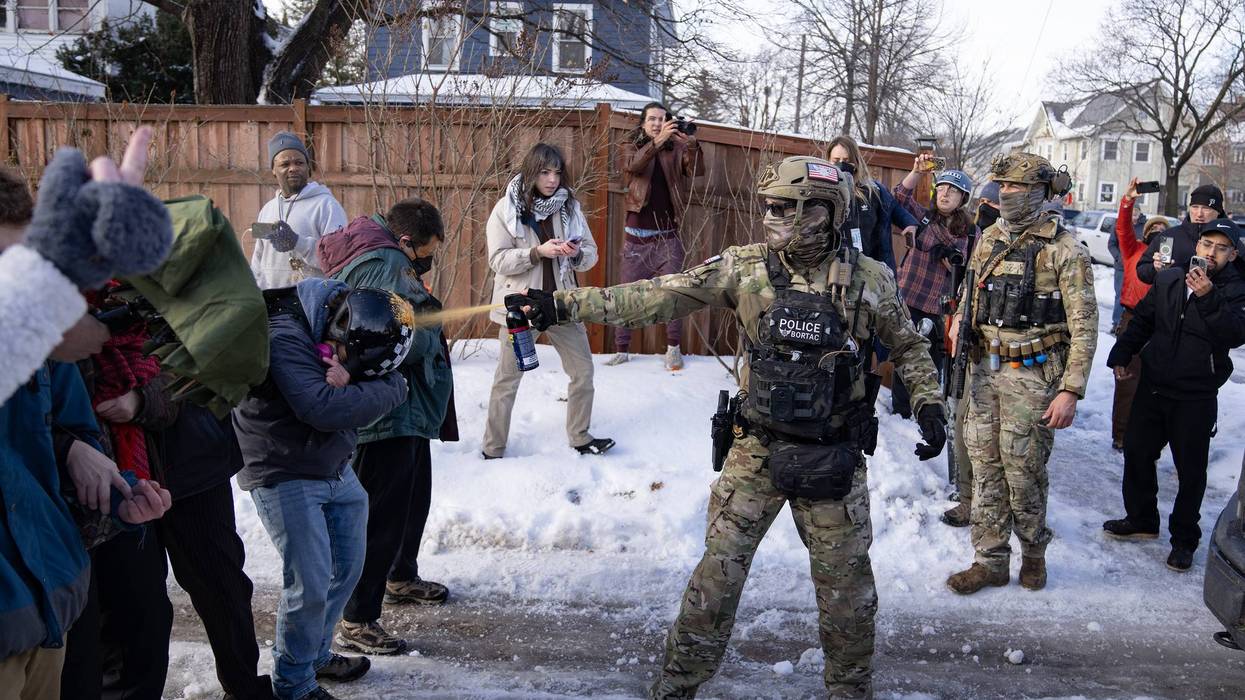
These overlooked offices control the budgets, databases, and cooperation that make the terror possible—or impossible.
Trump and Noem’s strategy of deploying federal agents to punish our cities is backfiring.
Here’s why: Local elected officials have enormous power to resist federal immigration enforcement. Sheriffs can refuse ICE detainer requests. City councils can pass sanctuary policies. County commissioners control jail access. State legislators can restrict cooperation with federal agents and protect residents' civil rights.
But this is only possible if those offices are filled with people who will fight back.
If you are looking at your leaders and wondering why they aren’t taking a stand against these human rights violations, this is where you can and must step in.
In 2026, thousands of local seats are up for election across the country. Sheriff. County commissioner. City council. State representative. School board. These are the frontline defense against Trump's overreach, and unfortunately, the violence being inflicted on communities across the country.
The reality is brutal to face but can’t be ignored: Alex Pretti is at least the sixth person to die during ICE’s nationwide reign of terror since last year, with at least five shootings in January alone involving federal agents. This will keep happening in communities where there's no local resistance.
People are done staying silent, and we can’t let up the pressure. Since Alex's murder, nurses across the country have organized vigils and acts of resistance. Minnesota Governor Tim Walz has demanded that all ICE and Border Patrol agents leave the state. Protests are growing, not shrinking. I'm seeing people who've “never been political before” suddenly asking what they can do to help.
My answer is always to run for office or recruit someone who will. Some of us must step up to build long-term power that defends our communities, while others hold down the immediate fight on the front lines.
We have three more years of MAGA-proofing to do. The organization I started, NDTC, is already investing in building up the resistance down ballot – at no cost to campaigns. Since Trump took office again in January 2025, over 970 campaigns chose us to lead them to victory. This weekend in Texas, NDTC-learner Menefee won his House seat and shrunk the GOP majority to one vote.
We are already filling crucial roles in school boards, councils, and legislatures – we need thousands more to mount a real challenge. No race should go unchallenged.
So one path forward is clear:
Filing deadlines for the 2026 elections are approaching fast in many states. In most places, it's not too late to get on the ballot this year. But you need to move now.
Trump and his administration want us to be afraid. They want us to believe resistance is futile. They want us to stay home. We're not going to do that.
I have supported thousands of campaigns over my career, training more than 120,000 candidates, staffers, and volunteers in the last ten years through the organization I founded. Together, we’ve won in red districts, swing districts, and everything in between. We’ve seen people less qualified than you do it. The fact that you’ve read this far proves that you have a spark. Answer the call, and let us teach you how to win.
The MAGA plan is to exhaust us by flooding the zone with muzzle velocity. They are betting on us giving up. We’ve already mobilized thousands to prove them catastrophically wrong; we need you to be next.
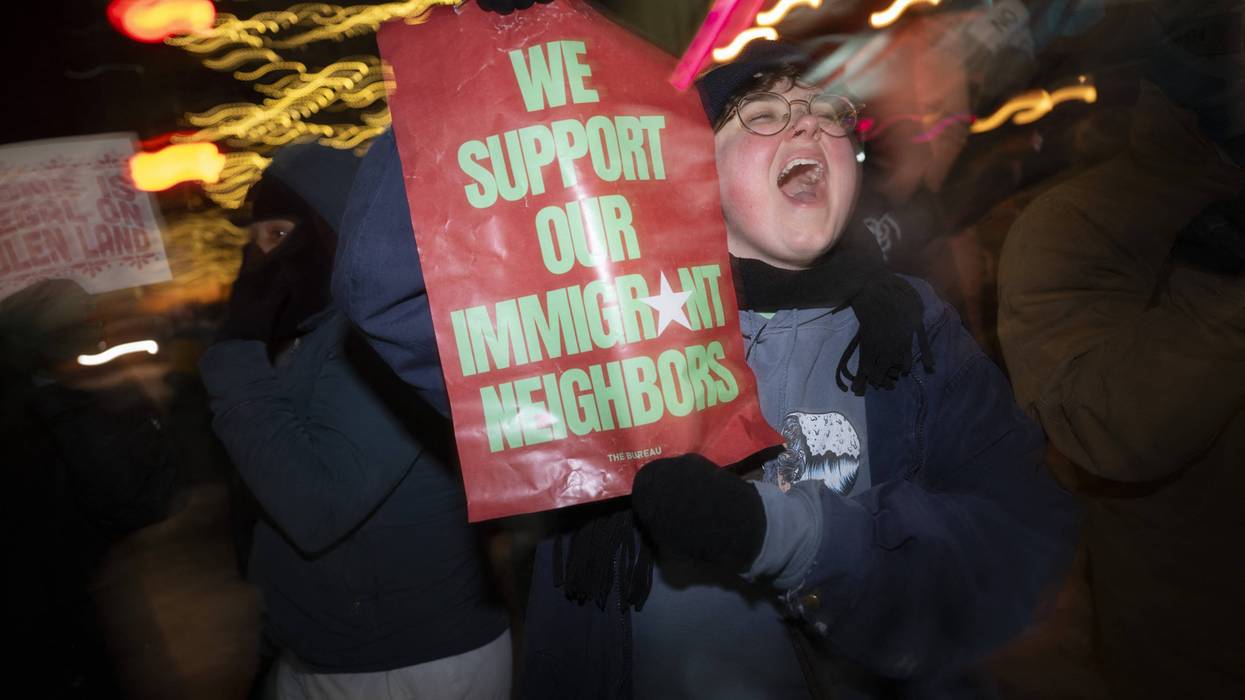
Not only is the president's policy cruel and inhumane, it’s also not what the American people, including the white working-class, want.
Ever since Trump rode down the escalator in 2016 attacking immigrants as drug smugglers and rapists, immigration has been his signature issue, often putting the Democrats on the defensive.
During his first term, however, his cruel policies of separating families at the border and his BS about Mexico paying for the wall contributed to his defeat in 2020. But the Biden administration had no answer for the flood of immigrants who then crossed the border, which Trump used as a cudgel during the 2024 campaign. Once again the issue was Trump’s and in his second term he’s decided to play hardball by, in effect, totally shutting down the border and deporting record numbers of immigrants.
And it was working. While his handling of the economy tanked his poll numbers, immigration enforcement remained strong, until Minneapolis.
There, he overplayed his hand and did not stick to his argument to deport undocumented felons. Instead, he allowed the psychotic Steven Miller to round up undocumented immigrants, non-felons and felons alike, with even some darker-skinned citizens (literally) tossed into the ICE detention centers.
Not only is this a cruel and inhumane policy, but it’s also not what the American people, including the white working-class, want.
For different reasons Trump and the Democrats seem oblivious to the fact that nearly two-thirds of the American people support “granting legal status to all illegal immigrants who have held jobs and paid taxes for at least 3 years and committed no felony crimes.”
Trump doesn’t give a damn about these hard-working immigrants. He’s quite happy to support the MAGA “replacement theory” that calls for the protection of a white America from people of color. For Democrats, a pathway to citizenship is too hot to handle, making them look as if they support “illegals,” even if these undocumented immigrants are not felons. They fear Trump’s cudgel and ignore what the American people want.
According to our YouGov survey of 3,000 voters in Michigan, Ohio, Pennsylvania, and Wisconsin, 63 percent support the “granting legal status” statement and only 37 percent oppose it.
In urban areas in these four states the support is massive:
Looking at urban and non-urban areas combined, 36 percent of those who voted for Trump in 2024 supported this path to citizenship. And 81 percent of Hispanic voters supported it.
We also have 2020 data on the support of the white working class throughout the country, which shows that 62 percent supported this same exact “granting legal status” statement, up from 32 percent in 2010.
It’s as if Trump and the Democrats are stuck in 2010 and don’t realize that the working-class has great sympathy for hard working undocumented immigrants, especially in urban areas where day-day contact is greatest. That’s where nearly everyone comes into contact with immigrants who do so much of the hard labor that makes our economy function. Just 20 metro areas account for 60 percent of all undocumented immigrants.
It is politically explosive to send thousands of ICE and border agents into urban areas to randomly round up undocumented workers. Unless you are trying to foment an urban rebellion so you can send in troops to crush it in the name of law and order and cancel the midterms.
The Trump administration has deported each month approximately 1,100 undocumented immigrants with prior violent convictions, according the New York Times. I have no doubt that many Americans support their deportation if it is done in a reasonable way. But at the same time Miller’s shock troops have deported 2,100 immigrants with no criminal records per month. Per month!
That’s what happens when thousands of heavily armed mask-wearing troops invade an urban area, stopping people on the street and raiding houses of worship, businesses, and hospitals without court-approved search warrants. That’s not how you catch felons, that’s how you round up undocumented non-felons. That’s how you get away with stopping people based solely on their skin tone, not on any investigative information about criminal activity. And it shouldn’t be surprising that that’s not OK with much of the American people, something Trump slowly is realizing.
You couldn’t ask for a better political moment given that Miller’s goons have killed two protesters in the last two weeks. This would be the perfect time to demand that ICE be prohibited from conducting any and all random stops throughout the country, and refrain from arresting any undocumented immigrants who have not committed a felony crime. And this is the time to call for a clear path to citizenship for hard working, non-felonious, undocumented workers.
Undocumented workers need political champions, those with enough guts to call for an end to the dual labor market system in which undocumented workers live and work in the shadows and are exploited again and again. That’s not grandstanding. That’s setting a principled agenda for justice and fairness...
But there’s little indication that the Democratic Party is willing to go there. The political calculous is obvious: let Trump overplay his hand and hope the anger against him crests into a massive blue wave flooding the midterms. Why risk supporting a path to citizenship, which only will be thrown back at the Democrats declaring they are weak-kneed on immigration? Stopping Trump, the thinking goes, is more important than grandstanding about paths to citizenship given that the Democrats don’t have the votes to deliver. And besides, undocumented workers can’t vote, angry protestors can and will.
But here are two problems with this strategy. The first is that Trump will adjust the ICE invasions between now and November. He has to realize that rounding up felons requires a different, less visible approach that refrains from random searches and street brawls in urban areas. It should be obvious to Trump that Miller’s masked goons will cost the Republicans the midterms if the shock troops continue to roam the streets. White House border czar Tom Homans already is in Minneapolis saying that the shock troops will stand down, in some way, soon.
The second problem is that undocumented workers need political champions, those with enough guts to call for an end to the dual labor market system in which undocumented workers live and work in the shadows and are exploited again and again. That’s not grandstanding. That’s setting a principled agenda for justice and fairness, something that working people of all shades can connect with.
The anti-ICE protestors are leading the charge with the backing of a few state and local Democrats. But nationally the Democrats seem more comfortable talking about Epstein than protecting terrorized immigrants.
The Democrats may not have the nerve, but Dan Osborn, a working-class independent in Nebraska running for the U.S. Senate sure does. Here’s how he put it:
I believe that undocumented workers, there should be a clear path for them to become documented or become legal status.
We need some meaningful immigration reform. These people are our friends. They’re our neighbors. A lot of them have been here 30 years or more, and I think it’s time they get into Social Security already. There’s 80,000 open jobs in Nebraska that we can’t fill, that we can certainly use immigrant labor for.
Did that kill his chances in his 2024 race? He lost by six points but ran 15 points ahead of Kamala Harris and he’s running again in 2026. He deserves our support.
And, as Bruce Springsteen sings in his a song he wrote last weekend, so do the people who are protecting “the stranger in our midst.”
Oh, our Minneapolis, I hear your voice
Singing through the bloody mist
We'll take our stand for this land
And the stranger in our midst
Here in our home, they killed and roamed
In the winter of '26
We'll remember the names of those who died
On the streets of Minneapolis
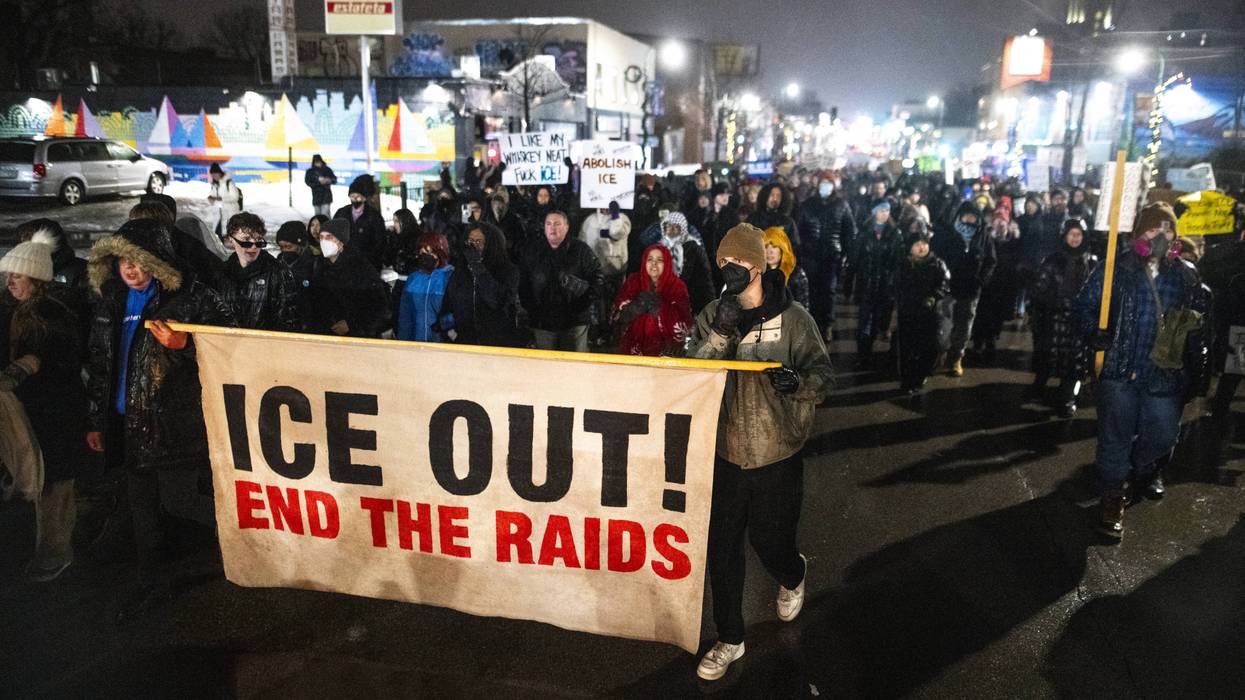
The United States is on a very dark path under President Donald Trump, argues political scientist, political economist, author, and journalist C. J. Polychroniou in the interview that follows with the independent French-Greek journalist Alexandra Boutri. Democratic rules and norms have virtually collapsed, and cruelty is the name of the game. Trump has used the military and federal law enforcement to build a paramilitary force that carries out pogroms against immigrant communities, assaults the constitutional rights of citizens and even murders people if they protest against its Nazi-like tactics. Under Trump, the US is acting at home in the same lawless manner that it acts abroad. How to fight Trump’s fascism is the million-dollar question.
Alexandra Boutri: I want to start by asking you to elaborate a bit on the concept of “imperial proto-fascism” that you referred to in the last interview we did together. I don’t think I have encountered this term before.
On the domestic front, you have the emergence of a regime that relies on the same tactics that it uses on the international arena. Cruelty and brute force are its main traits. Under Trump, the US is acting at home in the same lawless manner that it acts abroad. But Americans are rebelling against Trump’s imperial proto-fascist political order, so interesting times do lie ahead.
Alexandra Boutri: The Trump administration has brazenly lied in order to justify the deaths of the two people in Minneapolis. What sort of government people can justify the murders of their own citizens?
C. J. Polychroniou: Renee Good and Alex Pretti were killed by Trump’s own fascist paramilitary squad. The mission of ICE is to capture undocumented immigrants and instill fear across communities. In shooting and killing two harmless protesters, ICE thugs did not violate any protocol. They followed the protocol. When pressed about ICE’s tactics and the murder of Alex Pretti, Kristi Noem and Stephen Miller turned against each other. But they are both complicit in Trump’s lawless police state actions. They work for a criminal government and are carrying out its leader's orders. Miller is in fact the architect of Trump’s inhumane anti-immigration policies.
The current administration in Washington DC does not pretend to be a national government looking after the interests and the well-being of all Americans. So let’s put aside political niceties. It is an administration of hateful, racist, ruthless thugs who have embarked on an open war against democracy and the rule of law, against the “other,” and against human decency. It is fascism with US characteristics.
Alexandra Boutri: It appears that Trump has switched tactics and is now trying to turn attention back to the economy. Will it work?
C. J. Polychroniou: It depends on what he decides to do with his inhumane immigration crackdown. I don’t see anti-ICE protests going away as long as the paramilitary squad's barbaric tactics continue unabated. Most Americans are clearly fed up with Trump and his policies. He has nothing to point to that would make the public feel good about his administration. He had made life much less affordable in just one year. He has added trillions to the debt and the US dollar is collapsing. Only those supporting Trump like sheep, either because they are wearing blinders or because they have vested interests in him being in office, like the tech oligarchs, can find something positive with his administration. But he has three more years left in the White House and there is no doubt that his wrecking ball will keep swinging. And Trump will continue with his distraction tactics during damaging stories for his administration. And that includes embarking on new military adventures abroad, more bombings and killings, and even pursuing regime change.
Alexandra Boutri: How do people push back against Trump’s imperial proto-fascist order?
C. J. Polychroniou: The anti-ICE protests are very important because they signify resistance against one of the administration’s cruelest and most dangerous policies. The US is indeed on a very dangerous trajectory under Trump. The situation is so critical and overwhelming that only a united front, I believe, could defeat Trump’s imperial proto-fascist order. In this context, what is needed is full-fledged resistance against the Trump regime and all its collaborators, especially including its corporate collaborators. A united front against fascism is an alliance of working-class organizations with all progressive forces whether they are reformist or even attached to liberal institutionalism. And I am not necessarily referring to the united front strategy of Leon Trotsky against Hitlerism. The united-front formulation predates Trotsky, and it was a united front strategy in France that defeated the far right in the legislative elections of 2024. The primary goal here is to resist and ultimately defeat Trump’s plan for an imperial proto-fascist order. Nationwide general strikes which are a very powerful tool against unpopular and repressive regimes, but are exceptionally rare in the US, have a much better chance of happening if there is a movement of mass resistance based on a united-front formulation. Hopefully, with each passing day, more and more people will come to recognize Trump’s government for what it really is, an abomination, and realize that “you can’t be neutral on a moving train,” as Howard Zinn aptly put it.
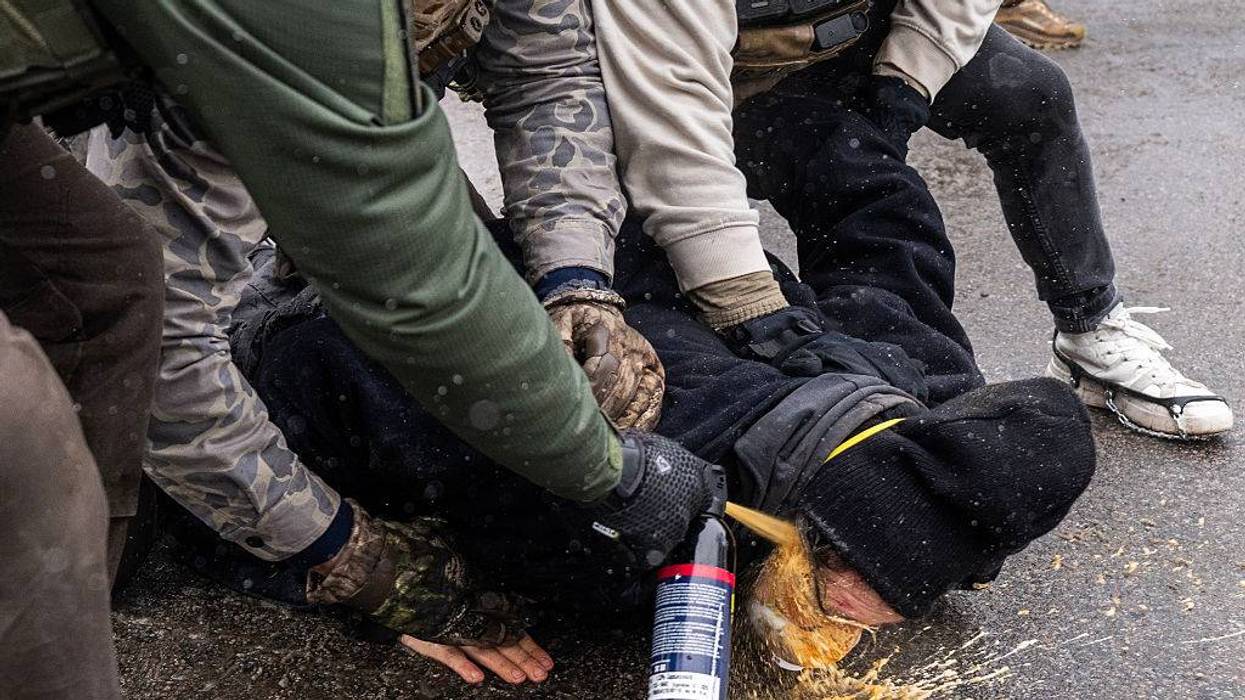
We have arrived at a critical juncture in the history of this country and the world beyond, which is being buffeted by reactionary forces.
In principle, extremists primarily seek to harm people who do not share their race, religion, or nationality. In practice, they often harm the very people they claim to serve and protect, people with whom they share some supposedly sacred demographic.
Consider Minnesota, currently under siege by anti-immigrant extremists in the employ of the federal government, with ICE and CBP at the forefront. Immigrants have indisputably suffered the most from this program of harm, but we have seen a recent turn toward harming non-immigrants.
This change was starkly illustrated with the January 7 slaying of Renee Good by anti-immigration forces, which was followed by an escalating crackdown on protesters, observers, and people simply trying to go about their lives. On Saturday, January 24, ICE killed another Minnesotan, Alex Pretti, a registered nurse who worked to help veterans, who put his body between immigration officials and other citizens targeted for violence, as clearly seen in multiple videos of the slaying. Federal government agents are shown shooting Pretti in the back while he was pinned to the ground, immobilized, and disarmed.
It goes without saying that citizens and immigrants alike should be equally entitled to live with dignity and free of state violence, and it should be emphasized that citizens are not “more important” victims than immigrants. However, these recent attacks highlight an important dynamic and key vulnerability in any extremist movement.
Through their courage and solidarity, Minnesotans from all walks of life are asserting an authentic American identity based on inclusive ideals in the face of adversity and escalating violence.
To make sense of this, we must first discuss how and why extremists classify people according to their social identity. The broadest categories of identity are in-groups and out-groups. An in-group is the group to which one belongs, and an out-group is anyone excluded from that in-group. As defined in my MIT Press book on the subject, extremism is the belief that an in-group’s success or survival can never be separated from the need for hostile action against an out-group.
Enacting harm on out-groups is risky, difficult, and costly, so extremists almost always seek to make the task easier by enlisting the entire in-group. To understand how this works, it’s useful to break the in-group down into subcategories.
In the extremist context, eligibility refers to the traits that make someone eligible for in-group membership. For instance, according to the KKK, light-colored skin is the minimum requirement for eligibility in the category of “white people.” But eligibility implies a counterpart: ineligibility. To continue with the same example, the most obviously ineligible people are members of an out-group, such as those with dark-colored skin.
But eligible in-groups often rebuke the extremists who claim to represent them, throwing the extremist movement’s legitimacy into crisis. If the extremist movement can’t persuade the eligible in-group to enact harm on out-groups, it may try to change the composition of the in-group by declaring that dissenters have forfeited the right to their in-group identity.
Extremist movements are at their most dangerous during times of uncertainty or upheaval.
The ineligible in-group thus consists of people who possess the canonical qualifications for membership but whose actions put them at risk of expulsion. In white supremacist extremism, for example, the ineligible in-group usually includes white people who have sexual relations with non-white people and are therefore subjected to even harsher treatment than the out-group. For instance, the infamous “Day of the Rope” massacre described in the neo-Nazi novel “The Turner Diaries” refers to the gruesome public execution of white “race traitors,” while racial out-group members are killed without fanfare “off camera.”
Extremist movements are at their most dangerous during times of uncertainty or upheaval, when group boundaries can be suddenly redrawn, with control of the in-group hanging in the balance. An extremist movement that hasn’t consolidated control of the in-group often declares war against “ineligible” dissenters. We saw this play out in the mid-2010s, when the Islamic State organization (IS) attempted to consolidate its control of a large swath of Iraq and Syria. Sunni Muslims who opposed IS control were massacred mercilessly under the principle “nine bullets for the traitors, one for the crusader.”
Disturbingly, we’re seeing the early stages of this dynamic right now in Minnesota, although we can hope it will not evolve into atrocities of the same scale. Anti-immigrant extremists in the U.S. federal government have increasingly menaced and used violence against dissenters and observers who are U.S. citizens — members of the in-group that the extremists claim to serve and protect. In addition to the Good and Pretti shootings, federal agents have roughed up and detained observers without provocation, and have repeatedly used pepper spray on peaceful gatherings, sometimes at close range and in violation of safe operation guidelines. In one horrific incident, a car full of children was exposed to tear gas while their parents tried to drive them home from a school event. The extremists continue to escalate their program of harm against the ineligible in-group, with no end in sight.
One of the most important ways extremists seek control of the eligible in-group is by exploiting the socially constructed nature of reality. The theory of social construction is popularly understood as “consensus reality,” and its premise is simple enough: The world is too big and complicated for people to experience in its entirety. We can only understand the world through consultation with trusted others, who tell us what happens out of our sight and help us determine right from wrong. Put simply, we can only understand the world in dialogue with others.
In-groups and out-groups come into play during social construction. We tend to trust people whose experience of life is most like our own, typically those with whom we share some concept of identity — anything from race and religion to neighborhood and nationality. When this normal instinct congeals into an excessive attachment to a specific identity and a mandate to harm people who don’t share that identity, it becomes extremism. Almost everything done by authoritarians and fascists (for whom extremism is an essential tool) can be understood as an effort to control the social construction of reality by amplifying selected in-group views and entirely suppressing the views of out-groups through methods that range from discrimination to segregation to genocide.
To this end, the current generation of anti-immigration extremists is navigating turbulent waters, in part because its coalition is complex and not exclusively focused on immigration writ large. The alliance includes often-overlapping categories of racists, antisemites, misogynists, homophobes, and transphobes, and the priorities of its factions are not always aligned. This increasingly fractious coalition is ill-equipped to face down an increasingly cohesive coalition of Americans united by anger that our nation’s peace, progress, and safety have been intentionally undermined.
Minnesotans are courageously demonstrating this unity, mobilizing to defend neighbors whose race or national origin puts them at risk. In the process, they are communicating a strong in-group consensus to their persecutors by turning out in large numbers and loudly asserting their condemnation through shouting, blowing whistles, giving sermons, honking horns, posting signs, and painting graffiti. These expressions of in-group disapproval can help defuse the psychological drivers of violence and undermine competing narratives and political power structures that seek to validate an extremist orientation and the repressive tactics that it justifies.
In a globalized media environment like America’s, the in-group is never just local. People around the country can support Minnesotans using many of the same tactics — by speaking out and showing up in large numbers, both online and offline, as so many have already done. In conjunction — and perhaps even more importantly — we can fight the tide of hate by demanding that institutions, including politicians and the media, recognize the severity of the current crisis in American democracy and respond proportionately.
Those institutions are critically important precisely because America’s consensus reality is, again, too big and too diverse to observe directly. You could spend your entire life talking to Americans and still understand only a tiny fragment of the American experience. For in-groups larger than a neighborhood, the consensus is therefore described and defined by institutions and individuals in journalism, politics, and the arts. These portraits of the in-group consensus are distributed through traditional and new media platforms, and none of them are neutral.
The winner of this struggle will define what values the American in-group stands for, perhaps for generations to come.
It is no accident that the purveyors of hate have moved to take control of major news and social media platforms through a combination of money and pressure tactics, and to discredit and defund those they can’t control. In some cases, these platforms have been bought outright and subjected to blunt and obvious manipulation. In other cases, reporters have succumbed to flawed journalistic conventions, such as providing “both sides” of every controversy with equal weight, even when one side is obviously lying or otherwise detached from reality. This practice misleads the public by inflating the extremists’ appearance of strength and credibility under the guise of “balance.” (Imagine news programs inviting a flat-earth believer to weigh in whenever the subject of the globe comes up. That’s what happens now when the topic is immigration or vaccines.)
The in-group consensus can never be determined with perfect objectivity. The tools for measuring it, such as polls, are complex and subject to bias. Even if polls were perfectly composed and executed, they would still be open to wildly divergent interpretations. Look through the archives and ask which presidents won “with a mandate” over the last 100 years. Then compare their vote counts.
In other words, the consensus is won through perception. And when an authority figure, an institution, or an algorithm creates the perception that extremists are winning, it can become a self-fulfilling prophecy. People have a well-documented tendency to justify the legitimacy of the status quo as they perceive it.
Although we can reject those who would assign us to an out-group or an ineligible in-group, we cannot assume that our voices will be acknowledged. If America is to climb out of this era of rage and hate, those who stand against the extremist wave cannot just show up and expect to be counted. They must loudly demand their voices be acknowledged in every setting and institution of civic life, from business to politics, from news to the creative arts. With every death at the hands of anti-immigrant extremists, this assertion becomes more necessary and potentially more powerful.
Even so, a winning narrative or communication strategy may not be enough to defeat those who seek to control the in-group consensus using state violence. If the extremists can’t persuade the ineligible in-group to surrender, they will seek to intimidate and perhaps kill its members, an escalation that is now well underway. That is why the eligible in-group must defend its relevance with all available methods, including the courts, the ballot box, mutual aid, and more. Justice must be pursued, regardless of whether accused murderers wear a badge. And all of these in-group actions will build and reinforce support and mobilization networks that will be sorely needed before this is over.
We’ve arrived at a critical juncture in the history of this country and the world beyond, which is being buffeted by the same reactionary forces. The winner of this struggle will define what values the American in-group stands for, perhaps for generations to come. Through their courage and solidarity, Minnesotans from all walks of life are asserting an authentic American identity based on inclusive ideals in the face of adversity and escalating violence. For those values to prevail, we must stand together in their defense.
This piece was originally published by The MIT Press Reader and appears here at Common Dreams with permission.
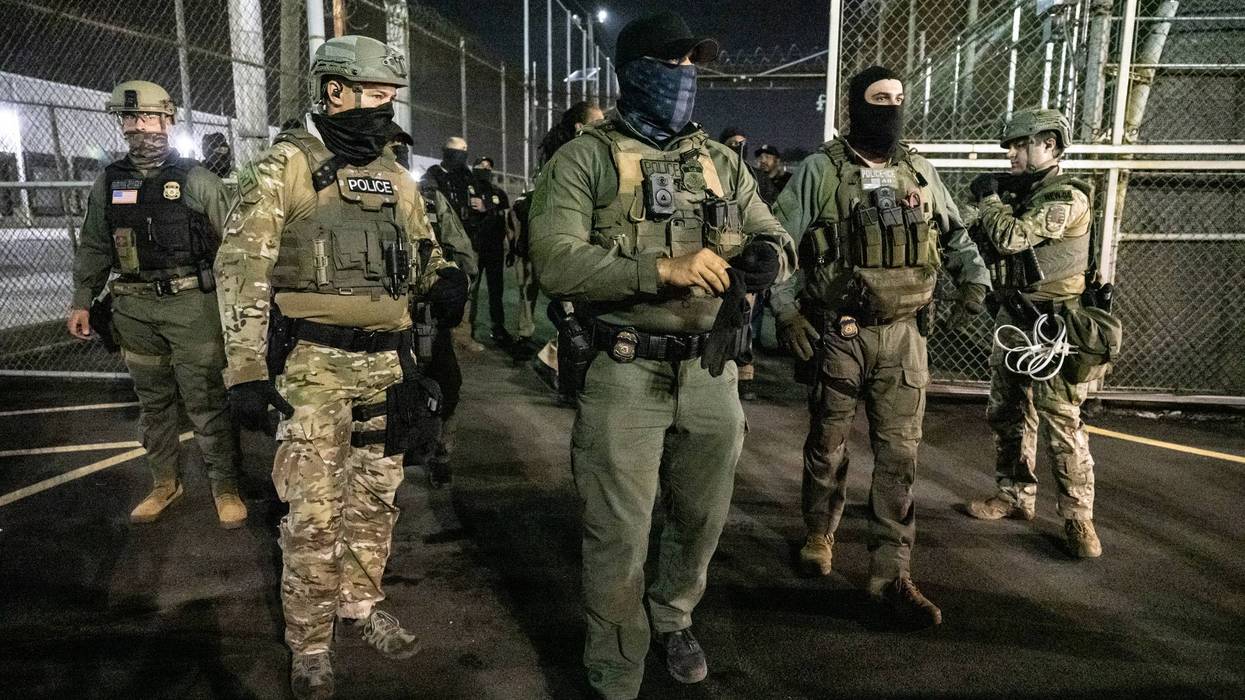
With unprecedented funding and minimal oversight, DHS is rapidly building a national detention infrastructure that will treat human beings as freight and confine civilians at an industrial scale.
The Department of Homeland Security’s (DHS) warehouse detention system is rapidly unfolding across the United States, advancing in open contempt of oversight, outpacing public scrutiny, and operating with the same disregard for the Constitution, the rule of law, and human life that defines the Trump administration’s exercise of power.
In November 2025, NBC News reported that DHS was actively scouting enormous industrial warehouses across the country, particularly in rural areas near major airports and transportation hubs, in an effort to expand the administration’s capacity to execute its mass deportation agenda—a system Secretary Noem recently aptly described as “one of the most consequential periods of action and reform in American history.”
After the “Big Beautiful Bill” allocated an additional $45 billion specifically to ICE for building new immigration detention centers through 2029—a budget 62 percent larger than the entire federal prison system—DHS gained unprecedented financial capacity to expand its system of terror on a massive scale. Some of the warehouses under imminent consideration exceed 800,000 square feet and could hold far more people than existing detention centers, compressing thousands of human beings into spaces designed for inventory, not habitation.
Further reporting in December showed that with this massive budget increase, DHS is not merely expanding capacity at the margins, but is redesigning the model itself. All those detained by DHS and ICE agents, including predominantly people without criminal records, both documented and undocumented im/migrants, and US citizens, will presumably be swiftly processed at local sites before being funneled into a small number of mega-facilities, each holding between 5,000 and 10,000 people. The plans outlining the duration of confinement and the conditions under which people will be held in these warehouses while awaiting deportation remain unknown.
Regardless of motive, Americans must confront that this hub-and-spoke detention network is a moral calamity, echoing some of the most inhumane periods in American and world history.
One can only assume the system will operate as Trump’s ICE Director Todd Lyons described at the 2025 Border Security Expo in Phoenix: “like Amazon Prime, but with human beings.” Concern for fundamental standards of care and due process, or pathways to legal immigration is replaced with the directive to “get better at treating this like a business.” The confinement, neglect, abuse, and exploitation that this process will inevitably worsen will be excused by the administration as “efficient.”
Since the news first broke, local reporting has confirmed the rapid construction and conversion of mass confinement centers across the country. Warehouse sites in Maryland, Texas, Florida, and New York’s Hudson Valley were reported to be under active consideration just in the past two weeks. Many communities slated to host these facilities have only learned of the plans through national reporting. In early January, The Washington Post found that when it contacted local governments in all 23 cities on ICE’s internal list, many officials had not been informed by federal authorities and could not comment. Multiple members of Congress have also stated publicly that they were not formally notified about the plans to establish these facilities in their districts.
State and local officials near proposed sites are now scrambling to hold emergency meetings, trying desperately to prevent being cut out of decisions with profound moral and ethical consequences that will reshape their communities. Still, there is widespread fear that the federal government will simply ignore local zoning and land-use laws.
Under the Supremacy Clause, federal agencies are largely immune from local zoning rules unless Congress explicitly requires compliance. Private contractors or lessees are not automatically covered, but in practice, immigration detention facilities and their operators face almost no local oversight. States like California have passed laws to empower health inspections and enforce standards against operators such as GEO Group, yet counties rarely act, and courts often side with federal preemption. If this continues, DHS could override community land-use standards entirely, imposing massive detention infrastructure on rural, resource-strained neighborhoods without consent, accountability, or regard for local residents.
Notably, the Trump administration has already made clear its intention to restrict congressional oversight of existing detention facilities, leaving little reason to believe the mega-warehouse model will be any more transparent or accountable. On January 8, DHS issued a directive requiring members of Congress to provide prior notice before inspecting immigration facilities, attempting to circumvent a court order that blocked such restrictions. Although federal law allows for unannounced visits, the Noem memo instructs staff that visits are not considered actionable until acknowledged by the Office of Congressional Relations, which coordinates with ICE and confirms details “as soon as practicable.”
The only supposed oversight of this expansion is being handled by figures deeply embedded in the detention industry, such as David Venturella, who has been seen in recent weeks touring ICE facilities slated for the “unloading and loading of goods.” Venturella quietly entered the Trump administration in early 2025 to avoid Senate confirmation, when DHS hired him as a full-time adviser and granted him an ethics waiver. Prior to this role, he spent more than a decade at GEO Group, one of the nation’s largest private prison corporations, where public filings show he was paid over $6 million to oversee immigrant detention operations. His career has moved seamlessly between ICE leadership and private security firms, including GEO Group, L-3 Communications, and USIS—companies whose profits depend on surveillance, enforcement, and confinement. He now oversees the ICE division responsible for detention contracts and infrastructure, the same system he previously expanded for private prison shareholders.
Private contractors such as GEO Group continue to operate facilities housing the vast majority of ICE detainees, positioning themselves to make substantial profit as the administration moves to double detention capacity to 100,000 beds with tens of billions in federal spending. GEO Group and CoreCivic have already reported soaring revenues under Trump’s second term, with executives describing the expansion as “pivotal” and “an unprecedented growth opportunity.” In this system, human confinement has been transformed into an investment strategy.
Regardless of motive, Americans must confront that this hub-and-spoke detention network is a moral calamity, echoing some of the most inhumane periods in American and world history. These warehouses lack climate control, ventilation, running water, sanitation, and medical facilities. The public cannot assume they will be retrofitted to meet even basic standards. Under the pressures imposed by political will and the promise of enormous financial gain for both contractors and the administration, restrained only by Trump’s own notion of “morality,” overcrowding, medical neglect, sanitation failures, family separation, and death are not incidental or isolated. They are the predictable, systemic outcomes of this design. Frequent transfers between facilities further destabilize those detained, shattering whatever order remains in local custody, tearing families apart, severing access to legal support, and concentrating the suffering of detention out of public view.
2025 was already ICE’s deadliest year in more than two decades, with at least thirty-two people dying in custody. In December 2025, Amnesty International described ICE facilities as “a deliberate system built to punish, dehumanize, and hide the suffering of people in detention.” Recent site visits documented by Congressman Ro Khanna further revealed the inhumane and degrading conditions detainees face today, including denial of medical care and meals containing rocks and debris.
In this moment of utter chaos—multiple wars looming or underway, international law ignored and explicitly disregarded, pedophiles protected, cities under conditions of terror, with agents told they have “federal immunity” to occupy streets—the infrastructure for this mass detainment system is expanding largely out of public view. Facilities may be secured before communities can mobilize, contracts locked in before lawmakers intervene, and once operational, and our communities will be left to reckon with the human suffering they guarantee.
These facilities are instruments of state-sanctioned inhumanity, engineered to evade legal standards and public accountability. The depravity lies not only in the degrading conditions they produce but in the calculus that animates them: speed is treated as a virtue, suffering is deemed acceptable—perhaps even a goal—and profit is treated as proof of success. The administration is not asking the public to accept this system; it is demanding acquiescence and enforcing it through threat and force. ICE’s expansion has already reshaped the country’s physical and moral landscape, without consent, transparency, or regard for human life. The choice is no longer abstract; communities must decide whether to act against this system of cruelty, or let silence stand as consent.
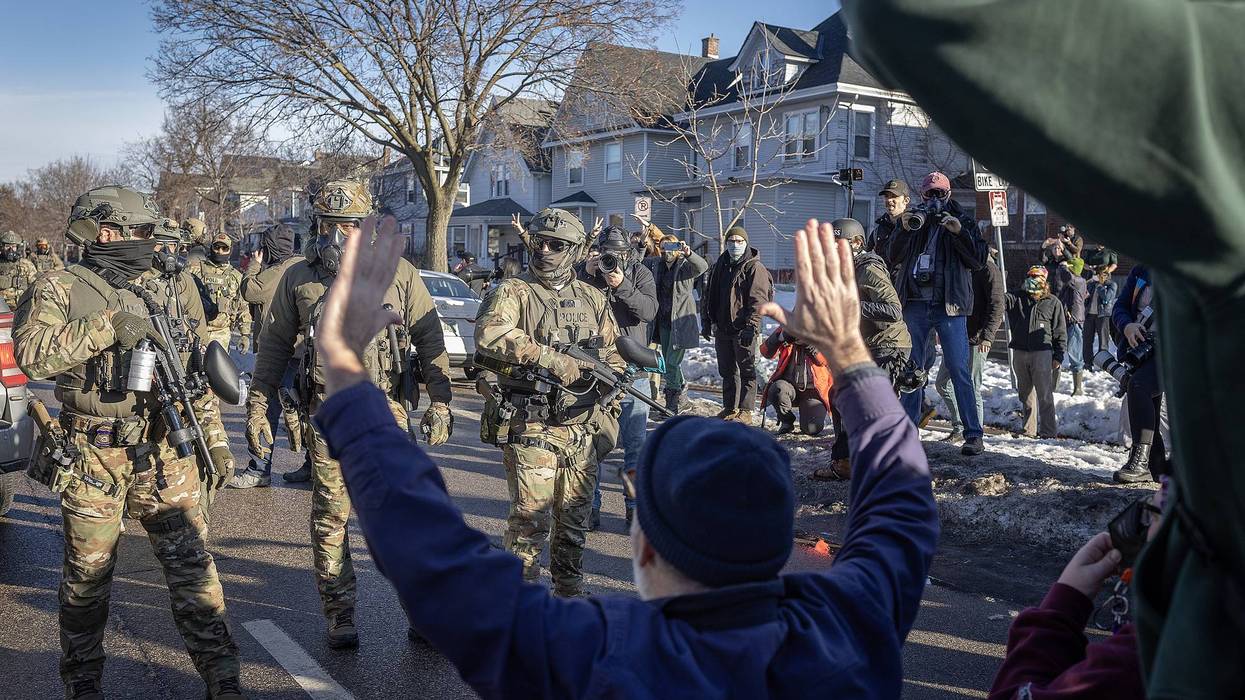
What is to be done when an assault on a city's population is an assault on democracy itself?
The denizens of Minneapolis are currently undergoing a violent attack on and occupation of their city by over three thousand heavily armed ICE and Border Patrol agents dispatched to the city by the Trump administration, over the strenuous objections of Minnesota Governor Tim Walz and Minneapolis Mayor Jacob Frey. This military assault on the city by “Homeland Security” has already resulted in the murder by ICE agents of one unarmed person, 37-year-old Renee Good, a US citizen; the shooting by ICE agents of at least one other individual; and untold incidents of harassment, intimidation, kidnapping, and the use of brute force.
This attack poses a threat, either directly or indirectly, to everyone living in Minneapolis.
At the same time, the attack is part of Trump’s broader authoritarian agenda, which centers on (1) a xenophobic campaign to arrest and deport over one million undocumented immigrants a year, which has led to similar “surges” of heavily armed ICE agents in Los Angeles, Portland, Chicago, Washington, D.C., Memphis, and Charlotte, some backed up by federalized National Guard troops, and (2) the pursuit of “retribution” against Democrat-controlled cities and states and against political opposition more generally. What is happening in Minneapolis right now thus poses a threat to every citizen of the US, and indeed every resident of the country whatever their legal citizenship status. For what is going on is a direct and indeed deliberate assault on civil liberties that are guaranteed by the US Constitution, and on constitutional democracy itself.
State power is now being wielded directly and violently by the Trump administration against individuals “under suspicion” of being “illegal,” against the communities where these individuals live and work, and against all citizens who act in solidarity with the victims of administration assaults or who join in protest against these assaults.
Participation in mass protest is a deliberately chosen public act as well as an individual moral choice. And so practices of civil resistance also implicate challenging questions of political ethics.
Last year’s intellectual debates about whether this is “fascism” have now been rendered entirely academic, for the manifest violence and the cruelty are now obvious for all to see, however various political theorists may choose to describe it.
Resisting this direct attack on civil liberty and constitutional democracy is essential, for the people directly violated, and for all who care about such violations or who are themselves vulnerable to similar violations–and anyone serious about democratic citizenship or even about going out in public without fear is so vulnerable.
Such an observation is hardly “academic” or merely theoretical. For right now, as the city of Minneapolis is the site of an assault, it is also the site of resistance to this assault, by masses of citizens who have taken to the streets of Minneapolis to protest, obstruct, disrupt, and counter ICE violence.
The situation is very dangerous, because ICE agents are heavily armed; either poorly trained or expertly trained to kill enemies in war rather than to patrol US cities; and obviously contemptuous of civil liberties and disposed to react to perceived “threats” with overwhelming force.
It is also dangerous because Trump has very publicly and repeatedly stated that if the situation on the streets devolves into greater chaos or violent confrontation, as he defines this, he is poised to invoke the Insurrection Act, which authorize him to deploy thousands of National Guard soldiers and active duty US military troops to back up the ICE occupation. This would in effect place the entire city of Minneapolis under martial law, and it would likely lead to similar measures taken in every city where protests intensify–and in that event protests will surely intensify in every city. Trump’s hesitance to take such measures thus far should provide no comfort for anyone, given the possibilities for things to spin out of control through misunderstanding or ICE provocation, and given Trump’s very serious mental instability, which is a very real factor that should frighten everyone.
What is to be done to resist this assault on a city and on democracy itself?
I’ve followed much of the discussion of this question online and in the media. And while the urge to hold forth with categorical statements of praise or denunciation is understandable, especially in a time of such heightened danger, there is surely more than one thing to be done, and differently situated people will surely respond differently, in ways that are often complementary but will also sometimes be in tension. Being clearer about these different ways, and mindful that tension between them can be genuinely productive, is thus important. Towards this end, I think it is particularly important to distinguish between morally justified forms of self-defense, and forms of public collective action that involve less proximate, and thus more political, goals.
Individuals that ICE seeks to detain on the grounds that they are “illegal”—a vile term– have every right to refuse to cooperate, to attempt to flee, and to fight back if attacked. In a moral sense, the violence of the situation clearly makes the use of counter-violence in self-defense legitimate. Whether it is wise to do so is a secondary but important question. But it is entirely reasonable for anyone approached by ICE to consider arrest by ICE as an extra-legal infringement of one’s liberty and an endangerment of one’s very life.
Individuals who ICE seeks to detain, or merely to subdue, because they protest the above efforts to detain people suspected of being “illegal,” also cannot reasonably be expected to simply submit to ICE orders. For such orders have questionable legal validity, and following them places any individual at serious risk of harm, disappearance, or worse. Here too, whether or not it is wise not simply to flee but to resist, to the point of employing counter-violence, is a secondary question. What is primary is that every individual has the moral and even arguably the legal right to judge this for themselves.
But participation in mass protest is a deliberately chosen public act as well as an individual moral choice. And so practices of civil resistance also implicate challenging questions of political ethics. For here the moral question is also a political one, not “how should an individual threatened directly by ICE respond?” but “how should organized groups of citizens act collectively to oppose ICE threats to individuals and to resist the broader ICE occupation?”
It is uncommon for elected politicians to hold forth with seriousness and integrity on such questions of political ethics. But in the current crisis, Minnesota’s elected politicians have spoken publicly ways I consider exemplary. Minneapolis Mayor Jacob Frey’s immediate response to the killing of Renee Good—an emphatic rejection of Trump administration bullshit about the killing and about Good, combined with an equally emphatic “get the fuck our of our city”—is one example. But here it is the response of Governor Tim Walz—who, let us not forget, was also in the cross-hairs of Justice Department allegations of corruption, even before it was announced that he and Frey were being investigated for their responses to the ICE occupation—that concerns me. Two nights ago, Walz put out a statement that has received much attention. It is worth quoting in its entirety:
My fellow Minnesotans:
What’s happening in Minnesota right now defies belief.
News reports simply don’t do justice to the level of chaos and disruption and trauma the federal government is raining down upon our communities. Two to three thousand armed agents of the federal government have been deployed to Minnesota. Armed, masked, undertrained ICE agents are going door to door, ordering people to point out where their neighbors of color live. They’re pulling over people indiscriminately, including US citizens, and demanding to see their papers. And at grocery stores, at bus stops, even at schools, they’re breaking windows, dragging pregnant women down the street, just plain grabbing Minnesotans and shoving them into unmarked vans, kidnapping innocent people with no warning and no due process.
Let’s be very, very clear: This long ago stopped being a matter of immigration enforcement. Instead, it is a campaign of organized brutality against the people of Minnesota by our own federal government. Last week, that campaign claimed the life of Renee Nicole Good. We’ve all watched the video. We all have seen what happened. And yet, instead of conducting an impartial investigation so we can hold accountable the officer responsible for Renee’s death, the Trump administration is devoting the full power of the federal government to finding an excuse to attack the victim and her family. Just yesterday, six federal prosecutors – including the longtime career prosecutor leading the charge to investigate and eliminate fraud in our state’s programs – quit their jobs rather than go along with this assault on the United States Constitution.
But as bad as it’s been, Donald Trump intends for it to get worse. This week, he went online to promise that, quote, “the day of retribution and reckoning is coming.” That is a direct threat against the people of this state, who dared to vote against him three times, and who continue to stand up for freedom with courage and empathy and profound grace. All across Minnesota, people are stepping up to help neighbors who are being unjustly, and unlawfully, targeted. They’re distributing care packages and walking kids to school and raising their voices in peaceful protest even though doing so has made many of our fellow Minnesotans targets for violent retribution.
Folks, I know this is scary. And I know it’s absurd that we all have to be defending law and order, justice, and humanity while also caring for our families and doing our jobs.
So, tonight, let me say, once again, to Donald Trump and Kristi Noem: End this occupation. You’ve done enough.
Let me say four critical things to the people of Minnesota – four things I need you to hear as you watch the news and look out for your neighbors.
First: Donald Trump wants chaos. He wants confusion. And, yes, he wants more violence on our streets. We cannot give him what he wants. We can – we must – protest: loudly, urgently, but also peacefully. Indeed, as hard as we will fight in the courts and at the ballot box, we cannot, and will not, let violence prevail.
You’re angry. I’m angry. Angry might not be strong enough of a word. But we must remain peaceful.
Second: You are not powerless. You are not helpless. And you are not alone. All across Minnesota, people are learning about opportunities not just to resist, but to help people who are in danger. Thousands upon thousands of Minnesotans are going to be relying on mutual aid in the days and weeks to come, and they need our support. Tonight, I want to share another way you can help: Witness. Help us establish a record of exactly what’s happening in our communities. You have an absolute right to peacefully film ICE agents as they conduct their activities. So carry your phone with you at all times. And if you see ICE in your neighborhood, take out that phone and hit record. Help us create a database of the atrocities against Minnesotans – not just to establish a record for posterity, but to bank evidence for future prosecution.
That’s the third thing I want to tell you tonight: We will not have to live like this forever. Accountability is coming, at the voting booth and in court. We will reclaim our communities from Donald Trump. We will re-establish a sense of safety for our neighbors. We will bring an end to this moment of chaos and confusion. We will find a way to move forward – together. And we will not be alone. Every day, we are working with business leaders, faith leaders, legal experts, and elected officials from all across the country. They have seen what Donald Trump is trying to do to our state. They know their states could be next.
And that brings me to the fourth thing I want to tell you tonight. Minnesota, I’m so proud of the way we’ve risen to meet this unbearable moment. But I’m not surprised. Because this – this is who we are. Minnesotans believe in the rule of law. And Minnesotans believe in the dignity of all people. We’re a place where there’s room for everybody, no matter who you are or who you love or where you came from. A place where we feed our kids, take care of our neighbors, and look out for those in the shadows of life. We’re an island of decency in a country being driven towards cruelty. We will remain an island of decency, of justice, of community, of peace. And, tonight, I come before you simply to ask: Do not let anyone take that away from us.
Thank you. Protect each other And God bless the people of Minnesota.
Some have praised this statement as a necessary call for “civility” and respect for law and order at a moment of disorder that promises great danger. Many on the left have denounced the statement as a reactionary call for “civility” at a moment of disorder and crisis that presents opportunities for more robust “resistance” to ICE and for “antifascism” more generally.
Debate about such matters is healthy—but only if it generates greater understanding among those who stand, together, against Trump’s fascism. This means greater appreciation among some centrists for the justified outrange, and passionate opposition, that many protesters are acting out on the streets of Minneapolis. But it also involves much greater seriousness among some on the left about the grave dangers associated with the possible escalation of violent confrontation.
Careful attention to Walz’s words makes clear that his statement is not a simple appeal to “civility” or call for citizens, as one colleague has put it, to “stand down.” After leading with a denunciation of the Trump administration for orchestrating “a campaign of organized brutality against the people of Minnesota by our own federal government,” Walz proceeds to praise fellow Minnesotans for taking initiative both “to resist” and “to help people who are in danger.” He validates public anger and indignation, and declares that “We can – we must – protest: loudly, urgently, but also peacefully. Indeed, as hard as we will fight in the courts and at the ballot box, we cannot, and will not, let violence prevail.” He is very clear that the source of the violence is ICE, and not ordinary citizens who are resisting and protesting. He is also clear that while action in the courts and at the ballot box is crucial, protest is equally legitimate important. He is not telling people to go home and be patient, or to have faith in politics as usual. For he is very clear that the situation is not “normal” and represents a genuine crisis.
The danger of violent escalation is very great and the likelihood that it will lead to an even more repressive response by the fascistic Trump, Hegseth, and Noem is equally great.
Some have claimed that the insistence that “we must remain peaceful” is reactionary in a situation where calls for more resolute confrontation are possible. But what else can any elected politician in the flawed constitutional democracy that is the US be expected to say? Walz is not a revolutionary—if he was, he would not be Governor of Minnesota (Zohran Mamdani is also not a revolutionary, which is why he is the elected Mayor of New York City and not an editorialist for the DSA newsletter). And Minneapolis today is not the Paris Commune of 1871 or the revolutionary Bavaria of 1918-1919 or the Budapest-based Soviet Republic of 1919—all arguably noble revolutionary experiments, and all experiments that were crushed by overwhelming military force.
When Walz says that Trump “wants chaos,” because it mobilizes his base and can serve as a pretext for the invocation of the Insurrection Act, he is simply saying what is obviously true. Saying this does not morally or politically absolve Trump or Stephen Miller or Kristi Noem or Tom Homan or ordinary ICE agents of their criminal complicity in violence, nor does it imply in any way that counter-violence is the primary problem at issue. No false equivalence is being asserted. It is true, as some critics have noted, that Trump has gone very far on the basis of lies about non-existent “domestic invasions” and “radical threats.” What is the guarantee that a commitment to non-violent protest will inhibit him from going farther, it is asked. There is no such guarantee. But it is obviously that Trump can yet go much farther down the fascist road than he has thus far done, and it is simply naïve to ignore that chaos in the streets of Minneapolis would offer him a very convenient pretext to do so.
More importantly, it is worse than naïve to imagine that it is possible, through counter-violence, not simply to put Minneapolis ICE agents on the defensive, but to defeat Trumpism.
First, because Trump retains some measure of procedurally democratic legitimacy in the U.S—over seventy-seven millionpeople voted for him a little more than a year ago, for God’s sake; Trump’s recent poll numbers do not represent any kind of dramatic political reversal, and he will occupy the White House for the next three years, whatever happens in this year’s midterm elections (assuming that free and fair elections will even take place).
Second, because Trump and Hegseth have purged the US military of all independent voices and scrupulous career professionals, and have laid the basis for the Pentagon’s massive domestic deployment of overwhelming force—as the widely reported September meeting at Quantico made plain.
Finally, because those who might understandably fantasize about a “revolutionary conjuncture” fail to take account of the fact that in the event a serious outbreak of violent conflict it’s not just the US military that will follow Trump’s commands. There is also the large number of state and local police officers, many of whom lean far right, however liberal their Governors or Mayors might be. Further, in a real civil war, the far right in this country would annihilate the left in pretty much everyplace outside of the major coastal cities. I know there are left militias too. And they amount to little more than nothing by comparison to their fascist counterparts, who typically recruit combat veterans and retired police officers with real military training, and who have been prepping for decades.
In short, the danger of violent escalation is very great and the likelihood that it will lead to an even more repressive response by the fascistic Trump, Hegseth, and Noem is equally great.
It is worth repeating that the call to practice nonviolent resistance does not mean that individuals in the literal grasp of ICE ought to submit. Walz’s words do not include a call for individuals to submit to ICE commands or detentions. Nor do they imply that the kind of civic monitoring and solidarity offered by people like Renee Good and her wife, and thousands of others, is wrong even if it obstructs “officers.” There is no suggestion that it was wrong of Nicole Good to be parked where she was, or to try to drive away when approached by ICE agents. She clearly was in the right.
Walz is calling–as a public official who is, to be candid, totally outgunned and overpowered by Trump’s federal government—not for submission but for strategies and tactics likely to build political support without provoking a wave of repression far greater than anything yet attempted by Trump.
I can’t imagine a better response to the situation at hand from any elected public official in the country in which we actually live.
Obviously, protest leaders and movement activists speak from a very different place. It is understandable that some might be suspicious of Walz when he says that “we all have to be defending law and order, justice, and humanity,” and might believe, contrary to Walz, that tactics that press the boundaries of “civility” and “order” might be effective in mobilizing activists in the streets or even provoking ICE overreach. There are legitimate arguments to be had about such things. Indeed, such arguments are going on right now. For no movement can speak with a single voice. Yesterday’s Minnesota Star Tribune thus reports that “Debate grows in protest movement over how hard to push back against ICE,” and that “shootings by ICE agents have led to tension among protesters calling for a peaceful approach and those who want to get more confrontational.”
Indeed, such debates have characterized every significant social movement in US history that has struggled against injustice. At the same time, it is important to recognize that outside of the Civil War, every successful movement resisting injustice has by and large proceeded, and succeeded, through non-violent means. Yes, such movements have typically included radical groupings often willing to practice more risky forms of direction action and even to employ forms of counter-violence. But such efforts have always worked at the margins, and only up to a point. More importantly, there has never been a US president like Trump, who is so drawn to fascist ideology and so willing to flout the Constitution, subvert democratic elections, and deploy armed force, in cities across the country, to suppress opposition. And it has thus never been more dangerous to promote any kind of protest activity.
Now is a good time to recall the very distinguished tradition of non-violent movement activism and organized protest that has played such an important role in US history.
As I think about the exemplary upsurge of protest on the streets of Minneapolis, I am reminded of the most dramatic moment in “No Easy Walk,” an installment of the acclaimed PBS documentary “Eyes on the Prize,” which chronicled the evolution of the USUS civil rights movement. The installment centered on the 1963 Birmingham campaign, and featured a lesser known but hugely important movement leader, James Bevel. Bevel, a leader of the Freedom Rides, and a leading tactician of non-violent direct action, found himself at the head of one particular march, during “the children’s crusade,” that was threatening to erupt into a violent confrontation. In newsreel footage, Bevel is seen being given a bullhorn by a policeman on site, and using it to calm his large and understandably heated crowd. In voiceover, he recounts his experience, worth quoting at length:
We were coming off a demonstration and the police was driving the students back with water and dogs. . . The students was being playful and jovial and mocking the police, but the adults — upon seeing a lot of the students knocked down by the water and their clothes torn off by dogs — began to organize their guns and knives and bricks.
What I did, actually, was tell the students that they had to respect police officers, that their job was to help police and to keep order. That the police was there to keep order and that the people who was there throwing [things] was probably paid instigators, and therefore we had to watch them. And it was very effective. It started all the students to pointing at adults who had rocks and knives and guns, and then the adults had to start dropping them. Because it would’ve started a riot, and a riot would’ve gotten off the issue. The students was very aware of that, and the adults weren’t aware of that. . . [and there was] this policeman with a bullhorn not knowing what to do with it to keep order. . . And I said, ‘Let me use your bullhorn.’
So he just gave it to me, and I said, "OK, get off the streets now. We’re not going to have violence. If you’re not going to respect policemen, you’re not going to be in the movement."
Bevel, John Lewis, Diane Nash, and other young movement leaders– who studied nonviolent direct action with James Lawson in Nashville, Tennessee, first practiced it at lunch counters in Nashville and Greensboro, North Carolina, and in 1960 proceeded that year to form the Student Nonviolent Coordinating Committee—understood, from years of experience, that the practice of self-restraint has both ethical and strategic value. The 1963 Birmingham campaign organized by King’s Southern Christian Leadership Conference was indeed called “Project C,” with the “C” standing for Confrontation. Bevel, like King a student of Reinhold Niebuhr, understood that it is possible to confront injustice, even violent injustice, in ways that are coercive even as they abjure physical violence.
The whole world is now watching Minneapolis, the site of appalling ICE violence, but also brave civic solidarity and resistance to the violence.
The rhetoric of civility is often a rhetoric of pacification, a way of saying “calm down, be reasonable, be patient” to rebellious citizens who have been told too long to “wait,” and of insinuating that “we are all in this together” to people who have for too long been ignored, denied, or suppressed. Appeals to this rhetoric can be a way for power holders and those who believe in the essential rightness of the status quo to quiet dissenting and disruptive voices.
But it can also be a way for savvy citizen activists to build oppositional power in situations where mass direct confrontation with police, or the use of organized violence in response to police violence, is likely to furnish pretexts for much more violent and repressive official responses, and where creative nonviolence can more effectively resist injustice.
The whole world is now watching Minneapolis, the site of appalling ICE violence, but also brave civic solidarity and resistance to the violence.
And what happens in Minneapolis in the coming weeks will quite likely play an outsized role in what happens politically in the country at large. And the danger of a massive, full-scale campaign of repression, and thus of a dramatic curtailment of constitutional freedoms already stretched to the breaking point, has never been greater.
Tim Walz and Jacob Frey are not activists. But in the situation we face, which pits a fascistic Trump administration against both Minnesota’s citizens and its elected state and local governments, they are supporters and even allies of a political resistance not only to the brutal and unjust ICE assaults, but to Trumpism more generally. And in this context, their use of the rhetoric of “law and order” against the manifestly lawless violence of the Trump administration, plays a very important role, not as a substitute for angrier rhetoric or passionate protest, but as a necessary call for civic self-limitation in the name of democracy.
Rep. Ilhan Omar is an activist, even as she is also an elected member of the US House of Representatives. And just yesterday she urged similar restraint in response to reports of protesters hurling projectiles at police. Her public appeal seems a fitting way to conclude: “Do not let your anger get the best of you. . . We are justified in the rage that we feel, as Minnesotans with the paramilitary force that is roaming our streets and the brutality in which our neighbors are being treated and the inhumane ways we are being described, but giving into that rage gives them license to terrorize more.”
I’d like to thank my dear friends Bob Ivie and Bob Orsi for their helpful suggestions on this piece.

In a rational world, the conversation about the island would be about the melting ice sheet that could easily add a foot or more to the level of the ocean before the century is out.
When President Donald Trump first started fantasizing about seizing Greenland for the US, it sounded farcical—a little Gilbert and Sullivan, or maybe The Mouse that Roared. In the wake of America’s attack on Caracas, however, it now seems as likely as not that we’ll soon be landing troops in Nuuk, a truly hideous prospect that we should all try to head off. Here’s my small effort:
First off, I think it’s a very real possibility.
Here’s Stephen Miller on Monday, talking with Jake Tapper:
TAPPER: Can you rule out the US is going to take Greenland by force?
MILLER: Greenland should be part of the US. By what right does Denmark assert control over Greenland? The US is the power of NATO.
TAPPER: So force is on the table?
MILLER: Nobody is gonna fight the US militarily over future of Greenland.
And here’s our leader himself, speaking to a press gaggle on Air Force One while a beaming Sen. Lindsay Graham (R-Obsequious) grinned by his side:
Trump: We need Greenland. Right now, Greenland is covered with Russian and Chinese ships.
Reporter: What would the justification be for a claim to Greenland?
Trump: The EU needs us to have it.
None of this makes any actual sense—Greenland is not covered with Chinese and Russian ships, the EU does not want us to have it (European leaders united Tuesday to say, “Greenland belongs to its people. It is for Denmark and Greenland, and them only, to decide on matters concerning Denmark and Greenland,” which seems pretty clear), and Denmark asserts control over Greenland in pretty much the same way Washington asserts control over, say, Alaska or Vermont.
In fact, though, Denmark has been slowly loosening that control over the decades—not because it wants to sell it to America, but because it recognizes that the people who live there, most of whom are Inuit, should have the greatest say in how it’s managed. Greenlanders have exercised that say in ways that would be uncongenial to the White House: for instance, civil partnerships for gay people have been standard since 1996, and gay marriage legal since 2016 when the island’s parliament approved it by a 28-0 vote. Under the Kinguaassiorsinnaajunnaarsagaaneq pillugu inatsit law, sex changes have been allowed since 1976. In other words, Trump’s claim that Greenlanders “want to be with us” is palpable nonsense—a poll last January found that 85% of the population opposed the idea.
Discerning Trump’s “real” reason for wanting Greenland is a pointless exercise; he’s a sad, ancient baby, and babies just want. He seems to think that the point of a ruler is to acquire more territory, and that he more or less owns by divine right the land masses adjacent to our country. (MAGA bloggers this week were busily talking about “vassal states” across the hemisphere). There are minerals there, but hard to get at. Oh, and there’s petroleum in and around Greenland as well, and that usually sings a siren song to this child of the oil-driven 20th century.
Really, however, there’s only one truly vital strategic asset in Greenland, one thing that could change the world. And that’s the ice that covers almost all its landmass.
I’ve been up on this ice sheet—I’ve hiked up glaciers from the tideline, climbing and climbing till the sea disappears behind you and all you can see in every direction is white. It is uncannily beautiful.
I helped organize a trip there in 2018 so that two very fine poets could record a piece from atop this ice sheet. Kathy Jetnil-Kijiner came from her home in the Marshall Islands, which is already slipping under a rising sea (and which has long known about US imperialism; part of the atoll is still radioactive and off limits, thanks to US bomb testing in the 1950s); Aka Niviana is a native Greenlander whose home has begun to melt, a melt that if it continues will guarantee the submersion of Polynesia, and much else.
They stood there on that ice, in a chill summer wind, and recited their long and majestic poem for a camera; my job was to stand just outside its range with a pair of sleeping bags that they could wrap themselves in between takes. “Rise: From One Island to Another,” as their work was called, has won both prizes and large audiences on YouTube; it will, I think, be one of the documents of this global warming era that someday people will look at in a kind of outraged awe, one more proof that we knew exactly what was coming and did nothing about it.
The stakes are so enormous that they make the Trumpian greed for this land seem all the punier and more puerile.
We were camped above the Eagle Glacier—Jason Box, the American-born climatologist now living in Denmark who helped lead the trip had named it that because of its shape when he first visited five years earlier, “but now the head and the wings of the bird have melted away. I don’t know what we should call it now, but the eagle is dead.” And that’s true of so much of the island; we watched as one iceberg after another came crashing off the head of glaciers, each one raising the level of the ocean by some infinitesimal amount.
Greenland holds 23 feet of sea-level rise, should we eventually melt it all. That will take a while, but we’re doing our best. It’s been losing mass steadily for the last quarter-century—it lost 105 billion tons of ice (billion with a b) in 2025, and the ice was melting well into September, unusual in a place where winter usually descends in late August. The people of Greenland, by the way, recognize all this: They passed a law in 2021 banning all new oil exploration and drilling—the government described it as “a natural step” because Greenland “takes the climate crisis seriously.” (More than two-thirds of their power comes from renewables, mostly hydro).
I found those Greenlanders I met to be hardy, thrifty people very much in tune with their place. I spent a memorable afternoon with Box planting trees outside the former American air base in Narsarsuaq in an effort to, among other things, soak up some carbon dioxide. And I spent an equally pleasant afternoon drinking beer with him and the rest of our party at a microbrewery in Saqqannguaq (one of several in the country) which brews “with the purest drinking water on Earth, coming from the Greenlandic ice cap” and hence “free of toxins, chemicals, and microplastics.” Highly recommend the IPA, reminder of yet another imperial adventure.
Obviously seizing Greenland would be a terrible idea because it would break up NATO and put America at loggerheads with the liberal democracies of Europe (though that may be the single biggest incentive for the administration). Obviously, it would be a gross example of modern colonization, obliterating the rights of the people who live there. Obviously, it would raise tensions around the world even higher, and send the strongest possible signal that Beijing should just go grab Taiwan. Lots of people are talking about those things, though there’s not the slightest sign that anyone in power is listening. (Stephen Miller’s wife has tweeted out a map of Greenland decked out in red and white stripes).
But in a rational world what we’d mostly be talking about is all that ice. That’s what, for the other 8 billion people on the planet, actually matters about this island. It could easily add a foot or more to the level of the ocean before the century is out, all by itself (the Antarctic, much bigger but slower to melt, will eventually add much more). A foot is a lot—on a typical beach on, say, the Jersey shore, which slopes up at about 1°, that brings the ocean about 90 feet inland.
And the fresh water pouring off Greenland seems already to be disrupting the great conveyor belt currents that bring warm water north from the equator, maintaining the climates of the surrounding continents. That too could raise—by significant amounts—the level of the sea, especially along the coast of the southeast US (and also plunge Europe into the deep freeze even as the rest of the planet warms).
The stakes are so enormous that they make the Trumpian greed for this land seem all the punier and more puerile. Here’s how Jetnil-Kijiner and Niviana put it in their poem:
We demand that the world see beyond
SUVs, ACs, their pre-package convenience
Their oil-slicked dreams, beyond the belief
That tomorrow will never happen
And yet there’s a generosity to their witness—a recognition that whoever started the trouble, we’re now in it together.
Let me bring my home to yours
Let’s watch as Miami, New York,
Shanghai, Amsterdam, London
Rio de Janeiro and Osaka
Try to breathe underwater…
None of us is immune.
Life in all forms demands
The same respect we all give to money…
So each and every one of us
Has to decide
If we
Will
Rise
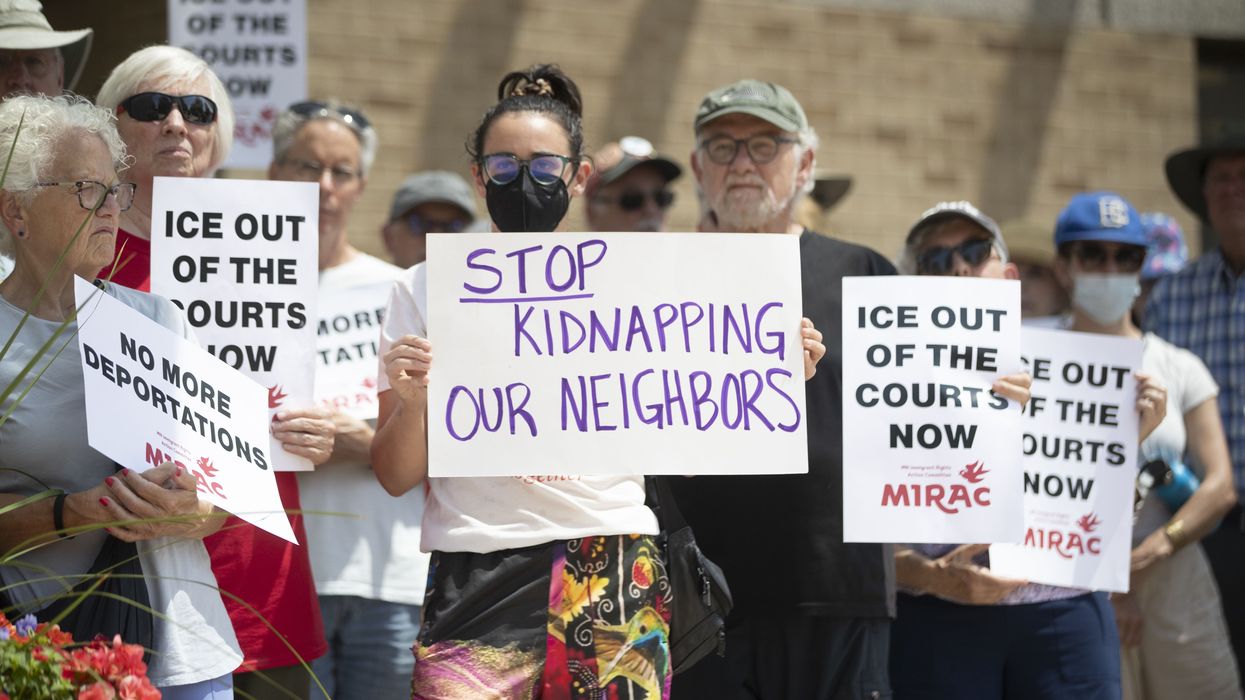
With the Republicans becoming ever more authoritarian, centrism moves the entire political spectrum to the right.
The Democratic centrists are at it again, looking to show that the road to success is paved with middle-of-the-road candidates like Mikie Sherrill and Abigail Spanberger. Zohran Mamdani’s victory in New York is being written off as the fluke product of a deep blue city, while the newly elected governors are hailed as the very model of successful centrist Democratic messaging.
Rahm Emanual, former Obama staffer, Mayor of Chicago and Wall Street advisor said:
If you are trying to win national campaigns that bring in a whole slew of swing voters, is the test Park Slope, Brooklyn — or what happens in New Jersey and Virginia? I am less interested in the Upper West Side and more interested in the Upper Peninsula. That is how you win.
Others argue that in substance Mamdani’s platform is not radically different from those of the moderate governors. Ry Rivard and Madison Fernandez wrote in Politico:
For all their ideological differences, Zohran Mamdani, Mikie Sherrill and Abigail Spanberger found a shared language that aims at the heart of President Donald Trump’s populism: the high cost of everyday life.
Their wins suggest a recalibration of Democratic politics — from moral crusades to kitchen-table math.
Affordability is the new mantra, to be sure, but the moderates are not ready to take on the fundamental causes of unaffordability. Those require you to take on the Democratic donor class. To truly make America affordable again, you need to slap major controls on Wall Street-financed oligopolies and rein in the wealth extraction machines that are private equity and hedge funds. Since the Democrats are not about to bite the donors’ hands that feed them, moderation is their best and only policy.
But maybe that timid moderation isn’t the reason the Dems won in this abbreviated cycle. Maybe the moderates won for a completely different reason that has little or nothing to do with affordability, like the fact that ICE has been coming after Hispanic immigrants, often with extreme violence, often arresting citizens and jailing them without cause. This everyday cruelty is ripping people from their communities and families across the country. It’s ugly and lots of voters of all persuasions don’t like it.
If that’s the case, I would think we would see a big shift in Hispanic votes from Trump in 2024 to Sherrill and Spanberger in 2025. And as best I can tell, that’s exactly what happened.
About 16 percent of all eligible voters in New Jersey are Hispanic. The two counties with the largest concentration are Hudson and Passaic. In Hudson County, the Hispanic vote shifted away from Trump by 23 percent, while it shifted away by 18 percent in Passaic County. “Sherrill carried Latino men and women alike, and even flipped 18% of Latino Trump voters,” reported CBS News.
While only 9 percent of Virginians are Hispanic, the two counties with the highest Hispanic concentrations (over 40 percent) are Manassas and Manassas Park. Although these are small counties, in Manassas Spanberger picked up 9 percent more votes than Harris did in 2024, while also picking up 13 percent more in Manassas Park.
It’s not hard to understand why Hispanic voters might be turning against Trump and his ICE machine. Many Hispanic citizens live with some undocumented immigrants, often family members. And Hispanic citizens have friends, neighbors, and co-workers who are Hispanic, all of whom know they might get stopped by masked members of ICE based on how they speak or the way they look or during a raid of their workplaces. Trump promised to deport serious criminals, but his administration has pivoted to targeting anyone who might be in the US without papers based on how they look. That includes many hardworking immigrant citizens.
The latest Kaiser Family Fund/New York Times poll confirms these fears:
“One in five immigrants say they personally know someone who has been arrested, detained or deported since January. Four in ten worry they or a family member could face such action. Many immigrants, including naturalized citizens and those who are lawfully present, say they feel less safe, are avoiding activities outside their home, and no longer view the U.S. as a good destination for immigrants.”
The Democrats would be wise and righteous to come to the defense of these working people, rather than dance the moderate two-step (“let’s work on affordability but leave the wealthy alone”).
As we’ve noted repeatedly, a strong majority of voters want a path to citizenship for undocumented workers. Our Rust Belt survey showed that 63 percent of the voters of Michigan, Ohio, Pennsylvania, and Wisconsin support granting citizenship to undocumented workers who have been here three years, paid their taxes, and have not committed a felony crime. That support includes 36 percent of 2024 Trump voters.
Mamdani openly supports a path to citizenship, but do the new governors?
Instead of giving marathon speeches and shutting down the government, Democrats would make a powerful statement if they went out into the streets to protect immigrants from deportation. What would the public’s reaction be if every Democratic member of Congress got arrested standing up for due process and immigrants at ICE raids and facilities? Their mugshots would be a badge of honor, noticed by a public hungry for human solutions to real problems, not political terror. They would likely have more impact than counting on “affordability centrism” to stop Trump and his billionaire friends.
With the Republicans becoming ever more authoritarian, centrism moves the entire political spectrum to the right. It is just an excuse for ducking the hard task of taking on the monied elites who are sucking wealth away from working people.
Jim Hightower, the old-school populist columnist who served as Texas Commissioner of Agriculture for eight years, always had disdain for political centrists. As he pointed out many moons ago, “There’s nothing in the middle of the road but yellow stripes and dead armadillos.”
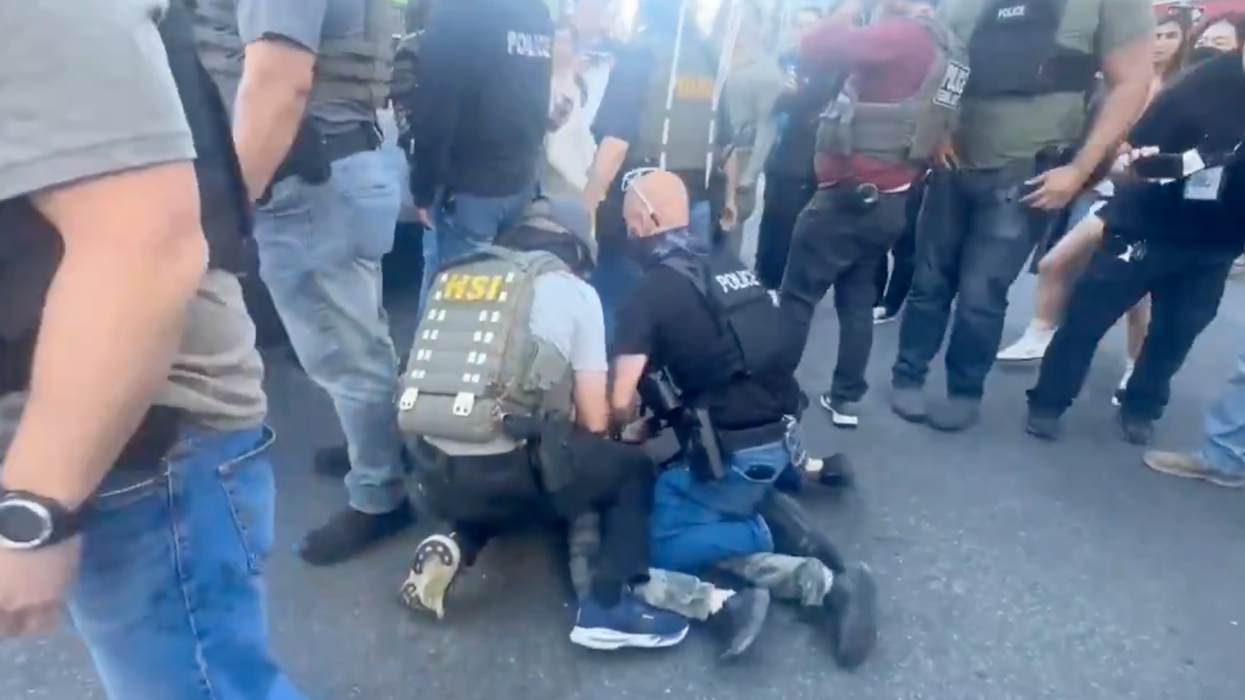
"Once again, the Trump administration chooses authoritarian theatrics that create fear, not safety," said NYC mayoral candidate Zohran Mamdani.
More scenes of chaos and community anger erupted Tuesday night in downtown New York City as federal agents under the orders of President Donald Trump targeted a popular area for street vendors, many of them immigrants struggling to get by, and shoppers looking for more affordable bags, clothing, and other accessories than what's available in retail stores.
Illegal street vending is a well-known practice in the Canal Street area of Chinatown. Still, the arrival of masked agents and military-style vehicles on Tuesday devolved into another episode of violence in Trump's America, with frightened vendors running for their lives and passersby expressing outrage over the violence being used against the unlicensed retailers.
According to local WABC 7:
NewsCopter 7 showed arrests taking place between Lafayette and Center streets in Chinatown, an area typically busy with merchants selling T-shirts, handbags, perfumes, and designer knockoffs, as New Yorkers faced off against federal agents.
The scene grew chaotic as vendors packed up their tables and attempted to flee, with several people seen running and falling as authorities from multiple agencies, including Homeland Security, ICE, DEA and the FBI, pursued them.
As agents tried to detain individuals, crowds of New Yorkers gathered, shouting and pushing in an attempt to intervene. Some bystanders were heard cursing at officers, one officer was seen pointing his taser at the angry crowd, and several arrests were made.
Footage from Canal Street posted online showed agents tackling vendors and the angry response from the crowds witnessing the heavy-handed raid:
Trump's Nazi ICE Gestapo has come to Canal Street in New York City to kidnap residents — and New Yorkers are having none of it. 😳👇 pic.twitter.com/olGgtLvjli
— Bill Madden (@maddenifico) October 21, 2025
"Trump's Nazi ICE Gestapo has come to Canal Street in New York City to kidnap residents—and New Yorkers are having none of it," said social justice activist Bill Madded in a social media post, pointing to the footage.
New York City Democratic mayoral candidate Zohran Mamdani also condemned the raid.
"Federal agents from ICE and HSI—some in military fatigues and masks—descended on Chinatown today in an aggressive and reckless raid on immigrant street vendors," Mamdani said in a statement. "Once again, the Trump administration chooses authoritarian theatrics that create fear, not safety. It must stop."
Tricia McLaughlin, a spokeswoman for DHS, told the New York Times that the operation was led by ICE and others, including the FBI and Border Patrol, but did not, the newspaper reported, "immediately indicate the number of people arrested or disclose their immigration status." Witnesses said agents were demanding proof of immigration status from those detained.
The surprise raid, noted many observers, came just days after right-wing political commentator Savanah Hernandez, a Trump loyalist, posted a video of herself on Canal Street documenting the street vending scene and denigrating many of the immigrants who find work there.
"A few days ago, this far-right poverty tourist and provocateur discovered Canal Street," noted Justin Brannan, a member of the New York City Council, referencing Hernandez's recent video segment. "Today, Trump’s ICE cowboys marched in. They're not hiding it. They're telegraphing it now."
As masked federal agents target street vendors on Canal Street, THE CITY watched one street vendor being detained.
As the operation carried on, agents were confronted with a spontaneous crowd of protesters.
MORE HERE: https://t.co/DsHGCcdDMV pic.twitter.com/jvAbm0jVgQ
— THE CITY (@THECITYNY) October 22, 2025
While members of the New York community denounced the raid, Hernandez, who is not from New York City, took a bow for what she accepted as her role in instigating it.
"Illegal immigration and the crime tied to it have been plaguing your city," Hernandez said with pride. "I make no apologies for reporting on what real New Yorkers have to deal with every single day."
A statement from the office of New York's Democratic Governor, Katherine Hochul, described Hernandez as "a bigot" and denounced the operation in the city.
The afternoon raid sparked an impromptu protest in lower Manhattan outside federal buildings that lasted late into the evening, with residents denouncing Trump and the behavior of the agencies operating in the city.
"I am so angry. What are they doing to our city? It's terrible," Nicole Parcher, a New York City resident who attended the protest, told WABC.

The man has been charged with one misdemeanor count of driving under the influence and two felony counts of reckless child endangerment.
Newly released body camera footage shows a Florida man claiming to be a federal immigration enforcement official racially profiling a police officer who pulled him over on the highway for drunk driving.
The footage, which was published on Thursday by YouTube account "The CrimePiece," shows the arrest of 42-year-old Miami resident Scott Thomas Deiseroth, who was pulled over by officers from the Monroe County Sheriff's Office on August 13.
The footage begins with the officer who pulled Deiseroth over asking him for his identification and asking him if he knew his current location.
Deiseroth reacted belligerently to the officer's questions and told him that he was a federal agent who worked for the Department of Homeland Security. As reported by local news station CBS 12, the Monroe County Sheriff's Office website at one point listed his occupation as an Immigration and Customs Enforcement (ICE) officer.
Deiseroth also told the officer that he was simply trying to get home and informed him that he had his two young sons with him riding in the backseat.
The officer then asked Deiseroth to step out of his car, to which Deiseroth replied, "Are you fucking serious right now?"
After exiting the vehicle, Deiseroth continued to exhibit hostility to the officer's questions, and he repeatedly demanded to know, "Are we really doing this right now?"
The officer then asked him how much he'd had to drink, and Deiseroth replied that he'd had four drinks, without specifying the nature of those drinks.
"Are you guys really trying to fuck me right now?" Deiseroth asked.
The officer informed Deiseroth that he could smell alcohol on him and he wanted to ensure that he was capable of safely driving his vehicle home.
The officer proceeded to administer field sobriety tests. During the tests, another officer came over to ensure that Deiseroth did not stumble while trying to walk a straight line along the side of a busy highway.
Deiseroth then questioned why the second officer, who was Black, was there, and the officer informed him that it was to prevent him from getting hit by oncoming traffic.
Deiseroth responded by repeatedly asking the officer, "Are you Haitian?"
Deiseroth was then informed by the officer administering the sobriety test that "it doesn't matter" where the other officer was from or his heritage.
"Yes it does," Deiseroth replied.
After failing the sobriety tests, Deiseroth was placed in handcuffs and informed that he was being placed under arrest. He then pleaded with the officers to not take him to prison and asked what they were going to do with his two children.
Later, after Deiseroth had been placed in the back of a police car, the officers informed him that his sons' mother—with whom Deiseroth had said earlier he was going through a divorce—would pick up the two children at the police station.
He repeatedly demanded that he be allowed to see his children before being taken to the police station, but the officers did not grant his request.
"Let me see my kids!" he demanded at one point.
"Brother, I really do not want them to see you in the way you're in right now," the officer replied.
Records at the Monroe County Sheriff's Office show that Deiseroth was subsequently charged with one misdemeanor count of driving under the influence and two felony counts of reckless child endangerment.
A request to the Florida State Attorney's Office in Monroe County to confirm Deiseroth's employment status at the time of the arrest was not returned by press time. The criminal case is pending.