

5
#000000
#FFFFFF
To donate by check, phone, or other method, see our More Ways to Give page.
Daily news & progressive opinion—funded by the people, not the corporations—delivered straight to your inbox.
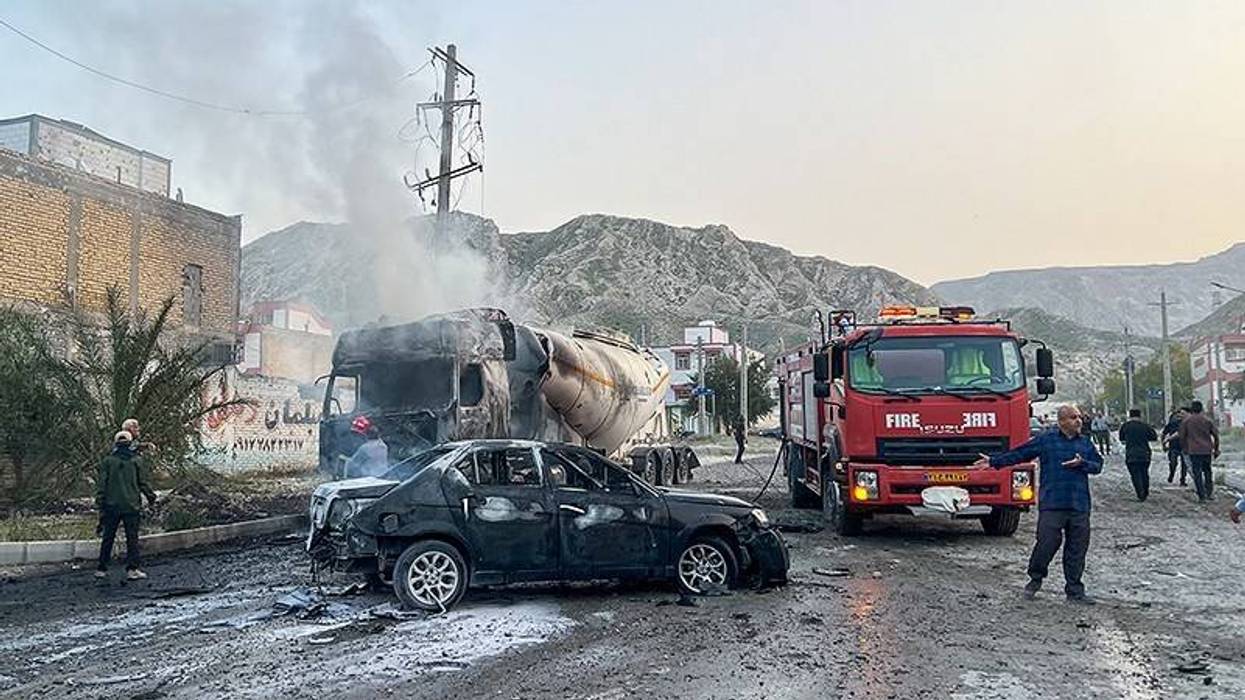
Munitions experts and The New York Times say a US missile designed to inflict maximum casualties was used in a February bombing that killed 21 people, including at least five children.
New information published Friday by the New York Times further suggests that the US military may have lied when it tried to pin the blame for a February airstrike that killed 21 people in Iran on the Iranian government, with evidence indicating that the US carried out the attack with a new missile designed to inflict maximum casualties.
While much of the world knows about the February 28 massacre of around 175 children and staff at the Shajareh Tayyebeh girls’ elementary school in Minab—and about how President Donald Trump initially blamed Iran for the slaughter—the strike that hit a sports hall and playground in Lamerd on the same day, the first day of the war, received far less media coverage.
Munitions experts and the Times concluded that US-made Precision Strike Missiles, or PrSMs—pronounced "prism"—struck the residential area of the southern Iranian city. Developed by Lockheed Martin, PrSMs are airburst weapons, exploding above their targets and blasting 180,000 lethal tungsten pellets in every direction. Video footage of the Lamerd strike shows multiple airbursts.
Pete Hegseth's Defense Dept appears to be caught in a lie.It involves deaths of 21 people (including at least 5 children), injuring 110 in Lamerd, Iran with sports hall and school.By a U.S. missile (PrSM) never before used in combat.NYT sources include: 3 US officials!1/
[image or embed]
— Ryan Goodman (@rgoodlaw.bsky.social) April 10, 2026 at 5:48 PM
The Times verified the identities of 21 people killed in the strike. At least five victims were children, the youngest of them just 2 years old. Helma Ahmadizadeh, 10, and Elham Zaeri, 11, were attending volleyball practice at the sports hall when it was bombed. Helma survived the strike with no visible injuries. However, she told her coach that she felt something enter her body. A medical examination at a local hospital revealed a small object in her body. She subsequently died.
"A young boy, Ilia Khatami, was killed alongside his coach, Mahmoud Najaf," the newspaper said. "The Times confirmed their deaths, and the death of a second boy, Abdul Mosavar Rahmani, who was from Afghanistan."
The 2-year-old, Avina Barzegar, was mortally wounded by a small object while she was playing outside her home. Video posted on Telegram shows her being treated in a local hospital before she died.
Local officials said 100 other people were injured in the attack.
Pentagon officials previously denied US responsibility for the attack following the March 29 publication of a Times investigation that used video analysis to identify PrSMs as the missiles used in the strike. US Central Command (CENTCOM) spokesperson Capt. Tim Hawkins issued a statement on March 31 calling reports that the US carried out the attack "false" and suggesting that weapon used in the strike was an Iranian Hoveyzeh cruise missile.
The Times' latest analysis is "based on new video footage of detonations, new photo evidence of the damage, a missile-trajectory assessment, and the perspectives of multiple experts, including three US government officials."
Findings include distinctive damage patterns consistent with tungsten pellet dispersion from a PrSM airburst, the discovery of a third detonation site consistent with a PrSM, a strike trajectory indicating the missile was launched from where US forces are based, and the sports hall's proximity to an Islamic Revolutionary Guards Corps base. The Minab girls' school is also located very close to an IRGC base.
Critically, Iran does not have any missiles in its arsenal that function in a similar manner to PrSMs.
“The problem is that CENTCOM chose as an alternative a very identifiable missile,” Amaël Kotlarski, who leads the weapons team at the defense intelligence firm Janes, told the Times. "And the Hoveyzeh’s distinct features aren’t seen in the video."
Shahryar Pasandideh, another military analyst consulted by the Times, said "there is no public information to suggest that Iranian cruise missiles, including the Hoveyzeh, are equipped with an airburst fuse, let alone an airburst fuse and pre-formed tungsten pellets."
After the Minab massacre, Trump claimed that Iran had somehow acquired a US Tomahawk missile and used it to blow up the school.
An earlier investigation by the BBC Verify also concluded that the Lamerd strike was carried out using US PrSM missiles.
VIDEO | According to a report from BBC Verify, video evidence and expert assessment suggest a US Precision Strike Missile (PrSM) was likely involved in an attack on a sports hall in Lamerd, southwestern Iran on 28 February. The attack killed at least 21 people, including… pic.twitter.com/alZ25dVMl6
— The Cradle (@TheCradleMedia) March 29, 2026
More than 3,000 people have been killed over 42 days of US and Israeli strikes on Iran, according to medical officials there. This figure reportedly includes over 1,300 civilians, hundreds of whom are women and children.

"Tupac said it decades ago, it continues to be true."
He may prefer Biggie over Tupac, but New York City Mayor Zohran Mamdani gave a nod to the latter's immortal observation on misplaced national priorities during an interview in which he condemned the US-Israeli war against Iran.
"I've made clear my very deep opposition to this war in Iran," Mamdani told Richard Gaisford in a "Talk to Al Jazeera" segment aired Thursday on the Qatari news network. "It is an opposition not just of a procedural nature or a political nature, but frankly of a moral nature."
"We are speaking about a war that has killed thousands of civilians, a war that is deeply unpopular across this city and across this country," Mamdani said. "Not just because of what we are seeing it result in, but also because it is utilizing tens of billions of dollars to kill people, money that could otherwise be spent on making life easier for people across this city and this country."
"The very things that I often speak about that are necessary for working class New Yorkers that we are told are impossible or unrealistic, they would cost a fraction of this tens of billions that we're seeing," the mayor asserted.
Gaisford asked Mamdani if he is frustrated that "$900 million a day [is] being spent on the war, when you have projects that cost much less that can make a difference."
"I think it should frustrate all of us, you know what I mean?" the democratic socialist mayor replied. "Tupac said it decades ago, it continues to be true, about the fact that we always seem to have money for war but not to feed the poor. And that is not the way politics should be; that is not what Americans want politics to be."
Mamdani was referring to Tupac Shakur's 1993 track "Keep Ya Head Up," which contains the lyrics, "You know, it's funny when it rains it pours/They got money for wars, but can't feed the poor."
Shakur's 1998 song "Changes" also feels relevant today, as the slain rapper asks, "Can't a brother get a little peace?/It's war on the streets and the war in the Middle East/Instead of war on poverty, they got a war on drugs so the police can bother me."
Watch Mamdani's interview with Gaisford here:
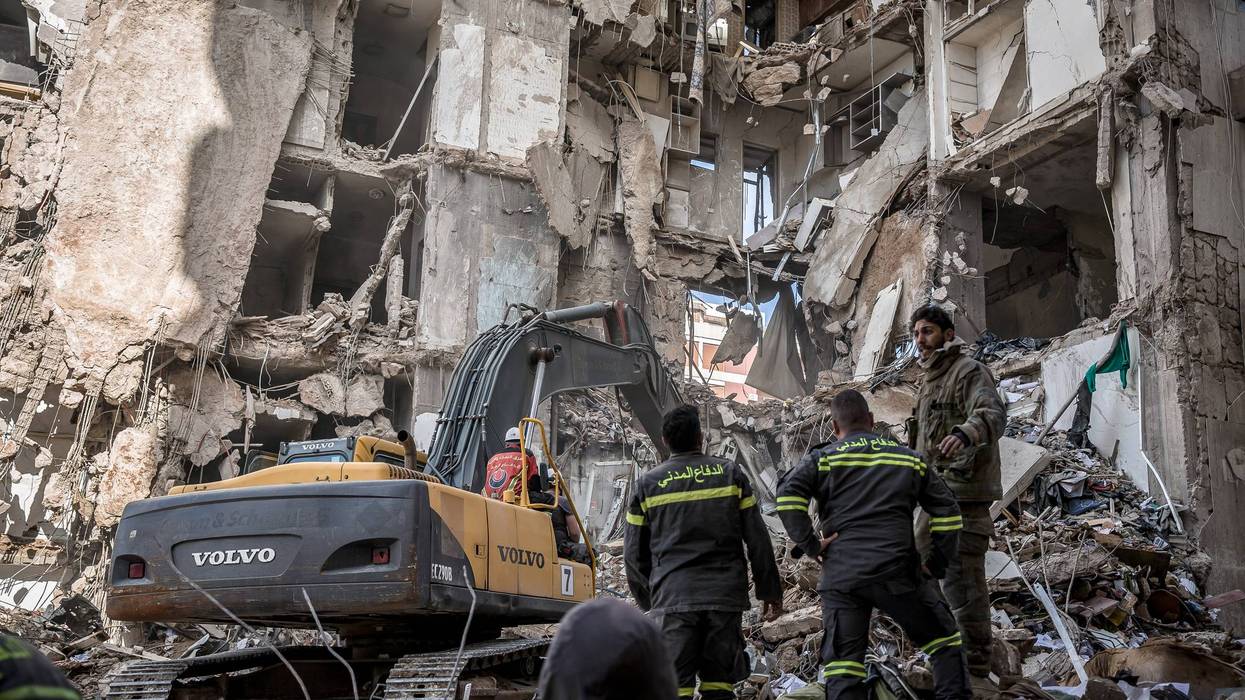
The United Nations Children's Fund warned that Israel's continued assault on Lebanon "poses a grave risk to the ceasefire and the efforts toward a lasting and comprehensive peace."
A United Nations agency said late Thursday that Israel's massive bombardment of Lebanon earlier this week killed or wounded more than 180 children, a statement issued as the Israeli military vowed to continue assailing the war-ravaged country—potentially derailing ceasefire efforts in Iran and across the region.
The UN Children's Fund, widely known as UNICEF, said the toll from Israel's assault on Wednesday brought the total number of children killed or wounded in Lebanon since March 2 to at least 600. The agency said it is "receiving reports of children being pulled from under the rubble, while others remain missing and separated from their families."
"Many are experiencing trauma, having lost loved ones, their homes, and any sense of safety," UNICEF said. "Across the country, more than one million people have been uprooted, including an estimated 390,000 children, many for the second, third, or even fourth time."
UNICEF went on to echo growing concerns in the region, and around the world, that Israel's continued bombing and invasion of Lebanon "poses a grave risk to the ceasefire and the efforts toward a lasting and comprehensive peace."
"The children in Lebanon cannot be left behind," the UN agency said.
UNICEF's statement came as the chief of staff of the Israel Defense Forces said Lebanon is the Israeli military's "primary combat" zone and that the IDF is "in a state of war, we are not in a ceasefire."
US President Donald Trump and Israeli Prime Minister Benjamin Netanyahu have both insisted that Lebanon was not included in the Iran ceasefire agreement announced late Tuesday—a claim that Iranian leaders and Pakistan's prime minister, who is mediating peace talks, have said is false.
On Thursday, Trump said Netanyahu agreed during a phone call to "low-key it" in Lebanon. But in a recorded statement addressed to residents of northern Israel on Thursday, Netanyahu declared: “There is no ceasefire in Lebanon. We continue to strike Hezbollah with force, and we will not stop until we restore your security.”
Netanyahu's decision to escalate Israel's attacks on Lebanon—killing hundreds of people and leveling entire neighborhoods—just hours after Trump announced the ceasefire deal with Iran fit with a longstanding pattern of the Israeli government undercutting diplomacy.
Jamal Abdi, president of the National Iranian American Council, wrote for The Intercept on Thursday that Israel "has worked ceaselessly to prevent any off-ramp from confrontation between the US and Iran," noting that "in 1995, when Iran and the US flirted with economic rapprochement by opening the Iran oil industry to American investment and development, Israel and AIPAC lobbied Congress and President Bill Clinton to block it."
"Netanyahu is widely thought to benefit from wars—from Gaza to Iran and now, most critically, in Lebanon—to shore up his political fortunes. He faces an election in October, and losing could lead to the revival of corruption charges that might land him in prison," Abdi noted. "The question now may unfortunately not be whether Iran and the US can find a compromise. Instead, the fate of the global economy and, not least, Iranians themselves, could rest between Netanyahu and Trump, who faces his own political challenges in midterm elections this year."
US Sen. Chris Van Hollen (D-Md.) wrote Thursday that "Netanyahu urged Trump to start this war, now Trump must demand he help end it."
"Who's calling the shots here?" Van Hollen asked.

“America’s small businesses, workers, and families are really feeling pain at the pump—all thanks to Trump’s illegal war on Iran,” the Massachusetts Democrat said.
An analysis published Thursday by the office of US Sen. Ed Markey estimates that the average American motorist will pay nearly $1,100 extra for gasoline in 2026 due to President Donald Trump's war of choice on Iran.
"The data highlights a worsening affordability crisis, with the average American family facing an annual increase of $1,096 this year if gas prices remain at $4.14 per gallon—a shocking increase of $1.16 per gallon since Trump launched his war on Iran in February," Markey's (D-Mass.) office said.
"These numbers are likely an underestimate," the analysis notes. "Many analysts predict gasoline prices will rise higher without a permanent end to the war. Instead of investing in energy independence, Trump has done everything in his power to destroy American-made affordable clean energy... and double down on the fossil fuels that are now skyrocketing in price."
"As Americans pay more at the pump, fossil fuel industry executives profit," Markey's office said. "During Trump’s first year in office, the five largest oil companies—ExxonMobil, Chevron, ConocoPhillips, Shell, and BP—made more than $75 billion dollars in profits."
Fossil fuel interests spent $445 million to help elect Trump and other Republicans in 2024. And while some Big Oil executives are reportedly upset that the ceasefire agreement with Iran apparently includes Iranian control of the Strait of Hormuz and the power to charge tolls to tankers passing through the vital waterway, industry executives sold a reported $1.4 billion in shares before and during the war that they may subsequently buy back during market dips fueled by the volatility caused by Trump's actions.
“America’s small businesses, workers, and families are really feeling pain at the pump—all thanks to Trump’s illegal war on Iran," Markey, the ranking member of the Senate Small Business and Entrepreneurship Committee, said in a statement introducing the analysis. "Instead of delivering real relief to the American people, Trump is doubling down on his reckless economic policies, which are only driving up energy prices, enriching his oil and gas buddies, and worsening the affordability crisis for everyone else."
“In uncertain times like these, gas prices go up like a rocket but come down like a feather," he added. "This administration must get serious about alleviating the crisis he alone created, or risk further throttling families’ finances and putting even more pain on Main Street.”
A Pew Research Center survey published earlier this week revealed that gas prices are Americans' biggest concern about the Iran War, with 69% worried about higher fuel costs. By comparison, 61% said they were concerned about sending ground troops to invade Iran, 59% fretted over high casualties among US troops, and 56% said they fear a terror attack on the United States.
This isn't the first time that Markey has shined a spotlight on the economic harm to American families caused by the actions of a president who campaigned upon core promises of lower consumer prices—including gasoline—and no new wars. Last month, Markey asked the Bureau of Labor Statistics to “immediately undertake and publish a comprehensive analysis of the likely consumer price impacts” of the war over the next 6-12 months.
Our nation is at a moral crossroads.Trump asked Congress for over 1 trillion to fund the Department of Defense and his war of choice. To get it, MAGA Republicans want to defund childcare. Healthcare. Education. I won't stand for that.
[image or embed]
— Ed Markey (@edmarkey.bsky.social) April 9, 2026 at 3:31 PM
Markey's analysis came on the same day that the National Priorities Project at the Institute for Policy Studies published a report estimating that the average American taxpayer gave $4,000 to the federal government last year “for militarism and its support systems."
That cost is likely to rise even further if Congress approves Trump's request for a record $1.5 trillion US military budget for the next fiscal year.