

SUBSCRIBE TO OUR FREE NEWSLETTER
Daily news & progressive opinion—funded by the people, not the corporations—delivered straight to your inbox.
5
#000000
#FFFFFF
To donate by check, phone, or other method, see our More Ways to Give page.
Daily news & progressive opinion—funded by the people, not the corporations—delivered straight to your inbox.
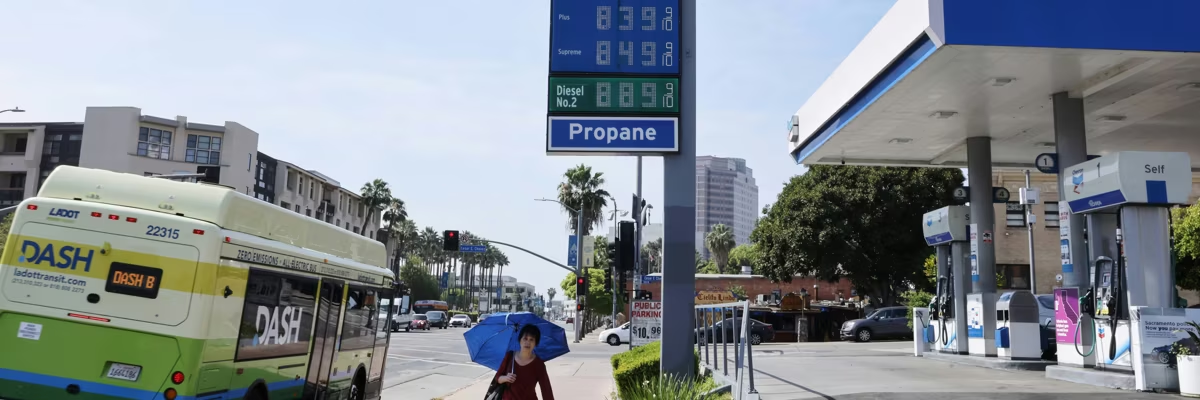
Gas is seen on sale for over $8 per gallon at a Chevron station in Los Angeles on April 9, 2026.
“America’s small businesses, workers, and families are really feeling pain at the pump—all thanks to Trump’s illegal war on Iran,” the Massachusetts Democrat said.
An analysis published Thursday by the office of US Sen. Ed Markey estimates that the average American motorist will pay nearly $1,100 extra for gasoline in 2026 due to President Donald Trump's war of choice on Iran.
"The data highlights a worsening affordability crisis, with the average American family facing an annual increase of $1,096 this year if gas prices remain at $4.14 per gallon—a shocking increase of $1.16 per gallon since Trump launched his war on Iran in February," Markey's (D-Mass.) office said.
"These numbers are likely an underestimate," the analysis notes. "Many analysts predict gasoline prices will rise higher without a permanent end to the war. Instead of investing in energy independence, Trump has done everything in his power to destroy American-made affordable clean energy... and double down on the fossil fuels that are now skyrocketing in price."
"As Americans pay more at the pump, fossil fuel industry executives profit," Markey's office said. "During Trump’s first year in office, the five largest oil companies—ExxonMobil, Chevron, ConocoPhillips, Shell, and BP—made more than $75 billion dollars in profits."
Fossil fuel interests spent $445 million to help elect Trump and other Republicans in 2024. And while some Big Oil executives are reportedly upset that the ceasefire agreement with Iran apparently includes Iranian control of the Strait of Hormuz and the power to charge tolls to tankers passing through the vital waterway, industry executives sold a reported $1.4 billion in shares before and during the war that they may subsequently buy back during market dips fueled by the volatility caused by Trump's actions.
“America’s small businesses, workers, and families are really feeling pain at the pump—all thanks to Trump’s illegal war on Iran," Markey, the ranking member of the Senate Small Business and Entrepreneurship Committee, said in a statement introducing the analysis. "Instead of delivering real relief to the American people, Trump is doubling down on his reckless economic policies, which are only driving up energy prices, enriching his oil and gas buddies, and worsening the affordability crisis for everyone else."
“In uncertain times like these, gas prices go up like a rocket but come down like a feather," he added. "This administration must get serious about alleviating the crisis he alone created, or risk further throttling families’ finances and putting even more pain on Main Street.”
A Pew Research Center survey published earlier this week revealed that gas prices are Americans' biggest concern about the Iran War, with 69% worried about higher fuel costs. By comparison, 61% said they were concerned about sending ground troops to invade Iran, 59% fretted over high casualties among US troops, and 56% said they fear a terror attack on the United States.
This isn't the first time that Markey has shined a spotlight on the economic harm to American families caused by the actions of a president who campaigned upon core promises of lower consumer prices—including gasoline—and no new wars. Last month, Markey asked the Bureau of Labor Statistics to “immediately undertake and publish a comprehensive analysis of the likely consumer price impacts” of the war over the next 6-12 months.
Our nation is at a moral crossroads.Trump asked Congress for over 1 trillion to fund the Department of Defense and his war of choice. To get it, MAGA Republicans want to defund childcare. Healthcare. Education. I won't stand for that.
[image or embed]
— Ed Markey (@edmarkey.bsky.social) April 9, 2026 at 3:31 PM
Markey's analysis came on the same day that the National Priorities Project at the Institute for Policy Studies published a report estimating that the average American taxpayer gave $4,000 to the federal government last year “for militarism and its support systems."
That cost is likely to rise even further if Congress approves Trump's request for a record $1.5 trillion US military budget for the next fiscal year.
Dear Common Dreams reader, It’s been nearly 30 years since I co-founded Common Dreams with my late wife, Lina Newhouser. We had the radical notion that journalism should serve the public good, not corporate profits. It was clear to us from the outset what it would take to build such a project. No paid advertisements. No corporate sponsors. No millionaire publisher telling us what to think or do. Many people said we wouldn't last a year, but we proved those doubters wrong. Together with a tremendous team of journalists and dedicated staff, we built an independent media outlet free from the constraints of profits and corporate control. Our mission has always been simple: To inform. To inspire. To ignite change for the common good. Building Common Dreams was not easy. Our survival was never guaranteed. When you take on the most powerful forces—Wall Street greed, fossil fuel industry destruction, Big Tech lobbyists, and uber-rich oligarchs who have spent billions upon billions rigging the economy and democracy in their favor—the only bulwark you have is supporters who believe in your work. But here’s the urgent message from me today. It's never been this bad out there. And it's never been this hard to keep us going. At the very moment Common Dreams is most needed, the threats we face are intensifying. We need your support now more than ever. We don't accept corporate advertising and never will. We don't have a paywall because we don't think people should be blocked from critical news based on their ability to pay. Everything we do is funded by the donations of readers like you. When everyone does the little they can afford, we are strong. But if that support retreats or dries up, so do we. Will you donate now to make sure Common Dreams not only survives but thrives? —Craig Brown, Co-founder |
An analysis published Thursday by the office of US Sen. Ed Markey estimates that the average American motorist will pay nearly $1,100 extra for gasoline in 2026 due to President Donald Trump's war of choice on Iran.
"The data highlights a worsening affordability crisis, with the average American family facing an annual increase of $1,096 this year if gas prices remain at $4.14 per gallon—a shocking increase of $1.16 per gallon since Trump launched his war on Iran in February," Markey's (D-Mass.) office said.
"These numbers are likely an underestimate," the analysis notes. "Many analysts predict gasoline prices will rise higher without a permanent end to the war. Instead of investing in energy independence, Trump has done everything in his power to destroy American-made affordable clean energy... and double down on the fossil fuels that are now skyrocketing in price."
"As Americans pay more at the pump, fossil fuel industry executives profit," Markey's office said. "During Trump’s first year in office, the five largest oil companies—ExxonMobil, Chevron, ConocoPhillips, Shell, and BP—made more than $75 billion dollars in profits."
Fossil fuel interests spent $445 million to help elect Trump and other Republicans in 2024. And while some Big Oil executives are reportedly upset that the ceasefire agreement with Iran apparently includes Iranian control of the Strait of Hormuz and the power to charge tolls to tankers passing through the vital waterway, industry executives sold a reported $1.4 billion in shares before and during the war that they may subsequently buy back during market dips fueled by the volatility caused by Trump's actions.
“America’s small businesses, workers, and families are really feeling pain at the pump—all thanks to Trump’s illegal war on Iran," Markey, the ranking member of the Senate Small Business and Entrepreneurship Committee, said in a statement introducing the analysis. "Instead of delivering real relief to the American people, Trump is doubling down on his reckless economic policies, which are only driving up energy prices, enriching his oil and gas buddies, and worsening the affordability crisis for everyone else."
“In uncertain times like these, gas prices go up like a rocket but come down like a feather," he added. "This administration must get serious about alleviating the crisis he alone created, or risk further throttling families’ finances and putting even more pain on Main Street.”
A Pew Research Center survey published earlier this week revealed that gas prices are Americans' biggest concern about the Iran War, with 69% worried about higher fuel costs. By comparison, 61% said they were concerned about sending ground troops to invade Iran, 59% fretted over high casualties among US troops, and 56% said they fear a terror attack on the United States.
This isn't the first time that Markey has shined a spotlight on the economic harm to American families caused by the actions of a president who campaigned upon core promises of lower consumer prices—including gasoline—and no new wars. Last month, Markey asked the Bureau of Labor Statistics to “immediately undertake and publish a comprehensive analysis of the likely consumer price impacts” of the war over the next 6-12 months.
Our nation is at a moral crossroads.Trump asked Congress for over 1 trillion to fund the Department of Defense and his war of choice. To get it, MAGA Republicans want to defund childcare. Healthcare. Education. I won't stand for that.
[image or embed]
— Ed Markey (@edmarkey.bsky.social) April 9, 2026 at 3:31 PM
Markey's analysis came on the same day that the National Priorities Project at the Institute for Policy Studies published a report estimating that the average American taxpayer gave $4,000 to the federal government last year “for militarism and its support systems."
That cost is likely to rise even further if Congress approves Trump's request for a record $1.5 trillion US military budget for the next fiscal year.
An analysis published Thursday by the office of US Sen. Ed Markey estimates that the average American motorist will pay nearly $1,100 extra for gasoline in 2026 due to President Donald Trump's war of choice on Iran.
"The data highlights a worsening affordability crisis, with the average American family facing an annual increase of $1,096 this year if gas prices remain at $4.14 per gallon—a shocking increase of $1.16 per gallon since Trump launched his war on Iran in February," Markey's (D-Mass.) office said.
"These numbers are likely an underestimate," the analysis notes. "Many analysts predict gasoline prices will rise higher without a permanent end to the war. Instead of investing in energy independence, Trump has done everything in his power to destroy American-made affordable clean energy... and double down on the fossil fuels that are now skyrocketing in price."
"As Americans pay more at the pump, fossil fuel industry executives profit," Markey's office said. "During Trump’s first year in office, the five largest oil companies—ExxonMobil, Chevron, ConocoPhillips, Shell, and BP—made more than $75 billion dollars in profits."
Fossil fuel interests spent $445 million to help elect Trump and other Republicans in 2024. And while some Big Oil executives are reportedly upset that the ceasefire agreement with Iran apparently includes Iranian control of the Strait of Hormuz and the power to charge tolls to tankers passing through the vital waterway, industry executives sold a reported $1.4 billion in shares before and during the war that they may subsequently buy back during market dips fueled by the volatility caused by Trump's actions.
“America’s small businesses, workers, and families are really feeling pain at the pump—all thanks to Trump’s illegal war on Iran," Markey, the ranking member of the Senate Small Business and Entrepreneurship Committee, said in a statement introducing the analysis. "Instead of delivering real relief to the American people, Trump is doubling down on his reckless economic policies, which are only driving up energy prices, enriching his oil and gas buddies, and worsening the affordability crisis for everyone else."
“In uncertain times like these, gas prices go up like a rocket but come down like a feather," he added. "This administration must get serious about alleviating the crisis he alone created, or risk further throttling families’ finances and putting even more pain on Main Street.”
A Pew Research Center survey published earlier this week revealed that gas prices are Americans' biggest concern about the Iran War, with 69% worried about higher fuel costs. By comparison, 61% said they were concerned about sending ground troops to invade Iran, 59% fretted over high casualties among US troops, and 56% said they fear a terror attack on the United States.
This isn't the first time that Markey has shined a spotlight on the economic harm to American families caused by the actions of a president who campaigned upon core promises of lower consumer prices—including gasoline—and no new wars. Last month, Markey asked the Bureau of Labor Statistics to “immediately undertake and publish a comprehensive analysis of the likely consumer price impacts” of the war over the next 6-12 months.
Our nation is at a moral crossroads.Trump asked Congress for over 1 trillion to fund the Department of Defense and his war of choice. To get it, MAGA Republicans want to defund childcare. Healthcare. Education. I won't stand for that.
[image or embed]
— Ed Markey (@edmarkey.bsky.social) April 9, 2026 at 3:31 PM
Markey's analysis came on the same day that the National Priorities Project at the Institute for Policy Studies published a report estimating that the average American taxpayer gave $4,000 to the federal government last year “for militarism and its support systems."
That cost is likely to rise even further if Congress approves Trump's request for a record $1.5 trillion US military budget for the next fiscal year.

