SUBSCRIBE TO OUR FREE NEWSLETTER
Daily news & progressive opinion—funded by the people, not the corporations—delivered straight to your inbox.
5
#000000
#FFFFFF
To donate by check, phone, or other method, see our More Ways to Give page.
Daily news & progressive opinion—funded by the people, not the corporations—delivered straight to your inbox.
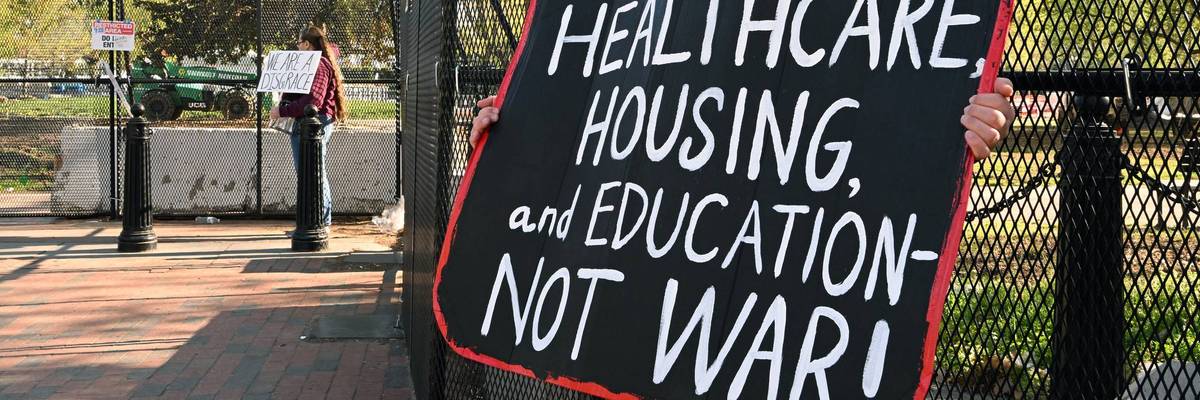
A demonstrator holds a placard in front of the White House in Washington, DC on April 7, 2026.
"Our tax dollars are doing more to bomb children in Iran and other countries than to feed and educate children here."
A new analysis released Thursday estimates that the average American taxpayer shelled out over $4,000 to the federal government last year "for militarism and its support systems" such as the Pentagon, whose already-massive annual budget is poised to surge to $1.5 trillion if President Donald Trump gets his way.
The National Priorities Project (NPP) at the Institute for Policy Studies found in its latest annual Tax Receipt report that, through their federal taxes, the average US taxpayer contributed $4,049.35 to Pentagon contractors, military personnel, nuclear weapons, aid to foreign militaries, and last year's bombing of Iran's nuclear energy facilities. That's significantly more than the average US taxpayer contributed to healthcare for low-income Americans through Medicaid—$2,492.
NPP's estimated militarism sum for last year does not include costs related to the current, massively unpopular US-Israeli war on Iran, which began on February 28, 2026 and has already cost Americans billions at the pump.
"But if we place the 2026 Iran war costs in the context of our 2025 tax receipt and put the cost at $35 billion—a line the US is likely on the verge of crossing—the average taxpayer will have paid $130 for the war on Iran, eight times more than the $16 the average taxpayer paid for a full year of home heating and energy assistance in 2025," NPP said.
The $1,870 that the average US taxpayer paid toward Pentagon contractors in 2025 was "fifteen times as much as the $124 the average taxpayer paid for school lunches and other nutrition programs," the analysis found.
“It’s shameful that our tax dollars are doing more to bomb children in Iran and other countries than to feed and educate children here," said Lindsay Koshgarian, NPP's program director. "Instead of spending even more of our hard-earned dollars on war and mass deportation, we deserve a massive reinvestment in making this country a place where we can all survive and thrive."
"We’re facing chronic underinvestment in this country, from healthcare to education and more. That money has instead been funding a $1 trillion war machine and a class of Pentagon contractors getting rich off our tax dollars."
NPP noted that Trump's recent request for a $1.5 trillion US military budget for the coming fiscal year would, if approved by Congress, further drive up costs for American taxpayers.
"Our tax receipt shows why so many people in this country are struggling," said Koshgarian. "We’re facing chronic underinvestment in this country, from healthcare to education and more. That money has instead been funding a $1 trillion war machine and a class of Pentagon contractors getting rich off our tax dollars. The good news is that if we reverse our backwards priorities, we can start to make Americans’ lives better."
MarketWatch reported earlier this week that Americans are "increasingly saying they won't pay their taxes this year as a political protest," citing the illegal war on Iran and Trump's unleashing of federal immigration agents and National Guard troops on US cities.
Activist and attorney Rachel Cohen wrote in Current Affairs magazine last month that she is not paying her federal income taxes this year, noting that "our enormous military budget is going to illegal wars of aggression in multiple hemispheres."
"When I learned about pacifists who participated in draft refusal during the Vietnam War," Cohen wrote, "I was confident they were doing the right thing, and that if I were similarly situated, I would have joined them."
Dear Common Dreams reader, It’s been nearly 30 years since I co-founded Common Dreams with my late wife, Lina Newhouser. We had the radical notion that journalism should serve the public good, not corporate profits. It was clear to us from the outset what it would take to build such a project. No paid advertisements. No corporate sponsors. No millionaire publisher telling us what to think or do. Many people said we wouldn't last a year, but we proved those doubters wrong. Together with a tremendous team of journalists and dedicated staff, we built an independent media outlet free from the constraints of profits and corporate control. Our mission has always been simple: To inform. To inspire. To ignite change for the common good. Building Common Dreams was not easy. Our survival was never guaranteed. When you take on the most powerful forces—Wall Street greed, fossil fuel industry destruction, Big Tech lobbyists, and uber-rich oligarchs who have spent billions upon billions rigging the economy and democracy in their favor—the only bulwark you have is supporters who believe in your work. But here’s the urgent message from me today. It's never been this bad out there. And it's never been this hard to keep us going. At the very moment Common Dreams is most needed, the threats we face are intensifying. We need your support now more than ever. We don't accept corporate advertising and never will. We don't have a paywall because we don't think people should be blocked from critical news based on their ability to pay. Everything we do is funded by the donations of readers like you. When everyone does the little they can afford, we are strong. But if that support retreats or dries up, so do we. Will you donate now to make sure Common Dreams not only survives but thrives? —Craig Brown, Co-founder |
A new analysis released Thursday estimates that the average American taxpayer shelled out over $4,000 to the federal government last year "for militarism and its support systems" such as the Pentagon, whose already-massive annual budget is poised to surge to $1.5 trillion if President Donald Trump gets his way.
The National Priorities Project (NPP) at the Institute for Policy Studies found in its latest annual Tax Receipt report that, through their federal taxes, the average US taxpayer contributed $4,049.35 to Pentagon contractors, military personnel, nuclear weapons, aid to foreign militaries, and last year's bombing of Iran's nuclear energy facilities. That's significantly more than the average US taxpayer contributed to healthcare for low-income Americans through Medicaid—$2,492.
NPP's estimated militarism sum for last year does not include costs related to the current, massively unpopular US-Israeli war on Iran, which began on February 28, 2026 and has already cost Americans billions at the pump.
"But if we place the 2026 Iran war costs in the context of our 2025 tax receipt and put the cost at $35 billion—a line the US is likely on the verge of crossing—the average taxpayer will have paid $130 for the war on Iran, eight times more than the $16 the average taxpayer paid for a full year of home heating and energy assistance in 2025," NPP said.
The $1,870 that the average US taxpayer paid toward Pentagon contractors in 2025 was "fifteen times as much as the $124 the average taxpayer paid for school lunches and other nutrition programs," the analysis found.
“It’s shameful that our tax dollars are doing more to bomb children in Iran and other countries than to feed and educate children here," said Lindsay Koshgarian, NPP's program director. "Instead of spending even more of our hard-earned dollars on war and mass deportation, we deserve a massive reinvestment in making this country a place where we can all survive and thrive."
"We’re facing chronic underinvestment in this country, from healthcare to education and more. That money has instead been funding a $1 trillion war machine and a class of Pentagon contractors getting rich off our tax dollars."
NPP noted that Trump's recent request for a $1.5 trillion US military budget for the coming fiscal year would, if approved by Congress, further drive up costs for American taxpayers.
"Our tax receipt shows why so many people in this country are struggling," said Koshgarian. "We’re facing chronic underinvestment in this country, from healthcare to education and more. That money has instead been funding a $1 trillion war machine and a class of Pentagon contractors getting rich off our tax dollars. The good news is that if we reverse our backwards priorities, we can start to make Americans’ lives better."
MarketWatch reported earlier this week that Americans are "increasingly saying they won't pay their taxes this year as a political protest," citing the illegal war on Iran and Trump's unleashing of federal immigration agents and National Guard troops on US cities.
Activist and attorney Rachel Cohen wrote in Current Affairs magazine last month that she is not paying her federal income taxes this year, noting that "our enormous military budget is going to illegal wars of aggression in multiple hemispheres."
"When I learned about pacifists who participated in draft refusal during the Vietnam War," Cohen wrote, "I was confident they were doing the right thing, and that if I were similarly situated, I would have joined them."
A new analysis released Thursday estimates that the average American taxpayer shelled out over $4,000 to the federal government last year "for militarism and its support systems" such as the Pentagon, whose already-massive annual budget is poised to surge to $1.5 trillion if President Donald Trump gets his way.
The National Priorities Project (NPP) at the Institute for Policy Studies found in its latest annual Tax Receipt report that, through their federal taxes, the average US taxpayer contributed $4,049.35 to Pentagon contractors, military personnel, nuclear weapons, aid to foreign militaries, and last year's bombing of Iran's nuclear energy facilities. That's significantly more than the average US taxpayer contributed to healthcare for low-income Americans through Medicaid—$2,492.
NPP's estimated militarism sum for last year does not include costs related to the current, massively unpopular US-Israeli war on Iran, which began on February 28, 2026 and has already cost Americans billions at the pump.
"But if we place the 2026 Iran war costs in the context of our 2025 tax receipt and put the cost at $35 billion—a line the US is likely on the verge of crossing—the average taxpayer will have paid $130 for the war on Iran, eight times more than the $16 the average taxpayer paid for a full year of home heating and energy assistance in 2025," NPP said.
The $1,870 that the average US taxpayer paid toward Pentagon contractors in 2025 was "fifteen times as much as the $124 the average taxpayer paid for school lunches and other nutrition programs," the analysis found.
“It’s shameful that our tax dollars are doing more to bomb children in Iran and other countries than to feed and educate children here," said Lindsay Koshgarian, NPP's program director. "Instead of spending even more of our hard-earned dollars on war and mass deportation, we deserve a massive reinvestment in making this country a place where we can all survive and thrive."
"We’re facing chronic underinvestment in this country, from healthcare to education and more. That money has instead been funding a $1 trillion war machine and a class of Pentagon contractors getting rich off our tax dollars."
NPP noted that Trump's recent request for a $1.5 trillion US military budget for the coming fiscal year would, if approved by Congress, further drive up costs for American taxpayers.
"Our tax receipt shows why so many people in this country are struggling," said Koshgarian. "We’re facing chronic underinvestment in this country, from healthcare to education and more. That money has instead been funding a $1 trillion war machine and a class of Pentagon contractors getting rich off our tax dollars. The good news is that if we reverse our backwards priorities, we can start to make Americans’ lives better."
MarketWatch reported earlier this week that Americans are "increasingly saying they won't pay their taxes this year as a political protest," citing the illegal war on Iran and Trump's unleashing of federal immigration agents and National Guard troops on US cities.
Activist and attorney Rachel Cohen wrote in Current Affairs magazine last month that she is not paying her federal income taxes this year, noting that "our enormous military budget is going to illegal wars of aggression in multiple hemispheres."
"When I learned about pacifists who participated in draft refusal during the Vietnam War," Cohen wrote, "I was confident they were doing the right thing, and that if I were similarly situated, I would have joined them."