

SUBSCRIBE TO OUR FREE NEWSLETTER
Daily news & progressive opinion—funded by the people, not the corporations—delivered straight to your inbox.
5
#000000
#FFFFFF
To donate by check, phone, or other method, see our More Ways to Give page.
Daily news & progressive opinion—funded by the people, not the corporations—delivered straight to your inbox.
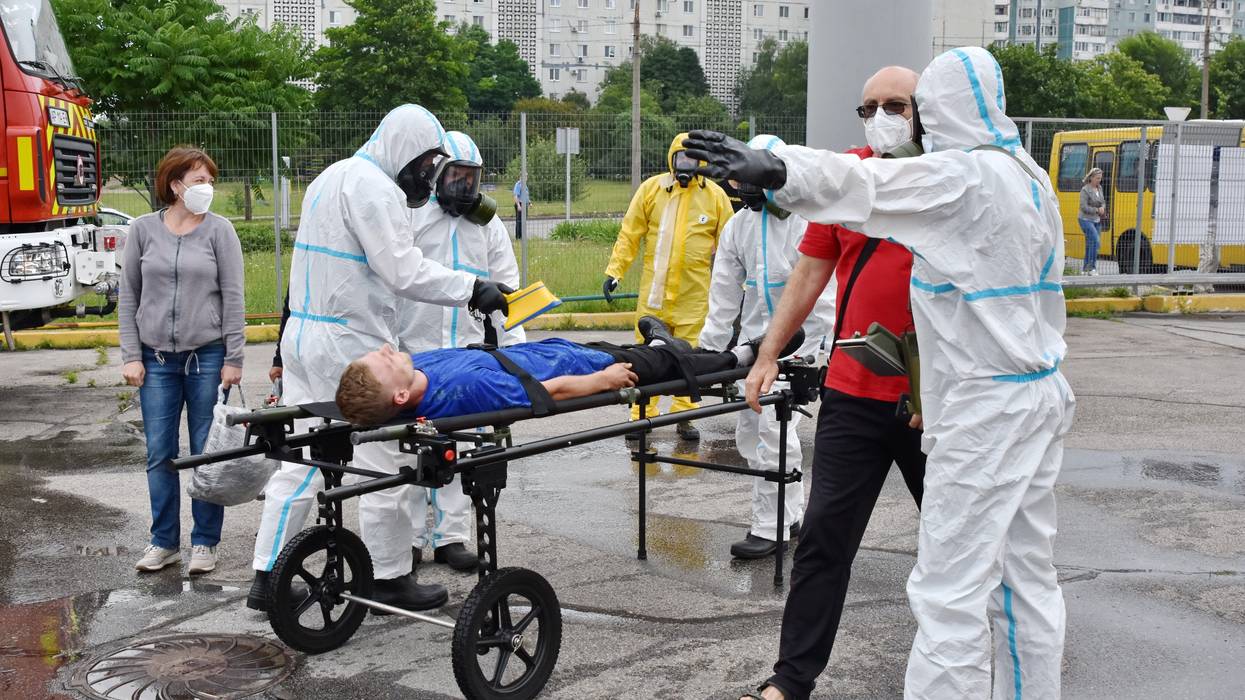
"Calling for a no-fire zone around Zaporizhzhia is not enough," said Beyond Nuclear. "We must call for no nuclear power at all."
With Ukrainian and Russian officials trading accusations about a possible looming attack on Europe's largest nuclear power plant this week, global experts and campaigners are sharing fresh concerns about the facility and the energy source more broadly.
Russian forces invaded Ukraine in February 2022 and took control of the Zaporizhzhia Nuclear Power Plant (ZNPP) the following month. Since then, fighting near the facility—with six reactors that are currently shut down—has generated fears around the world and controversial references to the 1986 Chernobyl disaster, the site of which is located in present-day Ukraine.
In recent days, an adviser to Russia's nuclear agency has claimed Ukraine will imminently cause a nuclear disaster at the ZNPP while Ukrainian President Volodymyr Zelenskyy has warned of a potential false flag operation, claiming that "the Russian military has placed objects resembling explosives on the roof of several power units."
While International Atomic Energy Agency (IAEA) experts at the facility have so far not observed any visible indications of mines or explosives, the new accusations led the United Nations watchdog on Wednesday to request additional access—specifically to the rooftops of two reactors along with parts of the turbine halls and cooling system.
"With military tension and activities increasing in the region where this major nuclear power plant is located, our experts must be able to verify the facts on the ground," said IAEA Director General Rafael Mariano Grossi. "Their independent and objective reporting would help clarify the current situation at the site, which is crucial at a time like this with unconfirmed allegations and counterallegations."
"In a time of national crises in multiple countries, increasing natural disasters, and a worsening climate emergency, nuclear power is demonstrating that it is a liability rather than an asset."
The U.S.-based group Beyond Nuclear noted in a lengthy statement Thursday that "Zaporizhzhia is in the news now almost every day. The propaganda may be deliberately alarmist, but the basis for the alarm is very real or it would not be the subject matter for headline-getting in the first place."
"The reason is simple. Nuclear power is the most dangerous way to boil water. It is unnecessary, expensive, and an obstacle to renewable energy development," the group argued. "It is time to see sense. Calling for a no-fire zone around Zaporizhzhia is not enough. We must call for no nuclear power at all."
Highlighting that Russia's invasion of Ukraine is far from the only threat to the world's nuclear facilities, the group added that "in a time of national crises in multiple countries, increasing natural disasters, and a worsening climate emergency, nuclear power is demonstrating that it is a liability rather than an asset."
Beyond Nuclear also weighed in on the intense debate among activists, Ukrainian and Russian officials, reporters, scientists, and others regarding the dangers of a nuclear disaster at the ZNPP, offering a list of unanswered questions:
"None of these threats would make headlines if Zaporizhzhia was instead home to a wind farm or utility-scale solar array," asserted Beyond Nuclear. "This perhaps explains the rush now to downplay the gravity of the situation, with claims in the press that a major attack on the plant would 'not be as bad as Chernobyl' and that radioactive releases would be minimal and barely travel beyond the fence line. This is an irresponsible dismissal of the real dangers."
As the group detailed:
After the massive explosion at Chernobyl, the graphite moderator used in the reactor fueled the fire, with the smoke further lofting radioactive fallout far and wide. This has led to an assumption that major fires and explosions at Zaporizhzhia would result in less serious consequences since the reactor designs are not the same as Chernobyl's.
However, if the uranium fuel in the Zaporizhzhia reactors or irradiated fuel storage pools overheats and ignites, it could then heat up the zirconium cladding around it, which would ignite and burn fiercely as a flare at temperatures too hot to extinguish with water. The resulting chemical reaction would also generate an explosive environment. The heat of the release and detonation(s) could breach concrete structures, then loft radioactive gas and fallout into the environment to travel on the weather.
Fallout could contaminate crucial agricultural land, potentially indefinitely, and would include Russia, should prevailing winds travel eastward at the time of the disaster.
Some have suggested that an attack on the plant would not seriously threaten surrounding communities. The American Nuclear Society, for example, said Wednesday that "our experts have carefully considered 'worst-case scenarios,' including bombardment and deliberate sabotage of the reactors and spent fuel storage canisters. They cannot foresee a situation that would result in radiation-related health consequences to the public."
"ZNPP's six reactors have been shut down for over 10 months and are no longer making enough heat to cause a prompt radiological release," the society said. "ZNPP is designed to withstand natural and manmade hazards. Thick, steel-reinforced concrete containment buildings protect the reactor cores and are designed to keep any radioactive materials isolated from the environment."
"In the unlikely event that containment structures were breached, any potential release of radiological material would be restricted to the immediate area surrounding the reactors. In this regard, any comparison between ZNPP and 'Chernobyl' or 'Fukushima' is both inaccurate and misleading," the group added, referencing the 2011 disaster in Japan.
Matthew Bunn, the James R. Schlesinger professor of the practice of energy, national security, and foreign policy at Harvard Kennedy School, made the case at the Bulletin of the Atomic Scientists on Thursday that the biggest danger regarding the ZNPP is intentional sabotage.
"How serious is the risk of a major radioactive disaster?" Bunn wrote. "That depends on whether we're talking about an intentional or inadvertent radioactive release. If the Russian forces that control the site want to cause a major radiation release—and are willing to use explosives to do it—they could contaminate a huge area. Although the reactors have been largely shut down and cooling for months, they still contain a huge amount of intensely radioactive material that explosives could disperse."
He continued:
A couple of mines on the roof of a reactor would not be enough. Causing a big release would require some serious demolition with explosives. But that's what was needed to destroy Ukraine's Kakhovka dam—which it appears was done with explosives from within, while Russian forces controlled the site—so a similar operation at Zaporizhzhia can't be ruled out.
No one can accurately evaluate how big an area might be affected; the extent of contamination would depend on how the disaster was caused, how hard the wind was blowing, whether rain brought the radioactive material back to the ground, and more. But one could easily imagine that Russia might hope that such a release would interfere with Ukraine's counteroffensive, forcing some units to focus on evacuating people and cleaning up radioactive fallout rather than battling Russian forces.
By contrast, looking only at inadvertent damage, there are reasons to be optimistic. The Zaporizhzhia reactors are built with thick concrete containment structures, have been cooling for months, and have extra safety features installed after the Fukushima accident in Japan. It is very unlikely that a few stray shells from fighting in the area would cause any serious radioactive release.
Bunn concluded that "over the longer term, there's a need to rethink nuclear safety and security in the context of the possibility that nuclear facilities can be exposed to war, mass civil unrest, or governmental collapse. And there's a need for new agreements to reduce the chance that major civilian nuclear facilities under international inspection will again be targets of military assault."
Meanwhile, Beyond Nuclear charged that "if Zaporizhzhia comes to harm, each side in the conflict will likely hold the other responsible. But ultimately, the responsibility we all share is to reject the continued use of a technology that has the potential to wreak such disastrous consequences on humanity."

The environmental consequences of the war include polluted soil, climate warming emissions, and a major nuclear threat.
Russia’s invasion of Ukraine in 2022 has resulted in the deaths so far of more than 8,700 Ukrainian civilians, including more than 500 children. It has caused a massive drop in the country’s economic output, with gross domestic product declining by 29.1%.
And it has had widespread consequences for the environment: inside Ukraine, in surrounding countries, and beyond.
Russia has occupied at least 25% of Ukraine’s renewable energy facilities and destroyed about 6% of the country’s renewable energy capacity. The war has rendered 40% of the country’s energy system at least temporarily inoperable. The air, soil, and water of Ukraine have been severely contaminated, with more than 1,000 industrial, agricultural, and maritime cases tracked by the Ukrainian NGO Centre for Environmental Initiatives “Ecoaction.” Thousands of landmines pose a continued risk to residents and farmers.
In collaboration with several international NGOs and the Ukrainian environment ministry, Ecoaction has calculated that the war-related greenhouse gas emissions equal the amount of carbon into the atmosphere as the country of the Netherlands or Belgium emitted over the same period.
An even greater environmental catastrophe lies in wait at the Zaporizhzhia nuclear power plant, the largest such facility in Europe. A meltdown at Zaporizhzhia on the order of the Chernobyl accident would have even greater impact than what happened on the territory of Ukraine in 1986.
“The difference is that Zaporizhzhia is close to the Black Sea and the Azov sea,” reports Yevheniia Zasiadko, the head of the climate department at Ecoaction and a climate policy expert. “So, it might also impact the whole marine ecosystem. The Russians are planting mines and exploding bombs on the territory of the Zaporizhzhia station.” The plant was built to withstand certain shocks, but the risks remain high.
Although Ukraine’s carbon footprint has likely decreased as a result of the war’s impact on the economy, the invasion has caused considerable unnecessary emissions. In collaboration with several international NGOs and the Ukrainian environment ministry, Ecoaction has calculated that the war-related greenhouse gas emissions equal the amount of carbon into the atmosphere as the country of the Netherlands or Belgium emitted over the same period. Fully half of those emissions come from the destruction of civilian infrastructure and its subsequent reconstruction.
Although the conflict is still ongoing, Ukraine has been able to rebuild in areas that aren’t too close to the conflict zones. The government has pledged to “build back better,” but there have also been enormous pressures to prioritize speed over sustainability.
“We want to build the country to be greener,” says Anna Ackermann, a board member of Ecoaction and a policy analyst at the International Institute for Sustainable Development working on the green reconstruction of Ukraine. “It’s not only about the environment. It’s also a lot about public participation—how to make sure that the communities are engaged—and how to make sure that International funds are effectively used. We shouldn’t be rebuilding roads or cities the way they were. In eastern Ukraine, where the war is still going on, these regions depended on heavy industry, coal, and so on. No one will be investing in coal anymore, and some of this heavy industry is also based on coal.”
Even as Russia’s war in Ukraine causes untold environmental consequences, it is also paradoxically pushing the world toward a tighter embrace of renewable energy. In Europe, for instance, coal consumption and carbon emissions hit their post-Covid peak in September 2022 but have been declining ever since. “Renewables and nuclear power were responsible for a record 39% of global electricity generation last year,” according to Fortune in 2023. “The gains came almost entirely from new wind and solar installations, which now account for a record 12% of global electricity generation, up from 10% in 2021.”
Ukraine, too, has discovered that renewable energy can be a tool of resistance. As Russia massively targeted the country’s energy infrastructure, some institutions from hospitals to schools turned to solar power, a relatively cheap and decentralized alternative, to keep the electricity on.
At a Global Just Transition webinar, Zasiadko and Ackermann discussed the many adverse environmental impacts of Russia’s war on Ukraine. But they also reflected on how post-war recovery can allow Ukraine to leapfrog into a Greener future.
It’s not easy to address environmental disasters during a war.
“The first reaction of most of the staff members of Ecoaction was that everything that we had been doing before was not relevant somehow after the Russian invasion,” recalls Anna Ackermann. “So that’s why we started to search for ways to help Ukraine and to do at least something. One thing we thought was important was to collect data about damage to the environment. This work is still going on, thanks to the support of our volunteers.”
The Ukrainian Ministry of Environment reached out to Ecoaction and other Ukrainian civil society organizations “during the second week of the war to help with monitoring because it was clear that the environmental consequences were huge,” adds Yevheniia Zasiadko. “We need to talk not only about war crimes and crimes against humanity, but also environmental impact. It’s been 14 months since the invasion, and we’ve compiled almost 1,000 cases. At the beginning, half our team at Ecoaction was involved in monitoring.”
“Maybe it’s good that we will have more nature-protected zones in Ukraine. But it won’t be because of biodiversity but because it’s too dangerous to grow anything or do anything on that land.”
That team divided the country up by region to assess damage to industrial facilities, energy safety, nuclear safety, and the war’s impact on marine, livestock, and waste. It has recently relied more on volunteers as well as media reports and government statistics to compile its cases.
“The largest damage in terms of cost has been to housing, buildings, industry, and infrastructure like road and rail,” Ackermann notes. “The price tag for this direct damage is $140 billion, which is much more than the annual state budget of Ukraine. This figure takes into account how much it would cost to actually rebuild Ukraine better according to European Union standards and not just the old Ukrainian standards. As the Russian invasion continues, this price is increasing every day.”
There are some obvious limitations to these assessments. For one, the Russian attacks have been so intense in some areas that it’s hard to grasp the full environmental impact. “In my hometown, we actually had thousands of missile strikes, so it was not possible to monitor missile by missile,” Zasiadko relates.
Also, there is very little information available for the Russian-occupied territories. “There is no independent journalism or any Ukrainian representatives in the Luhansk and Donetsk regions,” she continues. “We couldn’t even go to these occupied regions after 2014, so we don’t know the real situation, which is now much worse.” In that region, for instance, dozens of coal mines have been flooded since the war began in 2014, which not only renders them inoperable but threatens to pollute surrounding territory.
Then there’s the issue of demining the country. “Some experts estimate that it will take 10-15 years to demine all of Ukraine after the war,” Zasiadko reports. “That’s a minimum. In the example of the Balkans, 30 years after the wars in former Yugoslavia, there’s still heavily mined territory that poses a high risk. Russia has also mined the Black Sea, which also affects Georgia, Turkey, and Romania.”
Pollution, like mines, can have considerable future consequences. “Our team is planning a fact-funding mission to liberated territory to understand the real impact of pollution on the soil and the water and to actually understand the real risks for us,” she says, adding that contamination will eventually make its way into the food supply. “The moment when the territory is liberated people usually start to grow something on the land, even though it can be heavily polluted.”
Ukraine is a primarily agricultural country. “Soil is a very important resource for Ukraine since 40% of our economy comes from agriculture,” Zasiadko says. “And this soil has been heavily polluted from the military action.” Using soil samples from the Kharkhiv and Kherson regions, Ecoaction identified physical damage from vibration, radioactivity, and thermal impact, including the release of chemical pollution, all of which threatens both agricultural production and the health of surrounding communities.
France, after World War I, similarly had to deal with polluted lands, part of which was declared uninhabitable because of chemical contamination and unexploded ordnance. These became effectively nature-protected zones. “Maybe it’s good that we will have more nature-protected zones in Ukraine,” she adds. “But it won’t be because of biodiversity but because it’s too dangerous to grow anything or do anything on that land.”
Then there are the consequences of the destruction of industrial facilities. “In the east and south of Ukraine in particular we had a lot of industry,” Zasiadko points out. “When the Russians attacked, they damaged or destroyed many industrial facilities in Kharkhiv, Zaporizhzhia, and Dnipro. During first year of the full-scale war, 426 large or medium-sized enterprises were damaged or destroyed. Probably everyone saw the pictures of the destruction in Mariupol. But this happened in other places too. We saw a huge risk of pollution from the heavy metal and chemical industries, which were bombed. Russia also targeted livestock waste facilities, which contaminated rivers and killed fish. They bombed ships and ferries in the Black Sea and the Azov Sea, which has contaminated the marine ecosystem.”
But perhaps the greatest risk lies with the Zaporizhzhia nuclear power plant, which Russian troops occupied and have kept running with Ukrainian staff working under enormous stress. “Specific experts should be working there,” she notes. “Even though the Russians brought in some nuclear experts from Russian nuclear facilities, it doesn’t mean that they actually know how to deal with the facilities, because each plant is unique. So that’s why Ukrainian people are still there, trying to keep safe the whole world from this threat. We have two types of heroes in Ukraine: those in the military and those working in the energy sector like Zaporizhzhia.”
There is also the threat of Russia weaponizing Zaporizhzhia. “Depending on weather conditions—how strongly the wind is blowing and in which direction—an explosion at the plant could affect Europe to the west or lands to the south or north,” she continues. “Experts say that we are still lucky that nothing has happened yet.”
Zasiadko laments that the international response to these nuclear risks has been weak. “Russia’s state atomic energy corporation, Rosatom, still doesn’t face any sanctions,” she adds. “They are still selling nuclear fuel to Europe and to other countries.”
In a report on carbon emissions associated with the war, Ecoaction and its partners looked at five sources that produced approximately 100 million tons of carbon dioxide (or their equivalent). The largest source of emissions, fully half, comes from reconstruction, followed by fires (roughly one-quarter), warfare (just under 10%), and the movement of refugees (only 1.4%). Also included in the calculations was the leakage connected to the sabotage of the Nordstream pipelines, which accounted for 15% of the total amount. These figures only cover the first seven months of the war, though a full-year accounting is in the works.
“In this way, Russia has attacked the whole world,” Zasiadko says. “The war is affecting the whole climate discussion.”
Ukraine is a huge country. If it entered the European Union, it would suddenly become its second largest member by territory. The war is concentrated in the eastern and southeastern parts of the country. So, different regions experience the war in different ways: some through direct ground attacks, others through aerial bombing, and still others mostly from the movement of refugees and relocation of businesses.
“In the north, some territories were temporarily occupied by Russia in February and March last year, and then liberated by the Ukrainian army,” Anna Ackermann points out. “The damage was huge, but demining is already happening and so is reconstruction. The whole world heard about Bucha, which was heavily destroyed. It’s already been rebuilt. You can actually go there and see how this is happening. Meanwhile, cities in the east are still being destroyed, even erased: Bakhmut, Vuhledar, Marinka.”
For those areas of the country destroyed by the war—through occupation or by aerial attacks—the Ukrainian government is engaged in an ongoing process of planning and reconstruction. “We are thinking about how to improve, how to enlarge, how to change the economy, and so on,” she continues. “And now the question is: Who’s going to pay? Who’s going to rebuild? Ukraine will not be able to do all this. The economy has shrunk, and we don’t have enough resources because everything is going into fighting the aggressor at the moment.”
“Do we want to rebuild new heavy industries? What will happen with our coal mines? We have to transition to something else, to another type of economy.”
One option has been to divide the country into zones of international support. According to one map considered by the Ukrainian government, different countries would take primary responsibility for financing the reconstruction of different Ukrainian regions: Canada for Sumy, Germany for Chernihiv, and so on. With Ukraine becoming an EU candidate member in 2022, the EU is likely to take the overall lead in terms of reconstruction, with the United States and other G7 countries playing important but secondary roles. Also, as Ackermann notes, because of its candidate status, “Ukraine has to be moving toward European standards, climate neutrality goals, and other EU policies.”
Environmental standards play an essential role in this process. “We have dirty industries based on coal,” she continues. “Do we want to rebuild new heavy industries? What will happen with our coal mines? We have to transition to something else, to another type of economy. NGOs are trying to shape the discussion of this transition. But it’s progressing slowly.”
The essential challenge is to balance the need to build back sooner and the desire to build back better. “No country after a war has been built back that much better,” Ackermann observes. “No country was thinking really long term. Many of our colleagues from European countries where cities were rebuilt after the Second World War say that it was more about mass production and building back faster, definitely not about better.”
The motto “build back better” applies across the economy. “Here in Ukraine,” she continues, “we will have to transition from fossil-fuel power plants to renewables, from energy-inefficient buildings (of which we have a plenty) to using heat pumps and improving the energy efficiency of our building stock, to using new types of transportation.”
Ukraine has come to a new appreciation of renewables as a result of the war. “If we think about a destroyed thermal power plant, to fix it takes months or even years,” Ackermann reports. “But with solar panels, if several are shelled, you can move them around. You can quickly fix them and in just a few weeks the array works again. Some Ukrainians had their lives saved because their communication was sustained during the occupation. Thanks to the solar panels on their roofs, they could call their relatives to say that they were fine despite the blackouts when there there was no electricity.”
Ecoaction realized during the early days of reconstruction that it was important to provide concrete examples of the importance of renewables and Green building techniques. “Together with other NGOs, we worked to rebuild the energy system of a hospital in the north of Kyiv, not far from Bucha, in the city of Horenka,” she relates. “It’s a small hospital that was shelled by the Russian army. It was repaired. Then we put solar solar panels on top with energy storage and heat pumps. Ukraine can get quite cold in the winter, so we need good heating. This system also works during cloudy weather. It started up in January this year, and we calculated how much it actually costs. Now we have infographics to show to the government and our international partners. We brought them there to demonstrate why It was important.”
To replace destroyed energy infrastructure, outside donors sent diesel generators to Ukraine. “This was really critical and important,” she continues. “Running these generators is super expensive, in addition they are usually noisy and polluting. So, we wanted to show how renewables could be part of the critical infrastructure for hospitals, for water supply facilities, for kindergartens and schools that restarted their work recently. We are working with international partners to scale this up as much as possible, and the government also became interested in having this sort of installation around Ukraine. For us today it’s less about climate friendliness and more about resilience and security.”
Ackermann sees lessons here for the rest of the world as well. “These stories of resilience can affect a lot of people and show that these systems can work well,” she says. That includes building model cities that can inspire other countries. “What about having the first climate-neutral city in the whole of Europe?” she asks. “We’re working with coal mining communities, and they’d love to be this kind of pilot. It’s very sad, but making a city that was completely destroyed climate neutral is easier than remaking an intact city.”
One major obstacle to reconstruction efforts is labor. More than 2 million Ukrainians lost their jobs after Russia invaded last year with the destruction of industries and the mass displacement of people. At the same time, the military has absorbed many able-bodied personnel, and millions more fled the country. All of this has contributed to a shortage of skilled workers in the construction sector.
“We have to think about people coming back, and not just coming back but returning to rebuilt houses and roads and places to work,” Ackermann observes. “That’s why rebuilding Ukraine is also about rethinking what kind of economy we are building.”
It’s also about what place Ukraine will occupy in Europe. Will it just be a source of raw materials or agricultural goods? “We have to be an equal partner in this discussion,” she continues. “We have to be higher in the value chains of the whole of the EU. If we talk about building a green economy, we could be producing heat pumps that everybody needs now in Europe and beyond. We could be producing high-standard energy-efficient materials. Ukraine is already producing parts for wind turbines. There was a big factory in Kramatorsk, now quite close to the front line, and this production moved to the western part of the country. Together with German companies, they are planning to enlarge. This is the kind of example we need to expand upon. The question is, how many countries want to have Ukraine as a competitor? Probably no one, so Ukraine has to be fighting for this.”
Part of the rebuilding process is environmental restoration. Ecoaction is currently researching the new kinds of pollution associated with the war and how best to restore soil and water. Then there’s the question of dealing with military waste, which the country has little experience in addressing. “We don’t have the human resources to deal with this issue,” Zasiadko laments.
Another key part is democratic participation. “One of the best reforms in Ukraine before the war was decentralization,” she continues. “During the first period of the war, the cities survived because of this decentralization. During the last year, people and local authorities actually felt that they can decide for the communities. They have their own money, they can make decisions. And these cities are looking for partners to rebuild better. One of the best example is Irpin,” a liberated suburb of Kyiv that The New York Times has dubbed a “laboratory for rebuilding.”
The countries of the Global North have sided with Ukraine in its struggle against Russia. Much of the rest of the world condemned Russia’s invasion but has not levied sanctions against Russia or provided military support to Ukraine. Could environmental solidarity—around climate debt, for instance—serve as the basis for greater cooperation between Ukraine and the Global South?
“I can understand why there is less support from the Global South, which depends from country to country,” Anna Ackermann observes. “Before February 24, 2022, most people associated Ukraine with post-Soviet countries, including Russia. Then, everybody started discovering us, and we are also discovering the world. Now our diplomats started reaching out to secure international support.”
Russia, on the other hand, has long worked around the world to cultivate ties. “Promoting their culture, setting up embassies everywhere,” she continues. “They’ve had the resources. And we see the results of this kind of strategic work. Unfortunately, Ukraine did not do that.”
“In terms of the production of critical raw minerals needed for the energy transition, Ukraine is in the very same position as many countries of the global South.”
“Climate-related and energy transition-related issues offer some potential links,” Ackermann points out. “In terms of the production of critical raw minerals needed for the energy transition, Ukraine is in the very same position as many countries of the global South.”
Ukraine, like many countries in the Global South, is burdened with a lot of debt. “I’ve heard discussions that perhaps this debt should be forgotten,” she notes. “But in fact it keeps increasing. We hear a lot about countries claiming that they give a lot of assistance to Ukraine, but we never know if it’s a loan or a grant. Probably only our government knows all of the details.”
Ackerman understands why the government solicits all types of foreign investments. “Government officials see the very bad situation our economy is in, so their only thought is how to get any investments at all when there is no insurance, no guarantees for anyone,” she observes. “There is already big interest for reconstruction. Hundreds of German companies are in the queue to enter once the war is over, and the same applies to Italian companies and many others.”
Ecoaction has developed a detailed call to action for the international community around energy and environmental issues. At the top of the list is “strengthening Ukraine’s emergency response capacity” and demilitarizing and de-occupying the Zaporizhzhia nuclear plant. Ecoaction needs help in its monitoring efforts. And this includes building up their corps of experts, a problem that goes back at least to 2014 when the war with Russia started. The lack of expertise applies in particular to addressing environmental consequences such as land mines.
The call to action isn’t just focused on the here and now. It calls for holding Russia responsible for all of the consequences of the war and developing a global environment peace and security agenda that emerges from the wreckage of the conflict.
Nor should the international community wait before committing to long-term projects. “We don’t have to wait until the war is over,” Yevheniia Zasiadko says. “Reconstruction is happening now, so it’s important to have this vision of green sustainability.”
“Russia’s invasion of Ukraine actually led to an acceleration of the energy transition as countries realized their dependence on fossil fuels.”
The war has had even larger climate implications. “Russia’s invasion of Ukraine actually led to an acceleration of the energy transition as countries realized their dependence on fossil fuels,” Anna Ackermann observes. “This very tragic situation has led to many changes in climate policies—in the EU, of course, but also around the world. It revealed the vulnerability of countries to global agricultural trade, so hopefully countries will work on increasing sustainable domestic food production.”
And then there’s the link between climate and security. “We should work to combine security issues with the environmental and climate agenda,” Ackermann concludes. “This war revealed so many things that we hadn’t seen, that we didn’t want to see, so we’d closed our eyes. Now they are revealed, and we have to be working on that.”
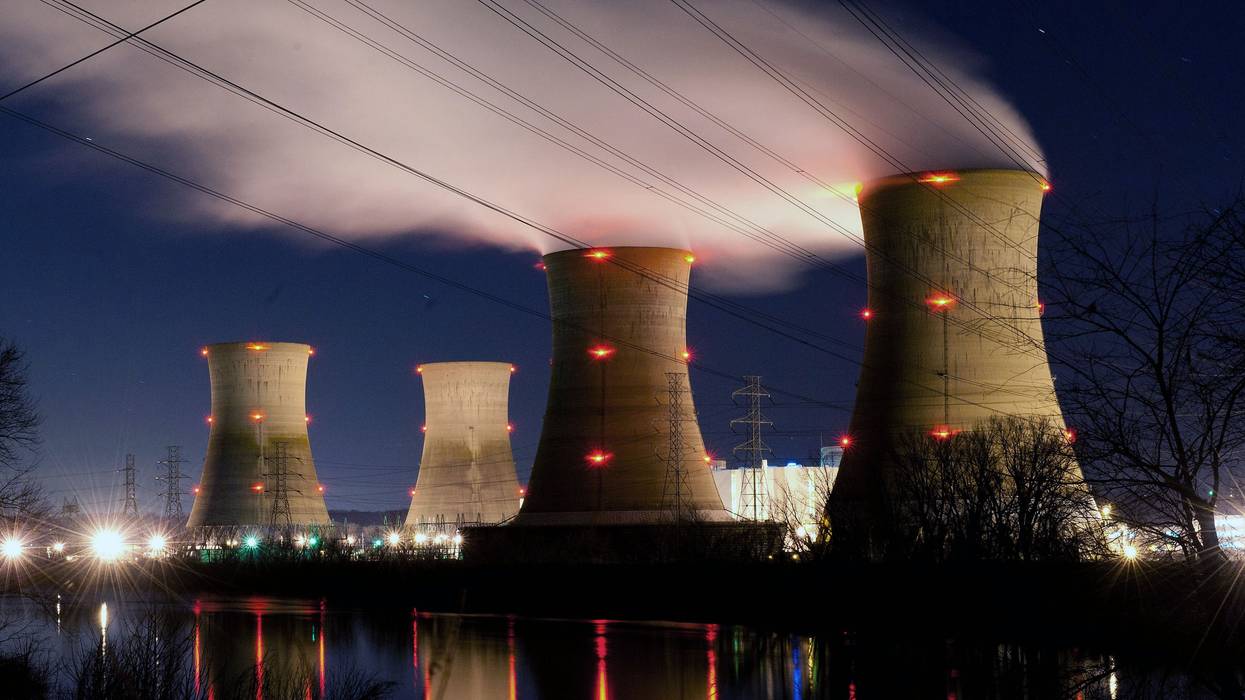
"The recent catastrophic train derailment in East Palestine, Ohio, and the crash of two Boeing 737 Max jets demonstrate the real-world consequences of inadequate or capriciously enforced safety regulation and oversight. We can't add radiological releases from U.S. nuclear plants to this list."
In the wake of another nerve-wracking outage at a Russian-held Ukrainian nuclear energy facility this week, 90 groups and dozens of individuals wrote to U.S. President Joe Biden expressing "grave concerns regarding security at U.S. nuclear power plants."
"We commend and wholeheartedly support your administration's much-needed efforts to make nuclear plants in the Ukraine war zone more secure in the face of daunting political and military challenges," states the letter, spearheaded by Nuclear Energy Information Service (NEIS) and sent to the White House Wednesday. "This work protects not only Ukraine but the entire planet."
"Our concern is that the security of U.S. nuclear power plants does not seem to be receiving a commensurate amount of attention, neither from the U.S. Nuclear Regulatory Commission (NRC), nor the administration," the coalition explained. "Worse, your administration is also seeking to expand the nuclear industry in dangerous ways that compound nuclear plant security threats."
"Attacks on nuclear facilities and other external dangers they face are credible threats and could happen here."
While the letter argues that given the associated security threats, "federal funding should prioritize scaling up renewables, storage, efficiency, and transmission upgrades, so as to phase out nuclear power as quickly as possible," it also calls for immediate action.
"Nuclear plant security MUST begin at home," the groups declared, urging the U.S. government to "learn the lesson" from Zaporizhzhia Nuclear Power Plant (ZNPP) since Russian forces invaded Ukraine early last year—that "attacks on nuclear facilities and other external dangers they face are credible threats and could happen here."
"The recent catastrophic train derailment in East Palestine, Ohio, and the crash of two Boeing 737 Max jets demonstrate the real-world consequences of inadequate or capriciously enforced safety regulation and oversight," the organizations asserted. "We can't add radiological releases from U.S. nuclear plants to this list."
The coalition also sent the president a separate document detailing security concerns and recommendations for U.S. facilities, but the letter highlights the top takeaways:
The coalition is calling on the Biden administration to enforce "enhanced, mandatory security measures for existing nuclear facilities and spent nuclear fuel to make them less vulnerable to attack," at the cost of licensees, not U.S. taxpayers.
The groups' recommendations include changes to storage policies. The letter says that "instead of transporting it to proposed CISFs, most spent nuclear fuel should be stored at reactor sites using hardened onsite storage (HOSS)."
In a statement, Kevin Kamps—a radioactive waste specialist with Beyond Nuclear, which signed the letter to Biden—took aim at Holtec International, a U.S.-based company that owns a proposed New Mexico CISF, has handled spent fuel in Ukraine, and recently signed a contract to deploy small modular nuclear reactors in the war-torn country.
"Holtec's performance in handling spent fuel has been abysmal in Ukraine and similarly abysmal in the United States," said Kamps. "That's one illustration among others that the problem is not limited to Ukraine, and that U.S. nuclear plants are subject to security threats we need to start addressing."
NEIS director Dave Kraft asked, "What sense does it make to send tens of millions of dollars to Ukraine to enhance security and safety, when our own 92 operating reactors and 90,000 tons of high-level radioactive wastes are not secure?"
"What sense does it make to sprinkle the next-generation micro- and mini-nuke reactors around the nation and the world, boasting they can be mobile on flatbed trucks or housed in factories or Walmarts, when it is daily demonstrated that silent drones are capable of turning heavily armored tanks and military vehicles into shredded heaps of burning metal?" he added. "This is the real world nuclear power now exists in, and this administration is not prepared to provide the safety and security necessary for it to survive."
On Monday, for the seventh time since the Russians took control of ZNPP last year, Europe's largest nuclear facility was fully disconnected from Ukraine's electricity grid and had to rely on backup diesel generators. The outage lasted over five hours.
Reuters reported that a "Russia-installed local official said Ukraine had disconnected a power line and Ukrainian state nuclear energy company Energoatom said the problem was caused by Russian shelling."
Rafael Mariano Grossi, director general of the International Atomic Energy Agency, said Monday's incident "demonstrates the highly vulnerable nuclear safety and security situation" at the facility and reiterated that "this simply can't go on."
"We're playing with fire. We must act now to avoid the very real danger of a nuclear accident in Europe, with its associated consequences for the public and the environment," he added. "I'm continuing to engage in intense negotiations with all the involved parties to secure the protection of the Zaporizhzhia Nuclear Power Plant. I will not stop until this has been achieved."
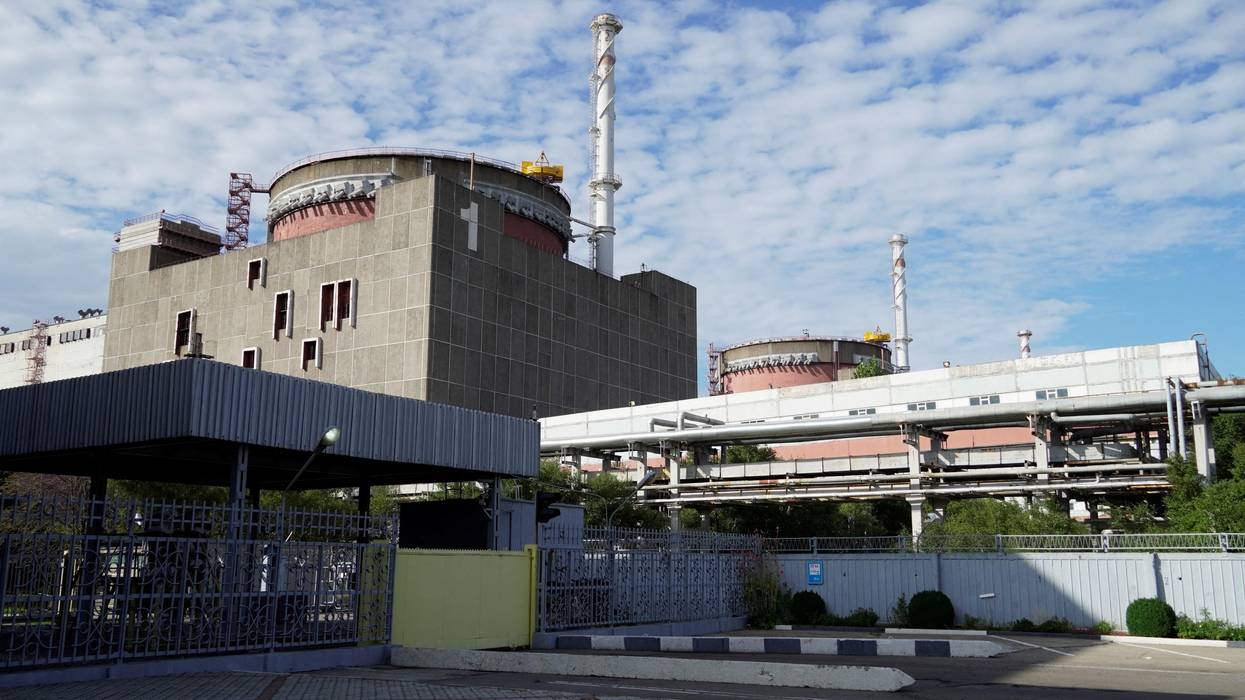
"The consequences not only for the people of Ukraine and neighboring Russia, but for all of Europe, should any or all of these reactors melt down or suffer a fuel pool fire are unimaginably dire."
Experts are warning ahead of an anticipated Ukrainian counteroffensive against invading Russian forces that continued fighting heightens the risk of a continent-wide calamity emanating from the occupied Zaporizhzhia Nuclear Power Plant—and necessitates immediate efforts to negotiate a ceasefire followed by a peace treaty to end the war.
Ukraine's state-owned atomic energy company, Energoatom, said Wednesday that Russia intends to relocate roughly 3,100 people from the city of Enerhodar—2,700 of whom work at the Zaporizhzhia plant in Russia-controlled southern Ukraine—and warned that such a move would lead to a "catastrophic lack of qualified personnel."
Since March 2022, Europe's largest nuclear facility has been held by Russian troops and operated by a mostly Ukrainian workforce, with periodic escalations in fighting around the plant resulting in repeated losses of offsite power that threaten to cause a disastrous meltdown.
The evacuation plan, which applies to roughly half of the plant's 6,000 employees, was prompted by fears of an imminent Ukrainian campaign to reclaim lost territory, including in Zaporizhzhia, one of four regions illegally annexed by Russia. It comes just days after a Moscow-installed official said that more than 1,600 civilians had been evacuated from areas near the plant.
As local civilian evacuations began last weekend amid intensified shelling, International Atomic Energy Agency (IAEA) director-general Rafael Grossi expressed concerns about the "increasingly tense, stressful, and challenging conditions" faced by Zaporizhzhia plant staff and warned of an "increasingly unpredictable and potentially dangerous" situation unfolding.
"A major assault on Zaporizhzhia, or even a prolonged loss of power, could lead to a catastrophe that would dwarf the impact of Chernobyl."
The head of the United Nations' nuclear power watchdog, who has spent months trying to persuade Russian and Ukrainian officials to establish a demilitarized zone around the site, called for immediate action "to prevent the threat of a severe nuclear accident and its associated consequences for the population and the environment."
Although all six nuclear reactors at the Zaporizhzhia plant have been shut down since September, they still require a constant supply of electricity to keep spent nuclear fuel rods cool and prevent a meltdown of the kind that devastated Chernobyl, roughly 400 miles away, some 37 years ago.
On Monday, the Moscow-installed governor of the Russia-controlled part of Ukraine's Zaporizhzhia region reportedly suspended operations at the plant. According to The Associated Press, "Russians have laid minefields around the plant and built defensive positions."
In a Wednesday statement, Beyond Nuclear said that just because "all six Zaporizhzhia reactors are currently shut down... does not mean they are out of danger."
"The fuel in the reactor core still requires electricity to power cooling, as do the pumps that supply cooling water to the fuel pools," said the group's international specialist, Linda Pentz Gunter. "A meltdown is still possible. Putting the reactors in what is termed 'cold shutdown' just buys workers more time to restore power, but a reliable supply of electricity to the site is still essential to avoid disaster."
"It is time for the United States to step up efforts toward a negotiated peace agreement rather than helping to prolong a likely unwinnable war."
"The consequences not only for the people of Ukraine and neighboring Russia, but for all of Europe, should any or all of these reactors melt down or suffer a fuel pool fire are unimaginably dire," Gunter warned.
"We only have to look at the fallout map from the 1986 Chernobyl disaster, a single unit with a far smaller radioactive inventory, to understand the potential scale of such a tragedy," she added.
Experts have repeatedly sounded the alarm about the growing risk of a continental-scale catastrophe, noting that the Zaporizhzhia plant contains more radioactive waste than was present at Chernobyl when it exploded.
That nuclear accident in what is now Ukraine "contaminated 40% of the European landmass with long-lived radioactive fallout," Beyond Nuclear pointed out. The meltdown rendered an area of more than 1,000 square miles uninhabitable and caused the illnesses and deaths of potentially hundreds of thousands of people.
"A major assault on Zaporizhzhia, or even a prolonged loss of power, could lead to a catastrophe that would dwarf the impact of Chernobyl," said Gunter.
"Despite the seeming entrenchment from both Ukraine and Russia, it is time for the United States to step up efforts toward a negotiated peace agreement rather than helping to prolong a likely unwinnable war," she added. "The stakes are simply too high."

The situation is 'becoming increasingly unpredictable and potentially dangerous'
The situation Zaporizhzhia Nuclear Power Plant has taken a turn for the worse as Russia has begun evacuating 18 settlements in the Zaporizhzhia region, including Enerhodar.
The BBC has cited as Ukrainian official as saying this has sparked a "mad panic" - and traffic jams have been observed as thousands of people pack up and head out of the city.
The exiled mayor of Melitopol, Ivan Fedorov, wrote on Telegram that shops in the evacuated areas had run out of goods and medicine. He also said hospitals were discharging patients into the street amid fears that electricity and water supplies could be suspended.
The International Atomic Energy Agency (IAEA ) experts still at the plant site are continuing to hear shelling on a regular basis, including Friday night. Ukrainian authorities on Sunday said that a 72-year-old woman was killed and three others were wounded when Russian forces fired more than 30 shells at Nikopol, a Ukrainian-held town neighboring the nuclear plant.
The situation is “becoming increasingly unpredictable and potentially dangerous,” the head of the U.N.’s nuclear watchdog said Saturday.
International Atomic Energy Agency Director-General Rafael Mariano Grossi said in a statement :
“The general situation in the area near the Zaporizhzhya Nuclear Power Plant is becoming increasingly unpredictable and potentially dangerous."
"I’m extremely concerned about the very real nuclear safety and security risks facing the plant."
"We must act now to prevent the threat of a severe nuclear accident and its associated consequences for the population and the environment. This major nuclear facility must be protected."
"I will continue to press for a commitment by all sides to achieve this vital objective, and the IAEA will continue to do everything it can to help ensure nuclear safety and security at the plant,” he said.
The expected Ukrainian spring counter-offensive is viewed as likely to take in the Zaporizhzhia region, around 80% of which is controlled by Russian forces.

In addition to tactical nuclear weapons Russian President Vladimir Putin said last week he plans to station in Belarus, Lukashenko said Friday he would seek intercontinental ballistic missiles.
Belarusian President Alexander Lukashenko on Friday claimed without evidence that his government needs to "safeguard" the Eastern European country from a looming Western invasion, saying he is seeking to station intercontinental nuclear missiles there to defend Belarus against the United States and other countries in the West.
In an hourslong speech to Parliament on the state of the nation, Lukashenko, who has been in office since 1994 and whose 2020 reelection was disputed by hundreds of thousands of Belarusians, said the West is planning to take over both Belarus and its neighboring Poland.
"Take my word for it, I have never deceived you," said Lukashenko. "They are preparing to invade Belarus, to destroy our country."
For this reason, he said, he may use so-called "tactical" nuclear weapons that Russian President Vladimir Putin said last week the Kremlin would deploy in Belarus, if Putin agrees to their use. In addition, Lukashenko said he would seek intercontinental ballistic missiles, capable of destroying whole cities from thousands of miles away, on Belarusian soil.
"Putin and I will decide and introduce here, if necessary, strategic weapons, and they must understand this, the scoundrels abroad, who today are trying to blow us up from inside and outside," Lukashenko told lawmakers and his constituents. "We will stop at nothing to protect our countries, our state, and their peoples. "We will protect our sovereignty and independence by any means necessary, including through the nuclear arsenal."
"Don't say we will just be looking after them, and these are not our weapons," he added. "These are our weapons and they will contribute to ensuring sovereignty and independence."
Putin said Saturday that the short-range nuclear weapons he plans to station in Belarus will remain under Russian control.
Belarus relinquished its nuclear arsenal after the collapse of the Soviet Union in 1991. Lukashenko noted in his speech that Belarus gave up the weapons under pressure from former Russian President Boris Yeltsin.
Russia's announcement last week that it would deploy weapons in Belarus would mark the country's first stationing of nuclear weapons outside its border in more than three decades.
U.S. President Joe Biden said Tuesday that the pending deployment is "worrisome."
"Belarus hosting Russian nuclear weapons would mean an irresponsible escalation and threat to European security," said European Union foreign policy chief Josep Borrell this week. "Belarus can still stop it, it is their choice. The E.U. stands ready to respond with further sanctions."
Lukashenko and Putin have strengthened their cooperation since Russia's invasion of Ukraine in February 2022, with Belarus providing a staging ground for Russian troops.
The Belarusian leader's comments came amid ongoing attacks in Ukraine, with multiple rocket strikes in the southeastern city of Zaporizhzhia, the site of a nuclear power plant, on Friday. Lukashenko included in his speech a call for an immediate ceasefire "without preconditions," warning Ukraine that "it is impossible to defeat a nuclear power" and that Russia will use "the most terrible weapon" if it is threatened.
Thijs Reuten, a Dutch member of the European Parliament, denounced Lukashenko as Putin's "lapdog" and condemned his attempt to "blame the West."
"Truly troubling: Each of these steps brings Belarus closer to full-blown occupation," said Reuten. "The Belarusian people deserve so much better."

"We must continue to do everything we can to avert the danger of a serious nuclear accident," said the IAEA chief, who plans to visit Ukraine next week for talks to establish a safety zone around the Russian-occupied facility.
A U.S.-based group on Friday recognized the "heroic" Ukrainian staff at a Russian-controlled nuclear power plant, highlighting concerns about the facility nearly 11 months into Russia's invasion.
The Arms Control Association (ACA) hosts an annual online contest celebrating efforts to "advance disarmament, nuclear security, nonproliferation, civilian protection, and international peace, security, and justice."
"Russia's illegal and unprecedented occupation of the Zaporizhzhia Nuclear Power Plant created an untenable nuclear safety and security situation."
After thousands of votes were cast from nearly 80 countries, the Energoatom workers at Ukraine's Zaporizhzhia Nuclear Power Plant (ZNPP) were selected as the 2022 Arms Control Persons of the Year.
ZNPP is one of four nuclear energy facilities in Ukraine, also home to the Chernobyl disaster of 1986. Ukrainian workers remain at the six-reactor Zaporizhzhia plant despite the Russian military's takeover and shelling that the countries have blamed on each other.
"Russia's illegal and unprecedented occupation of the Zaporizhzhia Nuclear Power Plant created an untenable nuclear safety and security situation," said Kelsey Davenport, ACA's director for nonproliferation policy, in a statement. "In the face of harassment and threats by Russian forces, Ukrainian personnel have continued to operate the plant and avert a nuclear crisis."
"The international community owes a debt of gratitude to the heroism and bravery of the Zaporizhzhia personnel, but this dire situation cannot continue," Davenport stressed. "The ongoing safety and security risks underscore the critical importance of establishing a zone of protection at the site, returning control of Zaporizhzhia to Ukraine, and strengthening the norm against targeting civilian nuclear infrastructure."
Rafael Mariano Grossi, director general of the International Atomic Energy Agency (IAEA), plans to travel to Ukraine next week to discuss a proposed nuclear safety and security protection zone around ZNPP with Ukrainian government officials in Kyiv.
"I remain determined to make the much-needed protection zone a reality as soon as possible," Grossi said in a statement Friday. "My consultations with Ukraine and Russia are making progress, albeit not as fast as they should. I remain hopeful that we will be able to agree and implement the zone soon."
Since the IAEA Support and Assistance Mission to Zaporizhzhya (ISAMZ) was established in September, five groups of agency experts have spent time at the facility, with the latest team arriving this week.
As the IAEA detailed:
The ISAMZ team reports that the ZNPP's last remaining 330 kilovolt (kV) backup power line is now connected to the plant, after suffering some further disconnections in the last week, highlighting the continued fragile off-site power supply situation for Europe's largest NPP. The ZNPP's six reactors are in shutdown but still need electricity for reactor cooling and other essential nuclear safety and security functions. The ZNPP receives off-site power also from its last remaining operational 750 kV external power line. In case of loss of external power, all the site's 20 diesel backup generators are ready to supply the site with the electricity needed for all safety related equipment. In addition, nine mobile diesel-fueled boilers are now operating to help prevent critical ZNPP systems from freezing during the winter and provide heating for ZNPP personnel. The situation at the ZNPP remains precarious.
The agency also noted that ZNPP staff are under pressure to accept new labor contracts with the Russian state nuclear energy company Rosatom, which the national Ukrainian operator Energoatom has discouraged.
"The reduced ZNPP staffing levels combined with psychological stress due to the ongoing military conflict and the absence of family members who fled the area have created an unprecedented situation that no NPP staff should have to endure," said Grossi.
"As this tragic war enters its second year, we must continue to do everything we can to avert the danger of a serious nuclear accident that would cause even more suffering and destruction for the people of Ukraine and beyond," he emphasized.
In addition to meeting with officials in the Ukrainian capital, Grossi plans to visit the South Ukraine and Rivne nuclear plants as well as to the Chernobyl site to launch the missions of two experts at each facility. The IAEA also intends to soon station a two-member team at the Khmelnitsky plant. The missions were requested by the Ukrainian government, according to the global agency.
"Soon the IAEA will be permanently present at all of Ukraine's nuclear pwer facilities, including Chernobyl," Grossi said. "This is an important step in our work to help Ukraine during these immensely difficult and challenging times. Our nuclear safety and security experts will monitor the situation at the plants, assess their equipment and other needs, provide technical support and advice, and report their findings to IAEA headquarters."
Discussing his Ukraine trip on an Italian television channel earlier this week, Grossi said: "After that, there is hope to get to Moscow. The plant is Ukrainian but under Russian control, and it is a reality. And I have to work with both sides."
"Our duty is to secure the plant. The establishment of a permanent group [of IAEA observers] is the first concrete and tangible result of our efforts, but we cannot stop; the main thing is to protect the plant's safety," he continued, stressing the need for a deal to establish a zone around ZNPP.
"This agreement is not impossible," he said, "because a nuclear accident is not in the interests of anyone, not even the Russians."