SUBSCRIBE TO OUR FREE NEWSLETTER
Daily news & progressive opinion—funded by the people, not the corporations—delivered straight to your inbox.
5
#000000
#FFFFFF
To donate by check, phone, or other method, see our More Ways to Give page.


Daily news & progressive opinion—funded by the people, not the corporations—delivered straight to your inbox.
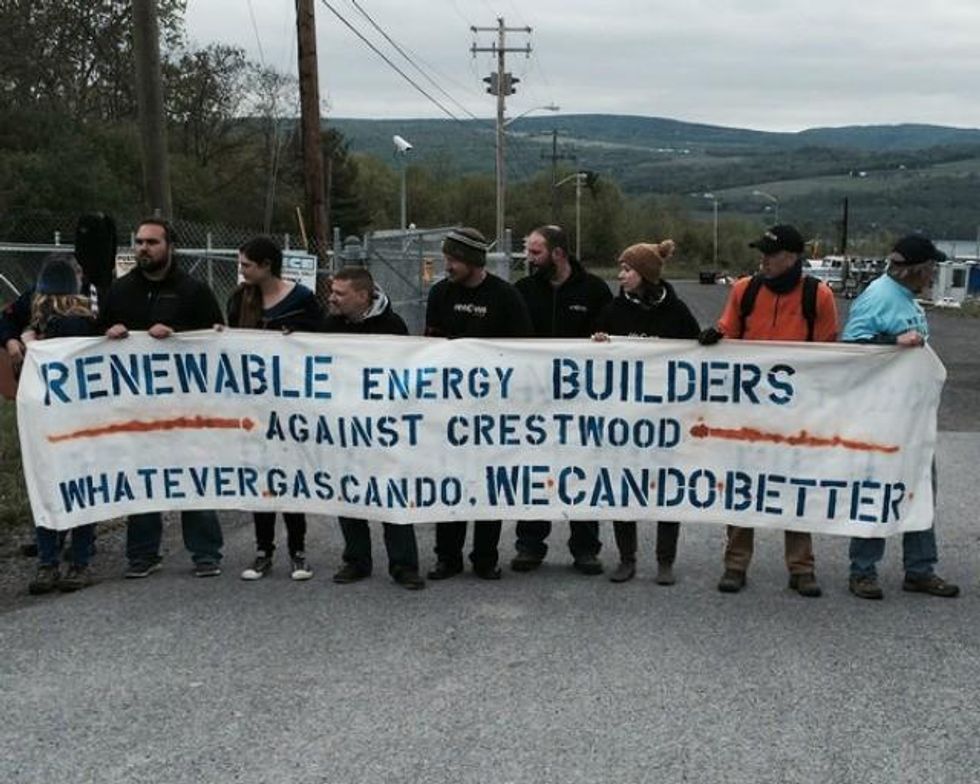
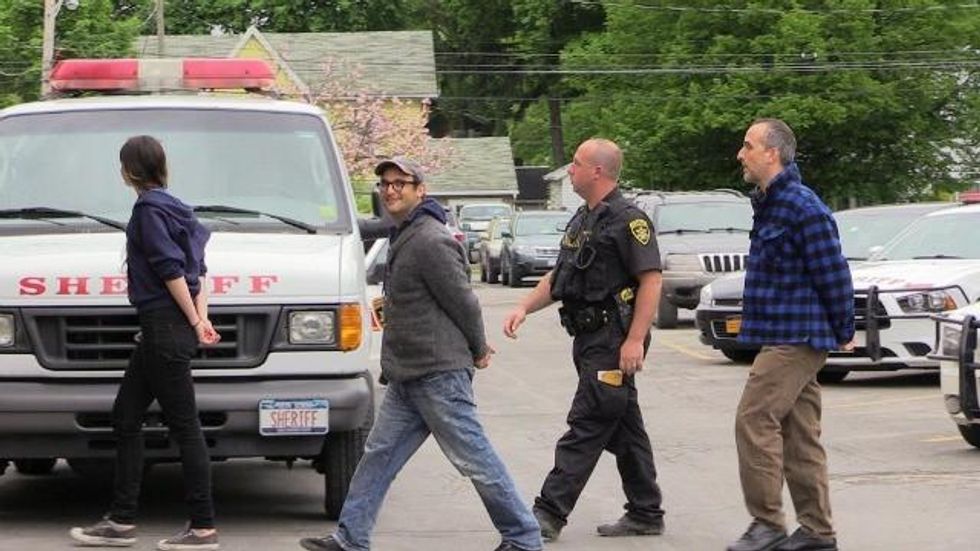
Another 21 people were arrested outside the controversial Crestwood Midstream gas storage facility in upstate New York on Wednesday, bringing the total number of arrests since the We Are Seneca Lake civil disobedience campaign began seven months ago up to 272.
Oscar-nominated filmmaker Josh Fox, whose documentary Gasland focuses on communities affected by fracking, was among those arrested during the human blockade.

"I'm here to support my friends and my community who are protecting Seneca Lake from underground gas storage," Fox said in a statement, noting that Crestwood's methane gas storage expansion project, which would see vast quantities of methane stored underground in questionably sound salt caverns, is situated in an "incredibly important location."
Seneca Lake is the largest of New York's Finger Lakes, providing drinking water for 100,000 people, and supporting local distilleries, wineries, breweries, and agriculture.
"I'm here primarily though because this is a fracking site," Fox continued.
As We Are Seneca Lake has repeatedly pointed out, Texas-based Crestwood has indicated that it intends to make Seneca Lake the gas storage and transportation hub for the northeast, as part of the gas industry's planned expansion of infrastructure across the region. Though New York recently banned the dangerous practice of hydraulic fracturing, Crestwood opponents are concerned that this infrastructure expansion would turn the area into a "gas station for fracking."
"We have to stop fracking all across America, wherever it is going to be," Fox added, before taking aim at the Federal Energy Regulatory Commission (FERC), which approved Crestwood's project last October in the face of broad public opposition and unresolved questions about geological instabilities, fault lines, and possible salinization of the lake.
FERC, Fox charged, "is really acting like a subsidiary of the fossil fuel industry masquerading as a government agency. FERC has to be overhauled. FERC is a disaster...So today is very important because it is a national moment." The protesters have a "very clear message," he concluded. "We want renewable energy, and not these kinds of crazy projects."

To that end, Renovus Solar--a local renewable energy company--set up an outdoor "help wanted" desk directly outside of Crestwood's gates during the demonstration.
"This gas storage facility threatens the community character and the economy of the entire region," said Renovus CEO Joe Sliker in advance of Wednesday's action. "In contrast, the solar industry complements the existing, thriving and growing winery and tourism industries. Solar is cleaner, safer, and a more prosperous path forth for families and even for all of the Crestwood employees."
Sliker was also arrested Wednesday.
Jim Connor, 83, was not among the 20 protesters arrested on Monday afternoon as part of the latest human blockade at the entrance gates of Crestwood Midstream two miles north of Watkins Glen, New York.
Had the sheriff's deputies arrived an hour earlier, his name would appear in the list of the now 200 arrests that have take place at these gates since October. But Jim--who uses a walker and was blockading while seated in a lawn chair and wrapped in a blanket--needed to go home after 2.5 hours of turning back trucks with his own body.
The deli cook folded her civil disobedience cards at about the same time.
Along with a mom who needed to relieve her babysitter.
Which is how the two-dozen original blockaders were whittled down to 20 during a non-violent direct action on a January morning atop an icy hill above Seneca Lake where winds drop effective temperatures well below the already-wickedly-low digits on the thermometer and where the advice, "dress in layers," means that you pull mittens on over your gloves, wear two coats on top of three sweaters and throw some chemical handwarmers into the toes of your snow boots.
We are Seneca Lake Celebrates Martin Luther King Day at Crestwood's GatesMLK civil disobedience at Crestwood Gates, Watkins Glen, NY.
But perhaps the reluctant attrition of the elderly, the workers and the parents of toddlers only attests to the homespun determination of this ongoing civil disobedience uprising--now in its third month.
As does the enduring presence of the 40 other protesters who rallied for hours in support of the blockaders along the shoulder of the highway. One of them was 90-year-old Martha Ferger of Dryden. I was another.
Because it was MLK Day, we sang Civil Rights songs and held banners with messages--"We Are Seneca Lake and We Have a Dream," "Clean Air, Clean Water = Civil Rights,"--honoring Martin Luther King, Jr. on the national holiday that celebrates his birth. The singing went on for hours. We unarrested protesters, when ordered by deputies to disperse, could hear those inside the squad cars still belting out the refrain to "Wade in the Water."
And water is, fundamentally, what this fight is all about. We Are Seneca Lake is an ongoing, citizen-based civil disobedience campaign that seeks to protect Seneca Lake and the surrounding region from gas storage expansion by Texas-based energy company, Crestwood Midstream. Crestwood's intention is to repurpose the crumbling salt mines underneath Seneca Lake's hillside into massive gas tanks for the highly-pressurized products of fracking: methane, propane and butane.
Seneca Lake, a source of drinking water for 100,000 people, is a very deep lake that drains very slowly. A contamination event, hydrologists tell us, would linger not days or weeks but over a time scale measured by human generations. Because of its depth, Seneca Lake also creates a unique, self-moderating microclimate for the entire Finger Lakes region, allowing vineyards to flourish on our hillsides and making possible a thriving wine industry, which is the bedrock of our local economy.
The methane gas storage expansion project is advancing in the face of broad public oppositionand unresolved scientific questions about geological instabilities, fault lines and possible salinization of the lake. Crestwood has indicated that it intends to make Seneca Lake the gas storage and transportation hub for the entire Northeast, as part of the gas industry's planned expansion of infrastructure across the region. The wise decision by New York Governor AndrewCuomo to ban fracking in our state--and his corollary announcement of a $20 million green jobs competition--only makes the plan to store mass amounts of fracked gas under our lake seem even more insane.
Seneca Lake Defenders--as those risking arrest call themselves--come in all ages, from 18 to 90, and from many walks of life. As diverse as we are, everyone is united in the belief that Crestwood is an out-of-state trespasser that threatens to harm all we hold dear, starting with water and wine. Being arrested for trespassing in order to make that point only helps reinforce it.
Seth Thomas, 34, who lives in the Town of Lodi on the opposite bank of the lake, said, before his own arrest, "I'm protesting gas storage because I was born and raised here. I'm in the wine industry, so this is a direct threat to our way of life."
His words were echoed by Marty Dodge, 72, who lives two Fingers Lakes over in village of Canandaigua and who had driven over early that morning to stand with us. "I am here to do what I can to prevent Crestwood from destroying this lake," said Dodge. "It just doesn't belong here."
Marty, who has a rotator cuff injury in his shoulder, had some difficulty getting his arms behind his back and close enough together for handcuffs. His recent hip replacement made it hard for him to climb into the police van.
Later, outside the Schuyler County sheriff's department, I asked if he had pointed out these disabilities to his arresting officer. The county deputies and state troopers have all been consistently respectful toward us--and sometimes downright compassionate--even during mass arrests.
Marty said no. "I didn't want to cause any trouble."
Increasingly, the protests out at the gates of Crestwood are thematic and self-organized by participants. One self-identified uprising seems to spawn another, and there is no end in sight.
The Teachers Blockade on Dec. 16 resulted in the most arrests in a single day (41), but it was the Musicians Blockade on Dec. 17> (28 arrests) that was the direct inspiration for the Mothers and Grandmothers Blockade of last Friday.
These women--who quickly figured out that they had themselves created, all together, 32 children and 20 grandchildren--blocked the entrance into Crestwood in bitterly cold temperatures and prevented all traffic from entering or leaving the facility for 5.5 continuous hours.
Like the MLK Day Blockade--and, of course, the Musicians Blockade--singing was a key element of the mothers and grandmothers' action. The mothers debuted a new song, The Ballad of Seneca Lake, written by singer-songwriter Edith McCrea.
What made the Mothers and Grandmother's Blockade unusual--besides the fact that cookies were served--is that no arrests were made. A sheriff's deputy stopped by late in the morning, lights flashing, and everyone thought the party was over. But he only expressed concern about the car parked just north of the gate along the highway's edge. (It held our all important port-a-potty.) Could we move it further off the road? We agreed.
The deputy looked at the blockade line. The banners read "Mothers Against Crestwood: Defending Our Children's Future" and "Mom Says: N-O Spells No. You Have Until the Count of 3." And he drove off.
That was the last we saw of law enforcement. The snow kept falling. At 4 p.m. the women dispersed.
Meanwhile, one of the Seneca Lake Defenders (arrested Nov. 21) reports that he overheard a woman at a dinner party encouraging her husband to get involved with us on the grounds that being arrested to save the planet is sexy. He went on to write a blog essay called I'm Mostly Just In This for the Women, which is getting some attention.
So, now it's inevitable: somebody out there is laying plans for a Fathers and Grandfathers Blockade.
"Clean Air and Clean Water are Civil Rights," was the message as dozens of protesters, taking up the call for civil disobedience in honor of Dr. Martin Luther King Jr.'s birthday, continued their months-long blockade of a natural gas facility near the shores of Seneca Lake in upstate New York.
Twenty people were arrested blocking the entrance to Texas-based energy company Crestwood Midstream on Monday, bringing the total number of arrests since the actions began late October to 200 people.
The group is protesting plans to turn the region's salt caverns into a storage facility for gases extracted during fracking operations. Despite strong local opposition and what the group says are "grave" geological and public health concerns, the Federal Energy Regulatory Commission (FERC) recently approved construction of the storage infrastructure on the west side of Seneca Lake.
With the Martin Luther King Jr. Day demonstration, the diverse group of protesters paid homage to the lessons learned from the civil rights movement.
"We believe, just as the civil rights marchers must have, that a small group of people taking a stand and showing determination and bravery can achieve something huge," Sandra Steingraber, Ithaca College biologist and co-founder of the grassroots group We Are Seneca Lake, told Common Dreams.
Emboldened by New York's recently announced fracking ban, the group intends to continue the demonstrations as long as Crestwood poses a threat to the health of the community and local environment. However, they see their fight as part of a larger war against an economy and infrastructure rooted in the exploitation of fossil fuels.
"Civil rights marchers didn't try to desegregate every single lunch counter across the South," Steingraber explains. "They planted their flag in one lunch counter and tried to make it a national story. We're trying to do that here."
This fossil fuel infrastructure project is one "among many," she adds, "but this is where we are planting our flag."
Among those who took part in Monday's 3.5-hour long blockade or rallied in support of the blockaders were a 90-year-old woman, an 83-year-old polio survivor, and former Tompkins County legislator Pamela Mackesey, who marched with King as a teenager in 1963 and who was one of the 20 protesters charged with trespassing and released. The demonstrators are due to appear in court on February 18.
The coalition of concerned residents is seeking an injunction and rehearing on the risks posed by Crestwood's plan and are calling on U.S. Senators Kristen Gillibrand (D-N.Y.) and Chuck Schumer (D-N.Y.), as well as other officials, to intervene.
Seneca Lake, one of the deepest lakes in the nation, is the source of drinking water for 100,000 people. According to Steingraber, its unique geology moderates the temperatures in the area and allows the region's $4.8 billion wine industry to flourish.
"This is a story about ordinary people standing up for a lake that turns water into wine, as well as being a source of drinking water and source of beauty," said Steingraber.
Referencing a concept of King's, Steingraber says that their "beloved community" is pitted against a Texas-based energy company that is "only interested in our holes in the ground" to be used as a "gas station for fracking."
The below videos show demonstrators singing civil rights songs and the arrests during the MLK Day blockade.
We are Seneca Lake Celebrates Martin Luther King Day at Crestwood's GatesMLK civil disobedience at Crestwood Gates, Watkins Glen, NY.
Carrying banners that declared "Christmas Against Crestwood" and "Methane in Your Stocking is Worse Than Coal," nine local activists dressed as Santa Claus and his North Pole ensemble were arrested Monday and charged with trespassing and disorderly conduct at Texas-based Crestwood Midstream's gas storage facility gates on the shore of Seneca Lake in New York.
Only Santa (Stefan Senders of Schuyler County) was handcuffed and searched before being taken into custody. The action marked nine weeks and 170 arrests as part of the 'We Are Seneca Lake' civil disobedience campaign.
Protesters have been blocking the Crestwood gas storage facility gates, on the shore of the largest of New York's Finger Lakes, since Thursday, October 23--the day before major new construction on the controversial gas storage facility was authorized to begin. On Wednesday, October 29, Crestwood called the police and the first 10 protesters were arrested. Since then, protests have been ongoing, with more arrests each week.
The methane gas storage expansion project is advancing in the face of broad public opposition and unresolved questions about geological instabilities, fault lines, and possible salinization of the lake, which serves as a source of drinking water for 100,000 people. Crestwood has indicated that it intends to make Seneca Lake the gas storage and transportation hub for the northeast, as part of the gas industry's planned expansion of infrastructure across the region.
While the New York State Department of Environmental Conservation has temporarily halted plans to stockpile propane and butane in nearby caverns--out of ongoing concerns for safety, health, and the environment--Crestwood is actively constructing infrastructure for the storage of two billion cubic feet of methane (natural gas), with the blessing of the Federal Energy Regulatory Commission.
"As a greenhouse gas, methane is carbon dioxide's younger and more dangerous brother," said biologist Sandra Steingraber in a video documenting Monday's action. "It is 86 times more powerful at trapping heat than carbon dioxide. So the methane that will inevitably leak from these caverns, and the pipelines that feed them, will be trapped in the atmosphere. So scientists--plus Santa and elves together--are standing in solidarity with residents of Seneca Lake and we're going to shut this place down."
Monday's detentions followed 28 arrests last Wednesday in a blockade led by local musicians. While blockading a large truck, the musicians sang, danced, played instruments, and held banners that read "This Land is Our Land" and "Gas/Water: Which Side Are You On?"
Anti-fracking activists gathered in an act of non-violent civil disobedience on Friday morning near where energy company Crestwood Midstream was scheduled to begin construction on a massive underground gas storage depot on the banks of one of the Finger Lakes in central New York.
Wearing the color blue and calling themselves We Are Seneca Lake, protesters congregated for a rally and human blockade at the gates of the Crestwood compressor station site. Some were prepared to get arrested.
"Seneca Lake is a source of drinking water for 100,000 people and a source of economic prosperity for the whole region, not a gas station for fracking operations," said biologist and author Sandra Steingraber, who lives in the Finger Lakes region and participated in the demonstration. Steingraber spent 10 days in jail last year for blocking the entrance to the Inergy natural gas facility. "It's a place for tourists, wineries, farms, and families. Speaking with our bodies in an act of civil disobedience is a measure of last recourse to protect our home, our water, and our local economy--with our bodies and our voices, telling Texas-based Crestwood to go home!"
Watch Steingraber's invitation to the rally here:
WeAreSenecaLakeThe Texas-based energy corporation, Crestwood Midstream, is moving forward with plans to store highly pressurized, explosive ...
In late September, the Federal Energy Regulatory Commission approved Crestwood Midstream's request to begin construction to expand underground methane storage in salt caverns next to Seneca Lake, one of 11 Finger Lakes. The New York Department of Environmental Conservation is still considering whether a Crestwood subsidiary, Arlington Storage, can use other caves near the lake to store liquefied petroleum gas.
Opponents of both projects say the effort to store highly pressurized, explosive gas in salt caverns is part of a coordinated strategy to build out fracking infrastructure throughout the Northeast. More than 200 businesses, along with at least 60 wineries, 11 municipalities, and thousands of residents in the Finger Lakes region have stated concerns about the threat gas storage poses to human health, drinking water, and the local economy, including the tourism industry.
There remain unresolved questions about geological instabilities, fault lines, and possible salinization of the lake.
Friday morning's action follows a smaller, seven-hour human blockade that took place Thursday.
Protesters are calling on elected officials to step in and block Crestwood's ambitions.
"As we literally put our bodies on the line, we once again call on President Obama, Governor Cuomo, Senator Schumer, Senator Gillibrand, and Congressman Reed to do what's right and step in and stop this terrible project from ruining the heart of the Finger Lakes," said Watkins Glen resident Lyn Gerry, who also participated in Friday's blockade.
Three upstate New York community members-cum-activists, charged with criminal trespass for blockading a gas company installation last month, were sentenced to 15 days in jail on Wednesday by a local judge in an upstate courthouse.
Among those sentenced was university biology professor and author Sandra Steingraber, who delivered an impassioned statement ahead of the sentencing explaining why she was compelled to civil disobedience and why she would refuse to pay the fine levied by the judge.
"My small, non-violent act of trespass," said Steingraber to the crowd, "is set against a larger, more violent one: the trespass of hazardous chemicals into water and air and thereby into our bodies. This is a form of toxic trespass."
Speaking with journalist Bill Moyers just one day prior to the sentencing, Steingraber explained why she and other community members felt in necessary to protest "plans to store millions of barrels of highly-pressurized liquid propane and butane -- gases produced in the controversial process of fracking -- in [local] salt caverns."
Also sentenced on Wednesday were massage therapist Melissa Chapman and local farm owner Michael Dineen.
The courtroom at sentencing, according to reports, was brimming over with more than 150 supporters and onlookers.
The gas compression site they were blockading, owned by Missouri-based Inergy corporation, is part of an underground 'gas storage operation' near the region's Seneca Lake, which provides drinking water for more than 100,000 area residents.
Opponents of the project, including those sentenced, say the project is a danger to families, farms and the health of the local ecosystem. In addition, they contend, Inergy has continually undermined safety regulations and blocked calls attempts to compel disclosure of vital information about the nature of the project.
"I do not take this step lightly," said Michael Dineen, reflecting on his own actions. "My wife and I have a small farm in Seneca County. We grow organic grains and maintain a large garden we use to feed our and our daughter's families. Our garden is irrigated with lake water. I believe the Inergy gas storage complex will, at best, damage the community, and has the potential to do catastrophic damage. Important information has been kept from the public with the DEC's cooperation. I do this to attempt to protect the community when all other means have failed. I blocked the entrance to the Inergy gas storage facility because I believe that the institutions who, by law and purpose, are required to protect the people and the environment from harm can no longer be relied on to do so."
Local Channel 34 News explained the case's background:
On March 18, Steingraber and 10 fellow residents of the Seneca Lake region, in a peaceful act of civil disobedience, blockaded a gas compressor station site run by Missouri-based Inergy, LLP, on Seneca Lake. They did so to demonstrate their opposition to Inergy's planned heavy industrialization of the Finger Lakes region, renowned for its natural beauty, vineyards, and tourism- and agriculture-based economy.
Inergy's gas storage and transportation project in the Town of Reading, right on Seneca Lake, threatens the water supply for 100,000 people.
All 11 protesters, along with a legal liaison, were arrested and charged with trespassing.
On April 17, Judge Raymond Berry of the Town of Reading imposed a fine of $375 for trespassing for Chipman, Dineen, and Steingraber, the three people appearing that evening. All three refused to pay (their statements are attached), and the judge ordered that each spend 15 days in jail.
Steingraber's full sentencing statement follows:
Good afternoon. My name is Sandra Steingraber. I'm a biologist and a Distinguished Scholar in Residence at Ithaca College. I'm 53 years old and the mother of an 11-year-old son and a 14-year-old daughter. I'm married to an art teacher, and we all live in the village of Trumansburg, which is about 15 miles to the northeast, as the crow flies.
On March 18, 2013, together with 11 other local residents, I stood in the driveway of this site, which is owned by the Kansas City-based energy company called Inergy and located on the west bank of Seneca Lake. In so doing, I broke the law and am charged with trespassing. Before my arrest, I and the others with whom I linked arms, temporarily blocked a truck carrying a drill head from going where it wanted to go. This is my first experience with civil disobedience. Here is an explanation of my actions.
First, and most importantly, this act of civil disobedience is a last resort for me. Prior to this, I and other community members have taken every legal avenue to raise the serious health, economic, and environmental concerns associated with the Inergy plant. However, time and again, we've been deterred from participating in the decision-making process. For example, Inergy has declared the geological history of the salt caverns to be proprietary business information, so that much of the basic science on the structural integrity of the salt caverns is hidden from view. How can we offer informed public comments and raise scientific objection when we are denied this fundamental information?
Inergy has asked for fast-track FERC approval and that we fear that authorities are poised to rubber stamp these applications before the public has had a chance to review all the relevant information and the full impacts of these combined projects have been considered.
This act of civil disobedience was also undertaken to bring attention to the fact that this company has been out of compliance with the Clean Water Act every quarter for the last 12 quarters--which is as far back as the data go-exceeding its effluent discharge limit. For this behavior, the company has been fined, not once, but twice, to the tune of over $30,000.
Effluent discharge means that the company dumps chemicals directly into Seneca Lake, which is a source of drinking water for 100,000 people.
It is my belief that paying trivial fines does not excuse the crime of salting the lake. And it's because I have such a high respect for the rule of law that I will be choosing not to pay a fine for my act of trespassing and will instead will show responsibility by accepting a jail sentence.
Second, I seek by my actions to shine a spotlight on the dangerous practice of converting abandoned salt caverns into storage containers for highly pressurized hydrocarbon gases, namely propane and butane. Legal or not, this practice is tantamount to burying giant cigarette lighters in the earth.
This form of liquefied petroleum gas storage has a troubled safety record. Leaks, explosions, and collapses have occurred in at least ten other places. Additionally, the fleets of diesel trucks and the planned 60 ft. high flare stack--even absent calamitous accidents--will add hazardous air pollutants to our communities. Thus, my small, non-violent act of trespass is set against a larger, more violent one: the trespass of hazardous chemicals into water and air and thereby into our bodies. This is a form of toxic trespass.
Lastly, I desire to bring attention to the rapid build-out of fracking infrastructure in New York. Even as we are engaged in a statewide conversation about whether our governor should maintain or lift the current moratorium on shale gas extraction via horizontal fracking in New York, technology that further entrenches our dependency on shale gas--pipelines, storage, compressor stations, processing plants--is being rapidly deployed. These infrastructure investments make fracking in New York State more likely and aid and abet fracking in other states, where it is associated with sickness and misery among people causes devastation to land, water, and air quality.
In a time of climate emergency, the transformation of the Finger Lakes into a massive transportation and storage hub for climate-destroying fossil fuel gases that have been fracked out shale in other states is the absolute wrong form of development.
I am a biologist, not a lawyer. But when I looked up my crime on Wikipedia, here is what it said:
Trespass to land involves the wrongful interference with one's possessory rights in [real] property. William Blackstone's Commentaries on the Laws of England articulated the common law principle... translating from Latin as "for whoever owns the soil, it is theirs up to Heaven and down to Hell." In modern times, courts have limited the right of absolute dominion over the subsurface. For instance, drilling a directional well that bottoms out beneath another's property to access oil and gas reserves is trespass, but a subsurface invasion by hydraulic fracturing is not [emphasis added].
In other words, trespassing laws are unjust. They make a criminals of people who stand on a lakeshore purchased by an out-of-state fossil fuel company only interested in the hollowed out salt chambers that lie 1500 feet beneath the surface, while, at the same time, allowing drilling and fracking operations to tunnel freely under homes, farms, and aquifers, shatter our bedrock, and pump the shards full of toxic chemicals.
I broke the law by standing in a privately owned driveway. Fossil fuel companies are not breaking the law by trespassing into the atmosphere with heat-trapping gases and so creating planetary crisis. There are the disparities that I seek to communicate with my actions and, out of respect for the fidelity of law, with my willingness to accept a jail sentence rather than pay a fine.
As a working mother of two school-aged children, this is a decision I have reached after much discernment.