

SUBSCRIBE TO OUR FREE NEWSLETTER
Daily news & progressive opinion—funded by the people, not the corporations—delivered straight to your inbox.
5
#000000
#FFFFFF
To donate by check, phone, or other method, see our More Ways to Give page.
Daily news & progressive opinion—funded by the people, not the corporations—delivered straight to your inbox.
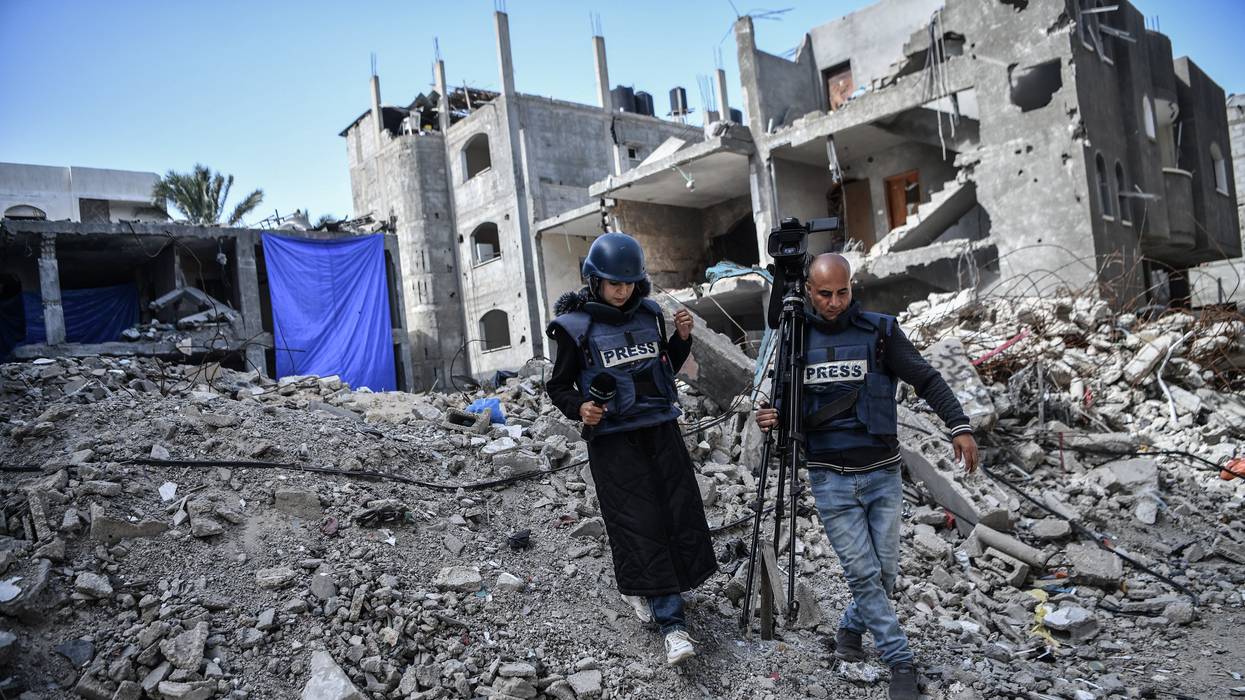
The Pulitzer Prize Board avoided "naming the brave Palestinian journalists who did the reporting and filming and died in record numbers," said one journalist.
In recent years, the Pulitzer Prize Board has given special recognition to the journalists of Ukraine and Afghanistan for reporting from war zones, honoring their "courage, endurance, and commitment to truthful reporting" and their ability to tell their communities' stories under "profoundly tragic and complicated circumstances."
On Monday, no such recognition was given to Palestinian reporters in Gaza, at least 92 of whom have been among more than 34,000 Palestinians killed in the enclave since Israel began its bombardment in October.
The annual journalism and literature awards included a special citation for "journalists and media workers covering the war in Gaza"—but didn't differentiate between those around the world who have spent the last seven months telling the story of Israel's escalation from the safety of far-off countries, and those struggling to report on the destruction of their own home under the constant threat of Israel Defense Forces (IDF) attacks.
"The missing word is—is always—Palestinian," said Writers Against the War on Gaza (WAWOG). "Palestinian journalists and media workers deserve, if nothing else, this recognition; and half of them are dead."
Public health writer Abdullah Shihipar noted that in 2022, the board awarded the special citation to the "journalists of Ukraine." In 2021, it recognized "women and men of Afghanistan," saying that from "staff and freelance correspondents to interpreters to drivers to hosts, courageous Afghan residents helped produce Pulitzer-winning and Pulitzer-worthy images and stories."
This year, said Intercept journalist Jeremy Scahill, giving a special citation to "'media workers covering the war in Gaza' is a way to avoid naming the brave Palestinian journalists who did the reporting and filming and died in record numbers."
Many of those killed, Scahill added, might not have been had it not been for U.S.-made weapons sold to Israel.
The Pulitzer Prize for international reporting was awarded to The New York Times "for its wide-ranging and revelatory coverage of Hamas' lethal attack in southern Israel on October 7, Israel's intelligence failures, and the Israeli military's sweeping, deadly response in Gaza."
One of the Times' most explosive articles about Israel and Gaza, "Screams Without Words," about the alleged sexual assaults of Israeli victims of the October 7 attack, was not among those submitted for consideration. The article has come under scrutiny because of the anti-Palestinian bias expressed by one of the freelance reporters who worked on it, and questions about its veracity.
WAWOG, which has started a website titled The New York War Crimes, posted on social media that the Times should have instead been awarded the Pulitzer for "manufacturing consent."
By honoring the Times for its international reporting this year, said City University of New York sociology professor Heba Gowayed, the Pulitzer Prize "lost any credibility it ever had."
The prize is administered by Columbia University, where students have been protesting for weeks against U.S. support for the IDF and against the school's investment in companies that contract with Israel.
Last week, the university called on the New York Police Department to forcibly remove student protesters from a school building; police told student journalists they would be arrested if they left Pulitzer Hall to report on the incident. Student journalists are reportedly still being barred from campus.
Columbia, said Jack Mirkinson of The Nation, announced the Pulitzers "at the exact same time it is clamping down on the press freedom of its own students. You couldn't make it up."
Influential author Nelle Harper Lee, whose novel To Kill A Mockingbird won the Pulitzer Prize in 1961, has died at the age of 89.
A relative said Lee died in her sleep at the Meadows, an assisted living facility in Monroeville, Alabama--the same town in which she was born in 1926.
| Tweets about Harper Lee |
"This is a sad day for our family. America and the world knew Harper Lee as one of the last century's most beloved authors," Hank Conner, Lee's nephew and a spokesman for the family, said in a statement Friday morning. "We knew her as Nelle Harper Lee, a loving member of our family, a devoted friend to the many good people who touched her life, and a generous soul in our community and our state. We will miss her dearly."
To Kill A Mockingbird "needs no introduction -- because it is the introduction, for most American children, to civil rights, literature, and the justice system," Boris Kachka wrote for Vulture in 2014. The book accumulated countless accolades over the years; in 2006, the Guardian noted, "British librarians
The novel's huge success, combined with a popular 1962 film adaptation--which Lee herself considered a triumph--turned the characters of Scout and Atticus Finch, Boo Radley, and Calpurnia into household names.
Lee, on the other hand, was more inscrutable. As the LA Times writes, "Fame and its burdens overwhelmed Harper Lee, who wrote one masterpiece, then shut the door on an adoring public. She had hoped for modest approval of her debut work 'but I got rather a whole lot,' she once said, 'and in some ways this was just about as frightening'."
Still, she wasn't isolated. "Although reporters imagined a Southern Miss Havisham," the New York Times wrote on Friday, "Ms. Lee lived a quiet but relatively normal life in Monroeville, where friends and neighbors closed ranks around her to fend off unwelcome attention by tourists and reporters. She lived with [her sister] Alice, who practiced law in her 90s and died in 2014 at 103."
Her novel Go Set a Watchman, which revisits a now 26-year-old Scout who encounters intolerance in her small Alabama hometown while visiting from New York, was published, amid controversy, last year to mixed reviews.
After the news broke on Friday, fellow writers, anti-censorship advocates, and many others shared remembrances on Twitter.
Meanwhile, Michael Morrison, U.S. president of Lee's publisher HarperCollins, said in a statement: "The world knows Harper Lee was a brilliant writer, but what many don't know is that she was an extraordinary woman of great joyfulness, humility and kindness. She lived her life the way she wanted--in private--surrounded by books and the people who loved her."
It's hard to imagine an American poet more celebrated than four-time Pulitzer Prize winner Robert Frost, whose most famous poem concludes:
"Two roads diverged in a wood and I --I took the one less traveled by, and that has made all the difference."
When the most celebrated poet's most well-known lines praise difference why is it that we're so scared of it?
Maybe we need more poets. That's what John F Kennedy said just weeks before his death, at the groundbreaking of the Robert Frost Library at Amherst College. It was soon after the Cuban Missile Crisis, the Cold War was raging on, ten million Americans needed jobs, and America needed strength, said Kennedy, but strength, he said, "takes many forms, and the most obvious forms are not always the most significant."
The men who create power make an indispensable contribution to the Nation's greatness, the President continued, "but the men who question power make a contribution just as indispensable... for they determine whether we use power or power uses us."
Music and poetry and the arts push us, said Kennedy. "When power leads man toward arrogance, poetry reminds him of his limitations. When power narrows the area of man's concern, poetry reminds him of the richness and diversity of existence."
That was half a century ago. Today we have entire months supposedly dedicated to "diversity", including this one, June, LGBTQI Pride Month.
Mostly, we don't celebrate diversity; we celebrate sameness. We honor all the progress that we lesbian, gay, bisexual and trans Americans have made, becoming "accepted" as, well, just like everybody else.
Now I'm all for everyone enjoying the same rights in these United States. I support that - on-going - project. But I'd like to celebrate something else too: roads less travelled. Especially the roads less travelled that LGBTQI people take daily, opening up the possibilities for everybody.
The same old roads will take us to the same old destinations. It's divergence, as the straight, white poet once wrote, that makes all the difference.
Pulitzer Prize-winning journalist also says that US government refused to tell his lawyers about possibility of his arrest
Journalist Glenn Greenwald, who has now received both the George Polk Award and shared in a Pulitzer Prize for his reporting on the NSA documents leaked by whistleblower Edward Snowden, appeared on CNN to discuss the honors for the first time and said that beyond the vindication those awards have bestowed on the work of Greenwald and his colleagues, it is the continued attacks by powerful members of the nation's political and intelligence elite that convinces him that what he's "doing is the right thing."
"That's just part of what I think journalism is," said Greenwald to the host of CNN's Reliable Resources Brian Stelter. "If you want to be adversarial to those who wield power, you have to expect that those who wield power aren't going to like what you're doing very much. And not only that doesn't bother me, I see that as a vindication."
In his first televised interview since the Pulitzers were announced Wednesday, Greenwald said that most important was the recognition by the jury of the coveted award that the revelations of the mass surveillance program was journalism done in the service of the public interest.
Asked by Stelter about reactions from those opposed to the nature of the disclosures and the reporting--like Republican New York Congressman Peter King who said giving the Pulitzer to the Guardian and Washington Post reporting teams for their coverage of the Snowden documents "was "a disgrace"--Greenwald said he wears comments like that as a "enormous badge of honor."
In the interview, Greenwald also discusses the lengths he went through in order to discover whether or not he would be arrested, detained, or even charged with a crime when he recently returned to the United States, the first time since the publication of the Snowden documents last year.
He confesses having many lawyers on the case, but that none could get straight answers from the Justice Department about the possibility or nature of a sealed indictment or the government's intentions.
His attorneys, says Greenwald, were given no information, they were completely stonewalled, the government wouldn't say if there was a jury impaneled, if there was indictment under seal, if they intended to arrest us, they wanted to keep us in the state of uncertainty."
Watch the full interview:
Glenn Greenwald reacts to winning Pulitzer PrizeBack in the US and now a Pulitzer Prize winner, Glenn Greenwald joins Brian Stelter for an exclusive interview. More from CNN at ...