SUBSCRIBE TO OUR FREE NEWSLETTER
Daily news & progressive opinion—funded by the people, not the corporations—delivered straight to your inbox.
5
#000000
#FFFFFF
To donate by check, phone, or other method, see our More Ways to Give page.
Daily news & progressive opinion—funded by the people, not the corporations—delivered straight to your inbox.
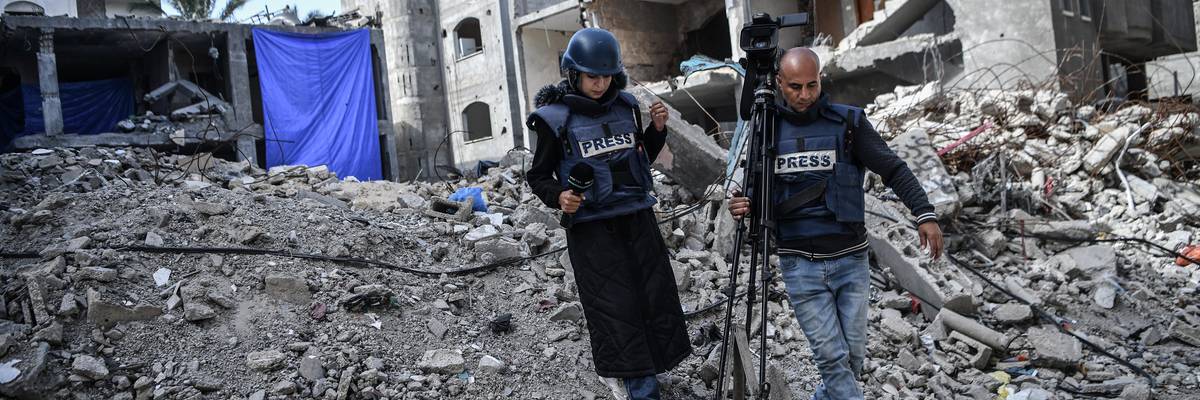
TRT Arabi reporter Reba Khalid al-Ajami reports from Gaza amid ongoing Israeli attacks in Rafah, Gaza on February 29, 2024.
The Pulitzer Prize Board avoided "naming the brave Palestinian journalists who did the reporting and filming and died in record numbers," said one journalist.
In recent years, the Pulitzer Prize Board has given special recognition to the journalists of Ukraine and Afghanistan for reporting from war zones, honoring their "courage, endurance, and commitment to truthful reporting" and their ability to tell their communities' stories under "profoundly tragic and complicated circumstances."
On Monday, no such recognition was given to Palestinian reporters in Gaza, at least 92 of whom have been among more than 34,000 Palestinians killed in the enclave since Israel began its bombardment in October.
The annual journalism and literature awards included a special citation for "journalists and media workers covering the war in Gaza"—but didn't differentiate between those around the world who have spent the last seven months telling the story of Israel's escalation from the safety of far-off countries, and those struggling to report on the destruction of their own home under the constant threat of Israel Defense Forces (IDF) attacks.
"The missing word is—is always—Palestinian," said Writers Against the War on Gaza (WAWOG). "Palestinian journalists and media workers deserve, if nothing else, this recognition; and half of them are dead."
Public health writer Abdullah Shihipar noted that in 2022, the board awarded the special citation to the "journalists of Ukraine." In 2021, it recognized "women and men of Afghanistan," saying that from "staff and freelance correspondents to interpreters to drivers to hosts, courageous Afghan residents helped produce Pulitzer-winning and Pulitzer-worthy images and stories."
This year, said Intercept journalist Jeremy Scahill, giving a special citation to "'media workers covering the war in Gaza' is a way to avoid naming the brave Palestinian journalists who did the reporting and filming and died in record numbers."
Many of those killed, Scahill added, might not have been had it not been for U.S.-made weapons sold to Israel.
The Pulitzer Prize for international reporting was awarded to The New York Times "for its wide-ranging and revelatory coverage of Hamas' lethal attack in southern Israel on October 7, Israel's intelligence failures, and the Israeli military's sweeping, deadly response in Gaza."
One of the Times' most explosive articles about Israel and Gaza, "Screams Without Words," about the alleged sexual assaults of Israeli victims of the October 7 attack, was not among those submitted for consideration. The article has come under scrutiny because of the anti-Palestinian bias expressed by one of the freelance reporters who worked on it, and questions about its veracity.
WAWOG, which has started a website titled The New York War Crimes, posted on social media that the Times should have instead been awarded the Pulitzer for "manufacturing consent."
By honoring the Times for its international reporting this year, said City University of New York sociology professor Heba Gowayed, the Pulitzer Prize "lost any credibility it ever had."
The prize is administered by Columbia University, where students have been protesting for weeks against U.S. support for the IDF and against the school's investment in companies that contract with Israel.
Last week, the university called on the New York Police Department to forcibly remove student protesters from a school building; police told student journalists they would be arrested if they left Pulitzer Hall to report on the incident. Student journalists are reportedly still being barred from campus.
Columbia, said Jack Mirkinson of The Nation, announced the Pulitzers "at the exact same time it is clamping down on the press freedom of its own students. You couldn't make it up."
Dear Common Dreams reader, It’s been nearly 30 years since I co-founded Common Dreams with my late wife, Lina Newhouser. We had the radical notion that journalism should serve the public good, not corporate profits. It was clear to us from the outset what it would take to build such a project. No paid advertisements. No corporate sponsors. No millionaire publisher telling us what to think or do. Many people said we wouldn't last a year, but we proved those doubters wrong. Together with a tremendous team of journalists and dedicated staff, we built an independent media outlet free from the constraints of profits and corporate control. Our mission has always been simple: To inform. To inspire. To ignite change for the common good. Building Common Dreams was not easy. Our survival was never guaranteed. When you take on the most powerful forces—Wall Street greed, fossil fuel industry destruction, Big Tech lobbyists, and uber-rich oligarchs who have spent billions upon billions rigging the economy and democracy in their favor—the only bulwark you have is supporters who believe in your work. But here’s the urgent message from me today. It's never been this bad out there. And it's never been this hard to keep us going. At the very moment Common Dreams is most needed, the threats we face are intensifying. We need your support now more than ever. We don't accept corporate advertising and never will. We don't have a paywall because we don't think people should be blocked from critical news based on their ability to pay. Everything we do is funded by the donations of readers like you. When everyone does the little they can afford, we are strong. But if that support retreats or dries up, so do we. Will you donate now to make sure Common Dreams not only survives but thrives? —Craig Brown, Co-founder |
In recent years, the Pulitzer Prize Board has given special recognition to the journalists of Ukraine and Afghanistan for reporting from war zones, honoring their "courage, endurance, and commitment to truthful reporting" and their ability to tell their communities' stories under "profoundly tragic and complicated circumstances."
On Monday, no such recognition was given to Palestinian reporters in Gaza, at least 92 of whom have been among more than 34,000 Palestinians killed in the enclave since Israel began its bombardment in October.
The annual journalism and literature awards included a special citation for "journalists and media workers covering the war in Gaza"—but didn't differentiate between those around the world who have spent the last seven months telling the story of Israel's escalation from the safety of far-off countries, and those struggling to report on the destruction of their own home under the constant threat of Israel Defense Forces (IDF) attacks.
"The missing word is—is always—Palestinian," said Writers Against the War on Gaza (WAWOG). "Palestinian journalists and media workers deserve, if nothing else, this recognition; and half of them are dead."
Public health writer Abdullah Shihipar noted that in 2022, the board awarded the special citation to the "journalists of Ukraine." In 2021, it recognized "women and men of Afghanistan," saying that from "staff and freelance correspondents to interpreters to drivers to hosts, courageous Afghan residents helped produce Pulitzer-winning and Pulitzer-worthy images and stories."
This year, said Intercept journalist Jeremy Scahill, giving a special citation to "'media workers covering the war in Gaza' is a way to avoid naming the brave Palestinian journalists who did the reporting and filming and died in record numbers."
Many of those killed, Scahill added, might not have been had it not been for U.S.-made weapons sold to Israel.
The Pulitzer Prize for international reporting was awarded to The New York Times "for its wide-ranging and revelatory coverage of Hamas' lethal attack in southern Israel on October 7, Israel's intelligence failures, and the Israeli military's sweeping, deadly response in Gaza."
One of the Times' most explosive articles about Israel and Gaza, "Screams Without Words," about the alleged sexual assaults of Israeli victims of the October 7 attack, was not among those submitted for consideration. The article has come under scrutiny because of the anti-Palestinian bias expressed by one of the freelance reporters who worked on it, and questions about its veracity.
WAWOG, which has started a website titled The New York War Crimes, posted on social media that the Times should have instead been awarded the Pulitzer for "manufacturing consent."
By honoring the Times for its international reporting this year, said City University of New York sociology professor Heba Gowayed, the Pulitzer Prize "lost any credibility it ever had."
The prize is administered by Columbia University, where students have been protesting for weeks against U.S. support for the IDF and against the school's investment in companies that contract with Israel.
Last week, the university called on the New York Police Department to forcibly remove student protesters from a school building; police told student journalists they would be arrested if they left Pulitzer Hall to report on the incident. Student journalists are reportedly still being barred from campus.
Columbia, said Jack Mirkinson of The Nation, announced the Pulitzers "at the exact same time it is clamping down on the press freedom of its own students. You couldn't make it up."
In recent years, the Pulitzer Prize Board has given special recognition to the journalists of Ukraine and Afghanistan for reporting from war zones, honoring their "courage, endurance, and commitment to truthful reporting" and their ability to tell their communities' stories under "profoundly tragic and complicated circumstances."
On Monday, no such recognition was given to Palestinian reporters in Gaza, at least 92 of whom have been among more than 34,000 Palestinians killed in the enclave since Israel began its bombardment in October.
The annual journalism and literature awards included a special citation for "journalists and media workers covering the war in Gaza"—but didn't differentiate between those around the world who have spent the last seven months telling the story of Israel's escalation from the safety of far-off countries, and those struggling to report on the destruction of their own home under the constant threat of Israel Defense Forces (IDF) attacks.
"The missing word is—is always—Palestinian," said Writers Against the War on Gaza (WAWOG). "Palestinian journalists and media workers deserve, if nothing else, this recognition; and half of them are dead."
Public health writer Abdullah Shihipar noted that in 2022, the board awarded the special citation to the "journalists of Ukraine." In 2021, it recognized "women and men of Afghanistan," saying that from "staff and freelance correspondents to interpreters to drivers to hosts, courageous Afghan residents helped produce Pulitzer-winning and Pulitzer-worthy images and stories."
This year, said Intercept journalist Jeremy Scahill, giving a special citation to "'media workers covering the war in Gaza' is a way to avoid naming the brave Palestinian journalists who did the reporting and filming and died in record numbers."
Many of those killed, Scahill added, might not have been had it not been for U.S.-made weapons sold to Israel.
The Pulitzer Prize for international reporting was awarded to The New York Times "for its wide-ranging and revelatory coverage of Hamas' lethal attack in southern Israel on October 7, Israel's intelligence failures, and the Israeli military's sweeping, deadly response in Gaza."
One of the Times' most explosive articles about Israel and Gaza, "Screams Without Words," about the alleged sexual assaults of Israeli victims of the October 7 attack, was not among those submitted for consideration. The article has come under scrutiny because of the anti-Palestinian bias expressed by one of the freelance reporters who worked on it, and questions about its veracity.
WAWOG, which has started a website titled The New York War Crimes, posted on social media that the Times should have instead been awarded the Pulitzer for "manufacturing consent."
By honoring the Times for its international reporting this year, said City University of New York sociology professor Heba Gowayed, the Pulitzer Prize "lost any credibility it ever had."
The prize is administered by Columbia University, where students have been protesting for weeks against U.S. support for the IDF and against the school's investment in companies that contract with Israel.
Last week, the university called on the New York Police Department to forcibly remove student protesters from a school building; police told student journalists they would be arrested if they left Pulitzer Hall to report on the incident. Student journalists are reportedly still being barred from campus.
Columbia, said Jack Mirkinson of The Nation, announced the Pulitzers "at the exact same time it is clamping down on the press freedom of its own students. You couldn't make it up."