
SUBSCRIBE TO OUR FREE NEWSLETTER
Daily news & progressive opinion—funded by the people, not the corporations—delivered straight to your inbox.
5
#000000
#FFFFFF
To donate by check, phone, or other method, see our More Ways to Give page.


Daily news & progressive opinion—funded by the people, not the corporations—delivered straight to your inbox.
"This is carpet-bombing, which has struck everything from playgrounds, to an emergency services HQ, schools, media buildings, and medical facilities," said one observer.
US and Israeli forces were accused Monday of "seemingly indiscriminate" bombing of Iran as the country's Red Crescent said that at least 555 people have been killed amid reports of fresh mass casualty attacks across the country.
The Iranian Red Crescent Society said at least 555 people have been killed so far during three days of a US and Israeli war of choice aimed at toppling Iran's long-ruling Islamist government. US Secretary of State Marco Rubio on Monday continued to insist that the war is not about regime change, but rather enduring yet bogus claims that Iran is close to developing nuclear weapons.
Those killed include many civilians as well as former Iranian Supreme Leader Ayatollah Ali Hosseini Khamenei and dozens of senior government and military officials. Iranian counterattacks have killed half a dozen US troops, 9 Israelis, and a handful of people in Gulf nations allied with the United States.
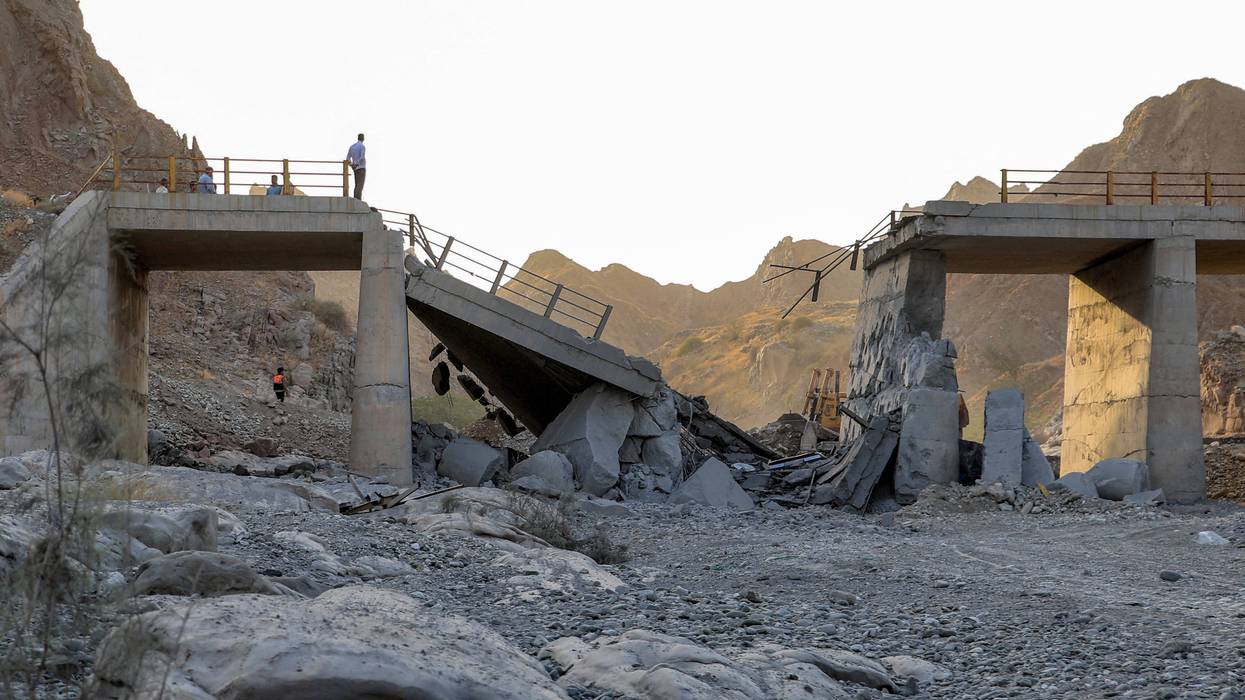
An attack on the Abbasabad Police Station—where anti-government protesters were allegedly tortured during the recent deadly crackdown—in Niloofar Square in central Tehran killed at least 20 people, local media reported.
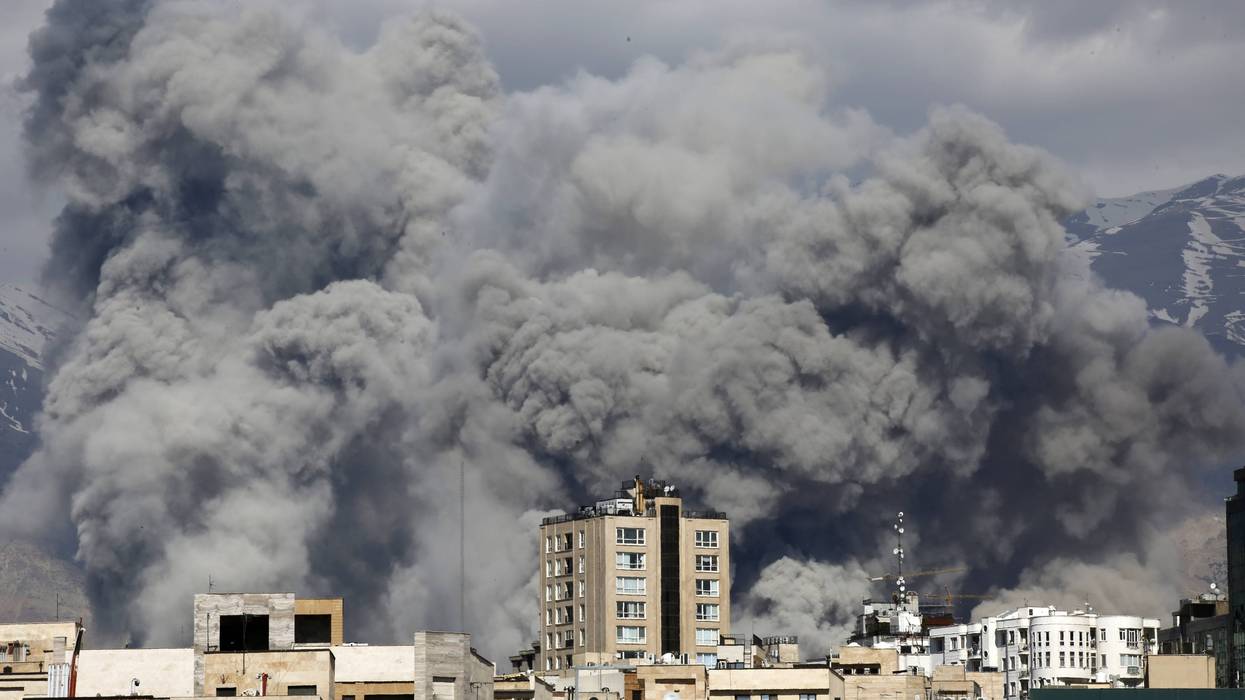
"This is carpet-bombing, which has struck everything from playgrounds, to an emergency services HQ, schools, media buildings, and medical facilities," documentary filmmaker Robert Inlakesh said in a social media post showing the aftermath of the strike.
Local residents said that the site was attacked for the second time in three days. This was part of broader US-Israeli strikes on Tehran, including attacks on the Revolutionary Court, Defense Ministry, other government sites, and civilian infrastructure including at least eight medical facilities and state media outlets.
Carpet bombing in Iran is stark reminder of how air superiority shapes modern warfare. In May 2025, Pakistan faced similar escalation from India—yet credible air defense and a combat-ready air force altered strategic calculus decisively.
Invest in air power, instead of proxies! pic.twitter.com/H3rx2tYS7T
— Sarah Khan (@sarahkhanjourno) March 2, 2026
Video footage of another attack on central Tehran—this one in Ferdowsi Square—showed devastation from what political analyst Trita Parsi called "seemingly indiscriminate" bombing.
"Increasingly, Israel and the US appear to be following the Gaza playbook, having failed to achieve a quick regime implosion," Parsi said on social media.
Parsi also shared video of a distraught woman who described an apparent so-called "double-tap" strike, a common tactic used by the US, Israel, and other militaries in which an initial bombing is followed up with a second one in a bid to kill and injure survivors and first responders.
"They killed everyone," the woman said of the attackers. "They dropped the first bomb, then when people went to help, they dropped another bomb."
Local and international media reported at least 35 people killed in multiple attacks on targets in the southern Fars province, which neighbors Hormozgan province, where the deadliest massacre of the young war took place on Saturday. Officials said at least 175 people—mostly children—were killed in a strike on the Shajareh Tayyebeh girls' elementary school in Minab.
Several hours later, a missile strike on a gymnasium in Lamerd, Pars province, where dozens of teenage girls were playing sports reportedly killed at least 18 people.
"Like the destruction of the school in Minab, basic protections to safeguard the lives of civilians in war either failed or were disregarded, leading to catastrophic loss among Iran’s civilian population," the National Iranian American Council said in a statement Monday.
Iranian Red Crescent chief Pirhossein Kolivand said in a video posted on social media Sunday that “the Minab school incident has no comparison with any other incident, even in Gaza."
Comparisons with Gaza—where Israel's genocidal assault has left more than 250,000 Palestinians dead, maimed, or missing since October 2023 and the coastal strip in ruins—have been numerous.
Condemning what it called the "barbarous" and "treacherous" US-Israeli attacks on Iran, Hezbollah, the Lebanon-based resistance group targeted by Israel during the Gaza war, said, “This aggression confirms the full and direct partnership between America and Israel in planning and execution, not only in the war against the Islamic Republic, but also in all the wars and crimes the region is facing, in Gaza, Lebanon, Syria, and Yemen.”
Ori Goldberg, an Israeli political analyst, said that, in Israeli society, "there’s a sense of triumphalism, of having attacked an enemy regime."
"Not really because we’re greatly invested in the future of the Iranian people, but because, through the genocide on Gaza, we’ve devalued human life,” he added.
Parsi said that "Israel appears to be going Gaza on Iran."
The renewed US and Israeli attacks on Iran follow last year's limited war on the country that left thousands of Iranians dead or wounded, including at least 436 civilians killed and over 2,000 others injured, according to officials and activists.
United Nations officials and international human rights defenders were also among those condemning the US-Israeli war of choice.
Addressing the Minab school strike, UNESCO—the UN's educational, scientific, and cultural agency—said that "the killing of pupils in a place dedicated to learning constitutes a grave violation of the protection afforded to schools under international humanitarian law."
UN Messenger of Peace and Nobel Peace laureate Malala Yousafzai asserted that “all states and parties must uphold their obligations under international law to protect civilians and safeguard schools," adding that "every child deserves to live and learn in peace.”
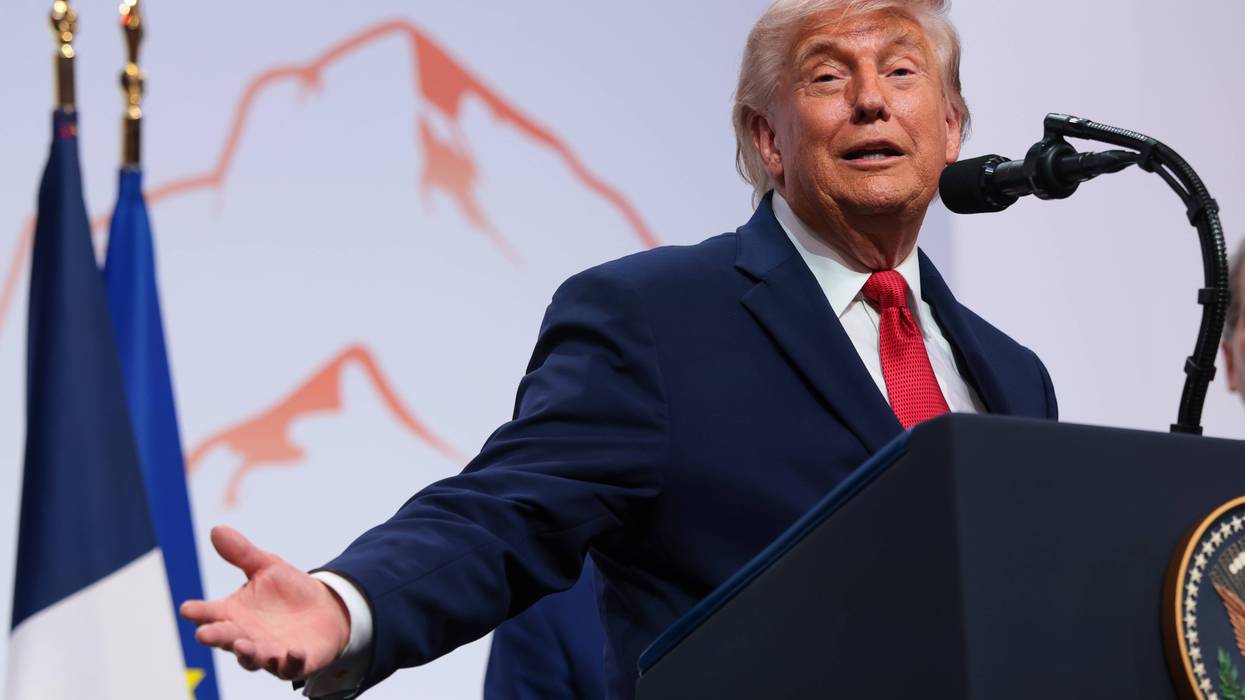
In the United States—where Democratic and a handful of Republican lawmakers are reportedly drafting a war powers resolution in a bid to rein in President Donald Trump's aggression—Rep. Rashida Tlaib (D-Mich.) took to social media to note the "over 555 Iranians already killed by US-Israeli bombs, including at least 165 at a girls' elementary school."
"At least four US service members are dead," she also wrote, before that figure rose to six. "Any member of Congress who votes against the war powers resolution is voting for more of this."
The Not Above the Law coalition was among the civil society groups urging Congress to pass an Iran war powers resolution.
“President Trump has launched deadly military strikes against Iran without congressional approval, in flagrant violation of the Constitution," the coalition's co-chairs said Monday. "Article I, Section 8 is crystal clear: Only Congress can declare war. Yet Trump has secured neither a declaration of war nor congressional authorization for military force."
"Trump’s reckless unilateral action puts American lives and global security at risk while trampling the foundational principle that no president is above the law," Not Above the Law added. “Congress must act immediately. Pass war powers resolutions to reject this unconstitutional power grab and reassert its authority over matters of war and peace. The rule of law demands it."
"HANDS OFF IRAN Mr. TRUMP," said Yanis Varoufakis. "And to the rest of us: Let's do whatever it takes to oppose another war crime—this time against the Iranian people."
As an adviser to President Donald Trump told Axios that "I think there is 90% chance we see kinetic action" against Iran in the next few weeks following nuclear talks in Switzerland, US military movement on Wednesday fueled fears of an imminent attack on the Middle Eastern country.
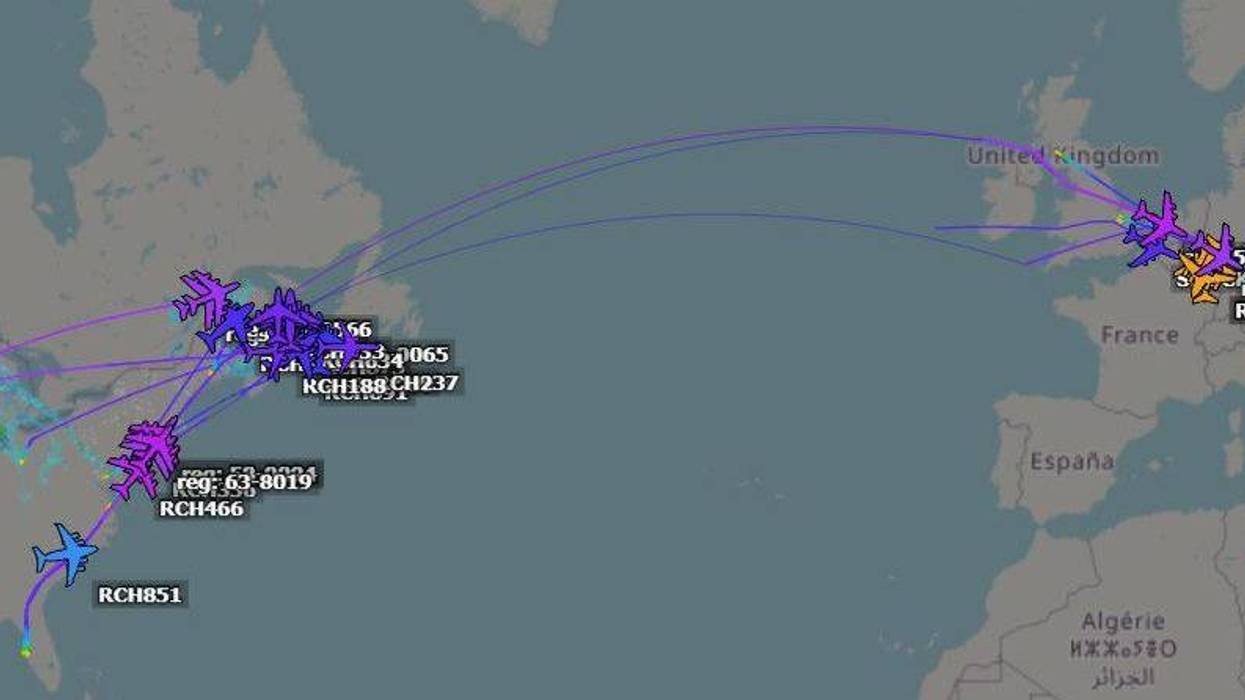
Multiple open-source intelligence accounts on social media shared images of what OSINTdefender called "one of the busiest days for the US Air Force in Europe that I have seen in recent history, with close to a dozen KC-135R/T Stratotankers airborne across the Mediterranean and off the coast of Spain, while a steady line of C-17A Globemaster IIIs can be seen heading towards and returning from bases in the Middle East."
Sharing a similar image showing North America, Europe, and the top of Africa, intelligence analyst Oliver Alexander declared on X that "the tankers just keep coming."
Greek economist and Progressive International co-founder Yanis Varoufakis responded to that post with a clear message directed at Trump—who notably abandoned the United States' previous nuclear deal with Iran during his first term.
"Looks like an imminent US strike is in train as US tanker planes are heading eastwards. HANDS OFF IRAN Mr. TRUMP," he said. "And to the rest of us: Let's do whatever it takes to oppose another war crime—this time against the Iranian people."
Also spotlighting the US military movements on Wednesday, progressive US political commentator and talk show host Kyle Kulinski nodded to Trump's deadly invasion of Venezuela last month to abduct Venezuelan President Nicolás Maduro and hand over the South American country's nationalized oil industry to his US campaign donors.
A US attack on Iran by "imperialist warmonger Trump" would be "another illegal and offensive war against a country that didn't attack us," Kulinski said.
The observed military movements came just hours after Axios not only published the Trump official's remark about a 90% chance of war, but also reported that "a US military operation in Iran would likely be a massive, weekslong campaign that would look more like full-fledged war than last month's pinpoint operation in Venezuela," according to unnamed sources who "noted it would likely be a joint US-Israeli campaign."
In the Middle East, "Trump's armada has grown to include two aircraft carriers, a dozen warships, hundreds of fighter jets, and multiple air defense systems. Some of that firepower is still on its way," the outlet highlighted. "More than 150 US military cargo flights have moved weapons systems and ammunition to the Middle East. Just in the past 24 hours, another 50 fighter jets—F-35s, F-22s, and F-16s—headed to the region."
The Wall Street Journal reported Wednesday that leaders in Iran "want to reach a nuclear deal with the US, but they are also rushing to prepare for war in case talks between the countries fail," including by "deploying its forces, dispersing decision-making authority, fortifying its nuclear sites, and expanding its crackdown on domestic dissent."
As the newspaper detailed:
A Russian warship arrived at the Strait of Hormuz and docked at the Iranian port town of Bandar Abbas ahead of a military exercise planned for Thursday, according to Iranian and Russian state-run media.
The exercises are taking place not far from the aircraft carrier USS Abraham Lincoln, which is sailing off the coast of Oman.
"More dangerous than the American warship is the weapon that can send it to the bottom of the sea," Iran's supreme leader, Ali Khamenei, said Tuesday.
While Iranian Foreign Minister Abbas Araghchi said this week's "constructive" talks with Trump envoys Steve Witkoff and Jared Kushner concluded with "a general agreement on some guiding principles," US Vice President JD Vance contributed to rising concerns on Tuesday as he discussed the ayatollah's remarks, negotiations, and regional military buildup on Fox News.
"I think the president has a lot of options. We do have a very powerful military. The president's shown a willingness to use it. He also has a remarkable diplomatic team and he's shown a willingness to use that too," Vance said. "The United States has certain red lines. Our primary interest here is we don't want Iran to get a nuclear weapon."
Vance, who noted that he spoke directly with Witkoff and Kushner earlier Tuesday, claimed that the administration wants a resolution reached through conversation but also stressed that Trump "has all options on the table."
Appearing on Democracy Now! Wednesday, Trita Parsi, co-founder and executive vice president of the Quincy Institute for Responsible Statecraft and an expert on US-Iranian relations, warned that "we have a very dangerous situation, because both sides actually believe that a short, intense war may improve their negotiating position. The Trump administration, of course, believes that because of its overwhelming military power that it has now gathered in the vicinity of Iran, it will be able to take out Iran militarily rather quickly and then force it to capitulate."
"The Iranians have a different calculation," Parsi continued. "They believe that they have the ability to inflict significant damage on the United States in the short term, including on civilian oil installations in the region, closing down the Strait of Hormuz, that would shoot up oil prices, and the initial cost of this to the United States would be so immense, and the United States would recognize that it would have to go for a longer war, which it cannot afford, and as a result, it would get the United States to back off."
Parsi previously led the National Iranian American Council (NIAC), which said in a Wednesday statement that the anonymous Trump official's comment about a 90% chance of an armed conflict with Iran "should trigger immediate action from Congress, the branch of government legally and constitutionally charged with deciding when the US goes to war."
"With extensive military deployments underway and public signals that diplomacy may soon be abandoned, the risk of a large-scale, prolonged, and senseless conflict is immediate and real," NIAC argued. "A war on Iran would not help Iranians demanding change in the face of government repression but instead kill innocent people, create instability inside Iran, and ignite a regionwide conflict."
The Republican-controlled Congress has so far shown an unwillingness to stand up to Trump's violence abroad, with multiple war powers resolutions about Venezuela and his boat bombings on high seas failing. Still, NIAC pressured lawmakers to act now, emphasizing that "a war with Iran would carry enormous regional consequences, endanger American service members and Iranian civilians alike, destabilize global markets, and risk spiraling escalation across the region and diminished civil liberties at home."
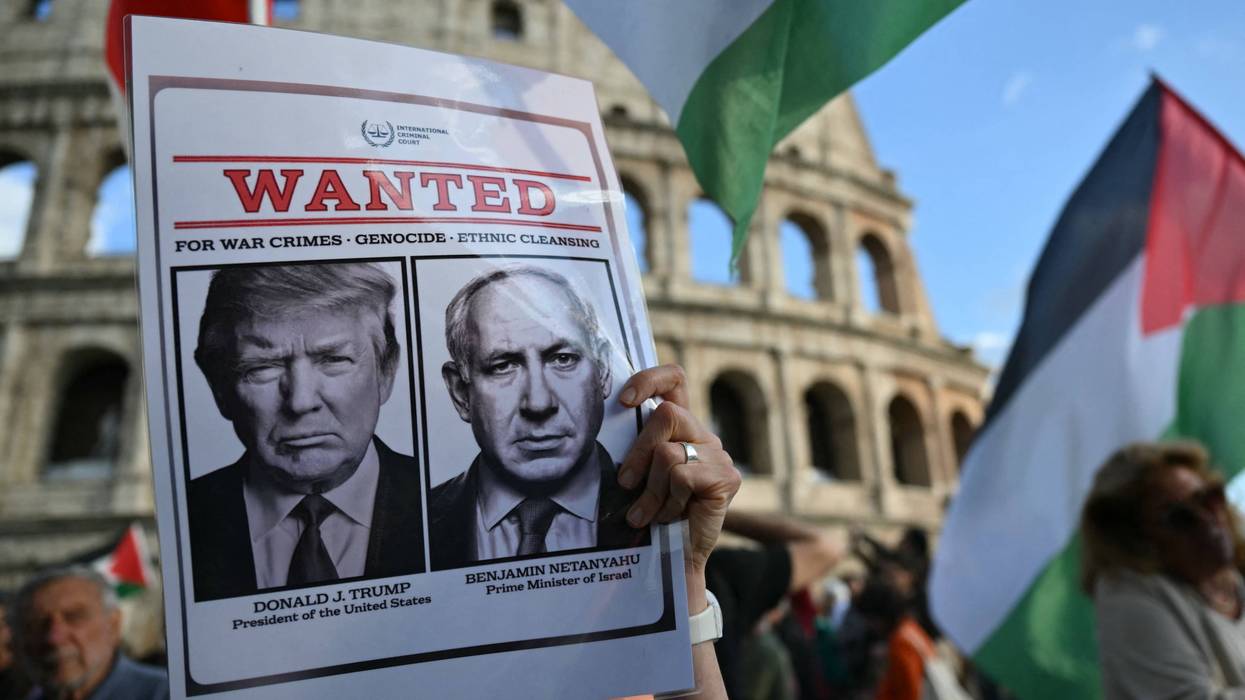
"This government has shown that it is not capable of reform," said one Iranian demonstrator. "On the other side, there are Trump and Netanyahu, both of whom are war criminals."
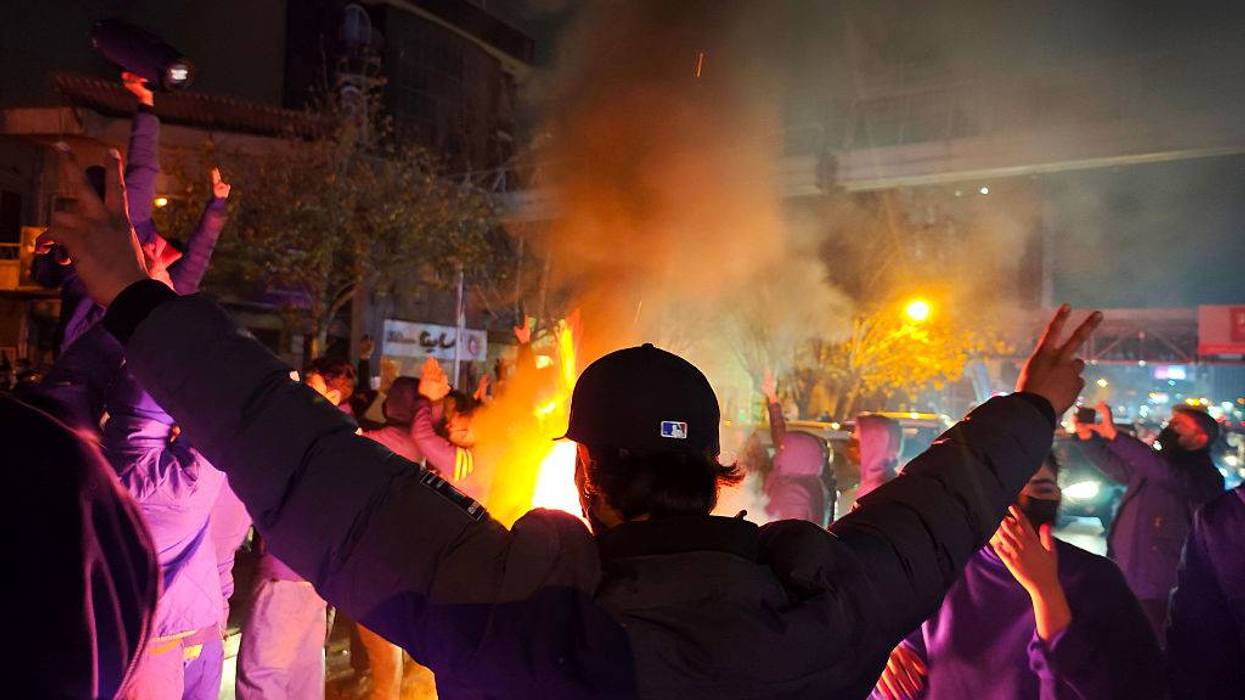
President Donald Trump has threatened to launch military strikes against Iran, purportedly to help anti-government protesters who are demanding change amid an economic crisis.
However, Middle East Eye spoke with some of the Iranian demonstrators and found they had little appetite for interference from either the US or Israel.
A 39-year-old protester from Tehran, who identified only as Sara, said that Israel's record of bombing countries in the region made her suspicious of any offer that its government would make to help the Iranian protest movement.
"Over the past one or two years, Israel has attacked almost every country in the region," she said. "They want the entire region to be in chaos while they remain safe."
Sara also emphasized that "we want regime change, but we do not want our country to be destroyed."
A 28-year-old demonstrator named Reza also expressed skepticism of Israel and US offers to help even while stating his fierce opposition to the Iranian government.
"On one side, this government has shown that it is not capable of reform and knows nothing but repression," he said. "On the other side, there are Trump and Netanyahu, both of whom are war criminals."
The Middle East Eye report noted that Trump, unlike past presidents, has not even offered a pretense of wanting to bring democracy to Iran to justify military action and has instead stated his desire to seize foreign nations' resources, such as when he declared that the US would take control of petroleum production in Venezuela after the US military abducted President Nicolás Maduro.
Jamal Abdi, president of the National Iranian American Council, earlier this month expressed solidarity with the Iranian protesters while also warning Trump and Israeli Prime Minister Benjamin Netanyahu to butt out.
"The outbreak of protests in Iran over the past week has been led by Iranians suffering under tremendous economic pressure and repression," said Abdi. "It is the Iranian people’s movement and they deserve to be heard, not President Trump or Israeli Prime Minister Netanyahu, who cannot and should not try to speak for them. President Trump’s decision to insert himself and threaten military intervention at this moment is profoundly reckless. It distracts from the legitimate grievances of Iranians and risks being exploited to justify a more violent government crackdown."
The Iranian government has responded to the protests with violence and mass arrests of demonstrators, and the government has blacked out internet access for its citizens.
The exact death toll resulting from the Iranian government's crackdown is not known, although the US-based Human Rights Activists News Agency estimated as of Monday night that more than 500 people had been killed, while an unnamed Iranian official told Reuters on Tuesday that 2,000 people had been killed so far, including Iranian security forces.