SUBSCRIBE TO OUR FREE NEWSLETTER
Daily news & progressive opinion—funded by the people, not the corporations—delivered straight to your inbox.
5
#000000
#FFFFFF
To donate by check, phone, or other method, see our More Ways to Give page.
Daily news & progressive opinion—funded by the people, not the corporations—delivered straight to your inbox.
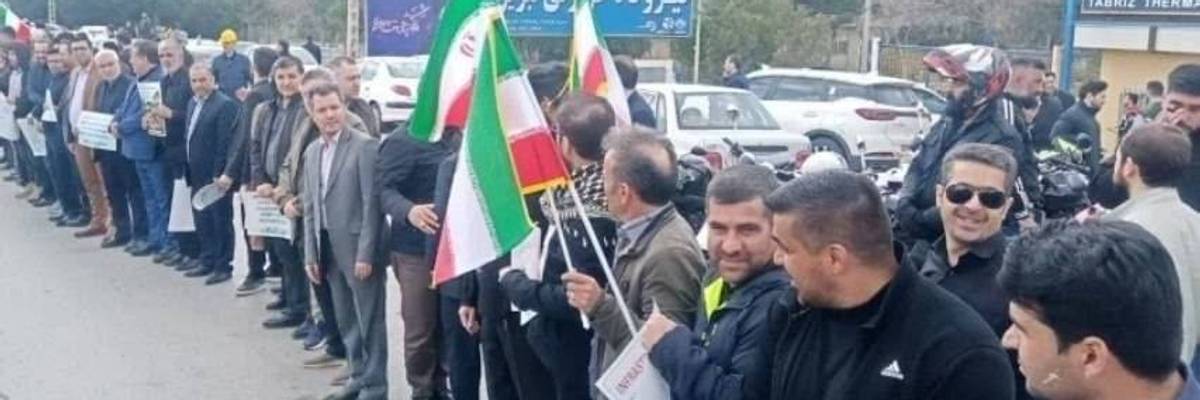
Iranians form a "human chain" outside the Tabriz Thermal Power Plant in Tabriz, Iran after US President Donald Trump threatened to destroy infrastructure across the country on April 7, 2026.
"The real legal and moral question is why civilian infrastructure is being targeted at all," said one expert.
After US President Donald Trump made his genocidal declaration on Tuesday that the "whole civilization" of Iran "will die tonight," reports began to roll in of people across the country standing outside the power plants, bridges, and other civilian infrastructure the president promised to bomb.
Photos shared to social media by the government-affiliated Mehr news agency showed scene after scene of Iranians forming human chains outside power plants in Tabriz and Kermanshah.
A video showed dozens of students assembled on the Dezful bridge in southwestern Iran, which is more than 1,700 years old and is believed to be one of the oldest functioning bridges in the world.
Over the weekend, Trump said that unless Iran opened the Strait of Hormuz, a critical shipping lane that it has used as a chokepoint against the Western economy, by Tuesday, he would bomb infrastructure relied upon by tens of millions of Iranians, which Amnesty International said could amount to a "war crime."
"We’re giving them till tomorrow, eight o’clock eastern time, and after that, they’re going to have no bridges. They’re going to have no power plants," Trump said on Monday, reiterating his plans to bomb Iran "back to the Stone Ages."
According to Iranian President Masoud Pezeshkian, more than 14 million people in the country responded to the threat by volunteering to put their bodies on the line and defend the infrastructure at risk. He said they'd "declared their readiness to sacrifice their lives in defense of Iran.”
The government has encouraged Iranians, including children and young students, to take to the streets to form human chains around infrastructure that may come under threat, leading some Western media outlets to raise the fear that people were being used as "human shields."
Sina Toossi, a fellow at the Center for International Policy, however, said this "is a deeply misleading framing."
"Iranians are not being placed in front of targets," he said, referencing several videos of the demonstrations. "Many are voluntarily showing up to defend the infrastructure that keeps their society alive."
He noted the participation of Iranian celebrities in the human chains, including the composer and Tar player Ali Ghamsari, who stationed himself outside a power plant, and the pop singer Benyamin Bahadori, who filmed a video of himself walking along a bridge that had come under threat.
"This is about people trying to safeguard electricity, water, and basic civilization under open threat," Toossi said. "The real legal and moral question is why civilian infrastructure is being targeted at all."
Agnès Callamard, secretary general of Amnesty International, said on Tuesday that Trump's threats could prove "apocalyptic" to millions of Iranians, plunging the "entire country into darkness and depriv[ing] millions of their fundamental human rights to life, water, food, healthcare, and an adequate standard of living."
"Power plants, water systems, and energy infrastructure are indispensable to civilian life, underpinning access to clean water, medical care, hospital electricity, food supply chains, and basic livelihoods," she added. "Attacking them would be disproportionate and thus unlawful under international humanitarian law and could amount to a war crime.”
Dear Common Dreams reader, It’s been nearly 30 years since I co-founded Common Dreams with my late wife, Lina Newhouser. We had the radical notion that journalism should serve the public good, not corporate profits. It was clear to us from the outset what it would take to build such a project. No paid advertisements. No corporate sponsors. No millionaire publisher telling us what to think or do. Many people said we wouldn't last a year, but we proved those doubters wrong. Together with a tremendous team of journalists and dedicated staff, we built an independent media outlet free from the constraints of profits and corporate control. Our mission has always been simple: To inform. To inspire. To ignite change for the common good. Building Common Dreams was not easy. Our survival was never guaranteed. When you take on the most powerful forces—Wall Street greed, fossil fuel industry destruction, Big Tech lobbyists, and uber-rich oligarchs who have spent billions upon billions rigging the economy and democracy in their favor—the only bulwark you have is supporters who believe in your work. But here’s the urgent message from me today. It's never been this bad out there. And it's never been this hard to keep us going. At the very moment Common Dreams is most needed, the threats we face are intensifying. We need your support now more than ever. We don't accept corporate advertising and never will. We don't have a paywall because we don't think people should be blocked from critical news based on their ability to pay. Everything we do is funded by the donations of readers like you. When everyone does the little they can afford, we are strong. But if that support retreats or dries up, so do we. Will you donate now to make sure Common Dreams not only survives but thrives? —Craig Brown, Co-founder |
After US President Donald Trump made his genocidal declaration on Tuesday that the "whole civilization" of Iran "will die tonight," reports began to roll in of people across the country standing outside the power plants, bridges, and other civilian infrastructure the president promised to bomb.
Photos shared to social media by the government-affiliated Mehr news agency showed scene after scene of Iranians forming human chains outside power plants in Tabriz and Kermanshah.
A video showed dozens of students assembled on the Dezful bridge in southwestern Iran, which is more than 1,700 years old and is believed to be one of the oldest functioning bridges in the world.
Over the weekend, Trump said that unless Iran opened the Strait of Hormuz, a critical shipping lane that it has used as a chokepoint against the Western economy, by Tuesday, he would bomb infrastructure relied upon by tens of millions of Iranians, which Amnesty International said could amount to a "war crime."
"We’re giving them till tomorrow, eight o’clock eastern time, and after that, they’re going to have no bridges. They’re going to have no power plants," Trump said on Monday, reiterating his plans to bomb Iran "back to the Stone Ages."
According to Iranian President Masoud Pezeshkian, more than 14 million people in the country responded to the threat by volunteering to put their bodies on the line and defend the infrastructure at risk. He said they'd "declared their readiness to sacrifice their lives in defense of Iran.”
The government has encouraged Iranians, including children and young students, to take to the streets to form human chains around infrastructure that may come under threat, leading some Western media outlets to raise the fear that people were being used as "human shields."
Sina Toossi, a fellow at the Center for International Policy, however, said this "is a deeply misleading framing."
"Iranians are not being placed in front of targets," he said, referencing several videos of the demonstrations. "Many are voluntarily showing up to defend the infrastructure that keeps their society alive."
He noted the participation of Iranian celebrities in the human chains, including the composer and Tar player Ali Ghamsari, who stationed himself outside a power plant, and the pop singer Benyamin Bahadori, who filmed a video of himself walking along a bridge that had come under threat.
"This is about people trying to safeguard electricity, water, and basic civilization under open threat," Toossi said. "The real legal and moral question is why civilian infrastructure is being targeted at all."
Agnès Callamard, secretary general of Amnesty International, said on Tuesday that Trump's threats could prove "apocalyptic" to millions of Iranians, plunging the "entire country into darkness and depriv[ing] millions of their fundamental human rights to life, water, food, healthcare, and an adequate standard of living."
"Power plants, water systems, and energy infrastructure are indispensable to civilian life, underpinning access to clean water, medical care, hospital electricity, food supply chains, and basic livelihoods," she added. "Attacking them would be disproportionate and thus unlawful under international humanitarian law and could amount to a war crime.”
After US President Donald Trump made his genocidal declaration on Tuesday that the "whole civilization" of Iran "will die tonight," reports began to roll in of people across the country standing outside the power plants, bridges, and other civilian infrastructure the president promised to bomb.
Photos shared to social media by the government-affiliated Mehr news agency showed scene after scene of Iranians forming human chains outside power plants in Tabriz and Kermanshah.
A video showed dozens of students assembled on the Dezful bridge in southwestern Iran, which is more than 1,700 years old and is believed to be one of the oldest functioning bridges in the world.
Over the weekend, Trump said that unless Iran opened the Strait of Hormuz, a critical shipping lane that it has used as a chokepoint against the Western economy, by Tuesday, he would bomb infrastructure relied upon by tens of millions of Iranians, which Amnesty International said could amount to a "war crime."
"We’re giving them till tomorrow, eight o’clock eastern time, and after that, they’re going to have no bridges. They’re going to have no power plants," Trump said on Monday, reiterating his plans to bomb Iran "back to the Stone Ages."
According to Iranian President Masoud Pezeshkian, more than 14 million people in the country responded to the threat by volunteering to put their bodies on the line and defend the infrastructure at risk. He said they'd "declared their readiness to sacrifice their lives in defense of Iran.”
The government has encouraged Iranians, including children and young students, to take to the streets to form human chains around infrastructure that may come under threat, leading some Western media outlets to raise the fear that people were being used as "human shields."
Sina Toossi, a fellow at the Center for International Policy, however, said this "is a deeply misleading framing."
"Iranians are not being placed in front of targets," he said, referencing several videos of the demonstrations. "Many are voluntarily showing up to defend the infrastructure that keeps their society alive."
He noted the participation of Iranian celebrities in the human chains, including the composer and Tar player Ali Ghamsari, who stationed himself outside a power plant, and the pop singer Benyamin Bahadori, who filmed a video of himself walking along a bridge that had come under threat.
"This is about people trying to safeguard electricity, water, and basic civilization under open threat," Toossi said. "The real legal and moral question is why civilian infrastructure is being targeted at all."
Agnès Callamard, secretary general of Amnesty International, said on Tuesday that Trump's threats could prove "apocalyptic" to millions of Iranians, plunging the "entire country into darkness and depriv[ing] millions of their fundamental human rights to life, water, food, healthcare, and an adequate standard of living."
"Power plants, water systems, and energy infrastructure are indispensable to civilian life, underpinning access to clean water, medical care, hospital electricity, food supply chains, and basic livelihoods," she added. "Attacking them would be disproportionate and thus unlawful under international humanitarian law and could amount to a war crime.”