SUBSCRIBE TO OUR FREE NEWSLETTER
Daily news & progressive opinion—funded by the people, not the corporations—delivered straight to your inbox.
5
#000000
#FFFFFF
To donate by check, phone, or other method, see our More Ways to Give page.
Daily news & progressive opinion—funded by the people, not the corporations—delivered straight to your inbox.
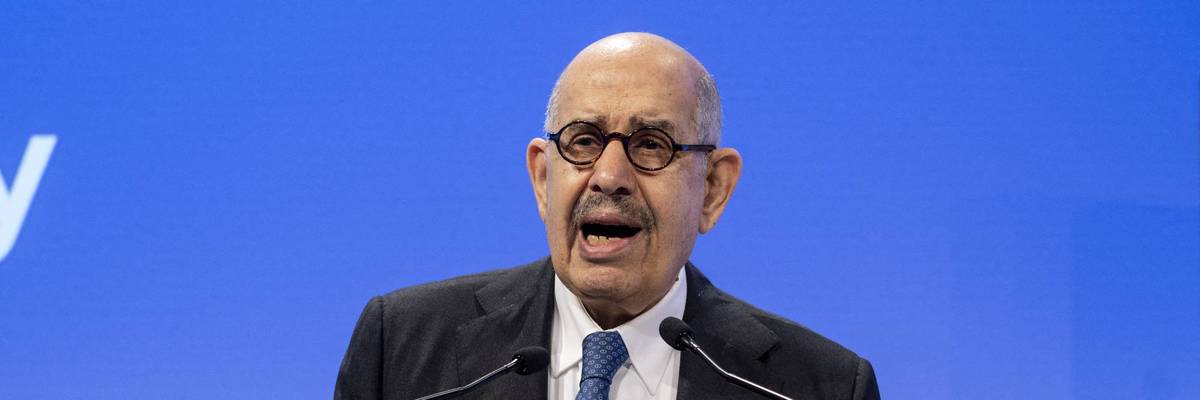
Mohamed ElBaradei, former director-general of the International Atomic Energy Agency, speaks during the 2022 Vienna Conference on the Humanitarian Impact of Nuclear Weapons at the Austrian Center in Vienna, Austria on June 20, 2022.
"The US is intensifying the drumbeat of war against Iran, with zero explanation of the nonexistent legal authority to use force and zero evidence of an 'imminent threat,'" said Mohamed ElBaradei.
The former head of the International Atomic Energy Agency said Wednesday that a US war on Iran would have "horrific costs," a warning that came before American and Iranian officials gathered in Geneva for the latest round of closely watched negotiations.
"The US is intensifying the drumbeat of war against Iran, with zero explanation of the nonexistent legal authority to use force and zero evidence of an 'imminent threat' other than hypothetical scenarios based on possible future intentions," Mohamed ElBaradei, a Nobel Peace Prize laureate who served as IAEA director-general from 1997 to 2009, wrote in a social media post.
"All wars, including 'wars of choice,' have horrific costs," he added. "That is the reason for the restraints and limitations established by international norms. This is Iraq redux... It seems we never learn."
US President Donald Trump and members of his administration have repeatedly claimed, without evidence, that Iran desires and is on the brink of making a nuclear weapon, even after Trump claimed to have "obliterated" the country's nuclear program with airstrikes last year.
Iran has said its nuclear program is entirely for peaceful purposes; the nation's foreign minister, Abbas Araghchi, said earlier this week that Iran would "under no circumstances ever develop a nuclear weapon."
"A deal is within reach, but only if diplomacy is given priority," said Araghchi.
In recent weeks, the Trump administration has assembled a massive fleet of warplanes and aircraft in the Middle East as the US president has threatened to attack Iran, accusing the country of harboring "sinister nuclear ambitions."
But Rafael Grossi, the current head of the IAEA, said last week that the nuclear agency had not seen any evidence that Iran is currently working to develop nuclear weapons capacity.
"On the contrary, I see, today, a willingness on both sides to reach an agreement," said Grossi.
Dear Common Dreams reader, It’s been nearly 30 years since I co-founded Common Dreams with my late wife, Lina Newhouser. We had the radical notion that journalism should serve the public good, not corporate profits. It was clear to us from the outset what it would take to build such a project. No paid advertisements. No corporate sponsors. No millionaire publisher telling us what to think or do. Many people said we wouldn't last a year, but we proved those doubters wrong. Together with a tremendous team of journalists and dedicated staff, we built an independent media outlet free from the constraints of profits and corporate control. Our mission has always been simple: To inform. To inspire. To ignite change for the common good. Building Common Dreams was not easy. Our survival was never guaranteed. When you take on the most powerful forces—Wall Street greed, fossil fuel industry destruction, Big Tech lobbyists, and uber-rich oligarchs who have spent billions upon billions rigging the economy and democracy in their favor—the only bulwark you have is supporters who believe in your work. But here’s the urgent message from me today. It's never been this bad out there. And it's never been this hard to keep us going. At the very moment Common Dreams is most needed, the threats we face are intensifying. We need your support now more than ever. We don't accept corporate advertising and never will. We don't have a paywall because we don't think people should be blocked from critical news based on their ability to pay. Everything we do is funded by the donations of readers like you. When everyone does the little they can afford, we are strong. But if that support retreats or dries up, so do we. Will you donate now to make sure Common Dreams not only survives but thrives? —Craig Brown, Co-founder |
The former head of the International Atomic Energy Agency said Wednesday that a US war on Iran would have "horrific costs," a warning that came before American and Iranian officials gathered in Geneva for the latest round of closely watched negotiations.
"The US is intensifying the drumbeat of war against Iran, with zero explanation of the nonexistent legal authority to use force and zero evidence of an 'imminent threat' other than hypothetical scenarios based on possible future intentions," Mohamed ElBaradei, a Nobel Peace Prize laureate who served as IAEA director-general from 1997 to 2009, wrote in a social media post.
"All wars, including 'wars of choice,' have horrific costs," he added. "That is the reason for the restraints and limitations established by international norms. This is Iraq redux... It seems we never learn."
US President Donald Trump and members of his administration have repeatedly claimed, without evidence, that Iran desires and is on the brink of making a nuclear weapon, even after Trump claimed to have "obliterated" the country's nuclear program with airstrikes last year.
Iran has said its nuclear program is entirely for peaceful purposes; the nation's foreign minister, Abbas Araghchi, said earlier this week that Iran would "under no circumstances ever develop a nuclear weapon."
"A deal is within reach, but only if diplomacy is given priority," said Araghchi.
In recent weeks, the Trump administration has assembled a massive fleet of warplanes and aircraft in the Middle East as the US president has threatened to attack Iran, accusing the country of harboring "sinister nuclear ambitions."
But Rafael Grossi, the current head of the IAEA, said last week that the nuclear agency had not seen any evidence that Iran is currently working to develop nuclear weapons capacity.
"On the contrary, I see, today, a willingness on both sides to reach an agreement," said Grossi.
The former head of the International Atomic Energy Agency said Wednesday that a US war on Iran would have "horrific costs," a warning that came before American and Iranian officials gathered in Geneva for the latest round of closely watched negotiations.
"The US is intensifying the drumbeat of war against Iran, with zero explanation of the nonexistent legal authority to use force and zero evidence of an 'imminent threat' other than hypothetical scenarios based on possible future intentions," Mohamed ElBaradei, a Nobel Peace Prize laureate who served as IAEA director-general from 1997 to 2009, wrote in a social media post.
"All wars, including 'wars of choice,' have horrific costs," he added. "That is the reason for the restraints and limitations established by international norms. This is Iraq redux... It seems we never learn."
US President Donald Trump and members of his administration have repeatedly claimed, without evidence, that Iran desires and is on the brink of making a nuclear weapon, even after Trump claimed to have "obliterated" the country's nuclear program with airstrikes last year.
Iran has said its nuclear program is entirely for peaceful purposes; the nation's foreign minister, Abbas Araghchi, said earlier this week that Iran would "under no circumstances ever develop a nuclear weapon."
"A deal is within reach, but only if diplomacy is given priority," said Araghchi.
In recent weeks, the Trump administration has assembled a massive fleet of warplanes and aircraft in the Middle East as the US president has threatened to attack Iran, accusing the country of harboring "sinister nuclear ambitions."
But Rafael Grossi, the current head of the IAEA, said last week that the nuclear agency had not seen any evidence that Iran is currently working to develop nuclear weapons capacity.
"On the contrary, I see, today, a willingness on both sides to reach an agreement," said Grossi.