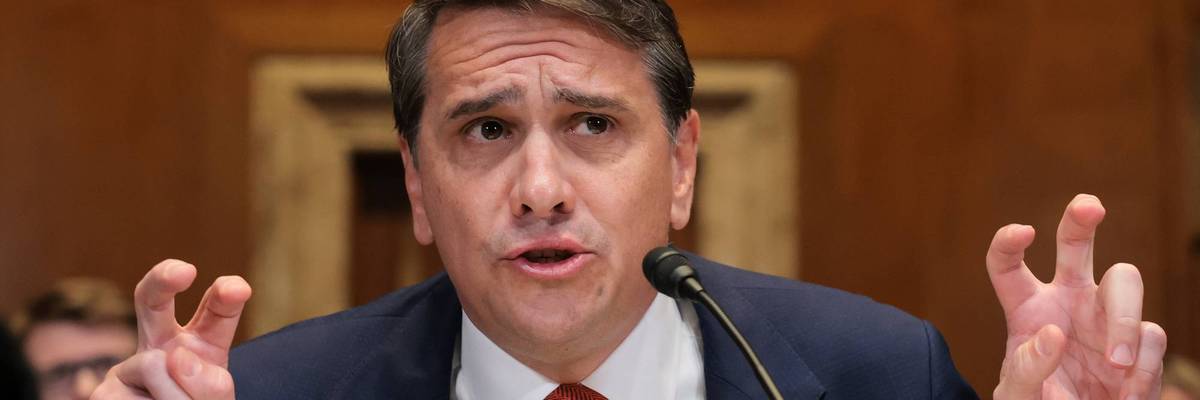
Acting U.S. Attorney General Todd Blanche testifies during a Senate Committee on Appropriations, Subcommittee on Commerce, Justice, Science, and Related Agencies hearing in the Dirksen Senate Office Building on Capitol Hill on May 19, 2026 in Washington, DC.
My Application for $30 Million From Trump’s $1.8 Billion Slush Fund
A formal letter to Acting Attorney General Todd Blanche, faithfully submitted.
Dear Acting Attorney General Todd Blanche,
I am writing to formally submit my application to your newly established federal “Anti-Weaponization Fund” for compensation in the form of a cash payment for damages incurred at the hands of the United States government.
As you stated while announcing President Trump’s new $1.776 billion fund, “The machinery of government should never be weaponized against any American, and it is this Department’s intention to make right the wrongs that were previously done while ensuring this never happens again.”
Todd, if I may, I saw your former client — President Trump, for whom you previously provided legal representation — backed you up, saying, “This is reimbursing people who were horribly treated.”
Additionally, Todd, I read an Associated Press report noting that during congressional testimony you stated that you “wouldn’t rule out the possibility that rioters who assaulted police on Jan. 6 would be eligible for fund payouts.” After hearing your remarkably broad interpretation of governmental victimization, I felt compelled to share with you what the government has done to me and my family by writing the letter below — which reveals several forms of government abuse my family and I have endured which, while you may not find as severe as the temporary loss of access to the U.S. Capitol experienced by individuals convicted of felonies related to January 6, nonetheless caused considerable hardship for us.
I was initially reassured that my request was reasonable after learning that Adam Johnson — best known for carrying Speaker Nancy Pelosi’s lectern through the Capitol during the January 6 attack — is reportedly considering a claim of up to $5 million himself.
However, after learning that Brandon Fellows — another January 6 defendant pardoned by President Trump — reportedly plans to seek $30 million from the fund, including $21.5 million for what he described as “wrongful imprisonment,” I realized that the harms experienced by my family and me may in fact fall closer to Mr. Fellows’s compensation range.
So, after reviewing your department’s stated principles, apparent standards, and anticipated applicant pool, I believe I am highly qualified for compensation and would like to make a modest request of $30 million.
In fact, Todd, I believe I possess two major qualifications that should place me among the strongest candidates for compensation, which I will detail below.
Claim One: Descendant of Enslaved People
First, since this appears to function as a reparations program for people harmed by state injustice, I should begin by saying that I come from a family with a long legacy of being brutalized by the United States. And if you think the January 6 defendants have a compelling claim for compensation due to governmental mistreatment, wait until you hear about this historical episode called slavery.
My great-great-grandparents, Laura and Thomas Lenoir, were enslaved in Marion County, Mississippi, and spent their lives laboring without compensation in a nation loudly proclaiming “liberty” while designating Black people as property. After decades spent tracing our family history, my father recently discovered the very plantation where they were enslaved— a breakthrough that finally allowed our family to identify the precise location where generations of uncompensated labor helped build this country’s wealth.
My ancestors worked this land they did not own, built wealth they could not keep, and endured violence they could not legally resist. No compensation was ever provided for the stolen labor, stolen children, stolen wages, stolen land, stolen futures, or the generations of poverty and discrimination that followed emancipation. Stories of Laura’s beatings and brutal treatment have been passed down through my family for generations.
In explaining why she believed January 6 defendants deserved compensation, Rachel Powell — who prosecutors identified as one of the first rioters to breach Capitol grounds and who was filmed using a battering ram to smash a Capitol window — recently stated: “We endured a lot. Our lives are still not the same. I don’t know what kind of price you can put on that.”
Todd, I must admit I found Ms. Powell’s reflections unexpectedly relatable. Indeed, many descendants of slavery have similarly struggled to determine what monetary figure might adequately compensate for generations of forced labor and legally sanctioned terror.
For many years, I was informed that reparations for descendants of slavery were unrealistic, unaffordable, divisive, or simply impossible. Republican and Democratic leaders alike repeatedly explained that while slavery was unfortunate, there was no practical mechanism for compensating descendants in the present day. However, your department’s new fund has helped me understand that no sum of money is too large for the government to produce once it decides that a great injustice has been perpetrated.
And then there is the symbolism of the fund’s exact amount — $1.776 billion — which is especially moving. President Trump, with his trademark subtlety and keen sense of gravitas, must have chosen this specific figure for providing reparations to people claiming mistreatment by the government as a fitting tribute to a nation founded by those who declared liberty for all in 1776 while simultaneously enslaving and brutalizing Black people.
Claim Two: My Arrest at a Capitol Building During Political Protest
My second major qualification is that, like many of the fund’s anticipated beneficiaries who stormed the capitol building on January 6, I was also arrested at a capitol building during a political protest.
In 2012, Washington state announced a special legislative session to determine how to slash education and healthcare budgets by some $2 Billion during the aftermath of the Great Recession. At the time, I was helping organize with the Social Equity Educators (SEE), a group of educators fighting against austerity and for educational justice.
We joined a much larger mass protest at the Washington State Capitol in Olympia to oppose billions of dollars in cuts to public services. Just before lawmakers gaveled in the special budget cutting session inside the House Ways and Means Committee meeting room, several of us managed to enter the chamber before they locked the door to the many protestors surrounding the building. The moment the session began, we mic-checked the room and read aloud the Washington State Constitution language that explicitly specifies funding education is the “paramount duty” of the state, and we declared therefore the state not only had a moral obligation but also a legal obligation to fully fund public education.
After finishing the statement, I produced a pair of plastic handcuffs I got at the dollar store and invited the legislators into my custody for what I announced was citizen’s arrest.
As I approached the legislators’ benches carrying self-made citizen’s arrest warrants to issue to each member, a police officer apparently arrived at a somewhat different interpretation of the law than I had. In an astonishing twist, he arrested me instead of the legislators.
He grabbed my arm, forced it behind my back, and cinched the handcuffs tightly around my wrists. Officers then moved me into a back room while they attempted to figure out how to remove me from the building as hundreds of protesters outside chanted, “Let the teacher go!”
Eventually, police whisked me out and pushed me into the back of a squad car and repeatedly questioned me about my actions even after I informed them that I wished to speak only in the presence of legal counsel. I was transported to a nearby jail, had my mugshot taken, ordered to exchange my clothes for a jail-issued orange jumpsuit, and placed in a jail cell with several other people for the evening.
While I was in jail, unbeknownst to me, my students at Garfield High School created a Facebook page titled “Free Mr. Hagopian.” When I returned to school the next day, students had changed the page into “Seattle Student Walkout for Education.”
Within twenty-four hours of my arrest, more than 500 Garfield students organized a mass walkout protesting the education cuts, carrying signs reading “Fund Our Future” and chanting, “We’re the future of our nation, no more cuts to education!” Students later formed a coalition called Students of Washington for Change to pressure the legislature through protests and letter-writing campaigns.
Importantly, Todd, not long afterward the Washington State Supreme Court ruled that the legislature actually was violating the constitution in what became known as the McCleary decision, so I trust that my legal vindication strengthens my application considerably. And if generations of slavery fall short in qualifying me for compensation, I trust my arrest at a capitol while protesting government lawbreaking will place me in strong standing under your department’s standards.
A Possible Weakness in My Application
Now Todd, in the interest of full transparency, I should acknowledge one possible weakness in my case. The Department of Justice fact sheet explaining your fund notes that “Claims are awarded on a case-by-case basis, and the Commissioners must consider a claimant’s personal conduct and character when making a determination.”
I must admit, Todd, this language gave me some pause.
While I was arrested at a capitol building during a large political protest — something I understand may weigh heavily in my favor given your department’s apparent sympathy for January 6 defendants — I did not use a battering ram to breach the Capitol building, assault police officers, carry Confederate flags through the halls of government, or attempt to overturn the results of a presidential election.
In retrospect, I recognize this may complicate my claim.
Still, I would respectfully submit that my application remains highly competitive. Unlike many January 6 defendants, when I protested at a capitol, the court later ruled that the government I was protesting had actually broken the law.
Instructions for Disbursement of Funds
Todd, thank you for taking the time to read and consider my formal application for compensation from the Anti-Weaponization Fund.
Once my claim has been approved, you may issue a direct payment in the form of a contribution to Where I Got My Name: Down in Mississippi — a documentary film project about my father discovering the plantation where our family had been enslaved and our journey to Mississippi to recover our family’s history — or to Rethinking Schools and the Zinn Education Project, organizations that have spent decades supporting honest education about the history of this country and the people who were truly “horribly treated” by their government (as President Trump put it).
Todd, I appreciate your department’s newfound commitment to reparative justice, and I look forward to receiving confirmation of my $30 million award soon.
Sincerely,
Jesse Hagopian
We are at a crossroads
This country and this world are at a monumental crossroads. In a few short weeks, US voters will have an opportunity to beat back the forces of fascism and confront the billionaires who are rigging the economy, our media system, and our democracy, making it increasingly impossible for ordinary people to get by. We’re not just talking about the election. We’re talking about what must be done once these fascist elements are vanquished from power. We need a bolder set of solutions than what either major party has so far been willing to offer and a working-class movement ready to fight like hell for it. Trump didn't emerge from nowhere. The conditions that fueled MAGA authoritarianism were created by decades of radical neoliberal economic policies and a corrupt political system dominated by corporate interests. They slashed taxes on the super-rich, promising that the benefits would trickle down. They said giveaways to the corporate titans would make life more affordable for the rest of us. It was all bullshit. And when a bitter, betrayed populace searches for someone to blame, right-wing demagogues have little trouble finding scapegoats. People know when they're being lied to, but you won't hear any of this from the corporate media. Only independent journalism—powered and funded by people who believe in building a better world—can deliver truly trustworthy daily news. Our Fall Campaign is underway, and we need your help. To power our newsroom through the rest of the year, we need to raise $125,000 by midnight on October 31. So if you share our vision, please contribute whatever you can to sustain our work. |
Dear Acting Attorney General Todd Blanche,
I am writing to formally submit my application to your newly established federal “Anti-Weaponization Fund” for compensation in the form of a cash payment for damages incurred at the hands of the United States government.
As you stated while announcing President Trump’s new $1.776 billion fund, “The machinery of government should never be weaponized against any American, and it is this Department’s intention to make right the wrongs that were previously done while ensuring this never happens again.”
Todd, if I may, I saw your former client — President Trump, for whom you previously provided legal representation — backed you up, saying, “This is reimbursing people who were horribly treated.”
Additionally, Todd, I read an Associated Press report noting that during congressional testimony you stated that you “wouldn’t rule out the possibility that rioters who assaulted police on Jan. 6 would be eligible for fund payouts.” After hearing your remarkably broad interpretation of governmental victimization, I felt compelled to share with you what the government has done to me and my family by writing the letter below — which reveals several forms of government abuse my family and I have endured which, while you may not find as severe as the temporary loss of access to the U.S. Capitol experienced by individuals convicted of felonies related to January 6, nonetheless caused considerable hardship for us.
I was initially reassured that my request was reasonable after learning that Adam Johnson — best known for carrying Speaker Nancy Pelosi’s lectern through the Capitol during the January 6 attack — is reportedly considering a claim of up to $5 million himself.
However, after learning that Brandon Fellows — another January 6 defendant pardoned by President Trump — reportedly plans to seek $30 million from the fund, including $21.5 million for what he described as “wrongful imprisonment,” I realized that the harms experienced by my family and me may in fact fall closer to Mr. Fellows’s compensation range.
So, after reviewing your department’s stated principles, apparent standards, and anticipated applicant pool, I believe I am highly qualified for compensation and would like to make a modest request of $30 million.
In fact, Todd, I believe I possess two major qualifications that should place me among the strongest candidates for compensation, which I will detail below.
Claim One: Descendant of Enslaved People
First, since this appears to function as a reparations program for people harmed by state injustice, I should begin by saying that I come from a family with a long legacy of being brutalized by the United States. And if you think the January 6 defendants have a compelling claim for compensation due to governmental mistreatment, wait until you hear about this historical episode called slavery.
My great-great-grandparents, Laura and Thomas Lenoir, were enslaved in Marion County, Mississippi, and spent their lives laboring without compensation in a nation loudly proclaiming “liberty” while designating Black people as property. After decades spent tracing our family history, my father recently discovered the very plantation where they were enslaved— a breakthrough that finally allowed our family to identify the precise location where generations of uncompensated labor helped build this country’s wealth.
My ancestors worked this land they did not own, built wealth they could not keep, and endured violence they could not legally resist. No compensation was ever provided for the stolen labor, stolen children, stolen wages, stolen land, stolen futures, or the generations of poverty and discrimination that followed emancipation. Stories of Laura’s beatings and brutal treatment have been passed down through my family for generations.
In explaining why she believed January 6 defendants deserved compensation, Rachel Powell — who prosecutors identified as one of the first rioters to breach Capitol grounds and who was filmed using a battering ram to smash a Capitol window — recently stated: “We endured a lot. Our lives are still not the same. I don’t know what kind of price you can put on that.”
Todd, I must admit I found Ms. Powell’s reflections unexpectedly relatable. Indeed, many descendants of slavery have similarly struggled to determine what monetary figure might adequately compensate for generations of forced labor and legally sanctioned terror.
For many years, I was informed that reparations for descendants of slavery were unrealistic, unaffordable, divisive, or simply impossible. Republican and Democratic leaders alike repeatedly explained that while slavery was unfortunate, there was no practical mechanism for compensating descendants in the present day. However, your department’s new fund has helped me understand that no sum of money is too large for the government to produce once it decides that a great injustice has been perpetrated.
And then there is the symbolism of the fund’s exact amount — $1.776 billion — which is especially moving. President Trump, with his trademark subtlety and keen sense of gravitas, must have chosen this specific figure for providing reparations to people claiming mistreatment by the government as a fitting tribute to a nation founded by those who declared liberty for all in 1776 while simultaneously enslaving and brutalizing Black people.
Claim Two: My Arrest at a Capitol Building During Political Protest
My second major qualification is that, like many of the fund’s anticipated beneficiaries who stormed the capitol building on January 6, I was also arrested at a capitol building during a political protest.
In 2012, Washington state announced a special legislative session to determine how to slash education and healthcare budgets by some $2 Billion during the aftermath of the Great Recession. At the time, I was helping organize with the Social Equity Educators (SEE), a group of educators fighting against austerity and for educational justice.
We joined a much larger mass protest at the Washington State Capitol in Olympia to oppose billions of dollars in cuts to public services. Just before lawmakers gaveled in the special budget cutting session inside the House Ways and Means Committee meeting room, several of us managed to enter the chamber before they locked the door to the many protestors surrounding the building. The moment the session began, we mic-checked the room and read aloud the Washington State Constitution language that explicitly specifies funding education is the “paramount duty” of the state, and we declared therefore the state not only had a moral obligation but also a legal obligation to fully fund public education.
After finishing the statement, I produced a pair of plastic handcuffs I got at the dollar store and invited the legislators into my custody for what I announced was citizen’s arrest.
As I approached the legislators’ benches carrying self-made citizen’s arrest warrants to issue to each member, a police officer apparently arrived at a somewhat different interpretation of the law than I had. In an astonishing twist, he arrested me instead of the legislators.
He grabbed my arm, forced it behind my back, and cinched the handcuffs tightly around my wrists. Officers then moved me into a back room while they attempted to figure out how to remove me from the building as hundreds of protesters outside chanted, “Let the teacher go!”
Eventually, police whisked me out and pushed me into the back of a squad car and repeatedly questioned me about my actions even after I informed them that I wished to speak only in the presence of legal counsel. I was transported to a nearby jail, had my mugshot taken, ordered to exchange my clothes for a jail-issued orange jumpsuit, and placed in a jail cell with several other people for the evening.
While I was in jail, unbeknownst to me, my students at Garfield High School created a Facebook page titled “Free Mr. Hagopian.” When I returned to school the next day, students had changed the page into “Seattle Student Walkout for Education.”
Within twenty-four hours of my arrest, more than 500 Garfield students organized a mass walkout protesting the education cuts, carrying signs reading “Fund Our Future” and chanting, “We’re the future of our nation, no more cuts to education!” Students later formed a coalition called Students of Washington for Change to pressure the legislature through protests and letter-writing campaigns.
Importantly, Todd, not long afterward the Washington State Supreme Court ruled that the legislature actually was violating the constitution in what became known as the McCleary decision, so I trust that my legal vindication strengthens my application considerably. And if generations of slavery fall short in qualifying me for compensation, I trust my arrest at a capitol while protesting government lawbreaking will place me in strong standing under your department’s standards.
A Possible Weakness in My Application
Now Todd, in the interest of full transparency, I should acknowledge one possible weakness in my case. The Department of Justice fact sheet explaining your fund notes that “Claims are awarded on a case-by-case basis, and the Commissioners must consider a claimant’s personal conduct and character when making a determination.”
I must admit, Todd, this language gave me some pause.
While I was arrested at a capitol building during a large political protest — something I understand may weigh heavily in my favor given your department’s apparent sympathy for January 6 defendants — I did not use a battering ram to breach the Capitol building, assault police officers, carry Confederate flags through the halls of government, or attempt to overturn the results of a presidential election.
In retrospect, I recognize this may complicate my claim.
Still, I would respectfully submit that my application remains highly competitive. Unlike many January 6 defendants, when I protested at a capitol, the court later ruled that the government I was protesting had actually broken the law.
Instructions for Disbursement of Funds
Todd, thank you for taking the time to read and consider my formal application for compensation from the Anti-Weaponization Fund.
Once my claim has been approved, you may issue a direct payment in the form of a contribution to Where I Got My Name: Down in Mississippi — a documentary film project about my father discovering the plantation where our family had been enslaved and our journey to Mississippi to recover our family’s history — or to Rethinking Schools and the Zinn Education Project, organizations that have spent decades supporting honest education about the history of this country and the people who were truly “horribly treated” by their government (as President Trump put it).
Todd, I appreciate your department’s newfound commitment to reparative justice, and I look forward to receiving confirmation of my $30 million award soon.
Sincerely,
Jesse Hagopian
- 'He's Just Stealing Your Money': House Dems Launch Bid to Block $1.8 Billion Trump-MAGA 'Slush Fund' ›
- 'Totally Illegal,' Says Senate Dem as Trump Pledges $10 Billion in US Funds for His Board of Peace ›
- 'A $1,700,000,000 Fraud on the American Taxpayer': Trump to Drop IRS Suit in Exchange for MAGA Slush Fund ›
Dear Acting Attorney General Todd Blanche,
I am writing to formally submit my application to your newly established federal “Anti-Weaponization Fund” for compensation in the form of a cash payment for damages incurred at the hands of the United States government.
As you stated while announcing President Trump’s new $1.776 billion fund, “The machinery of government should never be weaponized against any American, and it is this Department’s intention to make right the wrongs that were previously done while ensuring this never happens again.”
Todd, if I may, I saw your former client — President Trump, for whom you previously provided legal representation — backed you up, saying, “This is reimbursing people who were horribly treated.”
Additionally, Todd, I read an Associated Press report noting that during congressional testimony you stated that you “wouldn’t rule out the possibility that rioters who assaulted police on Jan. 6 would be eligible for fund payouts.” After hearing your remarkably broad interpretation of governmental victimization, I felt compelled to share with you what the government has done to me and my family by writing the letter below — which reveals several forms of government abuse my family and I have endured which, while you may not find as severe as the temporary loss of access to the U.S. Capitol experienced by individuals convicted of felonies related to January 6, nonetheless caused considerable hardship for us.
I was initially reassured that my request was reasonable after learning that Adam Johnson — best known for carrying Speaker Nancy Pelosi’s lectern through the Capitol during the January 6 attack — is reportedly considering a claim of up to $5 million himself.
However, after learning that Brandon Fellows — another January 6 defendant pardoned by President Trump — reportedly plans to seek $30 million from the fund, including $21.5 million for what he described as “wrongful imprisonment,” I realized that the harms experienced by my family and me may in fact fall closer to Mr. Fellows’s compensation range.
So, after reviewing your department’s stated principles, apparent standards, and anticipated applicant pool, I believe I am highly qualified for compensation and would like to make a modest request of $30 million.
In fact, Todd, I believe I possess two major qualifications that should place me among the strongest candidates for compensation, which I will detail below.
Claim One: Descendant of Enslaved People
First, since this appears to function as a reparations program for people harmed by state injustice, I should begin by saying that I come from a family with a long legacy of being brutalized by the United States. And if you think the January 6 defendants have a compelling claim for compensation due to governmental mistreatment, wait until you hear about this historical episode called slavery.
My great-great-grandparents, Laura and Thomas Lenoir, were enslaved in Marion County, Mississippi, and spent their lives laboring without compensation in a nation loudly proclaiming “liberty” while designating Black people as property. After decades spent tracing our family history, my father recently discovered the very plantation where they were enslaved— a breakthrough that finally allowed our family to identify the precise location where generations of uncompensated labor helped build this country’s wealth.
My ancestors worked this land they did not own, built wealth they could not keep, and endured violence they could not legally resist. No compensation was ever provided for the stolen labor, stolen children, stolen wages, stolen land, stolen futures, or the generations of poverty and discrimination that followed emancipation. Stories of Laura’s beatings and brutal treatment have been passed down through my family for generations.
In explaining why she believed January 6 defendants deserved compensation, Rachel Powell — who prosecutors identified as one of the first rioters to breach Capitol grounds and who was filmed using a battering ram to smash a Capitol window — recently stated: “We endured a lot. Our lives are still not the same. I don’t know what kind of price you can put on that.”
Todd, I must admit I found Ms. Powell’s reflections unexpectedly relatable. Indeed, many descendants of slavery have similarly struggled to determine what monetary figure might adequately compensate for generations of forced labor and legally sanctioned terror.
For many years, I was informed that reparations for descendants of slavery were unrealistic, unaffordable, divisive, or simply impossible. Republican and Democratic leaders alike repeatedly explained that while slavery was unfortunate, there was no practical mechanism for compensating descendants in the present day. However, your department’s new fund has helped me understand that no sum of money is too large for the government to produce once it decides that a great injustice has been perpetrated.
And then there is the symbolism of the fund’s exact amount — $1.776 billion — which is especially moving. President Trump, with his trademark subtlety and keen sense of gravitas, must have chosen this specific figure for providing reparations to people claiming mistreatment by the government as a fitting tribute to a nation founded by those who declared liberty for all in 1776 while simultaneously enslaving and brutalizing Black people.
Claim Two: My Arrest at a Capitol Building During Political Protest
My second major qualification is that, like many of the fund’s anticipated beneficiaries who stormed the capitol building on January 6, I was also arrested at a capitol building during a political protest.
In 2012, Washington state announced a special legislative session to determine how to slash education and healthcare budgets by some $2 Billion during the aftermath of the Great Recession. At the time, I was helping organize with the Social Equity Educators (SEE), a group of educators fighting against austerity and for educational justice.
We joined a much larger mass protest at the Washington State Capitol in Olympia to oppose billions of dollars in cuts to public services. Just before lawmakers gaveled in the special budget cutting session inside the House Ways and Means Committee meeting room, several of us managed to enter the chamber before they locked the door to the many protestors surrounding the building. The moment the session began, we mic-checked the room and read aloud the Washington State Constitution language that explicitly specifies funding education is the “paramount duty” of the state, and we declared therefore the state not only had a moral obligation but also a legal obligation to fully fund public education.
After finishing the statement, I produced a pair of plastic handcuffs I got at the dollar store and invited the legislators into my custody for what I announced was citizen’s arrest.
As I approached the legislators’ benches carrying self-made citizen’s arrest warrants to issue to each member, a police officer apparently arrived at a somewhat different interpretation of the law than I had. In an astonishing twist, he arrested me instead of the legislators.
He grabbed my arm, forced it behind my back, and cinched the handcuffs tightly around my wrists. Officers then moved me into a back room while they attempted to figure out how to remove me from the building as hundreds of protesters outside chanted, “Let the teacher go!”
Eventually, police whisked me out and pushed me into the back of a squad car and repeatedly questioned me about my actions even after I informed them that I wished to speak only in the presence of legal counsel. I was transported to a nearby jail, had my mugshot taken, ordered to exchange my clothes for a jail-issued orange jumpsuit, and placed in a jail cell with several other people for the evening.
While I was in jail, unbeknownst to me, my students at Garfield High School created a Facebook page titled “Free Mr. Hagopian.” When I returned to school the next day, students had changed the page into “Seattle Student Walkout for Education.”
Within twenty-four hours of my arrest, more than 500 Garfield students organized a mass walkout protesting the education cuts, carrying signs reading “Fund Our Future” and chanting, “We’re the future of our nation, no more cuts to education!” Students later formed a coalition called Students of Washington for Change to pressure the legislature through protests and letter-writing campaigns.
Importantly, Todd, not long afterward the Washington State Supreme Court ruled that the legislature actually was violating the constitution in what became known as the McCleary decision, so I trust that my legal vindication strengthens my application considerably. And if generations of slavery fall short in qualifying me for compensation, I trust my arrest at a capitol while protesting government lawbreaking will place me in strong standing under your department’s standards.
A Possible Weakness in My Application
Now Todd, in the interest of full transparency, I should acknowledge one possible weakness in my case. The Department of Justice fact sheet explaining your fund notes that “Claims are awarded on a case-by-case basis, and the Commissioners must consider a claimant’s personal conduct and character when making a determination.”
I must admit, Todd, this language gave me some pause.
While I was arrested at a capitol building during a large political protest — something I understand may weigh heavily in my favor given your department’s apparent sympathy for January 6 defendants — I did not use a battering ram to breach the Capitol building, assault police officers, carry Confederate flags through the halls of government, or attempt to overturn the results of a presidential election.
In retrospect, I recognize this may complicate my claim.
Still, I would respectfully submit that my application remains highly competitive. Unlike many January 6 defendants, when I protested at a capitol, the court later ruled that the government I was protesting had actually broken the law.
Instructions for Disbursement of Funds
Todd, thank you for taking the time to read and consider my formal application for compensation from the Anti-Weaponization Fund.
Once my claim has been approved, you may issue a direct payment in the form of a contribution to Where I Got My Name: Down in Mississippi — a documentary film project about my father discovering the plantation where our family had been enslaved and our journey to Mississippi to recover our family’s history — or to Rethinking Schools and the Zinn Education Project, organizations that have spent decades supporting honest education about the history of this country and the people who were truly “horribly treated” by their government (as President Trump put it).
Todd, I appreciate your department’s newfound commitment to reparative justice, and I look forward to receiving confirmation of my $30 million award soon.
Sincerely,
Jesse Hagopian
- 'He's Just Stealing Your Money': House Dems Launch Bid to Block $1.8 Billion Trump-MAGA 'Slush Fund' ›
- 'Totally Illegal,' Says Senate Dem as Trump Pledges $10 Billion in US Funds for His Board of Peace ›
- 'A $1,700,000,000 Fraud on the American Taxpayer': Trump to Drop IRS Suit in Exchange for MAGA Slush Fund ›