SUBSCRIBE TO OUR FREE NEWSLETTER
Daily news & progressive opinion—funded by the people, not the corporations—delivered straight to your inbox.
5
#000000
#FFFFFF
To donate by check, phone, or other method, see our More Ways to Give page.
Daily news & progressive opinion—funded by the people, not the corporations—delivered straight to your inbox.

A screengrab shows Iranian mother Mohaddeseh Fallahat speaking to the UN Human Rights Council on March 27, 2026.
"Israel and the United States, who are the cause of this suffering, must be held accountable," said a mother whose two children were killed in the school strike. "Not for revenge, but for justice."
A grieving Iranian mother told the United Nations Human Rights Council on Friday that when she sent her children off to their elementary school in the city of Minab late last month, "there was no sign that this would be the last time."
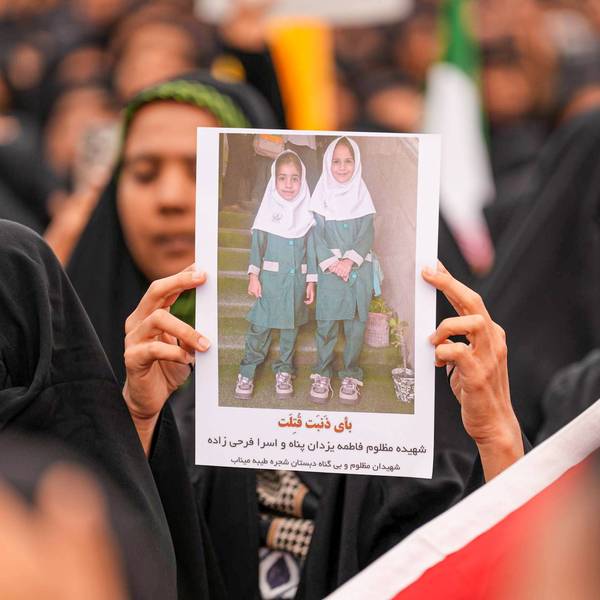
Speaking via video link to the 47-member UN body, Mohaddeseh Fallahat described combing the hair of Mahdiyeh and Amin, two of the more than 100 children killed in a US missile strike on Shajareh Tayyebeh Elementary School on February 28, the first day of the war.
"No mother is prepared to hear the words, 'Your child is not coming back,'" Fallahat told the council. "I am not just a grieving mother. No. I am the voice of all the mothers who sent their children to school believing they would be safe. A school was meant to be a place of learning, laughing, and building the future—a safe place for the children who were supposed to build the future of this world, not a place where their future is extinguished in an instant."
"Israel and the United States, who are the cause of this suffering, must be held accountable," she continued. "Not for revenge, but for justice, so that the world knows that children's lives are not worthless."
Iranian Foreign Minister Abbas Araghchi spoke after Fallahat, telling the council that the strike on the Minab elementary school was a crime, not a "miscalculation." Those killed in the attack, he said, were "slaughtered in cold blood."
“At a time when the American and Israeli aggressors, in their own assertion, possess the most advanced technologies and the highest precision military and data systems," said Araghchi, "no one can believe that the attack on the school was anything other than deliberate and intentional."
Preliminary findings in a US military investigation of the strike reportedly indicate that American forces were behind the attack, but that it was "the result of a targeting mistake" as the Trump administration conducted "strikes on an adjacent Iranian base of which the school building was formerly a part," according to The New York Times.
Volker Türk, the UN high commissioner for human rights, called for the US to complete its investigation "as soon as possible" and release the findings to the public.
"There must be justice for the terrible harm done," Türk said during Friday's human rights council session.
More broadly, the human rights chief called on the US and Israel to "end their attacks against Iran" and "return to negotiations—the only path towards a durable solution to their differences."
"There is a high and rising risk of further contagion and increased civilian suffering in the countries directly involved," said Türk. "Beyond the region, there are fears of grave economic consequences, from deepening poverty and hunger to shortages of medicine and fuel. It is imperative that all parties halt the escalation."
Dear Common Dreams reader, It’s been nearly 30 years since I co-founded Common Dreams with my late wife, Lina Newhouser. We had the radical notion that journalism should serve the public good, not corporate profits. It was clear to us from the outset what it would take to build such a project. No paid advertisements. No corporate sponsors. No millionaire publisher telling us what to think or do. Many people said we wouldn't last a year, but we proved those doubters wrong. Together with a tremendous team of journalists and dedicated staff, we built an independent media outlet free from the constraints of profits and corporate control. Our mission has always been simple: To inform. To inspire. To ignite change for the common good. Building Common Dreams was not easy. Our survival was never guaranteed. When you take on the most powerful forces—Wall Street greed, fossil fuel industry destruction, Big Tech lobbyists, and uber-rich oligarchs who have spent billions upon billions rigging the economy and democracy in their favor—the only bulwark you have is supporters who believe in your work. But here’s the urgent message from me today. It's never been this bad out there. And it's never been this hard to keep us going. At the very moment Common Dreams is most needed, the threats we face are intensifying. We need your support now more than ever. We don't accept corporate advertising and never will. We don't have a paywall because we don't think people should be blocked from critical news based on their ability to pay. Everything we do is funded by the donations of readers like you. When everyone does the little they can afford, we are strong. But if that support retreats or dries up, so do we. Will you donate now to make sure Common Dreams not only survives but thrives? —Craig Brown, Co-founder |
A grieving Iranian mother told the United Nations Human Rights Council on Friday that when she sent her children off to their elementary school in the city of Minab late last month, "there was no sign that this would be the last time."
Speaking via video link to the 47-member UN body, Mohaddeseh Fallahat described combing the hair of Mahdiyeh and Amin, two of the more than 100 children killed in a US missile strike on Shajareh Tayyebeh Elementary School on February 28, the first day of the war.
"No mother is prepared to hear the words, 'Your child is not coming back,'" Fallahat told the council. "I am not just a grieving mother. No. I am the voice of all the mothers who sent their children to school believing they would be safe. A school was meant to be a place of learning, laughing, and building the future—a safe place for the children who were supposed to build the future of this world, not a place where their future is extinguished in an instant."
"Israel and the United States, who are the cause of this suffering, must be held accountable," she continued. "Not for revenge, but for justice, so that the world knows that children's lives are not worthless."
Iranian Foreign Minister Abbas Araghchi spoke after Fallahat, telling the council that the strike on the Minab elementary school was a crime, not a "miscalculation." Those killed in the attack, he said, were "slaughtered in cold blood."
“At a time when the American and Israeli aggressors, in their own assertion, possess the most advanced technologies and the highest precision military and data systems," said Araghchi, "no one can believe that the attack on the school was anything other than deliberate and intentional."
Preliminary findings in a US military investigation of the strike reportedly indicate that American forces were behind the attack, but that it was "the result of a targeting mistake" as the Trump administration conducted "strikes on an adjacent Iranian base of which the school building was formerly a part," according to The New York Times.
Volker Türk, the UN high commissioner for human rights, called for the US to complete its investigation "as soon as possible" and release the findings to the public.
"There must be justice for the terrible harm done," Türk said during Friday's human rights council session.
More broadly, the human rights chief called on the US and Israel to "end their attacks against Iran" and "return to negotiations—the only path towards a durable solution to their differences."
"There is a high and rising risk of further contagion and increased civilian suffering in the countries directly involved," said Türk. "Beyond the region, there are fears of grave economic consequences, from deepening poverty and hunger to shortages of medicine and fuel. It is imperative that all parties halt the escalation."
A grieving Iranian mother told the United Nations Human Rights Council on Friday that when she sent her children off to their elementary school in the city of Minab late last month, "there was no sign that this would be the last time."
Speaking via video link to the 47-member UN body, Mohaddeseh Fallahat described combing the hair of Mahdiyeh and Amin, two of the more than 100 children killed in a US missile strike on Shajareh Tayyebeh Elementary School on February 28, the first day of the war.
"No mother is prepared to hear the words, 'Your child is not coming back,'" Fallahat told the council. "I am not just a grieving mother. No. I am the voice of all the mothers who sent their children to school believing they would be safe. A school was meant to be a place of learning, laughing, and building the future—a safe place for the children who were supposed to build the future of this world, not a place where their future is extinguished in an instant."
"Israel and the United States, who are the cause of this suffering, must be held accountable," she continued. "Not for revenge, but for justice, so that the world knows that children's lives are not worthless."
Iranian Foreign Minister Abbas Araghchi spoke after Fallahat, telling the council that the strike on the Minab elementary school was a crime, not a "miscalculation." Those killed in the attack, he said, were "slaughtered in cold blood."
“At a time when the American and Israeli aggressors, in their own assertion, possess the most advanced technologies and the highest precision military and data systems," said Araghchi, "no one can believe that the attack on the school was anything other than deliberate and intentional."
Preliminary findings in a US military investigation of the strike reportedly indicate that American forces were behind the attack, but that it was "the result of a targeting mistake" as the Trump administration conducted "strikes on an adjacent Iranian base of which the school building was formerly a part," according to The New York Times.
Volker Türk, the UN high commissioner for human rights, called for the US to complete its investigation "as soon as possible" and release the findings to the public.
"There must be justice for the terrible harm done," Türk said during Friday's human rights council session.
More broadly, the human rights chief called on the US and Israel to "end their attacks against Iran" and "return to negotiations—the only path towards a durable solution to their differences."
"There is a high and rising risk of further contagion and increased civilian suffering in the countries directly involved," said Türk. "Beyond the region, there are fears of grave economic consequences, from deepening poverty and hunger to shortages of medicine and fuel. It is imperative that all parties halt the escalation."