

SUBSCRIBE TO OUR FREE NEWSLETTER
Daily news & progressive opinion—funded by the people, not the corporations—delivered straight to your inbox.
5
#000000
#FFFFFF
To donate by check, phone, or other method, see our More Ways to Give page.
Daily news & progressive opinion—funded by the people, not the corporations—delivered straight to your inbox.

“Here we are prepared to fight imperialism," said Cuban lawmaker Mariela Castro, daughter of Raúl Castro. "Cuba is a small and poor country, but one with experience confronting US imperialism."
Tens of thousands of Cubans rallied Friday in Havana to denounce the Trump administration's indictment of former President Raúl Castro and threats to attack the island nation, whose socialist government has been preparing its citizens to defend their homeland and revolution against US aggression.
“No disrespect is shown to the heroes of the homeland!" Cuban President Miguel Díaz-Canel said as people flooded the streets outside the US Embassy in Havana. "History and traditions are not insulted without a response! That does not happen in Cuba!"
The massive rally followed Wednesday's US Department of Justice indictment of revolutionary hero Raúl Castro, who served as president for a decade after his older brother, Fidel Castro, stepped down in 2008. The DOJ indicted Castro for his alleged role in the 1996 shoot-down of planes operated by the counterrevolutionary group Brothers to the Rescue after repeated warnings that they had violated Cuban airspace.
Rallying under the slogan "Raúl is Raúl"—originally popularized during the transitional period of rule between the Castros to highlight the younger brother's reforms—Cubans vowed to defend their revolution in the face of the latest US threats.
“This new aggression has united us more and elevated the honor, dignity, and anti-imperialist spirit of a people already recognized around the world for their brave resistance to any form of subordination to the empire,” Díaz-Canel said.
Cuban legislator Mariela Castro, Raúl's granddaughter, told rallygoers that “we are prepared for combat."
"No one is going to kidnap him. I can assure you of that," she said, alluding to the US invasion and abduction of Venezuelan President Nicolás Maduro on dubious narco-terrorism charges earlier this year. "Neither him nor anyone else."
"My father is very calm, watching and smiling,” Castro added. "Here, we are prepared to fight imperialism. Cuba is a small and poor country, but one with experience confronting US imperialism. We know that as long as there is an anti-imperialist revolution, there will be a gigantic and ruthless enemy."
Critics noted the hypocrisy of the Castro indictment, given the ongoing illegal US bombing of boats that the Trump administration claims—without providing evidence—were smuggling drugs in the Caribbean Sea and Pacific Ocean.
“Washington has no moral authority to judge anyone,” Gerardo Hernández, coordinator of the Committees for the Defense of the Revolution, said, referring to the boat-bombing campaign, which has killed nearly 200 people in close to 60 reported attacks. “Cuba is a people of peace and reaffirms its legitimate right to self-defense."
"Cuba does not constitute a threat to US security," he continued. "On the contrary, Cuba is a state under attack by the United States."
Observers have pointed to the decadeslong US-backed campaign of anti-Castro terrorism against the Cuban people, including the 1976 bombing of Cubana Flight 455, a commercial airliner with 73 people aboard, including 11 Guyanese nationals and 24 teenage members of Cuba's junior Olympic fencing team. Perpetrators of the attack enjoyed safe haven in the United States, mainly in Miami, where the city celebrated a day in honor of one of the bombing's alleged masterminds.
“The Cuban people reaffirm the unwavering decision to defend their homeland and revolution," Hernández added. "With the greatest determination, they reaffirm their absolute and firm support for Army General Raúl Castro."
Mariela Castro said that "my family, like all Cuban families, is waiting for instructions to know where we need to go" in the event of a US attack.
As US Secretary of State Marco Rubio—whose parents immigrated to the United States from Cuba during the US-backed dictatorship that preceded the Castro-led revolution—said Thursday that the chances of a "negotiated and peaceful agreement" with Havana are "not high," Deputy Cuban Foreign Minister Carlos Fernández de Cossío acknowledged that his country is preparing for war, asserting that "we would be naive not to."
Cuban officials have been circulating a pamphlet titled a “Family Guide for Protection Against Military Aggression." The publication warns that the US is preparing "to launch a military assault and destroy our society with the aim of perpetuating capitalism... and annihilating the dream of our Commander-in-Chief, Fidel Castro.”
The pamphlet instructs Cubans to pack survival kits and seek shelter in the event of air-raid alerts. It also contains life-saving first aid instructions.
“Should the enemy attack, our Revolution will defend itself until victory is achieved and the aggressor is expelled," the pamphlet states.
US President Donald Trump recently tightened the internationally condemned 65-year US economic embargo on Cuba, imposing a fuel blockade that has exacerbated an energy emergency characterized by blackouts and deadly suffering among the most vulnerable Cubans, including sick people and children.
Last month, Trump said that “we may stop by Cuba after we’re finished" with the illegal US-Israeli war of choice against Iran. The president has also stated he believes he’ll “be having the honor of taking Cuba,” language echoing the 19th-century US imperialists who conquered the island along with Puerto Rico, Guam, and the Philippines from Spain in another war waged on dubious pretense.
“Whether I free it, take it—I think I can do anything I want,” Trump said of the island and its 11 million inhabitants.
BreakThrough News interviewed Havana residents earlier this week about the specter of US attack.
"We Cubans have to protect ourselves," elderly Havana resident Juan Hernández said. "We're not going to hand any Cuban over to a foreigner, because that would be immoral. It would be treason."
Hernández accused the US of "provocation" in order to "justify invading the country," adding "that would only lead to bloodshed on both sides."
"Besides," he added, "Cuba isn't a threat to them at all. What does Cuba have? Do we have atomic bombs? Do we have anything? We have nothing."

"We will continue to denounce, in the firmest and most energetic way possible, the genocidal siege that seeks to strangle our people," said President Miguel Díaz-Canel.
Cuba's president said Monday night that the Trump administration should be "criminally prosecuted" for its continued economic war on the island nation, saying the oil blockade that began more than three months ago as well as new sanctions are part of a "collective punishment" policy that amounts to an "act of genocide."
President Miguel Díaz-Canel suggested that the White House was aware that its latest round of sanctions against Cuban officials was unnecessary, noting that "there isn’t even any evidence to present"—but said the new measures announced by the State Department on Monday were a way of furthering "anti-Cuban rhetoric of hate... to justify the escalation of its total economic war."
"Under the leadership of our party, state, government, and its military institutions, no one has any assets or property to protect under US jurisdiction. The US government knows this full well," said Díaz-Canel. "That’s why we will continue to denounce, in the firmest and most energetic way possible, the genocidal siege that seeks to strangle our people."
Díaz-Canel spoke out after the administration said it was imposing sanctions on the Cuban intelligence agency and nine Cuban officials, including the country's ministers for communications, energy, and justice, and three military generals. Several officials in the Communist Party of Cuba were also sanctioned.
US Secretary of State Marco Rubio, who is the son of Cuban immigrants and has long pushed for regime change in the communist country, released a statement saying those targeted by the sanctions "are responsible for or have been involved in repressing the Cuban people."
"These sanctions advance the Trump administration’s comprehensive campaign to address the pressing national security threats posed by Cuba’s communist regime," said Rubio.
The sanctions were announced a day after a White House official claimed to Axios that Cuban officials are "discussing plans" for drone attacks on the US; the outlet acknowledged several paragraphs into its article on the alleged threat that Cuba is believed to be strategizing for a defensive attack as the US ramps up hostilities, rather than an unprovoked strike.
Díaz-Canel emphasized that the White House's sanctions are only the latest action taken against Cuba following the "immoral, illegal, and criminal" executive order President Donald Trump signed in January, which threatened countries with tariffs if they provided fuel to Cuba—resulting in a severe energy shortage on the island, frequent rolling blackouts, and a crisis in the country's healthcare system, with hospitals struggling to offer basic services. Farmers have said the shortage has left them unable to efficiently provide food to communities.
“We have absolutely no fuel and absolutely no diesel,” Energy Minister Vicente de la O Levy said last week.
Díaz-Canel said the US has pushed the blockade that has been in place for decades "to levels never seen before, penalizing companies that want to invest in Cuba or simply provide us with basic goods like food, medicines, hygiene products, or others."
"The collective punishment to which the Cuban people are being subjected is an act of genocide that must be condemned by international organizations and criminally prosecuted against its promoters," said the president.
He also expressed gratitude to the governments of Mexico and Uruguay, which sent a shipment of aid to Cuba on Monday.
"This donation, which arrives in very difficult days for Cuba due to the direct and multidimensional impact of the United States blockade on the daily life of our people, is a living testament to the historic solidarity between our peoples and to the principles of humanism, cooperation, and integration that must unite the region," said Díaz-Canel.
The Trump administration's invasion of Venezuela, abduction of President Nicolás Maduro, and takeover of its oil reserves in January cut Cuba off from its top energy supplier.
The US is reportedly now considering an indictment former Cuban President Raúl Castro for shooting down planes that belonged to a US group and violated Cuban airspace in 1996. Trump—who has attacked not only Venezuela but also Iran—has repeatedly mused about the possibility of invading Cuba.
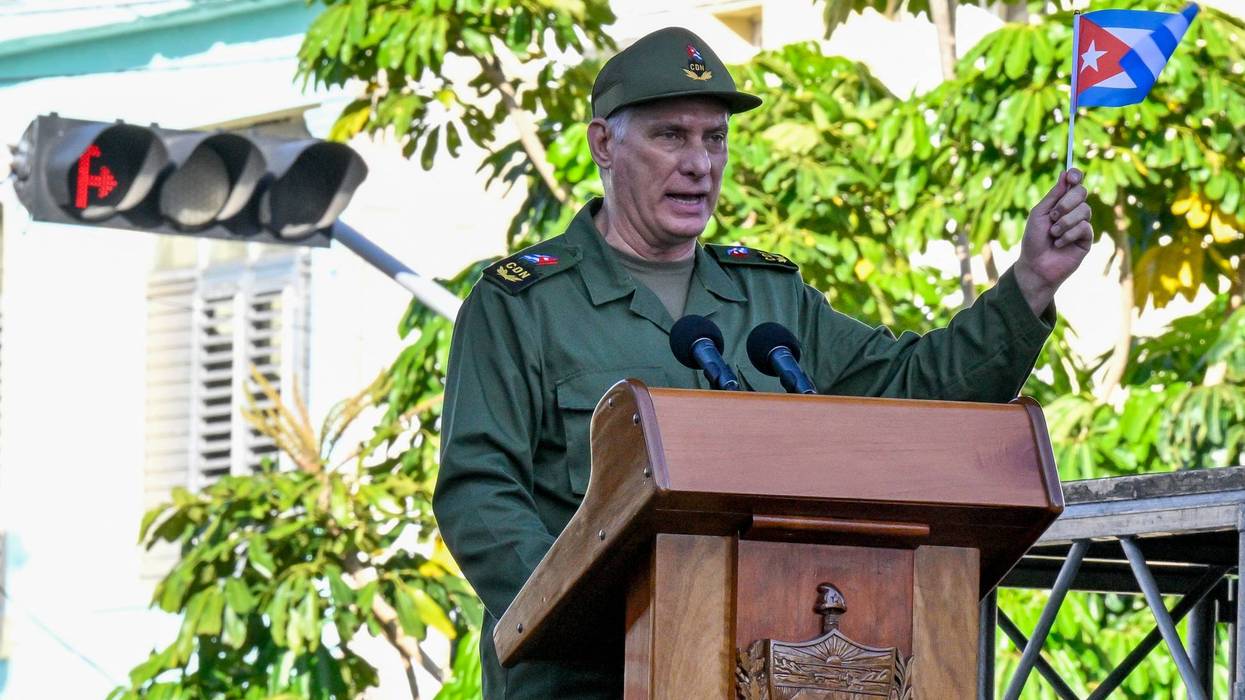
"Cuba, which already endures a multidimensional aggression from the US, does have the absolute and legitimate right to defend itself against a military onslaught," said President Miguel Díaz-Canel.
As the Trump administration seeks to justify a war with Cuba using what Cuban officials have called “increasingly implausible accusations” that it poses a danger to national security, President Miguel Díaz-Canel warned on Monday that an American assault would trigger a "bloodbath with incalculable consequences."
US President Donald Trump has imposed a punishing fuel blockade on Cuba for months that has devastated the island's civilian population with the explicit goal of forcing its government from power and has, on many occasions, threatened to use military force, including to outright "take" the island.
The densely populated island of nearly 11 million people is already in the midst of a humanitarian crisis as a result of "energy starvation" from the blockade, which has left the country's renowned healthcare system struggling to function, with 100,000 patients awaiting surgery, according to a recent United Nations report.
"The threats of military aggression against Cuba from the world's greatest power are well-known," Díaz-Canel said in a post to social media on Monday. "The threat itself already constitutes an international crime. If it were to materialize, it would trigger a bloodbath with incalculable consequences, plus the destructive impact on regional peace and stability."
His comments came after Axios reported Sunday on "classified intelligence" shared by unnamed senior US officials stating that Cuba possesses around 300 drones acquired from Russia and Iran and had been considering plans to attack the US military base at Guantánamo Bay, various US military vessels, and Key West, Florida.
Reporter Marc Caputo described the intelligence as a possible "pretext for US military action" against the island and quoted an unnamed senior official as saying it was "a growing threat."
Republican legislators, particularly those in South Florida, have seized on the report to argue for even harsher action against Cuba. US Reps. Mario Díaz-Balart and Elvira Salazar both said it was further evidence that Cuba poses a "threat to national security." Rep. Carlos Gimenez said it must be "dealt with accordingly."
However, buried deep within the report was the acknowledgment that "US officials don't believe Cuba is an imminent threat, or actively planning to attack American interests." Rather, the drones would be reserved for a scenario in which "hostilities erupt" in the event of a US military attack, which has been telegraphed for weeks by the Trump administration.
Cuba has not denied having drones, with its embassy saying on Sunday that it "has the right to defend itself against external aggression." But Cuba denied any intent to attack the US preemptively, saying that US officials were "distorting as extraordinary the logical preparation required to face a potential aggression."
Díaz-Canel reiterated on Monday that Cuba "poses no threat, nor does it have aggressive plans or intentions against any country."
"It has none against the US, nor has it ever had any—something the government of that nation knows full well, particularly its defense and national security agencies," the Cuban president continued.
"Cuba, which already endures a multidimensional aggression from the US, does have the absolute and legitimate right to defend itself against a military onslaught," he added. "Yet that cannot be wielded, either logically or honestly, as an excuse for imposing war on the noble Cuban people."

After the US president again threatened invasion, Cuban President Miguel Díaz-Canel Bermúdez said he would only "find a people determined to defend sovereignty and independence in every inch of the national territory."
President Miguel Díaz-Canel Bermúdez of Cuba on Saturday responded with stark and defiant words to the latest attacks coming from US President Donald Trump, who on Friday signed a new executive order authorizing even more aggressive sanctions against the island nation and later threatened to invade the country.
"The President of the United States escalates his threats of military aggression against Cuba to a dangerous and unprecedented scale," said Díaz-Canel in a statement. "The international community must take note and, together with the people of the United States, determine whether such a drastic criminal act will be allowed to satisfy the interests of a small but wealthy and influential group, driven by desires for revenge and domination."
"No aggressor, no matter how powerful, will find surrender in Cuba," he added. If Trump were to attack the country, the Cuban president said, "he will find a people determined to defend sovereignty and independence in every inch of the national territory."
"What does 'No Kings' mean when one man can snap his fingers and kill innocent Cubans on a whim?"
In addition "to blocking the US assets of foreign individuals and entities operating in Cuba's energy, defense, financial services, metals, mining, and security sectors, as well as anyone acting on behalf of the Cuban government," as Drop Site News notes, Friday's executive order also "authorizes sanctions on foreign financial institutions that conduct significant transactions with designated Cuban entities, potentially cutting them off from US correspondent banking."
As such, the outlet continued, the new sanctions "could further isolate Cuba from the international financial system, limit foreign investment, and exacerbate the island's already severely restricted access to medicine, food imports, and basic goods."
In addition to the signed executive order, Trump said during a Friday campaign-style event in Florida that the US "will be taking [Cuba] over almost immediately."
Upon their return from Iran, where Trump has waged a deeply unpopular war, the US president told the crowd, "We’ll have maybe the USS Lincoln [aircraft carrier] come in offshore, and they’ll give up."
In a floor speech earlier this week, Sen. Chris Van Hollen (D-Md.) rebuked the Trump administration for the humanitarian disaster it has unleashed in Cuba, which follows what he described as a "failed" policy towards the island country over decades.
As Trump ramps up his threats of war against Cuba, we must understand what led us to this point: 65 years of a bankrupt Cuba policy.
If we want to avoid war with Cuba, we must rein in this lawless President & learn from the failed, bipartisan policies that led us to this point. pic.twitter.com/H9MqviSe6d
— Senator Chris Van Hollen (@ChrisVanHollen) April 30, 2026
"If we want to avoid war with Cuba," said Van Hollen, "we must rein in this lawless president and learn from the failed, bipartisan policies that led us to this point."
David Adler, the co-general coordinator of Progressive International, condemned the relative silence of US opponents to the Trump administration, who have not done, in his mind, nearly enough to challenge the blockade or condemn the administration's repeated and ongoing threats to invade the island nation or overthrow its government.
" Donald Trump has given [Secretary of State] Marco Rubio the green light to annihilate a peaceful nation and its people—and the ‘resistance’ is silent," said Adler. "What does 'No Kings' mean when one man can snap his fingers and kill innocent Cubans on a whim?"
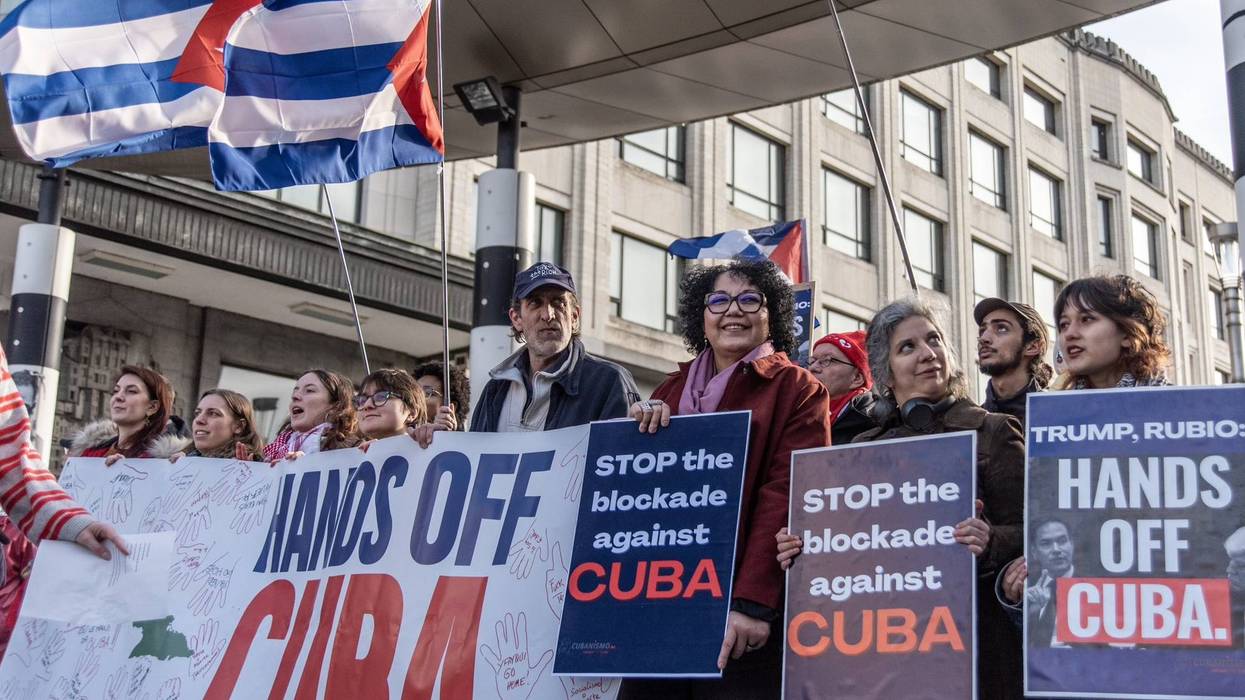
"Trump is preparing to take the US into another illegal war against Cuba," warned one progressive critic of the US president. "We must stop him. It’s not too late."
Is Cuba next in line for a US attack?
US President Donald Trump has repeatedly said it could be, and USA Today on Wednesday cited "sources familiar" with the matter who said that the Pentagon is "quietly ramping up" preparations to wage war on the socialist nation if Trump gives the order.
On Monday, Trump flippantly declared that “we may stop by Cuba after we’re finished with this," referring to the illegal US-Israeli war of choice on Iran that's left thousands of Iranians dead or wounded, including hundreds of children.
Trump has also said that he believes he’ll “be having the honor of taking Cuba,” language echoing the 19th century US imperialists who conquered the island along with Puerto Rico and the Philippines from Spain in another war waged on dubious pretense.
"Whether I free it, take it—I think I can do anything I want," Trump said of the island and its 11 million inhabitants.
The USA Today report—authored by Kim Hjelmgaard, Rick Jervis, and Francesca Chambers—sparked widespread alarm among advocates for peace.
"This is not a drill. Trump is preparing to take the US into another illegal war against Cuba to appease the Miami mafia," Progressive International co-general coordinator David Adler said Wednesday on X. "We must stop him. It’s not too late."
Cubans—who have been subjected to generations of privation and hardship due largely to the internationally condemned US economic embargo of their island—have mostly shrugged off Trump's threats, with some observers noting that Cuba's socialist era has outlasted a dozen American presidents.
Responding to a question about a possible US attack on his country, Cuban President Miguel Díaz-Canel said Sunday on NBC News' "Meet the Press" that “if that happens, there will be fighting, and there will be a struggle, and we will defend ourselves, and if we need to die, we’ll die, because as our national anthem says, ‘Dying for the homeland is to live’.”
Numerous observers expressed shock, but not surprise, that Trump—the self-proclaimed "peace president" who has bombed 10 countries, more than any other US president—is setting his sights on Cuba, which American presidents since Thomas Jefferson have coveted.
Trump has been threatening Cuba since his first administration, when he systematically rolled back the Obama administration's diplomatic normalization with the island's socialist government. He also activated a provision of the Helms-Burton Act allowing lawsuits over property confiscated after the Cuban Revolution.
On the last day of his first term, Trump re-designated Cuba a state sponsor of terrorism, a move critics slammed as absurd given that Cuba has never carried out any acts of terrorism—unlike the United States and the militant Cuban exiles it harbors, who have a decadeslong record of terrorist bombings and other attacks, as well as numerous failed or aborted attempts to assassinate former revolutionary leader Fidel Castro.
Since returning to office, Trump has ratcheted up military threats and economic pressure on Cuba, which was already reeling from decades of US sanctions and the inefficiencies of centralized state control. Trump tightened the embargo by severely restricting fuel imports, exacerbating an energy emergency characterized by blackouts and deadly suffering among the most vulnerable Cubans, including sick people and children.
Last month, US Sens. Tim Kaine (D-Va.), Adam Schiff (D-Calif.), and Ruben Gallego (D-Ariz.) introduced a war powers resolution aimed at preventing Trump from attacking Cuba without congressional authorization as required by law. Numerous war powers resolutions related to Iran, Venezuela, and Trump's extralegal high-seas boat bombings have failed to pass.

"The US publicly threatens Cuba, almost daily, with overthrowing the constitutional order by force," said Miguel Díaz-Canel.
Cuban President Miguel Díaz-Canel on Tuesday condemned US President Donald Trump's open threat to forcibly seize control of the island nation and vowed that any such aggression would be met with "impregnable resistance."
"The US publicly threatens Cuba, almost daily, with overthrowing the constitutional order by force," Díaz-Canel wrote on social media. "And it uses an outrageous pretext: the harsh limitations of the weakened economy that they have attacked and sought to isolate for more than six decades."
"They intend and announce plans to seize the country, its resources, its properties, and even the very economy they seek to strangle to make us surrender," the Cuban president added. "Only in this way can the fierce economic war be explained, which is applied as collective punishment against the entire people. In the face of the worst scenario, Cuba is accompanied by a certainty: Any external aggressor will clash with an impregnable resistance."
Díaz-Canel's statement came a day after Trump said from the Oval Office of the White House that he believes he will have "the honor of taking Cuba" as it faces a grave humanitarian crisis fueled by the administration's oil embargo, which began shortly after the US abducted Venezuelan President Nicolás Maduro in early January.
"I think I can do anything I want with it," Trump said of Cuba on Monday.
The New York Times reported earlier this week that Trump administration officials are demanding Díaz-Canel's ouster as part of any negotiated deal between the two countries.
US Secretary of State Marco Rubio, the son of Cuban immigrants and a longtime supporter of regime change on the island, said publicly on Tuesday that Cuba "has to get new people in charge." Trump said earlier this month that he's "going to put Marco over there and we’ll see how that works out."
A YouGov poll out this week shows that more Americans disapprove than approve of the US embargo on Cuba. The same survey found that only 13% of US voters would support attacking Cuba, and a mere 18% would support using military force to overthrow the country's government.
Trump's threats came as his oil embargo and the broader, decadeslong, and illegal economic warfare against Cuba continued to take their toll on the island's population, most recently in the form of an island-wide blackout that lasted nearly 30 hours.
On Wednesday, the first delegation of the Nuestra América Convoy arrived in Havana as part of an effort by individuals and organizations to deliver critical humanitarian aid to the Cuban people as the US besieges the island's economy and threatens its sovereignty.
Nathan J. Robinson and Alex Skopic, editors of the left-wing magazine Current Affairs, announced Wednesday that they are heading to Cuba to cover the mission, which they characterized as part of a "proud tradition of internationalism" on the American left.
"Beyond food, medicine, and energy infrastructure, this mission sends a message," Robinson and Skopic wrote. "As Americans, we want to make it crystal clear that the Trump administration does not speak for us when it talks about 'taking over' Cuba, and we’re sickened by what Trump and Rubio are doing to the Cuban people in the name of U.S. foreign policy. But we’re determined to do what we can, and we’re going to make sure the people of Cuba do not stand alone."

"Maybe—and stick with me here, Marco—the fact that the United States has had a near-total embargo on Cuba since before the Beatles’ first album might have something to do with its struggling economy?" said one critic.
As Cuba works to restore electricity to millions of people plunged into darkness across the fuel-starved island, US Secretary of State Marco Rubio on Tuesday blamed Cuba's socialist government for the nation's economic crisis—a crisis largely caused by 65 years of US economic embargo and exacerbated by President Donald Trump's tightened fuel blockade.
"Suffice it to say that the embargo is tied to political change on the island," Rubio told reporters at the White House. "The law is codified, but the bottom line is, their economy doesn’t work. It’s a nonfunctional economy."
"That revolution—it's not even a revolution, that thing they have—has survived on subsidies," he added. "They don’t get subsidies anymore, so they’re in a lot of trouble, and the people in charge, they don’t know how to fix it, so they have to get new people in charge."
Rubio—whose parents fled the island during the rule of pro-US dictator Fulgencio Batista—dismissed Cuba's proposed economic reforms, including opening the country to investment from Cubans living abroad.
“Cuba has an economy that doesn’t work in a political and governmental system that can’t fix it. So they have to change dramatically," he said. "What they announced yesterday is not dramatic enough. It’s not going to fix it. So they’ve got some big decisions to make over there."
Rubio added that although the Trump administration is currently focused on its war of choice in Iran—one of 10 countries attacked during the two terms of the self-proclaimed "president of peace"—the US would "be doing something with Cuba very soon."
The US has been doing something with Cuba since the 19th century, when it invaded and seized the island from Spain. In the 20th century, it supported successive dictatorships and, after the Fidel Castro-led revolution ousted Batista, imposed an economic embargo on the island that has been perennially condemned by an overwhelming majority of United Nations member states for 33 years.
In addition to the embargo—which Cuba's government says has cost the nation's economy more than $200 billion in inflation-adjusted losses—the US tried to assassinate Castro many times and supported the militant Cuban exiles who launched the ill-fated Bay of Pigs invasion in 1961. Other Cuban exiles carried out numerous terror attacks targeting Cuba's economy—and sometimes innocent civilians.
In language reminiscent of the US imperialists who conquered the island in 1898, Trump told reporters Monday, “I do believe... I’ll be having the honor of taking Cuba.”
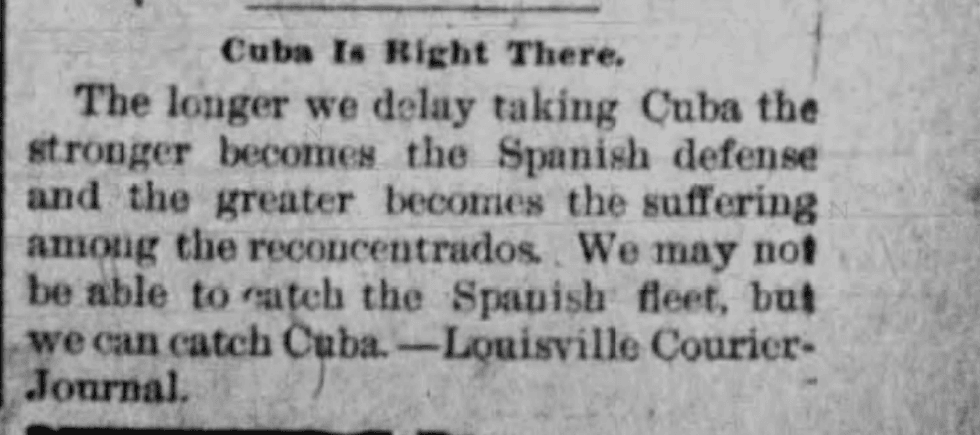 President Donald Trump's talk of "taking Cuba" harkens back to the most aggressively imperialist period in US history.
This, after Trump said last month ahead of talks with Cuban officials that he might launch what he called a "friendly takeover" of the island. The president has also boasted about the tremendous economic suffering caused by his illegal embargo and fuel blockade, which is widely unpopular and has been called a form of "economic warfare."
“Officials in the US must be feeling very happy by the harm caused to every Cuban family,” Cuban Deputy Foreign Minister Carlos Fernández de Cossío said Monday.
In Havana, residents hardened by decades of privation carried on the best they could without power. Some struggled in the dark.
“The power outages are driving me crazy,” 48-year-old Dalba Obiedo told The Associated Press. “Last night I fell down a 27-step staircase. Now I have to have surgery on my jaw. I fell because the lights went out.”
Cuban President Miguel Díaz-Canel last week acknowledged that high-level talks with US representatives were underway. Recent reporting by Drop Site News cited an unnamed White House official who accused Rubio—a longtime advocate for regime change in Cuba—of trying to sabotage the talks.
Some observers believe that Trump wants Díaz-Canel to face a similar fate as Venezuelan President Nicolás Maduro—who was kidnapped in January during a US invasion and is now jailed in the United States—while others warn that the United States cannot be trusted in talks, pointing to recent accusations by Oman's foreign minister, who said American negotiators duplicitously scuppered an Iran peace deal that "was within our reach."
However, instead of regime change, Trump may be seeking what some observers are calling regime compliance, which is likely why he did not move to oust Maduro's subordinates. Unlike Venezuela, Cuba has no oil, but it was once was a magnet for US investment—both legal and otherwise.
Last week, a trio of Democratic US senators introduced a war powers resolution to stop Trump from attacking Cuba without the legally required authorization from Congress. Numerous war powers resolutions concerning Iran, Venezuela, and the dozens of boats Trump claims—without providing evidence—were transporting drugs from South America have all failed to pass the Republican-controlled Congress.