SUBSCRIBE TO OUR FREE NEWSLETTER
Daily news & progressive opinion—funded by the people, not the corporations—delivered straight to your inbox.
5
#000000
#FFFFFF
To donate by check, phone, or other method, see our More Ways to Give page.
Daily news & progressive opinion—funded by the people, not the corporations—delivered straight to your inbox.
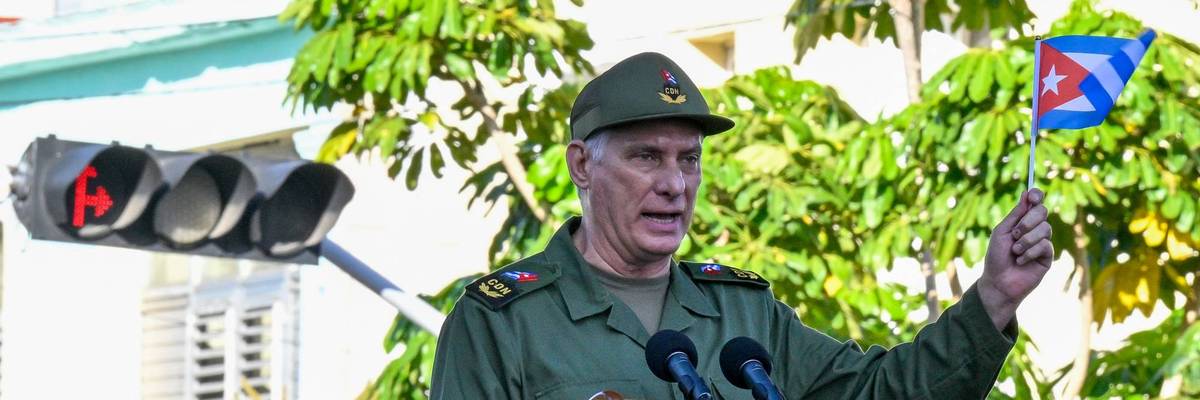
Cuba’s President Miguel Diaz-Canel waves a national flag during celebrations marking the 65th anniversary of the Bay of Pigs invasion and the declaration of the socialist character of the Cuban Revolution in Havana on April 16, 2026.
"Cuba, which already endures a multidimensional aggression from the US, does have the absolute and legitimate right to defend itself against a military onslaught," said President Miguel Díaz-Canel.
As the Trump administration seeks to justify a war with Cuba using what Cuban officials have called “increasingly implausible accusations” that it poses a danger to national security, President Miguel Díaz-Canel warned on Monday that an American assault would trigger a "bloodbath with incalculable consequences."
US President Donald Trump has imposed a punishing fuel blockade on Cuba for months that has devastated the island's civilian population with the explicit goal of forcing its government from power and has, on many occasions, threatened to use military force, including to outright "take" the island.
The densely populated island of nearly 11 million people is already in the midst of a humanitarian crisis as a result of "energy starvation" from the blockade, which has left the country's renowned healthcare system struggling to function, with 100,000 patients awaiting surgery, according to a recent United Nations report.
"The threats of military aggression against Cuba from the world's greatest power are well-known," Díaz-Canel said in a post to social media on Monday. "The threat itself already constitutes an international crime. If it were to materialize, it would trigger a bloodbath with incalculable consequences, plus the destructive impact on regional peace and stability."
His comments came after Axios reported Sunday on "classified intelligence" shared by unnamed senior US officials stating that Cuba possesses around 300 drones acquired from Russia and Iran and had been considering plans to attack the US military base at Guantánamo Bay, various US military vessels, and Key West, Florida.
Reporter Marc Caputo described the intelligence as a possible "pretext for US military action" against the island and quoted an unnamed senior official as saying it was "a growing threat."
Republican legislators, particularly those in South Florida, have seized on the report to argue for even harsher action against Cuba. US Reps. Mario Díaz-Balart and Elvira Salazar both said it was further evidence that Cuba poses a "threat to national security." Rep. Carlos Gimenez said it must be "dealt with accordingly."
However, buried deep within the report was the acknowledgment that "US officials don't believe Cuba is an imminent threat, or actively planning to attack American interests." Rather, the drones would be reserved for a scenario in which "hostilities erupt" in the event of a US military attack, which has been telegraphed for weeks by the Trump administration.
Cuba has not denied having drones, with its embassy saying on Sunday that it "has the right to defend itself against external aggression." But Cuba denied any intent to attack the US preemptively, saying that US officials were "distorting as extraordinary the logical preparation required to face a potential aggression."
Díaz-Canel reiterated on Monday that Cuba "poses no threat, nor does it have aggressive plans or intentions against any country."
"It has none against the US, nor has it ever had any—something the government of that nation knows full well, particularly its defense and national security agencies," the Cuban president continued.
"Cuba, which already endures a multidimensional aggression from the US, does have the absolute and legitimate right to defend itself against a military onslaught," he added. "Yet that cannot be wielded, either logically or honestly, as an excuse for imposing war on the noble Cuban people."
Dear Common Dreams reader, It’s been nearly 30 years since I co-founded Common Dreams with my late wife, Lina Newhouser. We had the radical notion that journalism should serve the public good, not corporate profits. It was clear to us from the outset what it would take to build such a project. No paid advertisements. No corporate sponsors. No millionaire publisher telling us what to think or do. Many people said we wouldn't last a year, but we proved those doubters wrong. Together with a tremendous team of journalists and dedicated staff, we built an independent media outlet free from the constraints of profits and corporate control. Our mission has always been simple: To inform. To inspire. To ignite change for the common good. Building Common Dreams was not easy. Our survival was never guaranteed. When you take on the most powerful forces—Wall Street greed, fossil fuel industry destruction, Big Tech lobbyists, and uber-rich oligarchs who have spent billions upon billions rigging the economy and democracy in their favor—the only bulwark you have is supporters who believe in your work. But here’s the urgent message from me today. It's never been this bad out there. And it's never been this hard to keep us going. At the very moment Common Dreams is most needed, the threats we face are intensifying. We need your support now more than ever. We don't accept corporate advertising and never will. We don't have a paywall because we don't think people should be blocked from critical news based on their ability to pay. Everything we do is funded by the donations of readers like you. When everyone does the little they can afford, we are strong. But if that support retreats or dries up, so do we. Will you donate now to make sure Common Dreams not only survives but thrives? —Craig Brown, Co-founder |
As the Trump administration seeks to justify a war with Cuba using what Cuban officials have called “increasingly implausible accusations” that it poses a danger to national security, President Miguel Díaz-Canel warned on Monday that an American assault would trigger a "bloodbath with incalculable consequences."
US President Donald Trump has imposed a punishing fuel blockade on Cuba for months that has devastated the island's civilian population with the explicit goal of forcing its government from power and has, on many occasions, threatened to use military force, including to outright "take" the island.
The densely populated island of nearly 11 million people is already in the midst of a humanitarian crisis as a result of "energy starvation" from the blockade, which has left the country's renowned healthcare system struggling to function, with 100,000 patients awaiting surgery, according to a recent United Nations report.
"The threats of military aggression against Cuba from the world's greatest power are well-known," Díaz-Canel said in a post to social media on Monday. "The threat itself already constitutes an international crime. If it were to materialize, it would trigger a bloodbath with incalculable consequences, plus the destructive impact on regional peace and stability."
His comments came after Axios reported Sunday on "classified intelligence" shared by unnamed senior US officials stating that Cuba possesses around 300 drones acquired from Russia and Iran and had been considering plans to attack the US military base at Guantánamo Bay, various US military vessels, and Key West, Florida.
Reporter Marc Caputo described the intelligence as a possible "pretext for US military action" against the island and quoted an unnamed senior official as saying it was "a growing threat."
Republican legislators, particularly those in South Florida, have seized on the report to argue for even harsher action against Cuba. US Reps. Mario Díaz-Balart and Elvira Salazar both said it was further evidence that Cuba poses a "threat to national security." Rep. Carlos Gimenez said it must be "dealt with accordingly."
However, buried deep within the report was the acknowledgment that "US officials don't believe Cuba is an imminent threat, or actively planning to attack American interests." Rather, the drones would be reserved for a scenario in which "hostilities erupt" in the event of a US military attack, which has been telegraphed for weeks by the Trump administration.
Cuba has not denied having drones, with its embassy saying on Sunday that it "has the right to defend itself against external aggression." But Cuba denied any intent to attack the US preemptively, saying that US officials were "distorting as extraordinary the logical preparation required to face a potential aggression."
Díaz-Canel reiterated on Monday that Cuba "poses no threat, nor does it have aggressive plans or intentions against any country."
"It has none against the US, nor has it ever had any—something the government of that nation knows full well, particularly its defense and national security agencies," the Cuban president continued.
"Cuba, which already endures a multidimensional aggression from the US, does have the absolute and legitimate right to defend itself against a military onslaught," he added. "Yet that cannot be wielded, either logically or honestly, as an excuse for imposing war on the noble Cuban people."
As the Trump administration seeks to justify a war with Cuba using what Cuban officials have called “increasingly implausible accusations” that it poses a danger to national security, President Miguel Díaz-Canel warned on Monday that an American assault would trigger a "bloodbath with incalculable consequences."
US President Donald Trump has imposed a punishing fuel blockade on Cuba for months that has devastated the island's civilian population with the explicit goal of forcing its government from power and has, on many occasions, threatened to use military force, including to outright "take" the island.
The densely populated island of nearly 11 million people is already in the midst of a humanitarian crisis as a result of "energy starvation" from the blockade, which has left the country's renowned healthcare system struggling to function, with 100,000 patients awaiting surgery, according to a recent United Nations report.
"The threats of military aggression against Cuba from the world's greatest power are well-known," Díaz-Canel said in a post to social media on Monday. "The threat itself already constitutes an international crime. If it were to materialize, it would trigger a bloodbath with incalculable consequences, plus the destructive impact on regional peace and stability."
His comments came after Axios reported Sunday on "classified intelligence" shared by unnamed senior US officials stating that Cuba possesses around 300 drones acquired from Russia and Iran and had been considering plans to attack the US military base at Guantánamo Bay, various US military vessels, and Key West, Florida.
Reporter Marc Caputo described the intelligence as a possible "pretext for US military action" against the island and quoted an unnamed senior official as saying it was "a growing threat."
Republican legislators, particularly those in South Florida, have seized on the report to argue for even harsher action against Cuba. US Reps. Mario Díaz-Balart and Elvira Salazar both said it was further evidence that Cuba poses a "threat to national security." Rep. Carlos Gimenez said it must be "dealt with accordingly."
However, buried deep within the report was the acknowledgment that "US officials don't believe Cuba is an imminent threat, or actively planning to attack American interests." Rather, the drones would be reserved for a scenario in which "hostilities erupt" in the event of a US military attack, which has been telegraphed for weeks by the Trump administration.
Cuba has not denied having drones, with its embassy saying on Sunday that it "has the right to defend itself against external aggression." But Cuba denied any intent to attack the US preemptively, saying that US officials were "distorting as extraordinary the logical preparation required to face a potential aggression."
Díaz-Canel reiterated on Monday that Cuba "poses no threat, nor does it have aggressive plans or intentions against any country."
"It has none against the US, nor has it ever had any—something the government of that nation knows full well, particularly its defense and national security agencies," the Cuban president continued.
"Cuba, which already endures a multidimensional aggression from the US, does have the absolute and legitimate right to defend itself against a military onslaught," he added. "Yet that cannot be wielded, either logically or honestly, as an excuse for imposing war on the noble Cuban people."