SUBSCRIBE TO OUR FREE NEWSLETTER
Daily news & progressive opinion—funded by the people, not the corporations—delivered straight to your inbox.
5
#000000
#FFFFFF
To donate by check, phone, or other method, see our More Ways to Give page.
Daily news & progressive opinion—funded by the people, not the corporations—delivered straight to your inbox.

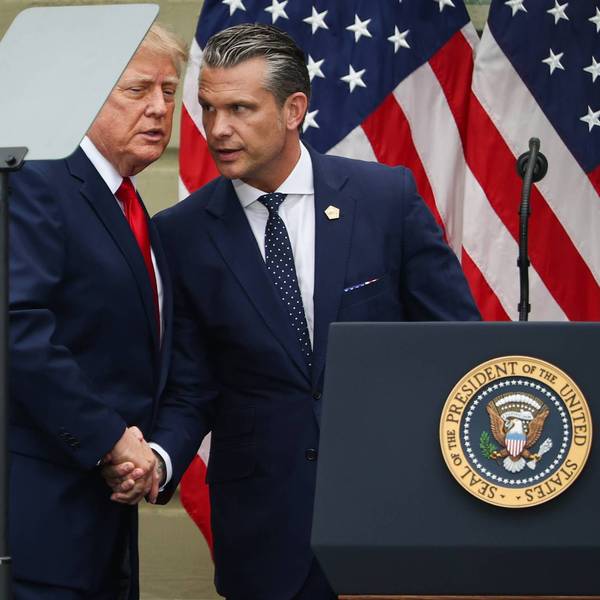
Pentagon Secretary Pete Hegseth and Secretary of State Marco Rubio speak in Washington, DC on January 7, 2026.
The Trump administration has conducted more than two dozen surveillance and reconnaissance flights off Cuba's coast since early February, according to CNN.
US surveillance and reconnaissance flights off the coast of Cuba have surged in recent months as President Donald Trump has issued increasingly belligerent threats to seize the island nation by force.
CNN reported Sunday that the US Navy and Air Force have conducted more than two dozen surveillance flights—mostly of them near Havana and Santiago de Cuba, the country's largest cities—since early February, after the Trump administration invaded Venezuela and kidnapped its president. The outlet noted that "similar patterns, in which ramped-up rhetoric by the Trump administration coincided with an uptick in publicly visible surveillance flights, occurred in the lead-up to US military operations in both Venezuela and Iran."
"The flights are notable not only for their proximity to the coast, which puts them well within range of gathering intelligence, but for the suddenness of their appearance—prior to February, such publicly visible flights were exceedingly rare in this area—and for their timing," CNN reported.
CNN published its story days after US Secretary of State Marco Rubio announced new sanctions targeting a conglomerate operated by Cuba's military and a natural resources firm, intensifying the United States' decades-long economic war against the island nation.
"Our people already know the cruelty behind the actions of the US government and the viciousness with which it is capable of attacking us," Cuban President Miguel Díaz-Canel said in response to the sanctions. "They understand, just as the rest of the world does, that this is a unilateral aggression against a nation and a population whose sole ambition is to live in peace, masters of their own destiny and free from the pernicious interference of US imperialism."
In a New York Times op-ed on Monday, US Reps. Pramila Jayapal (D-Wash.) and Jonathan Jackson (D-Ill.) wrote that the Trump administration's "blockade of fuel to Cuba, on top of the longest embargo in modern US history, defies the norms of international law that provide for state sovereignty, nonintervention in domestic affairs and the right of nations to trade freely."
"It amounts to an economic assault on the basic infrastructure of Cuba, designed to inflict collective punishment on the civilian population by manufacturing a humanitarian crisis in which healthcare, running water, agriculture and transportation are no longer available," wrote Jayapal and Jackson, who visited Cuba in April and witnessed firsthand the devastating impact of US economic warfare.
"During our visit, we spoke with a wide range of Cuban citizens—political dissidents, religious leaders, entrepreneurs, and members of civil society organizations and humanitarian aid groups," the Democratic lawmakers wrote. "We also met with the families of Cuba’s political prisoners. Everywhere, there was agreement: America’s blockade must end, and a US invasion must not take place."
Trump has repeatedly threatened a military assault on Cuba in the months since his administration illegally attacked Venezuela and abducted its president.
"Cuba is next, by the way," Trump declared at a Saudi-backed investment summit in Miami in late March. "Pretend I didn't say that, please."
Citing unnamed US officials, The Associated Press reported last week that the Trump administration "is not looking at imminent military action against Havana" as the two sides continued to negotiate a diplomatic agreement.
AP added that the administration officials cautioned "that Trump could change his mind at any time and that military options are still on the table."
This country and this world are at a monumental crossroads. US voters have an opportunity to beat back the forces of fascism and confront the billionaires who are rigging the economy, our media system, and our democracy, making it increasingly impossible for ordinary people to get by. We’re not just talking about the election. We’re talking about what must be done once these fascist elements are vanquished from power. We need a bolder set of solutions than what either major party has so far been willing to offer and a working-class movement ready to fight like hell for it. Trump didn't emerge from nowhere. The conditions that fueled MAGA authoritarianism were created by decades of radical neoliberal economic policies and a corrupt political system dominated by corporate interests. They slashed taxes on the super-rich, promising that the benefits would trickle down. They said giveaways to the corporate titans would make life more affordable for the rest of us. It was all bullshit. And when a bitter, betrayed populace searches for someone to blame, right-wing demagogues have little trouble finding scapegoats. People know when they're being lied to, but you won't hear any of this from the corporate media. Only independent journalism—powered and funded by people who believe in building a better world—can deliver truly trustworthy daily news. If you share our vision, please contribute whatever you can to sustain our work. |
US surveillance and reconnaissance flights off the coast of Cuba have surged in recent months as President Donald Trump has issued increasingly belligerent threats to seize the island nation by force.
CNN reported Sunday that the US Navy and Air Force have conducted more than two dozen surveillance flights—mostly of them near Havana and Santiago de Cuba, the country's largest cities—since early February, after the Trump administration invaded Venezuela and kidnapped its president. The outlet noted that "similar patterns, in which ramped-up rhetoric by the Trump administration coincided with an uptick in publicly visible surveillance flights, occurred in the lead-up to US military operations in both Venezuela and Iran."
"The flights are notable not only for their proximity to the coast, which puts them well within range of gathering intelligence, but for the suddenness of their appearance—prior to February, such publicly visible flights were exceedingly rare in this area—and for their timing," CNN reported.
CNN published its story days after US Secretary of State Marco Rubio announced new sanctions targeting a conglomerate operated by Cuba's military and a natural resources firm, intensifying the United States' decades-long economic war against the island nation.
"Our people already know the cruelty behind the actions of the US government and the viciousness with which it is capable of attacking us," Cuban President Miguel Díaz-Canel said in response to the sanctions. "They understand, just as the rest of the world does, that this is a unilateral aggression against a nation and a population whose sole ambition is to live in peace, masters of their own destiny and free from the pernicious interference of US imperialism."
In a New York Times op-ed on Monday, US Reps. Pramila Jayapal (D-Wash.) and Jonathan Jackson (D-Ill.) wrote that the Trump administration's "blockade of fuel to Cuba, on top of the longest embargo in modern US history, defies the norms of international law that provide for state sovereignty, nonintervention in domestic affairs and the right of nations to trade freely."
"It amounts to an economic assault on the basic infrastructure of Cuba, designed to inflict collective punishment on the civilian population by manufacturing a humanitarian crisis in which healthcare, running water, agriculture and transportation are no longer available," wrote Jayapal and Jackson, who visited Cuba in April and witnessed firsthand the devastating impact of US economic warfare.
"During our visit, we spoke with a wide range of Cuban citizens—political dissidents, religious leaders, entrepreneurs, and members of civil society organizations and humanitarian aid groups," the Democratic lawmakers wrote. "We also met with the families of Cuba’s political prisoners. Everywhere, there was agreement: America’s blockade must end, and a US invasion must not take place."
Trump has repeatedly threatened a military assault on Cuba in the months since his administration illegally attacked Venezuela and abducted its president.
"Cuba is next, by the way," Trump declared at a Saudi-backed investment summit in Miami in late March. "Pretend I didn't say that, please."
Citing unnamed US officials, The Associated Press reported last week that the Trump administration "is not looking at imminent military action against Havana" as the two sides continued to negotiate a diplomatic agreement.
AP added that the administration officials cautioned "that Trump could change his mind at any time and that military options are still on the table."