
SUBSCRIBE TO OUR FREE NEWSLETTER
Daily news & progressive opinion—funded by the people, not the corporations—delivered straight to your inbox.
5
#000000
#FFFFFF
To donate by check, phone, or other method, see our More Ways to Give page.


Daily news & progressive opinion—funded by the people, not the corporations—delivered straight to your inbox.
"Musk's attempt to buy Wisconsin's Supreme Court is a red alert that his attack on democracy isn't limited to gutting the federal government," said Wisconsin Democratic Party Chair Ben Wikler.
A nonprofit with links to billionaire and GOP megadonor Elon Musk is spending over a million dollars in the race for Wisconsin Supreme Court, a high stakes contest that will decide whether liberals or conservatives control the state's highest judicial body.
Wisconsin Democratic Party Chair Ben Wikler said in a statement Monday that the news is a sign that Musk and U.S. President Donald Trump know the Wisconsin Supreme Court could be a check "on their lawless coup"—likely in reference to efforts by Musk and the Trump administration more broadly to radically reshape the federal government in recent weeks.
The dark money group, Building America's Future—which was a financial backer for several Republican-aligned super political action committees (PACs) during the 2024 cycle—is spending at least $1.5 million in the state, including on ads that are slated to start running later this week, Politico reported Wednesday. Wisconsin outlets first reported that Building America's Future was involved in the race on Monday.
The ads are expected to be in support of GOP-backed candidate Brad Schimel, who is facing off against liberal-aligned candidate Susan Crawford, and whom Musk has boosted on social media.
In October 2024, multiple outlets reported that Musk gave millions to Building America's Future. According to Reuters, those donations started in 2022, "illustrating quiet financial support for right-wing causes even before the billionaire entrepreneur in July endorsed former President Donald Trump's bid for reelection."
"Musk's attempt to buy Wisconsin's Supreme Court is a red alert that his attack on democracy isn't limited to gutting the federal government," Wikler said. "He wants it all."
In a similar vein, Crawford's campaign spokesperson Derrick Honeyman told the Milwaukee Journal Sentinel that "it's not surprising that Schimel is groveling for the support of shady special interests—he's already been caught begging on his knees for far-right donors to give him cash, and now Elon seems to be answering his pleas."
At a recent event in Jefferson County, Schimel "all but begged" conservative groups to get involved in the race and lamented the cost of TV ads, according to the Journal Sentinel.
Crawford herself has weighed in, writing on X on Tuesday, "Elon Musk is buying off Brad Schimel."
Dark money groups were expected to wade into this race given the Wisconsin Supreme Court's prominence in national politics in recent years.
In April 2023, elected Milwaukee County Judge Janet Protasiewicz to the Wisconsin Supreme Court, flipping majority control of the body from conservative to liberal for the first time in 15 years. Groups like unions and the political arm of Planned Parenthood donated money in support of Protasiewicz—an outspoken supporter of abortion rights, ballot access, and union protections.
In summer 2024, the state Supreme Court moved to reinstate the ability to return absentee ballots via drop boxes in Wisconsin, a state the U.S. President Donald Trump narrowly won that November.
In January, Musk re-posted a social media comment about Protasiewicz's victory and the Wisconsin Supreme Court's decision to reinstate the drop boxes for absentee ballots and wrote: "Very important to vote Republican for the Wisconsin Supreme Court to prevent voting fraud!"
The race is one of the first high-profile special elections to take place after Trump's victory in November, and looking ahead, the ideological makeup of the Wisconsin Supreme Court could influence the maps used in elections for the U.S. House of Representatives in 2026, per Politico.

"At the very heart of our democracy is the fundamental freedom to vote," said Democratic Gov. Tony Evers. "This is a victory for our democracy."
Democracy defenders in Wisconsin celebrated on Friday after the state Supreme Court ruled that absentee ballot drop boxes can be located throughout communities for the November elections, reversing a decision from two years ago, when there was a majority of right-wing justices.
"Wisconsin voters won big today with the decision to reinstate drop boxes across the Badger State," said All Voting is Local Wisconsin state director Sam Liebert in a statement. "Drop boxes are an incredibly popular form of voting that offer greater access to the elections for those who may not be able to wait in line at the polls, particularly those with disabilities."
"Wisconsin voters should have more options, and drop boxes are a secure and easy way to increase civic participation and ensure voters have another safe, secure, and accessible way to cast their ballot," Liebert added.
Common Cause Wisconsin co-chair Penny Bernard Schaber, whose group joined an amicus brief to the court in May, also welcomed the ruling, saying that "reinstating the use of secure ballot drop boxes is good for all of us in Wisconsin."
"It is especially good for individual voters who have mobility issues and time constraints that make it difficult for them to go into and out of a polling place or an election clerk's office," the former Democratic state representative similarly stressed. "Secure ballot drop boxes are a necessary and safe way to return our ballots."
Congressman Mark Pocan (D-Wis.) declared: "This is huge news for democracy! Making it easier for folks to vote is a good thing."
Common Cause Wisconsin pointed out that "voter drop boxes have been used since before 2016 and in 2020-21, during the height of the Covid-19 pandemic, the number of drop boxes was expanded to 570 located in 66 of Wisconsin's 72 counties. The expanded number of drop boxes, authorized by the bipartisan Wisconsin Elections Commission (WEC), offered voters a more convenient and safe way to ensure that their absentee ballots could be returned in time to be counted, in part because of the uncertainty of timely delivery of ballots by the U.S. Postal Service."
Justice Ann Walsh Bradley wrote in the majority opinion that "our decision today does not force or require that any municipal clerks use drop boxes. It merely acknowledges what Wis. Stat. § 6.87(4)(b)1. has always meant: that clerks may lawfully utilize secure drop boxes in an exercise of their statutorily-conferred discretion."
She was joined by the other three liberals, including Justice Janet Protasiewicz, whose election last year ended right-wing control of the court. Wisconsinites are preparing for a similar electoral battle next year, when Walsh Bradley plans to retire.
The court earlier this week agreed to take up a pair of high-profile abortion cases. Late last year, the liberal majority threw out Wisconsin's legislative maps, which were rigged to favor Republicans. Democratic Gov. Tony Evers signed new maps in February.
Applauding the ruling on Friday, Evers said that the court "affirmed what we've been saying all along: Drop box voting is safe, secure, and legal, and local clerks should be empowered to make decisions that make sense for their local communities."
"At the very heart of our democracy is the fundamental freedom to vote," he continued. "This is a victory for our democracy. And we're going to keep fighting to ensure that every eligible voter can cast their ballot safely, securely, and as easily as possible to make sure their voices are heard."
The decision comes as Wisconsin is expected to play a key role in this year's contest for the White House. Democratic President Joe Biden, who is now seeking reelection and campaigning in Wisconsin on Friday, won the state by about 20,000 votes in 2020, when he beat former President Donald Trump, now the presumptive Republican nominee.
"Wisconsinites deserve the ability to make decisions that shape their future—to make decisions about if or when they become a parent. And they deserve to know this right is protected by our state constitution."
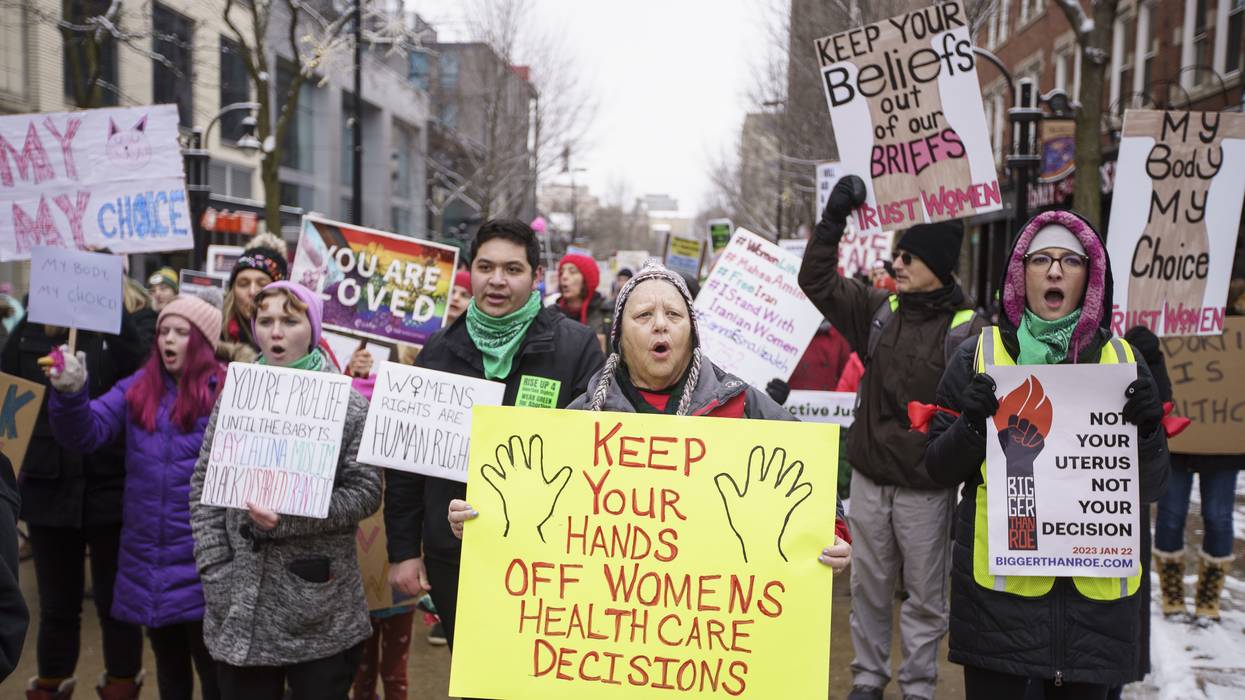
Continuing a legal battle that began with the nationwide reversal of Roe v. Wade in June 2022, Planned Parenthood on Thursday filed a petition urging the liberal-controlled Wisconsin Supreme Court to swiftly protect the right to abortion.
"We're asking the Wisconsin Supreme Court to answer this question: Does the Wisconsin Constitution protect the right to access abortion care and a provider's right to provide abortion care?" Planned Parenthood of Wisconsin (PPWI) president and CEO Tanya Atkinson explained in a video shared on social media.
"Wisconsinites deserve the ability to make decisions that shape their future—to make decisions about if or when they become a parent," she stressed. "And they deserve to know this right is protected by our state constitution."
According to the Wisconsin State Journal:
The lawsuit asks the high court to declare that abortion rights are protected in the constitutional provision stating, "All people are born equally free and independent, and have certain inherent rights; among these are life, liberty, and the pursuit of happiness."
"At the sacred core of the inherent right to life and liberty lies the right to determine what one does with one's own body, including whether and when to have a child," the lawsuit states.
The lawsuit doesn't seek to define when exactly abortion rights are guaranteed.
Planned Parenthood of Wisconsin has clinics that offer abortion care in Dane, Milwaukee, and Sheboygan counties. However, after the U.S. Supreme Court's right-wing majority overturned Roe in Dobbs v. Jackson Women's Health Organization, PPWI stopped providing abortions due to uncertainty over an 1849 state law.
PPWI decided to resume abortion care last September, in response to Dane County Judge Diane Schlipper's July ruling that the law only applies to feticide, or the act of killing a fetus, and not consensual pre-viability abortion. Joel Urmanski, Sheboygan County's Republican district attorney, asked Schlipper to reconsider her decision, but she reaffirmed it in December.
Urmanski on Tuesday asked the state's top court to bypass the appellate level and weigh in. In response, PPWI chief strategy officer Michelle Velasquez said in a statement that the group "vehemently opposes" his view that the 175-year-old law took effect upon Roe's reversal but "we do agree with DA Urmanski that bypass to the Wisconsin Supreme Court is appropriate, as this issue is of statewide importance and that requiring this case to be first decided by the Court of Appeals will only result in needless delay."
"Planned Parenthood of Wisconsin will continue to provide abortion care services at our Water Street Health Center in Milwaukee, Madison East Health Center, and Sheboygan Health Center," Velasquez added. "We will continue essential work to help protect and expand reproductive freedom in Wisconsin so that everyone who needs comprehensive reproductive healthcare in our state can get the nonjudgmental and compassionate care they deserve."
If the Wisconsin Supreme Court takes up the issue, its four liberal members are expected to affirm abortion rights, a key topic that led voters to end right-wing control of the court last April by electing Justice Janet Protasiewicz. However, even if the justices rule as anticipated, GOP state lawmakers across the country have ramped up efforts to restrict reproductive freedom since Dobbs.
Republicans in the Wisconsin State Assembly last month approved a bill that—if also passed by the Senate—could lead to a statewide referendum in the April election asking voters whether to ban abortion after 14 weeks of pregnancy. However, Democratic Gov. Tony Evers has vowed to veto the measure, which would block it from the ballot.
After the January vote, Jon McCray Jones, a policy analyst at the ACLU of Wisconsin, told theGrio that already, "1 in 5 patients are now traveling out of state for abortion care," and a new ban would exacerbate challenges faced by marginalized communities.
Residents now deal with "healthcare deserts," because "many young people who are graduating from residency are opting to go into states that have linear abortion laws," Jones said, arguing that "politicians need to stay out of the uteruses of Wisconsinites."
"Wisconsin, for the first time in over a decade, we will not have some of the most gerrymandered maps in America," Evers said.
For the first time since 2011, Wisconsin has state Assembly and Senate maps that do not unconstitutionally favor Republican candidates.
Gov. Tony Evers, a Democrat, signed new legislative maps into law on Monday that were crafted by his office and approved by the state Supreme Court.
"I've promised from the beginning that I will always try to do the right thing. Today, I'm keeping that promise and I'm signing fair maps for Wisconsin," Evers said in a statement posted on social media. "Wisconsin, for the first time in over a decade, we will not have some of the most gerrymandered maps in America."
"This is a win for Wisconsinites, who for decades have suffered under maps that Republicans gerrymandered to protect their power and allow themselves to obstruct action on popular policies while avoiding accountability at the ballot box."
Evers said that Wisconsin was a "purple state," and that its maps "should reflect that basic fact."
"The people should get to choose their elected officials, not the other way around," Evers continued.
Wisconsin has been one of the most gerrymandered states in the nation since 2011, when Republican lawmakers redrew the state's maps under Gov. Scott Walker. In one recent example, the GOP made so many alterations to the 73rd Assembly District in 2022 that residents said it looked like a Tyrannosaurus rex, according to ProPublica.
Fair election groups saw a chance to challenge the maps in August 2023, when the state's Supreme Court flipped from a conservative to liberal majority with the swearing in of Justice Janet Protasiewicz, who had criticized the maps during her campaign. Advocacy groups and law firms filed a suit on behalf of 19 Democratic Wisconsin voters, and, in December, the court ruled that the maps were unconstitutional because the districts were not "composed of physically adjoining territory" as the state Constitution requires.
The court asked different groups to submit new maps and tasked University of California, Irvine political scientist Bernard Grofman and Carnegie Mellon University political scientist Jonathan Cervas with reviewing them, as Wisconsin Public Radio reported. The experts determined that maps submitted by Evers, the Wisconsin Democrats behind the lawsuit, Democratic state senators, and a group of independent mathematicians were competitive, while two by the state legislature and the conservative Wisconsin Institute for Law and Liberty amounted to gerrymandering. Though Evers' maps are slightly more favorable to Republican candidates, the court determined that, using his maps, "the party that wins the most votes will win the most seats."
"The governor's maps are pretty darn good," said Jay Heck, the executive director of Common Cause Wisconsin.
The resolution to the fight over Wisconsin's maps came as something of a surprise, as Republican lawmakers had initially opposed Evers' maps before introducing them last week and passing them through both the Assembly and Senate. GOP legislators said they decided that the governor's maps were their best option.
"This fall Republicans will prove that we can win on any maps because we have the better policy ideas for the State of Wisconsin," Assembly Speaker Robin Vos, (R-63) said, as Wisconsin Public Radio reported.
Most Democrats voted against the maps out of concern that the GOP was not acting in good faith and was in fact preparing a new legal challenge.
"I am voting no because I do not trust what you guys are up to," Sen. Chris Larson, a Milwaukee Democrat, said, as ProPublica reported.
Good governance groups, however, applauded the development.
"This is a win for Wisconsinites, who for decades have suffered under maps that Republicans gerrymandered to protect their power and allow themselves to obstruct action on popular policies while avoiding accountability at the ballot box," Chris Walloch, executive director of A Better Wisconsin Together, said in a statement.
Walloch added that Evers' maps were "a more fair and accurate representation of Wisconsin's diverse communities than other maps proposed by Republicans" and that they would give Wisconsin voters "a renewed chance for competitive elections and a truly representative government for all." He also expressed gratitude to the state Supreme Court and Evers for making the new maps possible.
Walloch concluded: "We deserve a legislature that represents us as constituents and prioritizes our best interests. MAGA faction politicians and their special interest allies have gone to great lengths, and great expense, to protect a rigged system that benefited them, and we will continue to hold accountable any politician who attempts to obstruct today's progress."
The Democratic Legislative Campaign Committee (DLCC) said they saw the new maps as an opportunity, especially since the entire Wisconsin Assembly and half of its Senate are up for re-election in November, when the new maps will be in use.
"While we still have more work to do to ensure fair representation in each and every Wisconsin community, with these new maps in place, the Democratic Legislative Campaign Committee reaffirms its commitment to reverse the Republican takeover of this state and shift the balance of power in both the Wisconsin Assembly and the Wisconsin Senate," committee president Heather Williams said in a statement.
"Wisconsin is a top priority for the DLCC in 2024, and we're already hard at work building the campaigns that will fuel our legislative gains this fall," Williams continued. "The time for fair representation in Wisconsin is long overdue, and we are building winning campaigns and sustainable infrastructure to build power this cycle and ultimately take back both majorities."
Voting rights advocate Marc Elias hailed the ruling as "a huge win for democracy."
The Wisconsin Supreme Court on Friday ruled that the state's Republican-gerrymandered state legislative maps are unconstitutional and must be redrawn before the 2024 elections.
Justice Jill J. Karofsky wrote for the court's 4-3 majority that the current maps violate a constitutional provision "that Wisconsin's state legislative districts must be composed of physically adjoining territory."
The ruling only applies to Wisconsin's state Assembly and Senate maps, not its congressional map.
"Given the language in the Constitution, the question before us is straightforward," Karofsky wrote. "When legislative districts are composed of separate, detached parts, do they consist of 'contiguous territory'? We conclude that they do not."
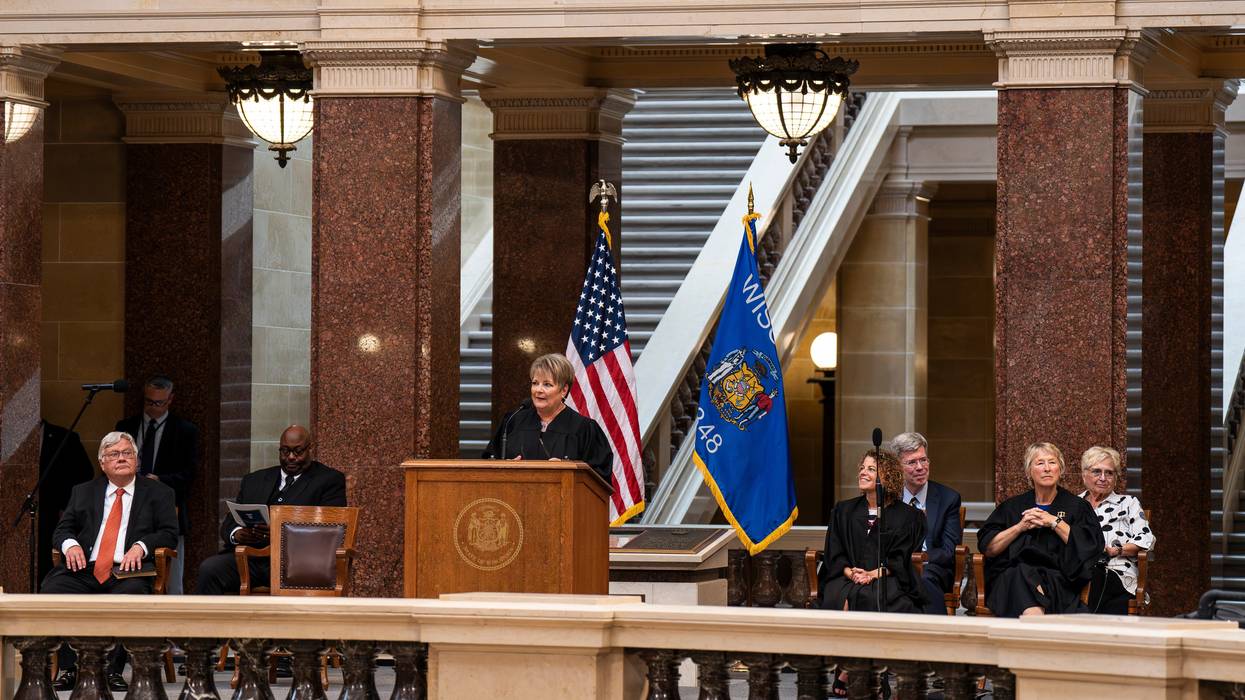
Justice Janet Protasiewicz—whose election earlier this year gave the court a liberal majority—voted with the majority. This was expected, as Protasiewicz made gerrymandering a key campaign issue and slammed the GOP-drawn maps as "rigged" and "unfair."
Brought by Campaign Legal Center (CLC), Law Forward, the Election Law Clinic at Harvard Law School, Stafford Rosenbaum LLP, and Arnold & Porter, the lawsuit argued that "Wisconsin's current legislative districts are unconstitutional in multiple ways" that deliberately split Democratic voters in mid-sized cities and towns, giving Republicans an illegal electoral edge.

Friday's ruling states:
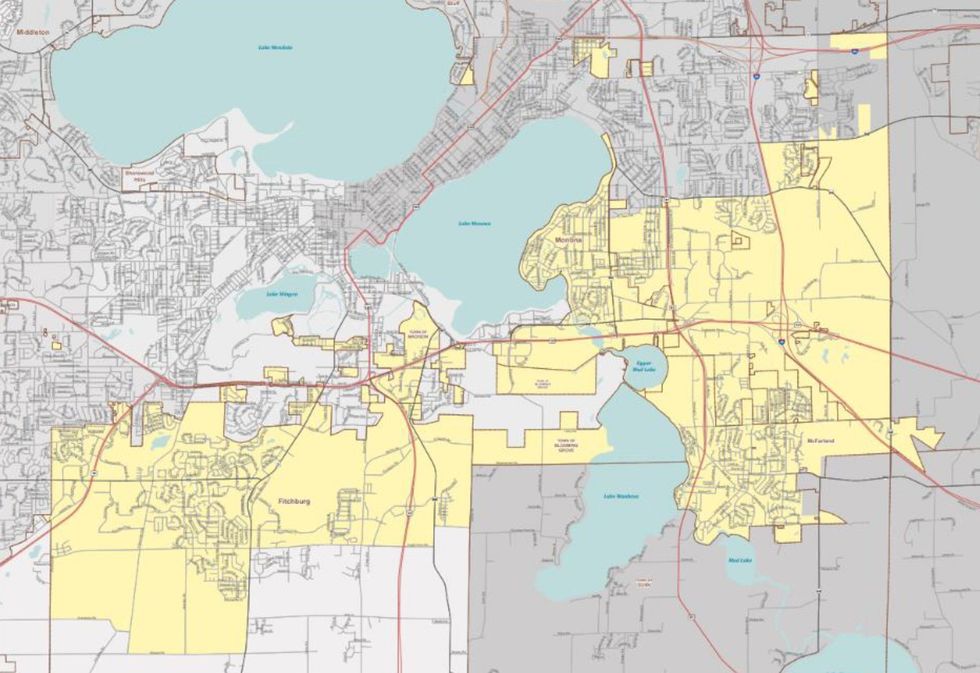
At least 50 of 99 Assembly districts and at least 20 of 33 Senate districts include separate, detached territory. A particularly stark example is the Madison-area 47th Assembly District... This district contains more than a dozen separate, detached parts that are home to thousands of people who must cross one or more other districts before reaching another part of the 47th.
Indigenous people are among those intentionally divided by Wisconsin's maps.
"Although my people have been on this land for thousands of years, we continue to fight for fair and equal access to the ballot," Anne Egan-Waukau, an enrolled member of the Menominee Nation, wrote for the Milwaukee Journal Sentinel. "We have faced significant barriers to voter access, from misinformation to restrictive voter identification laws, and most recently, gerrymandering."
"Our current legislative maps are among the most skewed in the country, and have specifically divided tribal communities across districts, depriving our people of fair representation," she added.
Dan Lenz, a lawyer for the petitioners in the case,
told The New York Times that the ruling is "a victory for a representative democracy in the state of Wisconsin."
"For too long, right-wing interests have rigged the rules without any consequences," he said. "Gerrymandered maps have distorted the political landscape, stifling the voice of the voters."
One expert said Republicans are using "extreme tactics" like the Senate vote and threats of impeaching a state Supreme Court justice "to subvert fair elections and maintain anti-democratic grip on power."
Democratic Wisconsin Attorney General Josh Kaul on Thursday swiftly filed a lawsuit after Republican senators attempted to oust the state's top election official, Meagan Wolfe, despite arguments that they lacked authority to do so.
The Wisconsin Senate's 22-11 party-line vote on Wolfe was "a bid to give election deniers and conspiracy theorists more control over how elections are run in the state," explained Mother Jones national voting rights correspondent Ari Berman.
"That follows threats by Republican legislative leaders to impeach newly elected state Supreme Court Justice Janet Protasiewicz before she has even ruled on a case," he added, "so that the court's new 4-3 liberal majority will be unable to strike down the heavily gerrymandered maps that have been integral to the GOP's stranglehold over the Legislature for the past decade-and-a-half."
Wolfe began serving as interim administrator of the Wisconsin Elections Commission (WEC) in early 2018 and was unanimously confirmed by the state Senate the following year. As Politico reported Thursday:
Wolfe's position is a nonpartisan, nonvoting one tasked with implementing the decisions made by the three Democratic and three Republican commissioners.
As the head of the commission, Wolfe has been the target of GOP attacks following the 2020 presidential election, when President Joe Biden narrowly beat former President Donald Trump in the state. Wolfe has garnered vitriol from Republicans who amplified Trump's false claims about widespread fraud in the election.
The administrator's term expired on July 1, but the WEC's three Democrats abstained from voting to renominate Wolfe because they feared GOP senators would refuse to confirm her and, as Kaul highlighted last month, "the Wisconsin Supreme Court has squarely held that a holdover appointee may legally remain in office following the expiration of the term."
GOP legislators—led by Senate Majority Leader (R-9) Devin LeMahieu—went ahead with the vote on Thursday even though "the Republicans' own lawyers, as well as the state's Democratic attorney general, told the senators before the vote that they didn't have the authority to remove Meagan Wolfe," according to The Washington Post.
"Wisconsin Republicans' attempt to illegally fire Wisconsin's elections administrator without cause today shows they are continuing to escalate efforts to sow distrust and disinformation about our elections, denigrate our clerks, poll workers, and election administrators, and undermine basic tenets of our democracy, including the peaceful transfer of power," declared Democratic Gov. Tony Evers.
Referencing a "bogus" bill unveiled earlier this week by GOP leaders, the governor said that "just days after Republicans announced they want Legislature-picked, Legislature-approved map drawers to conduct redistricting, Republicans today demonstrated why they cannot be trusted with that important responsibility—because they will threaten, intimidate, punish, and even attempt to illegally fire anyone who stands in the way of their relentless pursuit to retain political power."
"Our chief election administrator is a consummate, qualified professional who's worked in voter registration and outreach and election security for more than a decade—experience that I have no doubt was among the reasons she was unanimously confirmed by many of these same Republicans just a few years ago," he added. "I'm requesting the Wisconsin Department of Justice provide immediate representation to defend Ms. Wolfe so she can remain in this important role."
The Wisconsin attorney general, who filed a complaint in Dane County Circuit Court, said that "the story today is not what the Senate has purported to do with its vote. It's that the Senate has blatantly disregarded state law in order to put its full stamp of approval on the ongoing baseless attacks on our democracy."
"We are going to court to minimize the confusion resulting from today's stunt," Kaul continued, "and to protect a pillar of our democracy—the fair administration of elections."
The Cap Times reported that "there is no formal appeals process for Wolfe to tap in order to push back against her ousting, according to the Wisconsin Legislative Council, a nonpartisan agency that provides legal and policy analysis for the Legislature. That leaves a lawsuit as her only option."
Wolfe welcomed the lawsuit and confirmed that she will continue to serve as administrator unless a majority of the WEC or a court orders her out. She said that "the Senate's vote today to remove me is not a referendum on the job I do but rather a reaction to not achieving the political outcome they desire."
The controversy comes as the state prepares for next year's elections. At the presidential level, Biden is seeking reelection and Trump is currently the GOP front-runner, despite facing four criminal cases—including two related to his efforts to overturn the 2020 results—and arguments that inciting the January 6, 2021 insurrection constitutionally disqualifies him from holding office.
"I think it's really worrisome because we're in the final stages of preparation for the 2024 elections," Barry Burden, a political scientist at the University of Wisconsin-Madison and director of its Elections Research Center, told the Post. "The elections commission is training clerks around the state and issuing guidance, so to have uncertainty about who the top administrator is going into this crucial election season, I think is a real problem."
While welcoming the shift, Gov. Tony Evers also stressed that the broader battle is far from over and "I will keep fighting like hell every day until Wisconsinites have the right to make their own healthcare decisions."
Wisconsin residents, reproductive rights advocates, and Democratic political leaders on Thursday celebrated after Planned Parenthood announced that it will resume abortion care at Madison and Milwaukee clinics next week following a recent court ruling.
"With patients and community as our central priority and driving force, we are eager to resume abortion services and provide this essential care to people in our state," said Planned Parenthood of Wisconsin (PPWI) president and CEO Tanya Atkinson in a statement.
"With the recent confirmation from the court that there is not an enforceable abortion ban in Wisconsin, our staff can now provide the full scope of sexual and reproductive healthcare to anyone in Wisconsin who needs it, no matter what," added Atkinson.
After the U.S. Supreme Court's right-wing majority reversed Roe v. Wade last year, PPWI stopped providing abortion care due to uncertainty over an 1849 Wisconsin law—which is still being challenged and expected to eventually reach the state Supreme Court.
As Atkinson explained in a two-minute video posted on social media Thursday, PPWI decided to resume care after Dane County Judge Diane Schlipper ruled in July that "there is no such thing as an '1849 abortion ban' in Wisconsin."
Schlipper determined that the law only applies to feticide, or the act of killing a fetus, and wrote that "a physician who performs a consensual medical abortion commits a crime only 'after the fetus or unborn child reaches viability.'"
The Guttmacher Institute—which tracks state-level policy changes on abortion rights across the country—declared Thursday on X, formerly Twitter, that "this is a win for people in Wisconsin seeking care, advocates, and providers!"
The pause on abortion care in Wisconsin forced patients to continue dangerous or unwanted pregnancies, self-manage abortions, or seek care elsewhere—such as in Democrat-controlled Illinois, which is surrounded by states with strict anti-choice laws, including Wisconsin, and has been flooded with "abortion refugees" since the Roe reversal.
"The ability to provide abortion services in Wisconsin again is crucial to being able to address the full scope of care for our patients," PPWI associate medical director Dr. Allie Linton said Thursday. "Patients who walk through our doors can again know they will receive the comprehensive, high quality, nonjudgmental, and confidential reproductive care they deserve."
In a statement welcoming PPWI's decision, Democratic Wisconsin Gov. Tony Evers noted that Schlipper's ruling in July stemmed from an attempt to dismiss a lawsuit that he and state Attorney General Josh Kaul filed to clarify that the 1849 law could not be used to prevent abortion care.
"I've been clear from the beginning that I would fight to restore reproductive freedom in our state with every power and every tool we have, and I've spent every day over the last year doing just that," said Evers. "This is critically important news for Wisconsin women and patients across our state who, for a year now, have been unable to access the healthcare they need when and where they need it."
"But I also want to be clear today: I will never let up. And we must not let up. Our fight to restore the same reproductive rights and freedoms Wisconsinites had up until the day the U.S. Supreme Court overturned Roe must continue," he added. "I will keep fighting like hell every day until Wisconsinites have the right to make their own healthcare decisions without interference from politicians who don't know anything about their lives, their family, or their circumstances."
Other Democratic political leaders in Wisconsin who applauded the development included former Lt. Gov. Mandela Barnes, Secretary of State Sarah Godlewski, U.S. Sen. Tammy Baldwin, and Congresswoman Gwen Moore, who has previously spoken about her decision, as a low-income 19-year-old mother, to end her second pregnancy before Roe.
Praising PPWI's announcement as "an important step toward restoring reproductive freedom for everyone in our state," Opportunity Wisconsin said that "no Wisconsinite should face a massive financial burden just to access the basic healthcare services they need."
The coalition also called out Wisconsin Republicans in Congress who have joined their GOP colleagues in blocking federal legislation that would affirm abortion rights nationwide.
Abortion—and specifically, fights over the 1849 law—was a key issue in the April election in which voters elected Milwaukee County Judge Janet Protasiewicz to the Wisconsin Supreme Court, which now has a liberal majority for the first time in 15 years. Republicans in the state Legislature are threatening to impeach her before she even hears a case.
"Wisconsin Republicans are threatening to impeach Justice Protasiewicz for one reason: to stay in power," Moore said Sunday. "They know they're outnumbered on issues like abortion, so the only way to keep their extreme policies in place is to subvert the will of the voters."
"The entire country should know what's happening here in Wisconsin," said the state's Senate Democrats.
Wisconsin Democrats are urging the U.S. public to pay close attention to the Republican Party's maneuvering in the key battleground state, where GOP lawmakers are floating impeachment proceedings against a recently elected liberal Supreme Court justice if she doesn't recuse herself from cases related to the state's gerrymandered legislative maps.
"We've been sounding the alarm bells on the dangerous threats from Republicans to impeach justices who don't follow their orders. And yesterday, they doubled down," Wisconsin Senate Democrats wrote in a social media post on Wednesday after state Assembly Speaker Robin Vos (R-63) left open the possibility of an impeachment push against Wisconsin Supreme Court Justice Janet Protasiewicz.
Speaking to reporters on Tuesday, Vos suggested that Protasiewicz has "pre-judged" a potential case challenging the legality of Wisconsin's legislative maps. If Protasiewicz doesn't recuse, Vos said that would be "a pretty clear violation" and indicated impeachment proceedings would be on the table.
Wisconsin Republicans have the simple Assembly majority needed to impeach and the two-thirds Senate majority needed to convict. State Republicans are also currently attempting to remove Wisconsin's nonpartisan head of elections.
"This is crazy," Wisconsin Senate Democrats wrote Wednesday. "The entire country should know what's happening here in Wisconsin. Spread this far and wide."
In a statement, Senate Minority Leader Melissa Agard (D-16) said that "considering impeachment mere weeks after Justice Protasiewicz has been sworn in is utterly absurd."
"Legislative Republicans will jump over any hurdle to usurp the will of the majority," said Agard.
Earlier this month, a day after Protasiewicz was sworn in, voting rights organizations filed a legal challenge urging the Wisconsin Supreme Court to toss out the state's maps, which the groups argue have entrenched an unfair electoral advantage for Republicans and allowed them to cling to power in the Legislature for more than a decade.
A second legal challenge against the maps was filed days later.
Protasiewicz's victory over right-wing former Wisconsin Supreme Court Justice Dan Kelly in April wrested control of the state's high court from conservatives for the first time in 15 years.
During her campaign, Protasiewicz described Wisconsin's legislative maps as "rigged" and "unfair," an assessment that is widely shared by legal experts and voting rights campaigners. Protasiewicz did not say how she would rule should the Wisconsin Supreme Court take up a gerrymandering case.
Vos and other Wisconsin Republicans nevertheless seized upon Protasiewicz's comments as evidence that she has already decided how she would rule and should therefore recuse from any redistricting cases. Last week, Wisconsin Senate Republicans filed a motion demanding Protasiewicz's recusal from challenges to the constitutionality of the state's maps, which are so warped that they've been described as "Swiss cheese."
In response to the Republican motion, law firms that are suing over the state's maps argued that Republicans are pushing for Protasiewicz's recusal because they are "unhappy" with her election victory, "which they could not prevent through gerrymandering."
Wisconsin Republicans "now seek to nullify the election and pick their judges," the firms added. "Respondents' arguments in support of recusal are without merit, and this motion should be denied."
Chief Justice Annette Ziegler "claims that the court's new majority has 'gone rogue,'" wrote the editorial board of one newspaper. "That's absurd. That's dishonest. And, coming from Ziegler, that's wildly hypocritical."
One of the liberal Wisconsin Supreme Court justices who now make up the panel's majority after 15 years of conservative control strongly rejected right-wing Chief Justice Annette Ziegler's accusation on Monday that the liberal justices have staged a "coup" by voting on key court business.
Ziegler wrote to interim state court director Audrey Skwierawski on Monday to demand that she stop signing off on court business that she was hired earlier this month to oversee, claiming the liberal justices took part in an "illegal experiment" when Skwierawski was appointed to oversee state court operations, the judiciary's budget, and other business.
In the email obtained by the Associated Press, Ziegler wrote that Skwierawski should not sign off on assignments of reserve judges, who fill in for state judges when they are ill or need to be absent for another reason. Skwierawski has signed off on nearly 30 such assignments since Justice Janet Protasiewicz was sworn in on August 1, giving the liberals a 4-3 majority.
When they appointed Skwierawski, a Milwaukee County circuit judge, the liberal majority also voted to shift much of the chief justice's power to a committee that will appoint members of judicial committees and the court's planning and policy advisory panels, among other matters.
“This is nothing short of an unprecedented coup," Ziegler wrote to Skwierawski and the liberal justices, including Protasiewicz, Rebecca Dallet, Jill Karofsky, and Ann Walsh Bradley. "For 40 years, the role of the chief justice has been understood and respected. Your short-term goals will cause long-term, irreparable damage to the judiciary. What a historical disgrace."
Ziegler's comments, which Dallet later suggested were being leaked to the media, amounted to what Daily Kos political director David Nir called a "meltdown over the fact that Wisconsin voters elected a liberal Supreme Court," giving the majority the right to form the committee and hire a new state court director.
The chief justice told the AP she would soon advertise nationally for a replacement for Skwierawski and reissue the orders that the court director had signed, even though Skwierawski said in a statement earlier this month that she had reviewed legal opinions, including one from a former Republican state attorney general, to ensure she met the qualifications to serve in the position.
Dallet responded to Ziegler in another email obtained by the AP, calling her comments in the media "deeply inappropriate, and at times partisan, tone, and tenor" and saying that the chief justice, had pushed the committee and the state court director to operate without Ziegler's input.
"The attempt to obstruct the proper business of the court and the furtherance of justice comes from you," Dallet wrote. "Judge Skwierawski tried on many occasions to discuss how the Office of State Courts could better serve the people of our state. You not only refused to meet with her but today you send emails (which are then immediately leaked to the media) falsely accusing her of violating the law for doing her job in keeping the courts running in service to the people of the state of Wisconsin."
"We are simply creating process so that a majority of the court can effectively work in the face of an intransigent and uncollegial chief who apparently insists on a public debate about issues for political purposes, rather than allow a court majority to function as it always has," she added.
Ziegler has spent much of the month since Protasiewicz was sworn in publicly railing against the new liberal majority, writing an opinion piece in The Capital Times on August 3 arguing that the firing of the previous state court director, who was aligned with Ziegler, was "unwarranted" and a "dangerous" example of "overreaching power."
In response, The Capital Times editorial board noted on August 9 that Ziegler joined other right-wing justices to oust former Chief Justice Shirley Abrahamson in 2015 and refused to hold another conservative justice accountable for verbally and physically attacking colleagues.
"Ziegler and her allies shoved Abrahamson aside in what really was a raw exercise of overreaching power," wrote The Capital Times. "Now Ziegler claims that the court's new majority has 'gone rogue.' That's absurd. That's dishonest. And, coming from Ziegler, that's wildly hypocritical."
"It is Ziegler who went rogue years ago," the outlet added. "The new majority is simply seeking to restore a measure of balance and dignity to a court that desperately needs to turn a new page."
"Republicans are threatening to use their gerrymandered supermajority to remove the newly elected Wisconsin Supreme Court justice who could strike down their gerrymanders."
The Republican leader of Wisconsin's Assembly late last week threatened impeachment proceedings against liberal state Supreme Court Justice Janet Protasiewicz if she doesn't recuse herself from cases involving Wisconsin's legislative maps, which GOP lawmakers have aggressively gerrymandered to give themselves what experts say is an illegal electoral advantage.
In a radio interview on Friday, Wisconsin Assembly Speaker Robin Vos accused Protasiewicz of "prejudging" the outcome of a potential case challenging the legality of Wisconsin's maps.
Earlier this month, a coalition of voting rights groups and law firms filed a lawsuit over the maps, appealing directly to the Wisconsin Supreme Court to strike them down.
Protasiewicz, whose election victory earlier this year ended conservatives' 15-year dominance of the Wisconsin Supreme Court, was critical of the state's maps during her campaign, calling them "rigged" and arguing they "do not reflect people in this state."
"I don't think you could sell any reasonable person that the maps are fair," Protasiewicz said in January. "I can't tell you what I would do on a particular case, but I can tell you my values, and the maps are wrong."
During his Friday interview, Vos characterized Protasiewicz's comments as sufficient grounds for recusal, claiming that they show she can't be an "impartial observer" on cases related to the state's maps.
But critics see Vos' suggestion of impeachment proceedings as an anti-democratic threat by a supermajority worried about losing its grip on power.
Republicans have controlled the Wisconsin Legislature for 12 consecutive years, and they have the two-thirds majority necessary to convict in the Senate. Just a majority vote in the Assembly is needed to impeach.
As the Associated Press reported Sunday, the Wisconsin Constitution "requires legislative districts 'to consist of contiguous territory,'" but "many nonetheless contain sections of land that are not actually connected."
"The resulting map looks a bit like Swiss cheese, where some districts are dotted with small neighborhood holes assigned to different representatives," the outlet added. "Wisconsin's Assembly districts rank among the most tilted nationally, with Republicans routinely winning far more seats than would be expected based on their average share of the vote."
Stephen Wolf of Daily Kos Elections wrote in response to Vos' comments that "Republicans are threatening to use their gerrymandered supermajority to remove the newly elected Wisconsin Supreme Court justice who could strike down their gerrymanders."
"Gerrymandering let the GOP win exactly two-thirds in the state Senate in 2022 despite Dems winning most statewide races," Wolf noted.
Even if the Republican-controlled Wisconsin Senate doesn't ultimately succeed in convicting Protasiewicz, her impeachment in the Assembly would, under Wisconsin law, prevent her from hearing cases until her acquittal, observed Michael Li, redistricting and voting counsel at the Brennan Center for Justice.
"If the Senate drags its feet in holding a trial, that might be enough to leave gerrymandered maps in place for 2024," Li warned.
The Campaign Legal Center (CLC), Law Forward, the Election Law Clinic at Harvard Law School, Stafford Rosenbaum LLP, and Arnold & Porter argued in a petition filed with the Wisconsin Supreme Court earlier this month that the state's legislative maps are "extreme partisan gerrymanders that violate multiple provisions of the Wisconsin Constitution."
The lawsuit demands a redrawing of legislative maps and special elections for state Senate seats that wouldn't otherwise be up for reelection until 2026.
"The legislators elected in November 2022 took office in unconstitutionally configured districts," the lawsuit states. "That constitutional infirmity has persisted for over a decade now, and Wisconsinites have suffered under this unconstitutional system for long enough. Legislators have no right to complete a term of office that was unconstitutionally obtained."