

SUBSCRIBE TO OUR FREE NEWSLETTER
Daily news & progressive opinion—funded by the people, not the corporations—delivered straight to your inbox.
5
#000000
#FFFFFF
To donate by check, phone, or other method, see our More Ways to Give page.
Daily news & progressive opinion—funded by the people, not the corporations—delivered straight to your inbox.
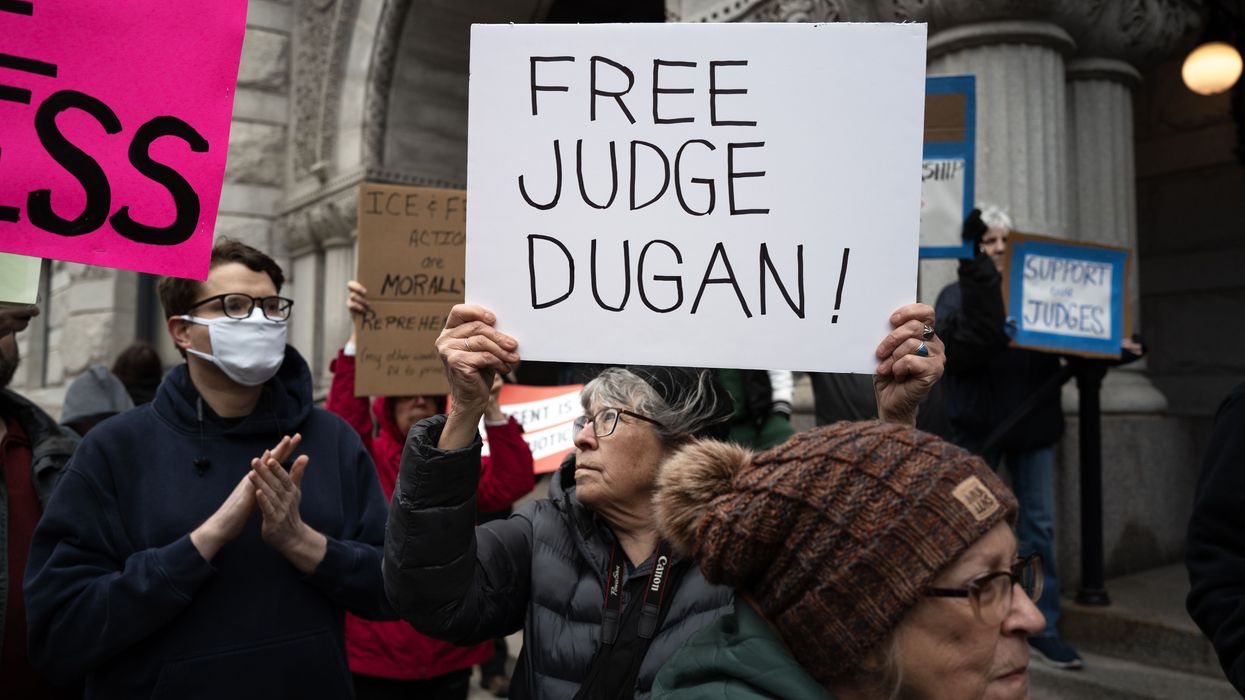
Judge Hannah Dugan's case is "not about one judge," said an advocacy group, but rather "the normalization of ICE operating in courthouses."
The case of Wisconsin Judge Hannah Dugan "is a long way from over" said a lawyer for the judge after a jury found her guilty late Thursday of the felony charge of obstructing immigration agents who showed up at her courtroom in April with the aim of arresting an immigrant who was appearing before Dugan.
The jury deliberated for six hours before finding Dugan, a Milwaukee County circuit court judge, guilty of obstructing an official proceeding. The jurors acquitted her of a misdemeanor charge of concealing a person from arrest—a result her lawyer, Steve Biskupic, said he would question when he seeks to have the conviction thrown out by a court.
"While we are disappointed in today's outcome, the failure of the prosecution to secure convictions on both counts demonstrates the opportunity we have to clear Judge Dugan's name and show she did nothing wrong in this matter," said Dugan's legal team.
The Trump administration seized on the case in April after Dugan responded to FBI and US Immigration and Customs Enforcement (ICE) agents' presence in the courthouse by telling the defendant, Eduardo Flores-Ruiz, to go out a back door of her courtroom after she had sent the agents to another part of the building.
FBI Director Kash Patel posted a photo of Dugan in handcuffs on social media in April, and Attorney General Pam Bondi attacked the judge in television appearances, accusing her of “protecting a criminal defendant over victims of crime.”
The case began at Milwaukee County Courthouse in April, when Dugan was hearing a number of misdemeanor cases in one day. Flores-Ruiz, who had been deported in 2013 and had reentered the US without authorization, was facing battery charges.
Emails presented in Dugan's case this week showed she had tried to push Milwaukee County Chief Judge Carl Ashley to make an official policy regarding how judges should handle the arrival of federal agents at a time when President Donald Trump's rapid escalation of his mass deportation campaign was sending ICE officers to courthouses across the country. Courts had previously been treated as protected areas where immigration enforcement could not take place.
"We reject a system that uses prosecution and brute force to advance a far-right, anti-immigrant agenda and criminalizes those who stand up against this assault on our human and constitutional rights."
Without official guidelines in place, the court clerk who notified Dugan of the ICE agents' presence, Alan Freed, testified that he had been "upset and a little bit outraged" that the officers were there.
Dugan confronted the agents, who were sitting in the hallway and waiting to arrest Flores-Ruiz, and told them to go down the hall to Ashley's office.
An FBI special agent testified that Dugan "seemed to be angry" when she confronted the officers.
Dugan then returned to her courtroom and told Flores-Ruiz's lawyer she would find a new date for his hearing. She spoke privately to a court reporter saying Flores-Ruiz could leave the room through a side door that was not open to the public.
“I’ll get the heat," Dugan said.
The side door led to a stairwell and also to another door that opened into a public hallway where the federal agents were. Flores-Ruiz and his lawyer went through the door and an agent followed and then chased the defendant, arresting him outside the courthouse. Flores-Ruiz was deported last month.
Prosecutors said during the case that Dugan had intended for Flores-Ruiz to escape the agents by going down the stairwell—even though he did the opposite.
An attorney on Dugan's legal team said during closing arguments that she "never acted corruptly in doing her job as a judge in the middle of a stressful, new, and confusing situation."
Dugan could serve up to five years in prison and will likely be barred from serving as a judge, as the Wisconsin Constitution prohibits people convicted of felonies from holding public office.
Norm Eisen, executive chair of Democracy Defenders Fund, also emphasized that the case is "far from over."
"Substantial legal and constitutional issues remain unresolved, and they are exactly the kinds of questions appellate courts are meant to address. Higher courts will have the opportunity to determine whether this prosecution crossed the lines that protect the judiciary from executive overreach," said Eisen.
Milwaukee-based advocacy group Voces de la Frontera emphasized that Dugan's case "is not about one judge," but rather "the normalization of ICE operating in courthouses and the expansion of immigration enforcement into spaces meant to guarantee fairness, safety, and access to justice."
"By validating this prosecution, the verdict blurs the line between the courts and executive enforcement power, signaling that the law will be enforced aggressively against immigrants and those who dare to defend their rights, while the privileged and powerful continue to evade accountability," said the group, calling Dugan's case "a political prosecution that criminalized the exercise of judicial independence and the defense of due process."
Christine Neumann-Ortiz, executive director of Vocesde la Frontera, said the verdict "tells judges, court staff, and our communities that defending due process comes with consequences."
"That is not justice, it is intimidation," she said. "We reject a system that uses prosecution and brute force to advance a far-right, anti-immigrant agenda and criminalizes those who stand up against this assault on our human and constitutional rights. We stand in solidarity with Judge Hannah Dugan as her legal defense moves forward to clear her name, and we stand with the immigrant community in calling for ICE out of our courtrooms."

The Republican Party now seeks to criminalize every aspect of helping a person who has fled a life of torture, violence, and suffering. Will we obey?
A person escapes slave labor, torture, rape, and murder, and illegally crosses a border to a land where such crimes are outlawed, to a land where people have the right to work for wages and are protected by the law. Anyone in this “Free Land” who harbors or aides such an escapee is subject to federal prosecution, fines, and imprisonment. Yet to turn them over to federal authorities returns these people to a life of wanton violence and suffering.
This was the United States in 1850 when Congress passed the Fugitive Slave Law, legislation requiring that all escaped slaves be returned to the slave owner and that officials and citizens in free states must cooperate. Aiding or harboring a slave meant prison and steep fines. Habeas corpus was suspended under this law. Citizens were required to return a runaway slave to the chains of bondage or face the wrath of the federal courts.
Americans in 1850 had to decide where they stood, with the newly passed federal law or with their conscience. The risk was great, for both the runaway slaves and those Americans who might help them.
Our choice on such a momentous issue determines not just our place on the right or wrong side of history but determines the fate of people impacted by our decision.
Today, the Republican Party, the very party which grew from the outrage over the wickedness of the Fugitive Slave Act, now seeks to criminalize every aspect of helping a person who has fled a life of torture, violence, and suffering. The Fugitive Slave Act of 1850 has been updated and amended for the fleeing refugees of 2025.
On April 25, 2025, U.S. officials arrested Hannah Dugan, a Wisconsin judge, and charged her with helping a man in her court evade immigration authorities. It is alleged she hindered immigration agents who appeared in the courthouse to arrest the man without a judicial warrant. She faces numerous federal charges.
We are only four months into Trump’s Second Term of Cruelty. Where will we be a year from now? Two years from now? How draconian will the laws be then?
Americans living in the border states of the 1850s were called upon to answer the question of what they would do when a runaway slave appeared in their community. Would they violate federal law and help, or would they turn the desperate families back over to the slaveholders, to the “manstealers,” as the bounty hunters were then called.
Many in the border state of Pennsylvania—Quakers, Amish, Brethren—followed their faith and funneled these runaways to freedom. In Lancaster County, Republican Congressman Thaddeus Stevens allegedly hid slaves in a cistern in his backyard as he facilitated their road to freedom. He was an oathbound member of Congress violating U.S. law to save lives.
In retrospect, it is easy to know what the right thing to do was in the case of slavery and The Underground Railroad. That issue today is clear for us. We know where we would stand: for freedom, for those fleeing slavery. But back then the issue was not so clear. Our choice on such a momentous issue determines not just our place on the right or wrong side of history but determines the fate of people impacted by our decision.
Will we help or hinder a person in need?
Will we violate immoral law to save a life?
Will we risk fines and imprisonment?
These questions were asked and answered by many Americans in 1850. How will we answer them today?
So often we wish to be part of a moment of great historical importance, a moment when we have to take a risk to save another, to take a stand when others wouldn’t. We feel certain we would know the right thing to do. If only such a moment would come our way.
Today, that moment comes not in the form of storming a beachhead or taking a hill in battle. It is not marching for civil rights in Birmingham or Selma. And it is not hiding a runaway slave in your attic, though the similarities to that particular act of conscience are striking. Today it is whether to provide shelter and safety to a refugee fleeing violence in their home country, a person illegally in the United States.
How will we respond this time? In this century? In this historic moment?
Is a refugee illegally entering this country to flee institutional violence different than a slave illegally entering a free state to escape slavery? Especially when that institutional violence has been precipitated by the U.S. repeatedly intervening and destabilizing the home country of the refugee?
In 1958, legendary peace activist Philip Berrigan asked a youth retreat group the following question: “What's it going to be with you? Are you going to go through life playing both ends against the middle, playing cozy, not committing yourself, sitting on the fence?”
That question is as potent, and as dangerous, today as it was then. For us, and for the victims in the breach.
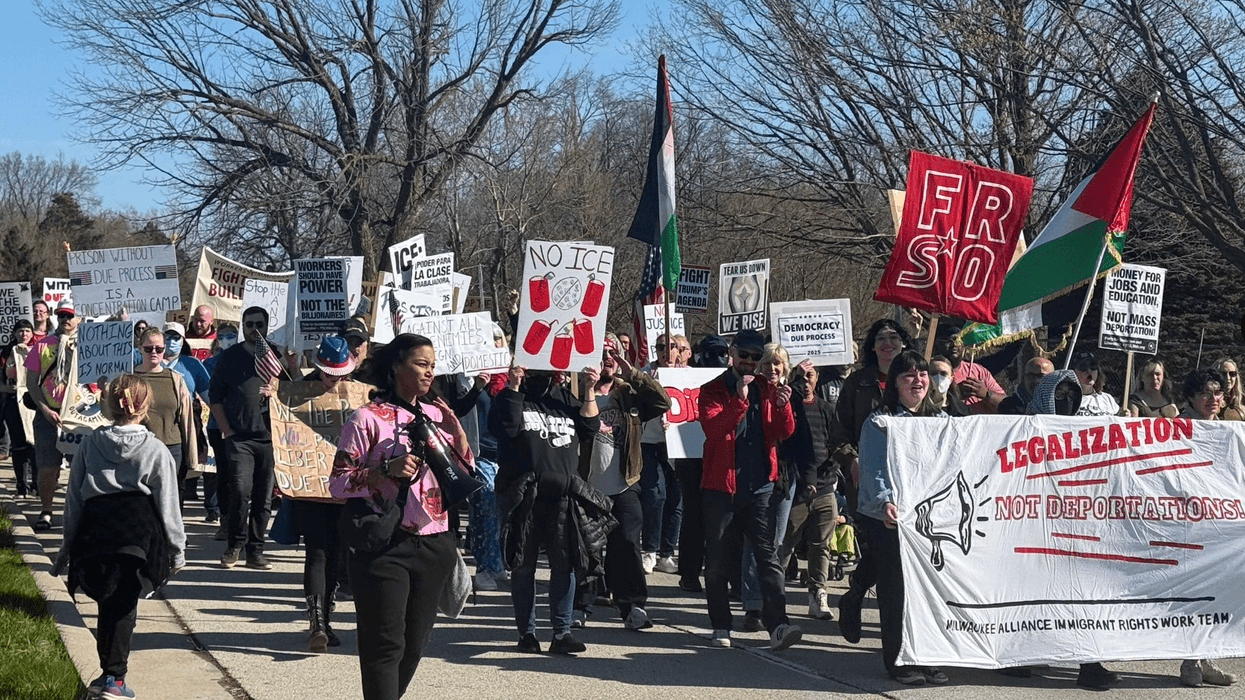
"We reject this lawless escalation against an immigration judge who appears to be showing a commonsense and humane approach to immigrants, and stands for due process for all," said one campaigner.
Hundreds of people rallied in Wisconsin's largest city on Saturday to protest the Trump administration's arrest of Milwaukee County Circuit Judge Hannah Dugan on what critics called "baseless" charges of felony obstruction after she allegedly helped an undocumented immigrant evade arrest during an appearance in her courtroom.
FBI agents arrested Dugan, 65, on Friday following an investigation, accusing her of escorting an undocumented man and his attorney through her courtroom's jury door after learning that Immigration and Customs Enforcement (ICE) agents showed up to arrest him.
Protesters chanted slogans including, "No ICE, No KKK, No Fascist USA!" and "No Hate, No Fear, Immigrants Are Welcome Here!" They held signs with messages like "Liberty and Justice for All" and "Resist Fascism!"
HAPPENING NOW: A HUGE crowd of protesters march through the streets outside an FBI office in Milwaukee in support of Judge Hannah Dugan (Video: @unraveledpress.com)
[image or embed]
— Marco Foster ( @marcofoster.bsky.social) April 26, 2025 at 3:05 PM
"I have never heard of a state court judge being arrested by the federal government because she chose to control her own courtroom. This is unprecedented," Sara Dady, an immigration attorney who traveled more than 90 miles from Rockford, Illinois to attend the demonstration outside the FBI field office in Milwaukee, told the Milwaukee Journal Sentinel.
Wisconsin state Rep. Ryan Clancy (D-19) told the crowd: "The judiciary acts as a check to unchecked executive power. And functioning democracies do not lock up judges."
"I hope that we can all be as brave as Judge Dugan was," Clancy added.
Janan Najeeb, one of the leaders of the Wisconsin Coalition for Justice in Palestine, told rallygoers: "The courtroom is not a hunting ground for ICE. It is a sanctuary. When our government turns our courtrooms into traps, they are betraying the very laws that they claim to defend."
Coalition for Humane Immigrant Rights director Angelica Salas said in a statement that "in an unprecedented move against members of the judicial branch, the Trump administration is exercising authoritarianism to degrees that should alarm us all."
"We reject this lawless escalation against an immigration judge who appears to be showing a commonsense and humane approach to immigrants, and stands for due process for all, and against wanton disregard for our Constitution," Salas added.
Critics have called Dugan's arrest part and parcel of President Donald Trump's attacks on immigrants, the nation's system of checks and balances, and the rule of law.
"The Trump administration deserves zero benefit of the doubt here. It has evinced utter contempt for due process and the rule of law since inauguration day," Ryan Cooper, managing editor of The American Prospect, wrote on Friday. "It has deported numerous legal residents, most notably Kilmar Abrego García, to an El Salvador torture dungeon, and is openly disobeying a 9-0 Supreme Court decision to bring García back."
"The ongoing mass layoffs of federal workers and outright dismantling of legislatively mandated agencies being carried out by Elon Musk and DOGE is blatantly unconstitutional," Cooper added, referring to the Department of Government Efficiency.
Among those pushing back against Dugan's arrest are Wisconsin Circuit Judge Monica Isham, who wrote in an email to other judges: "Enough is enough. I no longer feel protected or respected as a judge in this administration. If there is no guidance for us and no support for us, I will refuse to hold court."
"I have no intention of allowing anyone to be taken out of my courtroom by ICE and sent to a concentration camp, especially without due process as BOTH of the constitutions we swore to support require," Isham added. "If this costs me my job or gets me arrested, then at least I know I did the right thing."
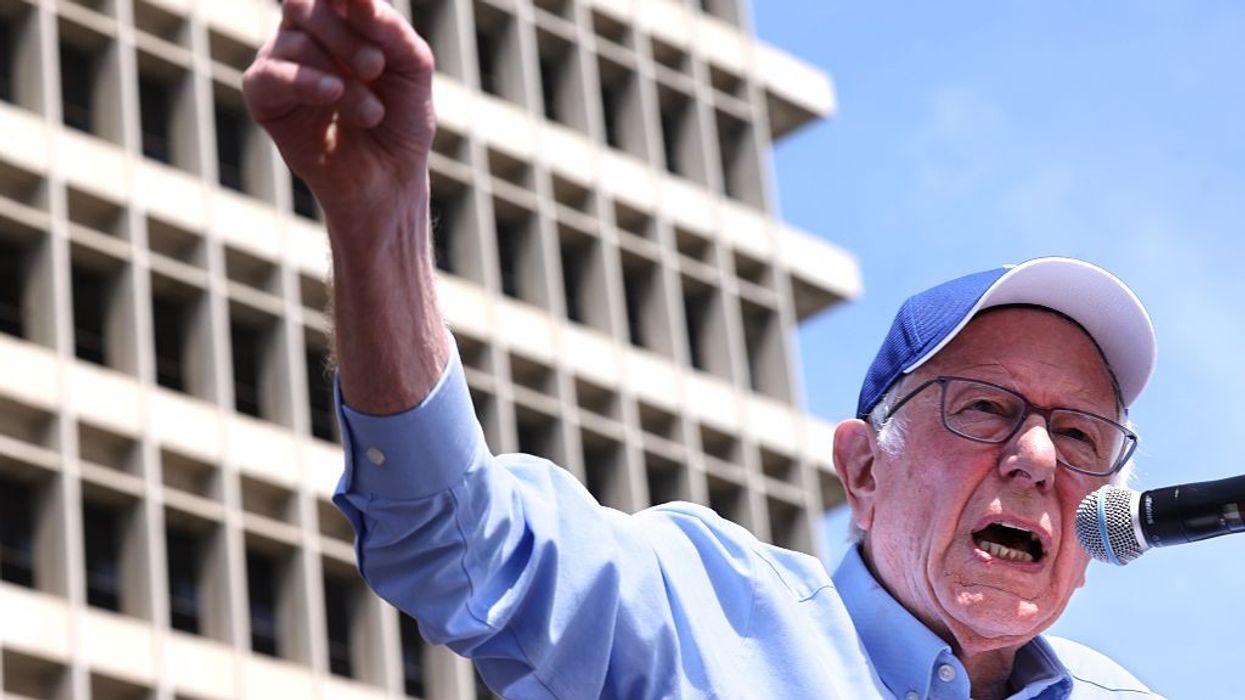
"Let's be clear. Trump's arrest of Judge Dugan in Milwaukee has nothing to do with immigration. It has everything to do with his moving this country toward authoritarianism."
U.S. Sen. Bernie Sanders led congressional progressives on Friday in condemning the Trump administration's arrest of a county judge in Wisconsin for allegedly helping an undocumented man evade capture by federal immigration agents.
FBI agents arrested 65-year-old Milwaukee County Circuit Judge Hannah Dugan, who faces felony charges of obstruction and concealing an individual, whom she is accused of giving refuge in her chambers as federal officers sought to arrest him.
In a statement accusing President Donald Trump of "illegally usurping congressional powers," Sanders (I-Vt.) said: "Let's be clear. Trump's arrest of Judge Dugan in Milwaukee has nothing to do with immigration. It has everything to do with his moving this country toward authoritarianism."
"Trump continues to demonstrate that he does not believe in the Constitution, the separation of powers, or the rule of law."
"He is suing media that he dislikes. He is attacking universities whose policies he disagrees with. He is intimidating major law firms who have opposed him," Sanders continued. "He is ignoring a 9-0 Supreme Courtdecision to bring Kilmar Abrego García back from El Salvador, where he was illegally sent. He is threatening to impeach judges who rule against him."
"Trump's latest attack on the judiciary and Judge Dugan is about one thing—unchecked power," the senator asserted. "He will attack and undermine any institution that stands in his way. Trump continues to demonstrate that he does not believe in the Constitution, the separation of powers, or the rule of law. He simply wants more and more power for himself."
"It is time for my colleagues in the Republican Party who believe in the Constitution to stand up to his growing authoritarianism," Sanders added.
Other progressive lawmakers also condemned Dugan's arrest, with Sen. Ed Markey (D-Mass.) calling this "a red alert moment" that we "all must rise against."
Rep. Mark Pocan (D-Wis.) said on the social media site X: "Judge Dugan's arrest is outrageous and a fear tactic to our independent judiciary. Trump has always thought he was above the law, but now he's enabling his goons to push that limit as far as it can go. His reckless deportations and flaunting of the Constitution will fail."
Rep. Summer Lee (D-Pa.)
said on social media that "arresting judges is the kind of crackdown you see in a police state."
"This is how dictators take power," Lee warned. "They manufacture crises, undermine our institutions, and erode our checks and balances. If they'll come for one, they'll come for all."
Rep. Jasmine Crockett (D-Texas) said that "Trump's playbook is simple: punish anyone who stands in his way."
"This ain't law and order—it's a rise of authoritarianism in real time," she added.
The FBI arrested a Wisconsin judge who stood up for due process for immigrants. This is unprecedented. All of us need to stand up and speak out against arresting judges in this country. We are living in dangerous times.
[image or embed]
— Rep. Ro Khanna ( @khanna.house.gov) April 25, 2025 at 11:07 AM
Accusing the Trump administration of a "shocking" willingness to "weaponize federal law enforcement," Rep. Gwen Moore (D-Wis.) contended that the FBI "coming into a community and arresting a judge is a serious matter" that would require a "high legal bar."
Moore added, "I am very alarmed at this increasingly lawless action of the Trump administration," including U.S. Immigration and Customs Enforcement (ICE), which has "been defying courts and acting with disregard for the Constitution."
Advocacy groups including Voces de la Frontera, Milwaukee Alliance Against Racist and Political Repression (MAARPR), and Milwaukee Turners led a Friday afternoon protest against Dugan's arrest outside the Milwaukee County Courthouse.
HAPPENING NOW: A HUGE crowd of protesters have gathered outside a Milwaukee courthouse to support Judge Hannah Dugan after her arrest earlier today
[image or embed]
— Marco Foster ( @marcofoster.bsky.social) April 25, 2025 at 1:46 PM
"To refer to this heinous attack as alarming would be an understatement," MAARPR said in a statement accusing FBI Director Kash Patel of "intentionally being public with his announcement and accusations" and "seeking to bypass Dugan's due process and label her as a criminal before she even has an opportunity to speak up."
"It's no coincidence that Patel and the FBI have acted this way when the agency has a long history of bypassing any due process," the group said. "They are seeking to send a clear message: Either you play along with Trump's agenda, or pay the consequences."
MAARPR continued:
During this period of racist and political repression, we must stand together to denounce today's actions by the FBI. What happened to Dugan is not new. The FBI and other agencies have been emboldened in recent months, snatching people off the streets, separating families, terrorizing communities, breaking doors down of pro-Palestine activists, and contributing to the unjust deportation of immigrants who don't have criminal records. What is new is that they have gone after a judge.
"The conditions we face are scary, but it will be the people united who can put an end to this terror by the FBI, ICE, and all other agencies committing such acts of injustice," the group added. "The people united will stand against Trump and his agenda."
"It's clear that actions like Judge Dugan's are what is required for democracy to survive the Trump regime," said one state lawmaker.
Federal agents arrested a sitting Wisconsin judge on Friday, accusing her of helping an undocumented immigrant evade arrest after he appeared in her courtroom last week, FBI Director Kash Patel said on social media.
In a since-deleted post, Patel said the FBI arrested 65-year-old Milwaukee County Circuit Judge Hannah Dugan "on charges of obstruction."
"We believe Judge Dugan intentionally misdirected federal agents away from the subject to be arrested in her courthouse... allowing the subject—an illegal alien—to evade arrest," Patel wrote. "Thankfully, our agents chased down the perp on foot and he's been in custody since, but the judge's obstruction created increased danger to the public."
FBI arrests judge in escalation of Trump immigration enforcement effort Federal agents arrested Milwaukee Circuit Court Judge Hannah Dugan on obstruction charges. Dugan is accused of “helping” an immigrant evade arrest. The fascism getting turned up!
[image or embed]
— RootsAction ( @rootsaction.org) April 25, 2025 at 8:05 AM
It is unclear why Patel deleted the post.U.S. Marshals Service spokesperson Brady McCarron and multiple Milwaukee County judges confirmed Dugan's arrest, according to the Milwaukee Journal Sentinel. McCarron said Dugan is facing two federal felony counts: obstruction and concealing an individual.
U.S. Attorney General Pam Bondi discussed the arrest during a Friday morning Fox News appearance in which she opined that judges like Dugan are "deranged" and believe they "are beyond and above the law."
The Journal Sentinel reported that Dugan "appeared before U.S. Magistrate Judge Stephen C. Dries during a brief hearing in a packed courtroom at the federal courthouse" and "made no public comments."
Dugan's attorney, Craig Mastantuono, told the court that "Judge Dugan wholeheartedly regrets and protests her arrest," which "was not made in the interest of public safety."
The FBI had reportedly been investigating allegations that Dugan helped the undocumented man avoid arrest by letting him hide in her chambers.
Here's the magistrate-signed complaint in US v. Dugan. She's charged with two counts, 18 USC 1505 and 1701; it doesn't appear they used a grand jury.
[image or embed]
— southpaw (@nycsouthpaw.bsky.social) April 25, 2025 at 9:13 AM
Wisconsin state Rep. Ryan Clancy (D-19) said in a statement Wednesday that "several witnesses report that [Immigration and Customs Enforcement] did not present a warrant before entering the courtroom and it is not clear whether ICE ever possessed or presented a judicial warrant, generally required for agents to access nonpublic spaces like Judge Dugan's chambers."
Clancy continued:
I commend Judge Hannah Dugan's defense of due process by preventing ICE from shamefully using her courtroom as an ad hoc holding area for deportations. We cannot have a functional legal system if people are justifiably afraid to show up for legal proceedings, especially when ICE agents have already repeatedly grabbed people off the street in retaliation for speech and free association, without even obtaining the proper warrants.
While the facts in this case are still unfolding, it's clear that actions like Judge Dugan's are what is required for democracy to survive the Trump regime. She used her position of power and privilege to protect someone from an agency that has repeatedly, flagrantly abused its own power. If enough of us act similarly, and strategically, we can stand with our neighbors and build a better world together.
Prominent Milwaukee defense attorney and former federal prosecutor Franklyn Gimbel called Dugan's arrest "very, very outrageous."
"First and foremost, I know—as a former federal prosecutor and as a defense lawyer for decades—that a person who is a judge, who has a residence who has no problem being found, should not be arrested, if you will, like some common criminal," Gimbel told the Journal Sentinel.
"And I'm shocked and surprised that the U.S. attorney's office or the FBI would not have invited her to show up and accept process if they're going to charge her with a crime," he added.
FBI has arrested Judge Hannah Dugan in Milwaukee, WI, for "helping an illegal escape arrest." FBI hasn't provided an arrest warrant or criminal complaint, but Judge Dugan already sits behind bars. We told you it would escalate when they disappeared immigrants without due process. This is fascism.
— Qasim Rashid, Esq. ( @qasimrashid.com) April 25, 2025 at 9:21 AM
Julius Kim, another former prosecutor-turned-defense lawyer, said on the social media site X that "practicing in Milwaukee, I know Judge Hannah Dugan well. She's a good judge, and this entire situation demonstrates how the Trump administration's policies are heading for a direct collision course with the judiciary."
"That being said, given the FBI director's tweet (since deleted), they are going to try to politicize this situation to the max," Kim added. "That sounds an awful lot like weaponizing the [Department of Justice], doesn't it?"
The National Women's Law Center (NWLC) was among the groups that condemned Dugan's arrest.
"This arrest is an escalation in the Trump administration's ongoing effort to dismantle the rule of law and consolidate power," NWLC director of nominations and democracy Alison Gill said in a statement. "These aggressive attacks on judges are dangerous."
"President [Donald] Trump has repeatedly shown contempt for the courts and our Constitution, refusing to accept their authority, defying court orders, and encouraging public criticism of due process," Gill added. "The FBI's apparent decision to make an example of Judge Dugan is part of a broader and deeply alarming agenda to silence dissent, incite fear, and erode the very institutions that protect our rights. The Trump administration's lawlessness is a threat to everyone in this country."
Responding to Dugan's arrest, U.S. Sen. Ed Markey (D-Mass.) said on the social media site Bluesky: "The Trump [administration] has arrested a judge in Milwaukee. This is a red alert moment. We must all rise up against it."