SUBSCRIBE TO OUR FREE NEWSLETTER
Daily news & progressive opinion—funded by the people, not the corporations—delivered straight to your inbox.
5
#000000
#FFFFFF
To donate by check, phone, or other method, see our More Ways to Give page.
Daily news & progressive opinion—funded by the people, not the corporations—delivered straight to your inbox.
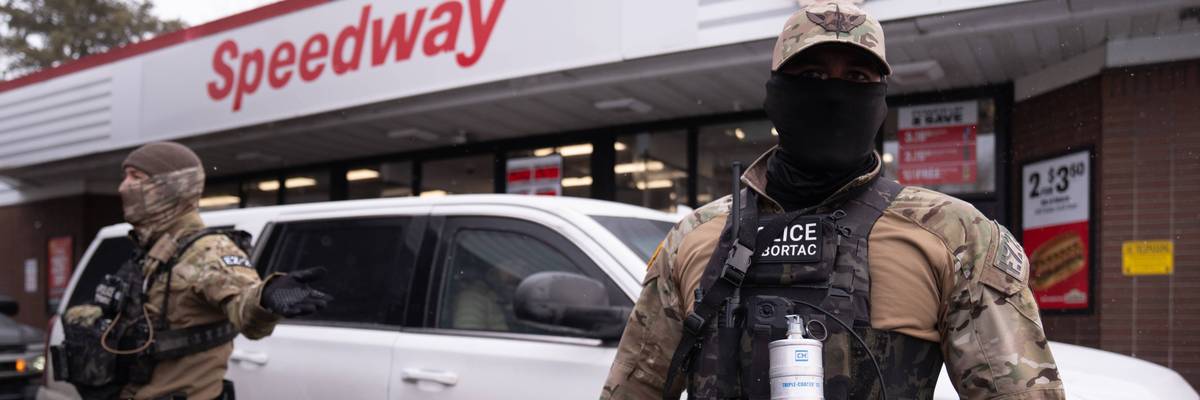
Agents stand outside as US Customs and Border Protection (CBP) Commissioner Gregory Bovino shops at a gas station while a group of citizens opposed to the country's immigration policies protested him in Minnesota on January 21, 2026.
Immigration agents "murdered two people on video since the beginning of the year, and the Trump administration still lied about what happened and tried to justify it," said one critic. "I don't think cameras are the solution."
As the Hennepin County medical examiner on Monday classified Alex Pretti's death as a homicide, US Homeland Security Secretary Kristi Noem said members of her department who are on the ground in Minnesota will be issued body-worn cameras—a development that came amid a congressional funding fight and was met with mixed reactions.
President Donald Trump and Noem this year have sent thousands of Department of Homeland Security (DHS) agents to the Twin Cities, where they have fatally shot Pretti and Renee Good, both US citizens acting as legal observers. Noem announced on social media Monday that she met with the heads of Customs and Border Protection (CBP) and Immigration and Customs Enforcement (ICE).
"Effective immediately we are deploying body cameras to every officer in the field in Minneapolis. As funding is available, the body camera program will be expanded nationwide. We will rapidly acquire and deploy body cameras to DHS law enforcement across the country. The most transparent administration in American history," the department chief wrote, also thanking the president.
Noem's revealed the move as Congress was in the process of reopening the government after a weekend shutdown. The package would give federal lawmakers until mid-February to sort out a battle over DHS funding. Democrats have fought for policies to rein in the department since ICE officer Jonathan Ross killed Good last month, and demands have mounted since Border Patrol agent Jesus Ochoa and Customs and Border Protection officer Raymundo Gutierrez killed Pretti.
Responding to the secretary on social media, House Appropriations Committee Ranking Member Rosa DeLauro (D-Conn.) said, "The funding is there, and every officer operating in our communities should be wearing a body camera."
"However, this alone won't be enough for Homeland Security to regain public trust or to ensure full transparency and accountability. Secretary Noem must be removed from office," DeLauro added. There have been growing calls to impeach her.
Pointing to extra money that ICE got in the budget package that congressional Republicans and Trump forced through last summer, Rep. Pramila Jayapal (D-Wash.) said: "You got $75 billion in the Big Bad Betrayal bill. You've got funding 'available' right now. And... release the Pretti bodycam footage NOW."
Congressman Don Beyer (D-Va.) also took to social media to call for releasing the bodycam footage from the Pretti shooting and stressed that funding is already available:
As the Associated Press reported:
Homeland Security has said that at least four Customs and Border Protection officers on the scene when Pretti was shot were wearing body cameras. The body camera footage from Pretti's shooting has not been made public.
The department has not responded to repeated questions about whether any of the ICE officers on the scene of the killing of Renee Good earlier in January were wearing the cameras.
Bystander footage of the Minneapolis shootings has circulated widely and fueled global demands for ending Trump's "Operation Metro Surge" in Minnesota as well as arresting and prosecuting the agents who shot and killed both legal observers.
Some Americans and a growing number of Democratic lawmakers are also calling to abolish ICE. Author Chantal James declared Monday: "We didn't say bodycams on ICE. Their murders are already on video. We said no more ICE."
Critics of the administration cast doubt on whether adding more bodycams to the mix will reduce violence by DHS. Campaign for New York Health executive director Melanie D'Arrigo said that immigration agents "murdered two people on video since the beginning of the year, and the Trump administration still lied about what happened and tried to justify it. I don't think cameras are the solution."
Todd Schulte, president of FWD.us, a a policy organization focused on harmful criminal justice and immigration systems, shared an image emphasizing that "surveillance is not accounability" and a fact sheet about body cameras his group put out last month.
"In the wake of the killing of Michael Brown in 2013, policymakers and police departments held up body-worn cameras as the path forward. Editorial boards joined the chorus," the fact sheet states. "Over a decade later, with 80% of large police departments in the US now having acquired body-worn cameras, it's safe to say body-worn cameras have not delivered on their lofty promise."
"The evidence that body-worn cameras reduce use of force is mixed, at best," and "footage ≠ transparency or accountability," the document details. Additionally, "contrary to their stated purpose, body-worn cameras are actually thriving as tools to surveil and prosecute civilians."
Body cameras are surveillance camerasBody cameras are surveillance camerasBody cameras are surveillance camerasBody cameras are surveillance camerasBody cameras are surveillance camerasBody cameras are surveillance cameras
— Evan Greer (@evangreer.bsky.social) February 2, 2026 at 7:03 PM
After a masked federal immigration agent told a legal observer in Maine that she was being put in a database for purported "domestic terrorists," independent journalist Ken Klippenstein reported last week that federal agencies are using multiple watchlists to track and categorize US citizens—especially activists, protesters, and other critics of law enforcement.
Dear Common Dreams reader, It’s been nearly 30 years since I co-founded Common Dreams with my late wife, Lina Newhouser. We had the radical notion that journalism should serve the public good, not corporate profits. It was clear to us from the outset what it would take to build such a project. No paid advertisements. No corporate sponsors. No millionaire publisher telling us what to think or do. Many people said we wouldn't last a year, but we proved those doubters wrong. Together with a tremendous team of journalists and dedicated staff, we built an independent media outlet free from the constraints of profits and corporate control. Our mission has always been simple: To inform. To inspire. To ignite change for the common good. Building Common Dreams was not easy. Our survival was never guaranteed. When you take on the most powerful forces—Wall Street greed, fossil fuel industry destruction, Big Tech lobbyists, and uber-rich oligarchs who have spent billions upon billions rigging the economy and democracy in their favor—the only bulwark you have is supporters who believe in your work. But here’s the urgent message from me today. It's never been this bad out there. And it's never been this hard to keep us going. At the very moment Common Dreams is most needed, the threats we face are intensifying. We need your support now more than ever. We don't accept corporate advertising and never will. We don't have a paywall because we don't think people should be blocked from critical news based on their ability to pay. Everything we do is funded by the donations of readers like you. When everyone does the little they can afford, we are strong. But if that support retreats or dries up, so do we. Will you donate now to make sure Common Dreams not only survives but thrives? —Craig Brown, Co-founder |
As the Hennepin County medical examiner on Monday classified Alex Pretti's death as a homicide, US Homeland Security Secretary Kristi Noem said members of her department who are on the ground in Minnesota will be issued body-worn cameras—a development that came amid a congressional funding fight and was met with mixed reactions.
President Donald Trump and Noem this year have sent thousands of Department of Homeland Security (DHS) agents to the Twin Cities, where they have fatally shot Pretti and Renee Good, both US citizens acting as legal observers. Noem announced on social media Monday that she met with the heads of Customs and Border Protection (CBP) and Immigration and Customs Enforcement (ICE).
"Effective immediately we are deploying body cameras to every officer in the field in Minneapolis. As funding is available, the body camera program will be expanded nationwide. We will rapidly acquire and deploy body cameras to DHS law enforcement across the country. The most transparent administration in American history," the department chief wrote, also thanking the president.
Noem's revealed the move as Congress was in the process of reopening the government after a weekend shutdown. The package would give federal lawmakers until mid-February to sort out a battle over DHS funding. Democrats have fought for policies to rein in the department since ICE officer Jonathan Ross killed Good last month, and demands have mounted since Border Patrol agent Jesus Ochoa and Customs and Border Protection officer Raymundo Gutierrez killed Pretti.
Responding to the secretary on social media, House Appropriations Committee Ranking Member Rosa DeLauro (D-Conn.) said, "The funding is there, and every officer operating in our communities should be wearing a body camera."
"However, this alone won't be enough for Homeland Security to regain public trust or to ensure full transparency and accountability. Secretary Noem must be removed from office," DeLauro added. There have been growing calls to impeach her.
Pointing to extra money that ICE got in the budget package that congressional Republicans and Trump forced through last summer, Rep. Pramila Jayapal (D-Wash.) said: "You got $75 billion in the Big Bad Betrayal bill. You've got funding 'available' right now. And... release the Pretti bodycam footage NOW."
Congressman Don Beyer (D-Va.) also took to social media to call for releasing the bodycam footage from the Pretti shooting and stressed that funding is already available:
As the Associated Press reported:
Homeland Security has said that at least four Customs and Border Protection officers on the scene when Pretti was shot were wearing body cameras. The body camera footage from Pretti's shooting has not been made public.
The department has not responded to repeated questions about whether any of the ICE officers on the scene of the killing of Renee Good earlier in January were wearing the cameras.
Bystander footage of the Minneapolis shootings has circulated widely and fueled global demands for ending Trump's "Operation Metro Surge" in Minnesota as well as arresting and prosecuting the agents who shot and killed both legal observers.
Some Americans and a growing number of Democratic lawmakers are also calling to abolish ICE. Author Chantal James declared Monday: "We didn't say bodycams on ICE. Their murders are already on video. We said no more ICE."
Critics of the administration cast doubt on whether adding more bodycams to the mix will reduce violence by DHS. Campaign for New York Health executive director Melanie D'Arrigo said that immigration agents "murdered two people on video since the beginning of the year, and the Trump administration still lied about what happened and tried to justify it. I don't think cameras are the solution."
Todd Schulte, president of FWD.us, a a policy organization focused on harmful criminal justice and immigration systems, shared an image emphasizing that "surveillance is not accounability" and a fact sheet about body cameras his group put out last month.
"In the wake of the killing of Michael Brown in 2013, policymakers and police departments held up body-worn cameras as the path forward. Editorial boards joined the chorus," the fact sheet states. "Over a decade later, with 80% of large police departments in the US now having acquired body-worn cameras, it's safe to say body-worn cameras have not delivered on their lofty promise."
"The evidence that body-worn cameras reduce use of force is mixed, at best," and "footage ≠ transparency or accountability," the document details. Additionally, "contrary to their stated purpose, body-worn cameras are actually thriving as tools to surveil and prosecute civilians."
Body cameras are surveillance camerasBody cameras are surveillance camerasBody cameras are surveillance camerasBody cameras are surveillance camerasBody cameras are surveillance camerasBody cameras are surveillance cameras
— Evan Greer (@evangreer.bsky.social) February 2, 2026 at 7:03 PM
After a masked federal immigration agent told a legal observer in Maine that she was being put in a database for purported "domestic terrorists," independent journalist Ken Klippenstein reported last week that federal agencies are using multiple watchlists to track and categorize US citizens—especially activists, protesters, and other critics of law enforcement.
As the Hennepin County medical examiner on Monday classified Alex Pretti's death as a homicide, US Homeland Security Secretary Kristi Noem said members of her department who are on the ground in Minnesota will be issued body-worn cameras—a development that came amid a congressional funding fight and was met with mixed reactions.
President Donald Trump and Noem this year have sent thousands of Department of Homeland Security (DHS) agents to the Twin Cities, where they have fatally shot Pretti and Renee Good, both US citizens acting as legal observers. Noem announced on social media Monday that she met with the heads of Customs and Border Protection (CBP) and Immigration and Customs Enforcement (ICE).
"Effective immediately we are deploying body cameras to every officer in the field in Minneapolis. As funding is available, the body camera program will be expanded nationwide. We will rapidly acquire and deploy body cameras to DHS law enforcement across the country. The most transparent administration in American history," the department chief wrote, also thanking the president.
Noem's revealed the move as Congress was in the process of reopening the government after a weekend shutdown. The package would give federal lawmakers until mid-February to sort out a battle over DHS funding. Democrats have fought for policies to rein in the department since ICE officer Jonathan Ross killed Good last month, and demands have mounted since Border Patrol agent Jesus Ochoa and Customs and Border Protection officer Raymundo Gutierrez killed Pretti.
Responding to the secretary on social media, House Appropriations Committee Ranking Member Rosa DeLauro (D-Conn.) said, "The funding is there, and every officer operating in our communities should be wearing a body camera."
"However, this alone won't be enough for Homeland Security to regain public trust or to ensure full transparency and accountability. Secretary Noem must be removed from office," DeLauro added. There have been growing calls to impeach her.
Pointing to extra money that ICE got in the budget package that congressional Republicans and Trump forced through last summer, Rep. Pramila Jayapal (D-Wash.) said: "You got $75 billion in the Big Bad Betrayal bill. You've got funding 'available' right now. And... release the Pretti bodycam footage NOW."
Congressman Don Beyer (D-Va.) also took to social media to call for releasing the bodycam footage from the Pretti shooting and stressed that funding is already available:
As the Associated Press reported:
Homeland Security has said that at least four Customs and Border Protection officers on the scene when Pretti was shot were wearing body cameras. The body camera footage from Pretti's shooting has not been made public.
The department has not responded to repeated questions about whether any of the ICE officers on the scene of the killing of Renee Good earlier in January were wearing the cameras.
Bystander footage of the Minneapolis shootings has circulated widely and fueled global demands for ending Trump's "Operation Metro Surge" in Minnesota as well as arresting and prosecuting the agents who shot and killed both legal observers.
Some Americans and a growing number of Democratic lawmakers are also calling to abolish ICE. Author Chantal James declared Monday: "We didn't say bodycams on ICE. Their murders are already on video. We said no more ICE."
Critics of the administration cast doubt on whether adding more bodycams to the mix will reduce violence by DHS. Campaign for New York Health executive director Melanie D'Arrigo said that immigration agents "murdered two people on video since the beginning of the year, and the Trump administration still lied about what happened and tried to justify it. I don't think cameras are the solution."
Todd Schulte, president of FWD.us, a a policy organization focused on harmful criminal justice and immigration systems, shared an image emphasizing that "surveillance is not accounability" and a fact sheet about body cameras his group put out last month.
"In the wake of the killing of Michael Brown in 2013, policymakers and police departments held up body-worn cameras as the path forward. Editorial boards joined the chorus," the fact sheet states. "Over a decade later, with 80% of large police departments in the US now having acquired body-worn cameras, it's safe to say body-worn cameras have not delivered on their lofty promise."
"The evidence that body-worn cameras reduce use of force is mixed, at best," and "footage ≠ transparency or accountability," the document details. Additionally, "contrary to their stated purpose, body-worn cameras are actually thriving as tools to surveil and prosecute civilians."
Body cameras are surveillance camerasBody cameras are surveillance camerasBody cameras are surveillance camerasBody cameras are surveillance camerasBody cameras are surveillance camerasBody cameras are surveillance cameras
— Evan Greer (@evangreer.bsky.social) February 2, 2026 at 7:03 PM
After a masked federal immigration agent told a legal observer in Maine that she was being put in a database for purported "domestic terrorists," independent journalist Ken Klippenstein reported last week that federal agencies are using multiple watchlists to track and categorize US citizens—especially activists, protesters, and other critics of law enforcement.