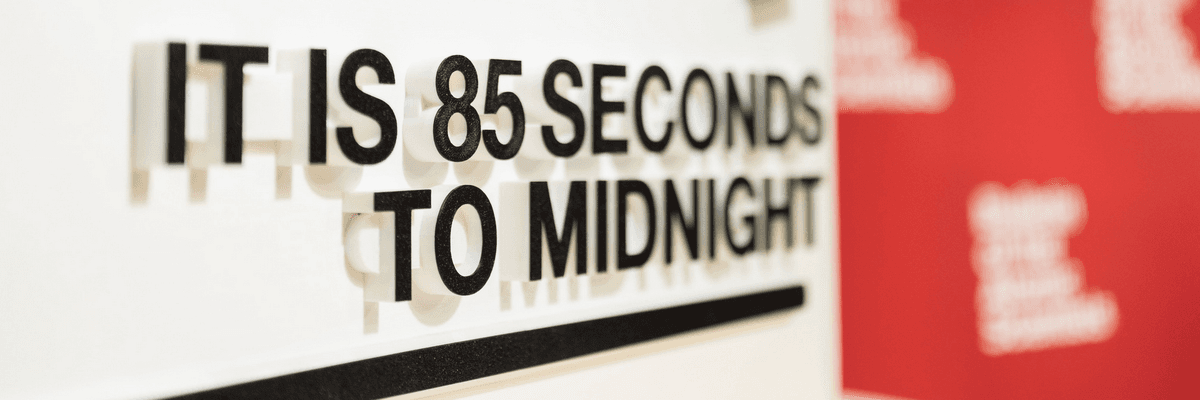
The Doomsday Clock, updated yearly by the Bulletin of the Atomic Scientists, ticked closer than ever to "midnight" on January 27, 2026, showing how close humanity is to nuclear destruction due to the nuclear arms race.
'85 Seconds to Midnight': Doomsday Clock Ticks Down as Trump Drags World Toward New Low
"Catastrophic risks are on the rise, cooperation is on the decline, and we are running out of time."
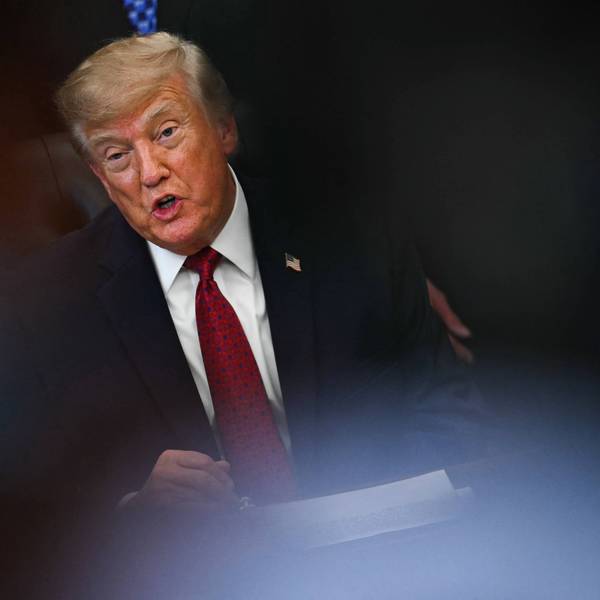
A "failure of leadership" by the world's most powerful governments and leaders, particularly President Donald Trump, has pushed the annually updated Doomsday Clock closer to midnight than ever, said the Bulletin of Atomic Scientists, the organization that monitors global existential threats including nuclear bombs, on Tuesday.
The clock was set to 85 seconds to midnight—or global destruction—four seconds closer than one year ago.
The Bulletin has updated the clock each year since 1947, when scientists set it at seven minutes to midnight, emphasizing that the world had little time to get the proliferation of nuclear weapons under control following the United States' bombing of Hiroshima and Nagasaki in 1945.
The scientists who announced the latest ticking of the clock on Tuesday stressed that a number of other threats appear closer then ever to dooming humanity and called for urgent action to limit nuclear arsenals as well as creating "international guidelines" for the use of artificial intelligence, solving the climate crisis, and forming "multilateral agreements to address global biological threats."
“The Doomsday Clock’s message cannot be clearer. Catastrophic risks are on the rise, cooperation is on the decline, and we are running out of time," said Alexandra Bell, president and CEO of the Bulletin. "Change is both necessary and possible, but the global community must demand swift action from their leaders.”
The organization, whose Doomsday Clock is monitored by its Science and Security Board (SASB) and Board of Sponsors, which includes eight Nobel laureates, said that countries including the US, China, and Russia did not heed the Bulletin's warning last year when it moved the clock's hands to 89 seconds to midnight.
Instead, major powers in the past year have become "increasingly aggressive, adversarial, and nationalistic."
"Hard-won global understandings are collapsing, accelerating a winner-takes-all great power competition and undermining the international cooperation critical to reducing the risks of nuclear war, climate change, the misuse of biotechnology, the potential threat of artificial intelligence, and other apocalyptic dangers," said the group. "Far too many leaders have grown complacent and indifferent, in many cases adopting rhetoric and policies that accelerate rather than mitigate these existential risks. Because of this failure of leadership, the Bulletin of the Atomic Scientists Science and Security Board today sets the Doomsday Clock at 85 seconds to midnight, the closest it has ever been to catastrophe."
International failures from 2025 include:
- Russia's testing of nuclear-capable weapons as it continued its war on Ukraine;
- The US and Israel's attacks on Iranian nuclear sites;
- China's increase of its nuclear warhead stockpile;
- Fueled by the continued extraction of fossil fuels, the global average temperature was the third-highest on record and the climate crisis caused disasters including deadly flooding and heatwaves;
- The treaty between the US and Russia on Measures for the Further Reduction and Limitation of Strategic Offensive Arms, also known as the New START Treaty, inched closer to its expiration date on February 4, 2026;
- The Trump administration dismantled public health infrastructure and climate regulations, making the US and the world more vulnerable to pandemics and the climate emergency; and
- Artificial intelligence grew more sophisticated as the Trump administration refused to rein in the technology.
Daniel Holz, chair of the SASB, said that the "dangerous trends" outlined by the Bulletin "are accompanied by another frightening development: the rise of nationalistic autocracies in countries around the world."
"Our greatest challenges require international trust and cooperation, and a world splintering into ‘us versus them’ will leave all of humanity more vulnerable," said Holz.
The Bulletin emphasized that with political will, the world's leaders are entirely capable of pulling humanity "back from the brink."
The US and Russia could resume dialogue about limiting their nuclear arsenals, and all nuclear-armed states could observe the existing moratorium on nuclear testing.
Through multilateral agreements and national regulations, the international community could also cooperate to "reduce the prospect that AI be used to create biological threats."
And in the US, Congress could take action to repudiate Trump's "war on renewable energy, instead providing incentives and investments that will enable rapid reduction in fossil fuel use."
Maria Ressa, co-founder and CEO of Rappler and a 2021 Nobel Peace Prize laureate, said that world leaders must also come to an agreement that the climate crisis, nuclear proliferation, and unregulated AI are grave threats, as the majority of the global community has.
“Without facts, there is no truth. Without truth, there is no trust. And without these, the radical collaboration this moment demands is impossible," said Ressa. "We cannot solve problems we cannot agree exist. We cannot cooperate across borders when we cannot even share the same facts. Nuclear threats, climate collapse, AI risks: none can be addressed without first rebuilding our shared reality. The clock is ticking."
We are at a crossroads
This country and this world are at a monumental crossroads. In a few short weeks, US voters will have an opportunity to beat back the forces of fascism and confront the billionaires who are rigging the economy, our media system, and our democracy, making it increasingly impossible for ordinary people to get by. We’re not just talking about the election. We’re talking about what must be done once these fascist elements are vanquished from power. We need a bolder set of solutions than what either major party has so far been willing to offer and a working-class movement ready to fight like hell for it. Trump didn't emerge from nowhere. The conditions that fueled MAGA authoritarianism were created by decades of radical neoliberal economic policies and a corrupt political system dominated by corporate interests. They slashed taxes on the super-rich, promising that the benefits would trickle down. They said giveaways to the corporate titans would make life more affordable for the rest of us. It was all bullshit. And when a bitter, betrayed populace searches for someone to blame, right-wing demagogues have little trouble finding scapegoats. People know when they're being lied to, but you won't hear any of this from the corporate media. Only independent journalism—powered and funded by people who believe in building a better world—can deliver truly trustworthy daily news. Our Fall Campaign is underway, and we need your help. To power our newsroom through the rest of the year, we need to raise $125,000 by midnight on October 31. So if you share our vision, please contribute whatever you can to sustain our work. |
A "failure of leadership" by the world's most powerful governments and leaders, particularly President Donald Trump, has pushed the annually updated Doomsday Clock closer to midnight than ever, said the Bulletin of Atomic Scientists, the organization that monitors global existential threats including nuclear bombs, on Tuesday.
The clock was set to 85 seconds to midnight—or global destruction—four seconds closer than one year ago.
The Bulletin has updated the clock each year since 1947, when scientists set it at seven minutes to midnight, emphasizing that the world had little time to get the proliferation of nuclear weapons under control following the United States' bombing of Hiroshima and Nagasaki in 1945.
The scientists who announced the latest ticking of the clock on Tuesday stressed that a number of other threats appear closer then ever to dooming humanity and called for urgent action to limit nuclear arsenals as well as creating "international guidelines" for the use of artificial intelligence, solving the climate crisis, and forming "multilateral agreements to address global biological threats."
“The Doomsday Clock’s message cannot be clearer. Catastrophic risks are on the rise, cooperation is on the decline, and we are running out of time," said Alexandra Bell, president and CEO of the Bulletin. "Change is both necessary and possible, but the global community must demand swift action from their leaders.”
The organization, whose Doomsday Clock is monitored by its Science and Security Board (SASB) and Board of Sponsors, which includes eight Nobel laureates, said that countries including the US, China, and Russia did not heed the Bulletin's warning last year when it moved the clock's hands to 89 seconds to midnight.
Instead, major powers in the past year have become "increasingly aggressive, adversarial, and nationalistic."
"Hard-won global understandings are collapsing, accelerating a winner-takes-all great power competition and undermining the international cooperation critical to reducing the risks of nuclear war, climate change, the misuse of biotechnology, the potential threat of artificial intelligence, and other apocalyptic dangers," said the group. "Far too many leaders have grown complacent and indifferent, in many cases adopting rhetoric and policies that accelerate rather than mitigate these existential risks. Because of this failure of leadership, the Bulletin of the Atomic Scientists Science and Security Board today sets the Doomsday Clock at 85 seconds to midnight, the closest it has ever been to catastrophe."
International failures from 2025 include:
- Russia's testing of nuclear-capable weapons as it continued its war on Ukraine;
- The US and Israel's attacks on Iranian nuclear sites;
- China's increase of its nuclear warhead stockpile;
- Fueled by the continued extraction of fossil fuels, the global average temperature was the third-highest on record and the climate crisis caused disasters including deadly flooding and heatwaves;
- The treaty between the US and Russia on Measures for the Further Reduction and Limitation of Strategic Offensive Arms, also known as the New START Treaty, inched closer to its expiration date on February 4, 2026;
- The Trump administration dismantled public health infrastructure and climate regulations, making the US and the world more vulnerable to pandemics and the climate emergency; and
- Artificial intelligence grew more sophisticated as the Trump administration refused to rein in the technology.
Daniel Holz, chair of the SASB, said that the "dangerous trends" outlined by the Bulletin "are accompanied by another frightening development: the rise of nationalistic autocracies in countries around the world."
"Our greatest challenges require international trust and cooperation, and a world splintering into ‘us versus them’ will leave all of humanity more vulnerable," said Holz.
The Bulletin emphasized that with political will, the world's leaders are entirely capable of pulling humanity "back from the brink."
The US and Russia could resume dialogue about limiting their nuclear arsenals, and all nuclear-armed states could observe the existing moratorium on nuclear testing.
Through multilateral agreements and national regulations, the international community could also cooperate to "reduce the prospect that AI be used to create biological threats."
And in the US, Congress could take action to repudiate Trump's "war on renewable energy, instead providing incentives and investments that will enable rapid reduction in fossil fuel use."
Maria Ressa, co-founder and CEO of Rappler and a 2021 Nobel Peace Prize laureate, said that world leaders must also come to an agreement that the climate crisis, nuclear proliferation, and unregulated AI are grave threats, as the majority of the global community has.
“Without facts, there is no truth. Without truth, there is no trust. And without these, the radical collaboration this moment demands is impossible," said Ressa. "We cannot solve problems we cannot agree exist. We cannot cooperate across borders when we cannot even share the same facts. Nuclear threats, climate collapse, AI risks: none can be addressed without first rebuilding our shared reality. The clock is ticking."
- By Moving to Resume Testing, Trump Threatens the Global Nuclear Balance ›
- 'Era of Unconstrained Nuclear Competition' Looms With US-Russia New START Treaty Expiring | Common Dreams ›
- Rubio Confirms End of New START, Sparking Calls For Nuclear Talks With Russia, China | Common Dreams ›
- Opinion | New START’s Expiration: A Threat to Humanitarian Disarmament | Common Dreams ›
A "failure of leadership" by the world's most powerful governments and leaders, particularly President Donald Trump, has pushed the annually updated Doomsday Clock closer to midnight than ever, said the Bulletin of Atomic Scientists, the organization that monitors global existential threats including nuclear bombs, on Tuesday.
The clock was set to 85 seconds to midnight—or global destruction—four seconds closer than one year ago.
The Bulletin has updated the clock each year since 1947, when scientists set it at seven minutes to midnight, emphasizing that the world had little time to get the proliferation of nuclear weapons under control following the United States' bombing of Hiroshima and Nagasaki in 1945.
The scientists who announced the latest ticking of the clock on Tuesday stressed that a number of other threats appear closer then ever to dooming humanity and called for urgent action to limit nuclear arsenals as well as creating "international guidelines" for the use of artificial intelligence, solving the climate crisis, and forming "multilateral agreements to address global biological threats."
“The Doomsday Clock’s message cannot be clearer. Catastrophic risks are on the rise, cooperation is on the decline, and we are running out of time," said Alexandra Bell, president and CEO of the Bulletin. "Change is both necessary and possible, but the global community must demand swift action from their leaders.”
The organization, whose Doomsday Clock is monitored by its Science and Security Board (SASB) and Board of Sponsors, which includes eight Nobel laureates, said that countries including the US, China, and Russia did not heed the Bulletin's warning last year when it moved the clock's hands to 89 seconds to midnight.
Instead, major powers in the past year have become "increasingly aggressive, adversarial, and nationalistic."
"Hard-won global understandings are collapsing, accelerating a winner-takes-all great power competition and undermining the international cooperation critical to reducing the risks of nuclear war, climate change, the misuse of biotechnology, the potential threat of artificial intelligence, and other apocalyptic dangers," said the group. "Far too many leaders have grown complacent and indifferent, in many cases adopting rhetoric and policies that accelerate rather than mitigate these existential risks. Because of this failure of leadership, the Bulletin of the Atomic Scientists Science and Security Board today sets the Doomsday Clock at 85 seconds to midnight, the closest it has ever been to catastrophe."
International failures from 2025 include:
- Russia's testing of nuclear-capable weapons as it continued its war on Ukraine;
- The US and Israel's attacks on Iranian nuclear sites;
- China's increase of its nuclear warhead stockpile;
- Fueled by the continued extraction of fossil fuels, the global average temperature was the third-highest on record and the climate crisis caused disasters including deadly flooding and heatwaves;
- The treaty between the US and Russia on Measures for the Further Reduction and Limitation of Strategic Offensive Arms, also known as the New START Treaty, inched closer to its expiration date on February 4, 2026;
- The Trump administration dismantled public health infrastructure and climate regulations, making the US and the world more vulnerable to pandemics and the climate emergency; and
- Artificial intelligence grew more sophisticated as the Trump administration refused to rein in the technology.
Daniel Holz, chair of the SASB, said that the "dangerous trends" outlined by the Bulletin "are accompanied by another frightening development: the rise of nationalistic autocracies in countries around the world."
"Our greatest challenges require international trust and cooperation, and a world splintering into ‘us versus them’ will leave all of humanity more vulnerable," said Holz.
The Bulletin emphasized that with political will, the world's leaders are entirely capable of pulling humanity "back from the brink."
The US and Russia could resume dialogue about limiting their nuclear arsenals, and all nuclear-armed states could observe the existing moratorium on nuclear testing.
Through multilateral agreements and national regulations, the international community could also cooperate to "reduce the prospect that AI be used to create biological threats."
And in the US, Congress could take action to repudiate Trump's "war on renewable energy, instead providing incentives and investments that will enable rapid reduction in fossil fuel use."
Maria Ressa, co-founder and CEO of Rappler and a 2021 Nobel Peace Prize laureate, said that world leaders must also come to an agreement that the climate crisis, nuclear proliferation, and unregulated AI are grave threats, as the majority of the global community has.
“Without facts, there is no truth. Without truth, there is no trust. And without these, the radical collaboration this moment demands is impossible," said Ressa. "We cannot solve problems we cannot agree exist. We cannot cooperate across borders when we cannot even share the same facts. Nuclear threats, climate collapse, AI risks: none can be addressed without first rebuilding our shared reality. The clock is ticking."
- By Moving to Resume Testing, Trump Threatens the Global Nuclear Balance ›
- 'Era of Unconstrained Nuclear Competition' Looms With US-Russia New START Treaty Expiring | Common Dreams ›
- Rubio Confirms End of New START, Sparking Calls For Nuclear Talks With Russia, China | Common Dreams ›
- Opinion | New START’s Expiration: A Threat to Humanitarian Disarmament | Common Dreams ›